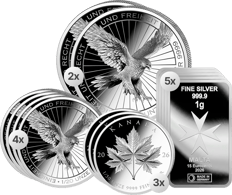
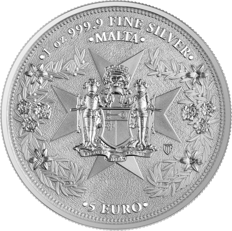
25 x 1 oz Silver Maple Leaf 2026
£1,222.19
excl. UK import VAT and shipping
Available in 2–3 business days

 More than 310,000
 Over 30 years
 Secure shipping
 Google: 4.9/5
The savings account used to be a reliable way to set money aside and build up a retirement fund, but trust in banks is declining more and more — you no longer earn any interest, quite the contrary, penalty interest is being imposed, and every year your money loses purchasing power. How are you supposed to secure your financial future for retirement now? We have the solution for you!


For decades, the savings account was considered the safe haven for one's savings. However, low interest rates, creeping currency devaluation and growing distrust of the banking system have thoroughly shifted this picture. Anyone wishing to remain financially independent in retirement can hardly do without well-thought-out private provision. Gold and other precious metals have established themselves as a tangible, crisis-proof investment that has preserved purchasing power for thousands of years. This guide explains why retirement provision with precious metals is gaining such importance, which forms are suitable, how taxes and storage are handled, and what matters when building a stable precious metals portfolio.
Retirement provision is a topic that affects everyone sooner or later. More and more people are no longer fully financially independent in old age, the number of working pensioners is rising, and pressure on the statutory pension system is growing. The German system is based on a pay-as-you-go model: the ongoing contributions of the working population finance today's pensions. This is precisely where the structural problem lies: demographic change is increasing the number of pensioners while the number of contributors is falling.
Added to this is inflation, which quietly erodes savings. Anyone relying solely on a savings account loses real purchasing power over the years. In this environment, precious metals are considered a proven counterbalance: they are a scarce, physical asset that cannot be multiplied at will and are not dependent on any payment promise from a bank or state. Especially as a complement to classic building blocks, investors thus develop a second, crisis-proof pillar, an idea also taken up by inflation protection with precious metals.
Private retirement provision is multi-layered, and experts agree that starting early creates the best foundation. At the same time, it is never too late to begin. Common building blocks include:
A mix is always sensible. Precious metals do not replace comprehensive provision; they complement it with a tangible asset that functions independently of the financial system.
Among all precious metals, gold holds a special position. Historically, it has preserved its purchasing power over thousands of years and is considered crisis-proof and largely inflation-protected. The great advantage of physical gold as retirement provision: it is directly linked to the gold price and does not depend on any payment promise from companies or government bodies. Even in the event of a currency reform, the precious metal retains its material value.
It is important for investors to distinguish between direct and indirect investment. In the direct variant, physical metal is acquired in the form of bars or coins. The indirect variant includes shares in mining companies or funds linked to the gold price; however, these carry additional risks such as corporate performance and market fluctuations. For down-to-earth retirement provision, many investors therefore prefer tangible, physical metal.
With physical gold, the question of form arises. Gold coins are particularly popular among investors. A distinction is made here between bullion coins (investment coins) and collector's coins: the price of a bullion coin is based almost exclusively on its material value, while collector's coins can also carry an additional collector's value. Classics such as the Krugerrand, the Maple Leaf or the Vienna Philharmonic are recognised worldwide and can always be readily traded.
Gold bars, in turn, are a particularly direct investment in the material price, since minting and dealer costs barely register for larger units. So-called gold CombiBars are popular: a combination of 1 g bars that can be separated from one another without loss and sold individually if needed. The following overview shows the differences between bullion and collector's coins:
| Criterion | Bullion coins | Collector's coins |
|---|---|---|
| Price basis | Directly linked to the gold price | Material plus collector's value |
| Suitability | For all investors | Rather for experienced collectors |
| Resale | Possible at any time, worldwide | Tied to collector interest |
| Crisis resilience | Very high, as price-linked | Limited |
Common standard products are particularly suitable for retirement provision: they are always in demand and can be sold quickly again if needed.
A well-positioned portfolio does not rest on a single metal. Silver is considered the smaller counterpart to gold: cheaper to enter, but more volatile in price. Popular silver coins such as the Maple Leaf or the Vienna Philharmonic are suitable for building reserves regularly even with a smaller budget. Those wishing to invest larger amounts often turn to silver bars, which offer a favourable price per gram.
In addition, the white metals platinum and palladium are gaining importance. Both play an important industrial role, for example in automotive and hydrogen technology, which affects their price development. As an addition, they provide further diversification: if the price of one metal falls, another often partially offsets the effect. This diversification is a central principle of any solid provision.
A balanced precious metals portfolio does not bet on a single horse but distributes weight wisely, with gold as a stable foundation and silver, platinum and palladium as complementary pillars.
A decisive advantage of physical gold is its tax treatment. Investment gold is exempt from VAT in Germany, which applies to bars and bullion coins that meet the statutory fineness criteria. For silver, platinum and palladium, however, VAT is charged, often in the form of the margin scheme for silver coins.
Particularly interesting for long-term provision is the one-year speculation period: if physical gold or silver is sold at a profit after a holding period of more than one year, this capital gain is tax-free for private individuals. Especially for investors with a long investment horizon, and retirement provision is by its nature long-term, this is a significant argument in favour of physical ownership.
Tax notice
Investment gold is exempt from VAT in Germany, and capital gains from physical gold and silver are tax-free for private individuals after a holding period of more than one year. This does not constitute tax advice; in individual cases, consulting a tax advisor is recommended.
Precious metals develop their strength in retirement provision above all over a long period. Instead of trying to hit the perfect entry point, many investors rely on regular, smaller purchases. This approach is known as the cost-average effect: those who invest continuously buy sometimes at higher and sometimes at lower prices, thereby balancing out short-term fluctuations over time. Appropriate savings plan products make this disciplined wealth building easier.
As a rule of thumb, gold should make up the largest share of the portfolio, as it fluctuates less than other commodities. It is also advisable to opt for small denominations: a collection of several 1/10 oz or 1/4 oz coins can be sold more flexibly and in smaller steps if needed than a single large bar. This way, even short-term financial bottlenecks can be bridged without having to touch the entire holding straight away. Those investing larger sums will find a convenient solution in ready-made investor packages.
Physical gold raises the question of secure safekeeping. Options include storage in a home safe, a bank safe deposit box, or specialised custody solutions. For home storage, suitable accessories such as coin capsules and coin cases are recommended, as they protect coins from scratches and environmental influences and help preserve their value. It is important to insure your holdings against theft, for example through home contents insurance.
Precious metals are a valuable building block, but no cure-all. An honest assessment is part of every investment decision. The key arguments at a glance:
Advantages
Limits
As a complement to property, insurance and savings plans, however, gold and other precious metals form a reliable cornerstone. Those looking to get started will find proven combinations among the bullion coins and crisis protection packages. As a German family business with over 200,000 customers and ISO-compliant authenticity verification, Kettner Edelmetalle accompanies investors along this path.
Gold is a valuable building block, but it should not be the only pillar of retirement provision. A sensible approach is a mix of various building blocks such as property, insurance, savings plans and physical precious metals. Gold acts as a crisis-proof foundation that functions independently of the financial system.
For physical gold and silver, capital gains are tax-free for private individuals after a holding period of more than one year. Investment gold is also exempt from VAT. This is not tax advice; a tax advisor should be consulted in individual cases.
Both have their merits. For larger units, bars offer the most favourable price per gram. Coins and small denominations, however, are more flexible when it comes to resale, as partial amounts can be liquidated more easily. For retirement provision, a combination of both is often ideal.
There is no universally valid rate, as it depends on individual circumstances. Many investors use an allocation within a broadly diversified portfolio as a guide. What matters is that precious metals are viewed as a long-term tangible asset and not as short-term speculation.
The cost-average effect describes investing smaller amounts regularly over a long period. Since purchases are made sometimes at higher and sometimes at lower prices, short-term price fluctuations balance out over time. Savings plans for precious metals make use of this principle.
Options include a home safe, a bank safe deposit box, or professional custody solutions. For home storage, coin capsules and cases protect the pieces from damage. Your own holdings should also be insured against theft, for example through home contents insurance.
Stay informed with product launches, financial news and exclusive offers. Sign up for our free newsletter today.
By entering your email address and clicking the "Submit" button, you give the following consent: "I agree to be informed by email about new products, financial news and exclusive offers, and therefore consent to the processing of my email address for the purpose of sending the newsletter. I can revoke this consent at any time without giving reasons, with effect for the future. The lawfulness of processing carried out prior to revocation remains unaffected."