


Only 1 left to order
Deutsche Mark 4 Gold Coins Fractional Set Reverse Proof 2026 (Mintage: 99 | Proof Design)
£2,924.22
VAT-free and excl. shipping
Ships from 05/03/2027
 +49 7930-2699

 More than 310,000
 Over 30 years
 Secure shipping
 Google: 4.9/5


Enhanced coins and in-house products form a distinct segment of the precious metals market that combines classic bullion coins with special minting techniques and exclusive designs. Whether partially gilded silver coins, coloured special editions, coins in Proof quality or strictly limited in-house creations with German motifs such as the Deutsche Mark, the Guardian Angel or native animals: this guide explains what finishing techniques technically mean, which denominations and materials are common, how collector value and material value differ, and what to look out for regarding authenticity, mintage and storage.
Coins whose surface has been reworked beyond the pure minting process are considered enhanced. This ranges from the partial gilding of individual design elements, through full gilding and colour applications, to hologram effects, diamond dust applications or so-called ruthenium and platinum finishing. The aim of these techniques is to make a design appear more three-dimensional and contrast-rich, and to give the collector's item an individual character.
The term in-house product refers to editions developed exclusively for a dealer and minted in a small mintage. They often appear in collaboration with renowned mints and carry designs that exist in this form only once. Unlike international bullion classics such as the Maple Leaf or the American Eagle, the focus with these editions is not on a mintage running into the millions but on limitation. Kettner Edelmetalle brings both worlds together in this category and complements them with editions created in close cooperation with mints such as the Bayerisches Hauptmünzamt.
It is important to understand that finishing does not change the fine content of precious metal contained. A partially gilded silver coin with one troy ounce of fine silver still contains exactly one troy ounce of silver: the applied gold layer is extremely thin and practically negligible for the pure material value. The added value lies in the appearance, the craftsmanship and the collectability.
The range of techniques is wide and keeps evolving alongside the art of minting. The most common techniques in the segment of enhanced coins are:
In addition, the grade of preservation plays a central role. Many in-house products appear in Proof quality, the highest minting quality, with mirrored surfaces and frosted design areas. Anyone who values flawless surfaces will find suitable protective solutions in the range of coin capsules, which protect the sensitive surface from scratches and fingerprints.

Enhanced editions and in-house products are available in silver and in gold as well as minted bars. The choice of denomination depends on budget and collecting purpose.
The 1 oz silver coin is by far the most common format for enhanced editions. It offers a generous design surface on which partial gilding, colour or holograms are shown off to particular advantage. Smaller denominations such as the half ounce round off the range at the lower end. Anyone interested in the broad field of classic silver editions will find further designs in the silver coins overview and specifically among the partially gilded silver coins.
In the gold segment, miniature formats such as 0.5 grams or 1/200 oz dominate. These editions make designs in fine gold accessible even with a small budget and are particularly suitable as a gift. Series with German motifs can be found in the German gold coins category, while the full range is accessible via the gold coins overview.
A special category is minted bars: rectangular or shaped bars that are struck like coins and feature elaborate designs. They combine the compact character of a bar with the design freedom of coin minting. Anyone interested in classic bar formats will find comparable products among the gold bars and the enhanced silver bars.
Note on mintage and limitation
For limited in-house products, the mintage figure significantly determines the collector character. Small mintages of just a few hundred or thousand pieces are considerably rarer than the bullion classics minted by the million. However, actual performance depends on many factors and cannot be predicted.
With enhanced coins and in-house products, two price components come together. The material value results from the fine weight of gold or silver contained and the current precious metal price. The collector value arises from factors such as design, minting quality, the effort involved in finishing and the mintage figure.
With a classic bullion coin, the price stays close to the material value, because minting costs are low and mintages are high. With an enhanced collector's item, on the other hand, the premium over the material value can be considerable. This is not a drawback but lies in the nature of the product: anyone buying a collector's item pays for design and rarity, not solely for the metal it contains. Anyone primarily seeking precious metal content, however, is generally served more cost-effectively by pure investment products such as silver bars or a 1 oz gold bar.
An enhanced collector's item combines the tangible value of the precious metal with the signature of the minting art: this is where its special appeal lies.
The tax classification for the enhanced segment follows the same basic rules as for other precious metal products and depends on the material.
This information provides general guidance only and does not replace tax advice. The specific treatment depends on the individual case and the legal situation applicable at the time. Further investment products can be found in the gold bullion coins and silver bullion coins sections.
Authenticity and condition are crucial for collector's items too. Reputable editions can be verified using several characteristics:
Kettner Edelmetalle uses an ISO-compliant authenticity verification process and handles shipping via a fully automated high-security logistics centre. To preserve the minting lustre permanently, suitable accessories are recommended, such as coin cassettes for the orderly storage of entire collections.
Proper storage is especially important for enhanced surfaces, since fingerprints, moisture and friction can impair the sensitive minting lustre. The following basic rules have proven effective:
For transporting or presenting individual pieces, coin pouches and velvet bags are also suitable, offering the collector's item additional protection against mechanical stress.
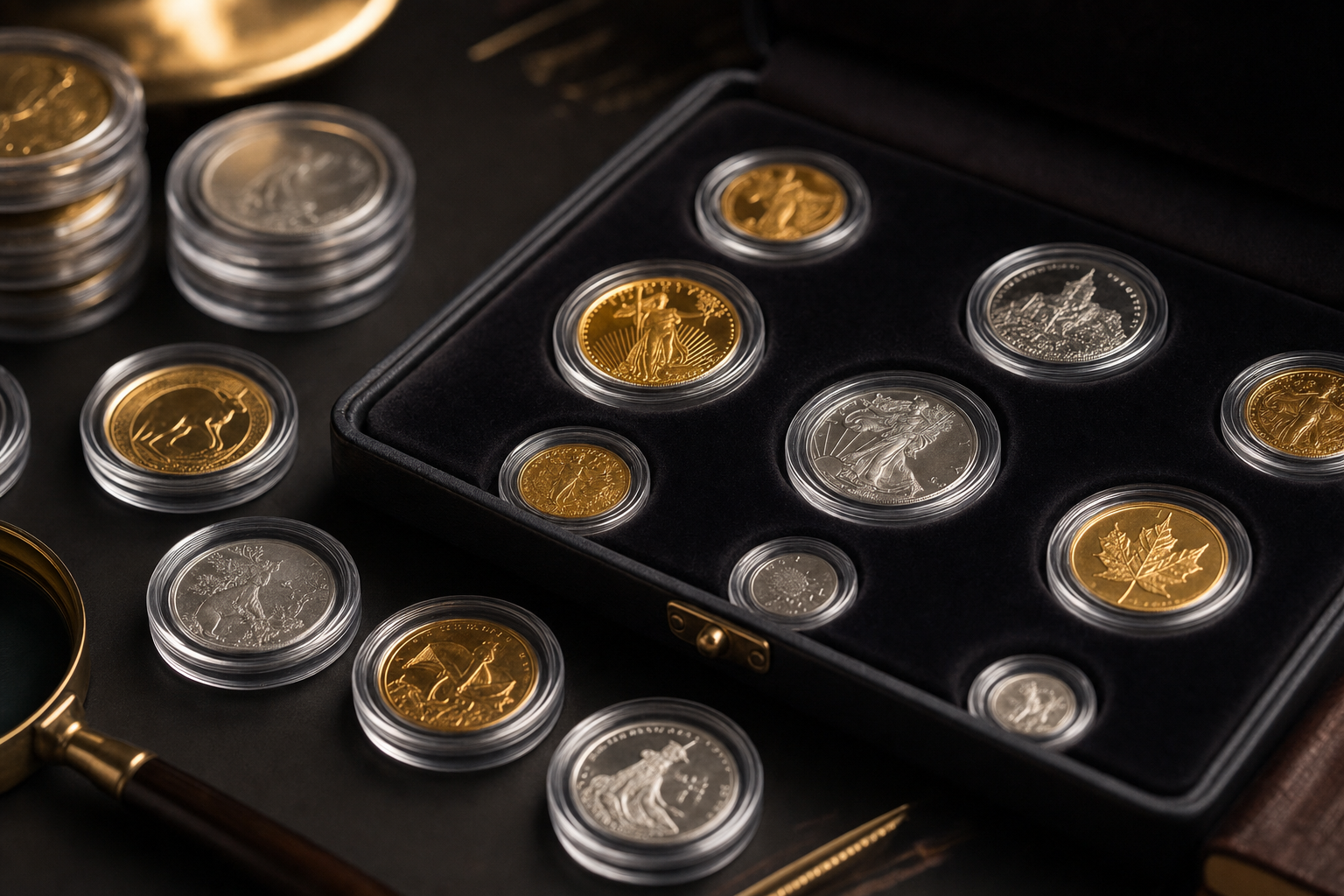
This segment appeals to several groups of interest. Collectors appreciate the variety of designs, the limitation and the craftsmanship. Anyone looking for a gift will find, in small gold formats and themed designs, a value-stable alternative to classic presents: corresponding suggestions are gathered in the gift ideas category. And theme collectors too, who gather designs around, for example, symbolism, zodiac signs or native animals, will find what they are looking for in the enhanced segment.
Anyone who wants to invest solely in the pure material value, however, should take the premium for the finishing into account and consider classic bullion classics as an alternative. Both approaches are not mutually exclusive: many collections deliberately combine both.
Partially gilded means that selected design areas of a silver coin are electroplated with a fine layer of gold. The silver content contained remains unchanged: the gold layer is extremely thin and serves solely to enhance the appearance and create contrast.
No. Partial gilding, colour finishing or hologram finishing practically does not change the fine content of silver or gold contained. The material value continues to be based on the fine weight of the base metal. The additional price results from craftsmanship, design and mintage limitation.
An in-house product is an edition developed exclusively for a dealer and minted in a limited mintage. Such coins carry designs that exist in this form only with this provider, and are often produced in collaboration with established mints.
Proof denotes the highest minting quality. It is characterised by mirror-polished surfaces and frosted, three-dimensionally raised design areas. Coins in Proof quality are particularly sensitive to fingerprints and should always be kept in a protective capsule.
Enhanced coins and in-house products primarily stand for collector value rather than pure material investment, since they carry a premium over the precious metal value. Anyone who wants to invest primarily in the metal itself will find the more cost-effective option in classic bullion coins and bars. A statement about future performance is, in principle, not possible.
Best stored individually in a coin capsule, in a dry place with a stable temperature. The design surface should never be touched with bare fingers. For larger collections, coin cassettes or coin cases are recommended. Cleaning or polishing measures are not advisable, as they can damage the enhanced surface.
Stay informed with product launches, financial news and exclusive offers. Sign up for our free newsletter today.
By entering your email address and clicking the “Submit” button, you give the following consent: “I agree to be informed by email about new products, financial news and exclusive offers, and therefore consent to the processing of my email address for the purpose of sending the newsletter. I can revoke this consent at any time without giving reasons, with effect for the future. The lawfulness of processing carried out prior to revocation remains unaffected.”
