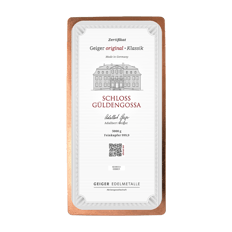
5kg Copper Bar Heimerle und Meule
£327.30
excl. UK import VAT and shipping
Available in 2–3 business days

 More than 300,000
 Over 30 years
 Secure shipping
 Google: 4.9/5
5 kg copper bars are the ideal investment form for copper investors. With this large denomination, you benefit from the actual consumption of copper in the production of cutting-edge technologies. A shortage of this semi-precious metal has already been predicted.

Copper is the metal that literally holds the modern world together: it is found in every electrical cable, every motor and every solar installation. It is precisely this industrial indispensability that makes the 5 kg copper bar the largest and most cost-effective denomination for adding physical copper to your own holdings as a tangible asset. This guide explains what distinguishes a 5-kilo bar, how it differs from smaller units, what to know about fineness, dimensions, storage and tax, and why this reddish, lustrous semi-precious metal is considered one of the metals of the future.
With physical copper, size determines cost-efficiency. Because the pure material value of copper is low compared to gold or silver, production costs weigh proportionally more heavily than with precious metals. The larger the bar, the lower the premium relative to the pure copper price, and this is exactly where the 5-kilo bar plays to its strength: it bundles five kilograms of fine copper into a single, compact piece, offering the best value for money within the entire range of copper bars.
Anyone buying copper in small units such as the 1 oz copper bar or the 10 oz copper bar pays proportionally much more for minting and packaging. The 5 kg copper bar is therefore aimed at investors who want to acquire a larger quantity of this semi-precious metal at the smallest possible spread between purchase price and material value.
The spread describes the difference between what a bar costs to buy and its pure metal value. With copper, this gap is naturally larger than with gold, because the metal itself is inexpensive while processing is relatively costly. The following rule of thumb applies across all denominations:
Investment-grade copper bars consist of 99.9% fine copper, in other words a fineness of 999/1,000. This purity is stamped on every bar together with the weight and manufacturer's marking, and forms the core of its lasting value. A bar with a gross weight of five kilograms therefore contains practically five kilograms of pure copper.
The real difference compared to precious metals lies in the space required: because copper has a significantly lower density than gold, a 5-kilo bar is surprisingly large. Depending on the manufacturer and production method, the dimensions typically fall within these ranges:
| Feature | Typical value |
|---|---|
| Fineness | 999/1,000 (99.9% Cu) |
| Gross weight | 5,000 g |
| Dimensions (cast/minted) | approx. 188 × 100 × 30 mm to 214 × 107 × 26 mm |
| Packaging | shrink-wrapped (protection against verdigris) |
| Condition | Brilliant Uncirculated (BU) |
By comparison: five kilograms of gold would take up a volume no bigger than the palm of a hand, whereas the copper bar reaches the size of a small brick. This should be taken into account from the outset when planning storage, especially if several bars are to be stacked.
Large copper bars are produced using two different methods. Minted bars look precise, with sharp edges and smooth surfaces. Cast bars, such as the well-known Schloss Güldengossa edition, display a more rustic, artisanal-looking surface and are valued by collectors for their character. Both variants contain the same fine copper; the choice is purely a matter of taste.
Copper ranks among the most heavily mined metals in the world: its annual production volume clearly exceeds that of all other metals. Demand for it is driven by the electrical industry, construction, mechanical engineering and medical technology. The reason lies in its physical properties: copper conducts electricity and heat exceptionally well, is corrosion-resistant and can be recycled almost indefinitely.
In particular, the energy and mobility transition is driving consumption. An electric car contains many times the amount of copper found in a combustion vehicle, and every wind turbine or photovoltaic installation requires large quantities of the red metal. Because copper is actually consumed in these applications rather than being predominantly hoarded as gold is, observers speak of a structurally rising demand. This genuine industrial use sets copper fundamentally apart from classic silver bars or gold bars, whose value is driven more by the investment and jewellery markets.
Copper is not a metal you merely own: it is a metal that builds the world a little further every single day.
Physical copper offers an advantage that exchange-traded paper products do not have: direct possession. Anyone investing in copper via certificates or ETCs holds nothing more than a promise of delivery. A 5 kg copper bar, by contrast, sits tangibly in the safe and its material value can never fall to zero. As a complement to a portfolio of gold and silver, copper broadens diversification across tangible assets.
A realistic perspective is important here: the copper price is distinctly cyclical and closely tied to global economic developments. Price swings of 50% or more within short periods of time are historically not uncommon. Copper is therefore suited as a long-term portfolio addition that requires patience, not as a short-term speculation. Anyone generally interested in physical tangible assets will find further information in the context of inflation hedging and copper in general.
Unlike investment gold, which is exempt from VAT, copper as an industrial metal is subject to VAT. When purchasing a copper bar, the statutory VAT therefore generally applies, comparable to the treatment of silver bars. This factor increases the entry price and should be factored into any profitability calculation.
Because tax regulations can change and individual circumstances vary, this information does not replace professional tax advice. For specific questions, a tax advisor is the right point of contact.
Tax notice
Copper bars are classed as an industrial metal and, unlike investment gold, are not exempt from VAT. The lower material value and proportionally higher production costs make larger denominations such as the 5-kilo bar the most attractive option both tax-wise and economically.
Over time, copper reacts with the air and forms the characteristic greenish patina known as verdigris. To preserve the Brilliant Uncirculated (BU) surface, investment bars are shrink-wrapped at the factory. As long as this protective film remains intact, the bar is reliably protected against oxidation.
For storage, a dry, temperature-stable location is recommended. Because of their considerable volume and weight, several 5-kilo bars should be placed on a stable surface and not stacked excessively high. Suitable storage accessories and a secure location such as a safe help keep the collection organised and protected. Anyone opening the film to take a look should only handle the bar with clean gloves, as skin oils accelerate the oxidation process.
Copper bars for the German market come predominantly from established refineries. Bars from Leipziger Edelmetallverarbeitung (LEV) and Heimerle und Meule, one of the oldest German gold and silver refineries, are frequently found, as is the cast original Schloss Güldengossa edition from Geiger. Each of these bars consists of pure copper with a fineness of 999/1,000, carries a stamped marking of weight and fineness, and is delivered shrink-wrapped.
Kettner Edelmetalle is a family business founded in 2011 in Villingen-Schwenningen with over 200,000 satisfied customers. Shipping is 100% insured, and every item undergoes an ISO-compliant inspection. An overview of the mints can be found on the Heimerle und Meule manufacturer page and at Leipziger Edelmetallverarbeitung.
Production costs per bar are largely independent of its size. For a 5-kilo bar, these costs are spread across much more material, which lowers the premium per kilogram. This means the purchase price is closer to the pure copper price than with small denominations such as 1 oz or 10 oz.
Investment-grade copper bars consist of 99.9% fine copper, in other words a fineness of 999/1,000. The fineness, weight and manufacturer's marking are stamped on the bar.
The gross weight is five kilograms. Depending on the manufacturer and production method, the dimensions typically range between approximately 188 × 100 × 30 mm and 214 × 107 × 26 mm. Because of copper's lower density, the bar is considerably more voluminous than a gold bar of the same weight.
Yes. Copper is classed as an industrial metal and, unlike investment gold, is not exempt from VAT. The statutory VAT is part of the purchase price. For an individual tax assessment, a tax advisor is the right point of contact.
The bars are delivered shrink-wrapped from the factory. As long as the protective film remains intact, the Brilliant Uncirculated (BU) surface is reliably protected against oxidation and the greenish patina. Dry, temperature-stable storage preserves the quality over the long term.
Both contain the same fine copper and are of equal value. Minted bars have sharp edges and smooth surfaces, while cast bars such as the Schloss Güldengossa edition display a more rustic surface. The decision is purely a matter of taste.
 5 kg Copper Bars
Stay informed with product launches, financial news and exclusive offers. Sign up for our free newsletter today.
By entering your email address and clicking the "Submit" button, you give the following consent: "I agree to be informed by email about new products, financial news and exclusive offers, and therefore consent to the processing of my email address for the purpose of sending the newsletter. I can revoke this consent at any time without giving reasons, with effect for the future. The lawfulness of processing carried out prior to revocation remains unaffected."