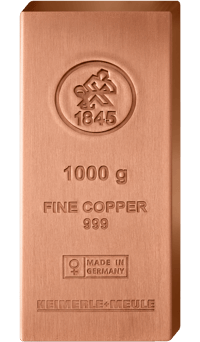
1kg Copper Bar Heimerle und Meule
£75.46£83.85
excl. UK import VAT and shipping
Available in 9–10 business days

 More than 300,000
 Over 30 years
 Secure shipping
 Google: 4.9/5


Most of us hold copper in our hands every day. The 1, 2 and 5‑cent coins have a skin of copper, with steel underneath. The Deutsche Bundesbank describes them as strongly magnetic.
The 10, 20 and 50‑cent coins are made of “Nordic gold”. It is not gold: the alloy is 89 per cent copper, with aluminium, zinc and tin added. It is not magnetic.
A magnet lifts the 1‑cent coin. The 10‑cent coin stays where it is.
The idea is older than the euro. The 1 pfennig coin of the D‑Mark had a steel core covered with copper on both sides. It measured 16.50 millimetres across, weighed 2.00 grams and was introduced in 1948. At 16.25 millimetres, the 1‑cent coin is almost the same size.
All three at the same scale. The diameters are given by the Deutsche Bundesbank, the ECB and our product data.
The design of the old pfennig, the numeral 1 between two ears of grain, now exists in copper for collectors. The coin was issued by Liberia, with a face value of 1 dollar.
Pure gold and pure silver are too soft for coins that pass through many hands. That is why copper was added to them. For the gold coins of the German Empire, the ratio was laid down in law.
“The mixing ratio of the Imperial gold coins is fixed at 900 thousandths gold and 100 thousandths copper.”
Gesetz, betreffend die Ausprägung von Reichsgoldmünzen, of 4 December 1871, § 4, Reichsgesetzblatt 1871, p. 404
Two years later, the silver coins were given the same formula. The Münzgesetz, the coinage act of 9 July 1873, lays down in Article 3: “900 parts silver and 100 parts copper” (Reichsgesetzblatt 1873, p. 234).
Sterling silver has a fineness of 925/1,000. According to The Royal Mint, the rest is usually copper, because copper makes the soft silver stronger.
Swiss gold coins, the Vreneli among them, are 90 per cent gold and 10 per cent copper. Of this alloy, Swissmint writes: “The colour of this material is quite red.”
The coins became yellow because the blanks were treated in a pickling bath before striking. In the process, copper is removed from the surface. The alloy itself makes the coin hard and resistant to wear and tear.
Goldmark, 1871Goldmark
Sterling silverSterling
Each grid has 1,000 squares, and each square is one thousandth. In sterling silver, the rest is usually copper.
The Statue of Liberty in New York is made of copper. Its skin is only 3/32 inch thick, about 2.4 millimetres, according to the National Park Service.
The copper was shaped in Paris, in the workshop of Gaget, Gauthier & Co. There the sheets were hammered over wooden forms, and the statue was assembled from 1881 to 1884.
The skin does not carry its own weight. Flat metal straps connect it to Gustave Eiffel’s framework. They hold the statue together and flex like springs.
Taken apart into 350 pieces, the statue arrived in New York on 17 June 1885 aboard the ship “Isère”. It was dedicated on 28 October 1886.

Both at the same scale, enlarged. The thickness of the skin is given by the National Park Service, that of the coin by the ECB.
There is a lot of copper in American small change, too. The 5‑cent coin is called the “nickel” there, but it is three quarters copper.
“The 5‑cent coin is an alloy of 75 percent copper and 25 percent nickel.”
United States Code, 2024 edition, Title 31, § 5112 (b)
For collectors, there is the Libertas Americana 2026 in copper, issued by Liberia with a face value of 1 dollar.
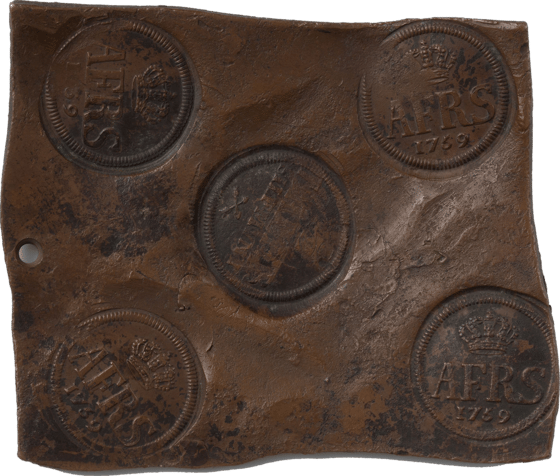
In Sweden in the 17th and 18th centuries, copper itself was money. The coins were worth as much as their metal. Because copper was worth less than silver, a copper coin of 10 daler had to be large and heavy.
The 10‑daler plate made at Avesta in 1644 weighs 19.7 kilograms. The Royal Coin Cabinet in Stockholm calls it the largest coin in the world.
The plates were moved on sledges. Europe’s first banknotes were issued in 1661 by Stockholms Banco. They quickly became popular because they were more convenient than the heavy copper coins, according to Sweden’s Riksbank.
Both at the same scale, seen from above. The measurements of the plate are given by the Rijksmuseum in Amsterdam, those of the coin by the ECB. A ½‑daler plate of 1759 with five stamps. Rijksmuseum Amsterdam, public domain (CC0).
By calculation: 19.7 kilograms is just under four bars of 5 kilograms each.
In the 17th century, at times around two thirds of the world’s copper came from Sweden, above all from the mine at Falun.
At Midsummer 1687, the mine collapsed. It left behind the “Stora Stöten”, a crater 95 metres deep. No miner was killed, because they all had time off to celebrate Midsummer.

In the Mansfeld region of Saxony‑Anhalt, the copper lies in a thin, dark layer of rock, the copper shale. It is only 20 to 40 centimetres thick and was laid down as sediment in a sea about 255 million years ago.
According to tradition, the miners Nappian and Neucke found this layer near Hettstedt in the year 1199. This is reported in the Mansfeldische Chronik by Cyriacus Spangenberg, dating from 1572.
Copper was mined here and near Sangerhausen for almost 800 years. Mining in the Mansfeld basin ended in 1969, near Sangerhausen in 1990.
Diagram of a section two metres high. The thickness of the layer is to scale, based on the Landesamt für Geologie und Bergwesen Sachsen‑Anhalt, the state office for geology and mining.
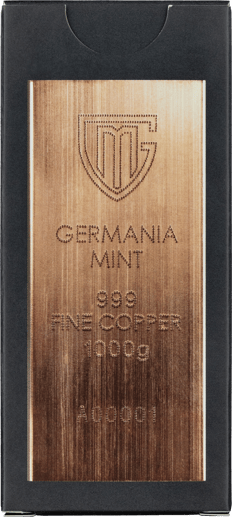
The 1 kg copper bar is the largest common denomination in the copper bar range and is aimed at anyone who wants to acquire the red industrial metal in concentrated form and with a low premium over the pure metal value. A one-kilogram copper bar typically consists of 999.9 fine copper and is produced either by casting or minting. This guide explains the production process, the leading manufacturers, the tax treatment, storage, and the role of copper as a tangible asset and entry point into the world of precious and industrial metals.
Copper is one of the oldest metals used by mankind and today is one of the most important commodities in the global economy. Referred to as red gold, it combines industrial demand with the role of a physical tangible asset. A one-kilogram bar bundles a large quantity of this metal into a single, easy-to-handle piece, offering a comparatively affordable entry point. While investors in gold and silver mainly value their monetary character, with copper the close connection to the real economy takes centre stage.
The large 1-kilogram bar is particularly interesting for anyone who wants to acquire a substantial amount of copper with as low a premium as possible. The larger the unit, the lower the percentage premium on the material value. Anyone wishing to try smaller units first will find suitable alternatives in the categories 100 oz copper bars and 500 g copper bars. An overview of all weight classes is available in the parent category copper bars.

A kilogram of copper can be brought into bar form in two fundamentally different ways. Both methods produce a bar with a fineness of 999.9, but they differ markedly in appearance and feel.
Minted bars are created by stamping a cut copper blank under high pressure with a die. The result is a smooth, even surface with sharply defined designs, manufacturer details and weight markings. These bars appear particularly precise and are especially common among manufacturers who also offer 1 kg gold bars and other precious metal bars using the same production method.
In casting, liquid copper is poured into a mould and left to solidify. Characteristic features are the individually slightly varying surface and the typical rustic cast charm. Each cast bar is therefore a one-off piece with a natural structure. The same traditional production method is also found in larger silver units such as the 1 kg silver bars.

The quality of a kilogram bar depends largely on the manufacturer. Established refineries and mints ensure a controlled fineness and clean workmanship. Well-known names in the copper sector include:
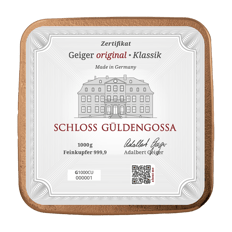
A cleanly minted or cast bar usually bears details of weight, fineness and manufacturer. These features make later identification and resale easier. Anyone interested in the variety of mints will find numerous further names in the overview of manufacturers.
Copper occupies a special position among tradable metals. It is not a classic precious metal like gold or silver, but an industrial metal of great importance for the energy transition, electric mobility and the construction industry. This industrial demand makes the copper price highly dependent on the global economic cycle.
In direct comparison, the price difference is particularly striking: one kilogram of copper costs only a fraction of what the same amount of silver or gold is worth. This makes copper particularly suitable as an affordable entry point for anyone wishing to own physical metals in large quantities and with a strong material presence. Anyone wanting to supplement their portfolio with classic precious metals will find suitable products in the categories silver bars and gold bars. Besides bars, copper coins are also an option for holding the red metal in collectible form.
Copper is the metal of the real economy: whoever owns it holds a piece of industrial basic supply physically in their hands.
Unlike investment gold, which is exempt from VAT in Germany, copper as an industrial metal is subject to the standard VAT rate. When purchasing a kilogram bar, VAT is included in the price. This is a key difference compared with gold bars, which are exempt from VAT.
Tax note
Copper bars are traded in Germany at the standard VAT rate. This information is for general purposes only and does not replace tax advice. For individual circumstances, we recommend consulting a tax advisor.
Because VAT is included, the effective purchase price lies above the pure material value. This should be taken into account when comparing with VAT-exempt investment products such as gold bullion coins. Copper is therefore regarded less as a pure store of value and more as a tangible, graspable asset and collectible.
A kilogram copper bar is a compact but weighty object and is easy to store. Since, unlike silver, copper is not valuable enough to justify expensive safe deposit boxes, it is usually stored at home. Protection from moisture is important, as copper oxidises in air over time and develops a dark to greenish patina.
The natural patina does not affect the material value but does change the appearance. Collectors who want to preserve the mint-fresh shine therefore turn to suitable coin cases and store the bars airtight.
For many, the kilogram copper bar is their first contact with physical metals. The low price lowers the entry barrier and makes it possible to develop a feel for the weight, feel and trading of physical goods without a major capital outlay. Anyone wishing to move on to classic precious metals afterwards will find an obvious next step with the 500 g silver bars.
The large bar also has its appeal as a gift or collectible: one kilogram of solid copper looks impressive and conveys the value of a genuine raw material. For thematically designed pieces, it is worth taking a look at the copper commemorative coins. Kettner Edelmetalle, a German online retailer with over 200,000 customers, stocks copper products from various manufacturers and inspects all goods before shipping.
A kilogram copper bar typically consists of 999.9 fine copper, i.e. almost pure copper. The exact fineness is usually stated on the bar together with the weight and manufacturer.
Yes. Copper is considered an industrial metal and is subject to the standard VAT rate in Germany. Unlike investment gold, copper is not exempt from VAT. The tax is included in the purchase price.
Minted bars are produced under high pressure and have a smooth, even surface with sharp designs. Cast bars are poured from liquid copper into moulds and have a more individual, rustic surface structure. Both achieve the same fineness.
Copper reacts with oxygen and moisture in the air, forming a patina that makes the surface appear darker or greenish. This natural oxidation does not affect the material value but does change the appearance. Dry, airtight storage slows down the process.
The large kilogram bar is suitable for anyone who wants to acquire a substantial amount of copper with a low premium over the material value, as well as for collectors and beginners wanting to get to know physical metals. Anyone who prefers smaller units will find suitable alternatives in the 500 g or 100 oz categories.
In principle, a copper bar can be sold again. However, since the trading margin for copper is narrower than for precious metals due to VAT and low material prices, copper is regarded more as a tangible asset and collectible. A cleanly marked bar from a well-known manufacturer is easier to pass on.
 1 kg Copper Bars
Stay informed with product launches, financial news and exclusive offers. Sign up for our free newsletter today.
By entering your email address and clicking the "Submit" button, you give the following consent: "I agree to be informed by email about new products, financial news and exclusive offers, and therefore consent to the processing of my email address for the purpose of sending the newsletter. I can revoke this consent at any time without giving reasons, with effect for the future. The lawfulness of processing carried out prior to revocation remains unaffected."