Sold out

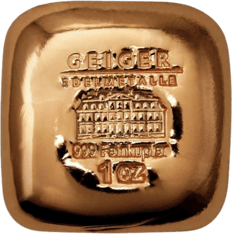
1 oz Copper Bar Schloss Güldengossa (Kupferknuffel)
£12.19
excl. UK import VAT and shipping
currently not available

 More than 300,000
 Over 30 years
 Secure shipping
 Google: 4.9/5


The 1 oz copper bar is the classic entry point into the world of physical metals: compact, affordable and, thanks to its fine strikes, just as popular as a collector's item as it is as a demonstration object. One troy ounce equals around 31.1 grams of pure copper, usually cast or struck at a fineness of 999.9. This guide explains the origin and significance of the red metal, the common denominations and designs, questions of authenticity, storage and tax, as well as the role copper can play in a broadly diversified commodities collection.

Copper has accompanied humankind for more than ten thousand years and gave an entire era, the Copper Age, its name. As the first metal to be put to technical use by humans, it still forms the backbone of modern industry today: electrical engineering, construction, vehicle manufacturing and the energy transition would scarcely be conceivable without this excellent electrical conductor. It is precisely this industrial demand that makes copper a raw material whose price is closely tied to the global economy.
For private collectors and newcomers, the 1 oz copper bar is above all one thing: a tangible, affordable way into physical metal. Unlike the classic precious metals, the pure material value rarely takes centre stage here; instead, it is the enjoyment of the strike and the interest in the raw material itself that count. Anyone wishing to expand their portfolio with other metals will find the full range of sizes and designs in the overarching range of copper bars.
Gold, silver, platinum and palladium are considered precious metals because they are chemically particularly stable and rare. Copper, on the other hand, is classed as a semi-precious or industrial metal. This classification has practical consequences for price, tax and value retention, which are described in detail further below. A look at the wide range of silver bars shows just how clearly material value and trading margin differ between metal classes.
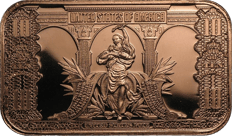
The troy ounce (oz) is the internationally standard unit of weight for investment metals and corresponds exactly to 31.1035 grams. A 1-ounce fine copper bar is therefore pleasantly manageable and fits into any collection. Besides the pure bar form, this category also commonly features bar-like strikes and medals weighing one ounce, visually reminiscent of historical banknotes or coin designs.
Those wishing to stack larger quantities of metal usually opt for heavier units. For a direct comparison, it is worth looking at the 10 oz copper bar or the compact kilo formats such as the 1 kg copper bar, where the premium per gram is usually noticeably lower than with the small ounce.
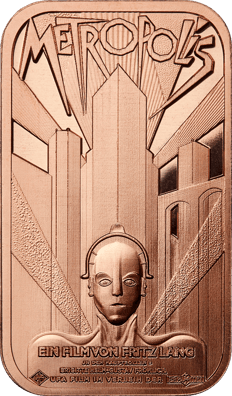
The appeal of the 1-ounce size lies in the low entry threshold and the variety of designs. Many strikes appear in themed series, for example as replicas of historical US banknotes or classic coin designs. This places the 1 oz copper bar somewhere between a pure commodity product and a collector's item. Those looking for the larger format will find the other end of the scale in the 5 kg copper bar.
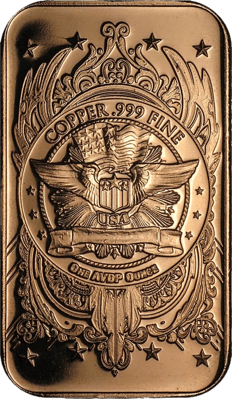
A large part of the charm of copper bars lies in their design. Because the material is inexpensive, mints can implement elaborate reliefs and highly detailed designs without the price rising significantly. Popular choices include replicas of historical banknotes, animal motifs such as the American bison, and classic depictions of liberty. This variety of designs makes the small bars an ideal collector's item for beginners.
The warm, reddish shine of freshly struck copper is characteristic. Over time, a natural patina forms, which many collectors even appreciate. Anyone wishing to preserve a shiny appearance should ensure airtight storage. Thematically related strikes with a face value can be found in the copper coins category, for example in series such as Buffalo or American Liberty.
A bar carries no official face value and is a pure metal product, whereas a coin is issued by a state mint with legal tender status. With copper, this boundary often becomes blurred, as many design bars are coin-like in shape. Collectors who specifically prefer coin formats will find what they are looking for in the China Panda series or under commemorative coins.
Due to its low material value, copper is rarely counterfeited; nevertheless, it is worth checking a few characteristics when purchasing. Fine copper has a characteristic density of around 8.96 g/cm³ as well as the typical reddish-orange colouring. Reputable products usually carry details of weight and fineness directly in the strike.
At Kettner Edelmetalle, every metal product undergoes an ISO-compliant authenticity verification before leaving the high-security logistics centre. Anyone interested in provenance will find established German refineries with a long tradition in metal processing among the manufacturers such as Heimerle und Meule.
An important difference from investment gold: copper is not exempt from VAT. While investment gold is exempt from VAT under §25c UStG, copper bars are subject to the standard VAT rate. This is reflected in the purchase price and is one of the reasons why copper is regarded more as a collector's and entry-level product and less as a classic store of value.
Tax notice
In Germany, copper bars are traded at the standard VAT rate and, unlike investment gold, are not exempt under §25c UStG. The difference between the buy and sell price (spread) is relatively high for a low-priced raw material such as copper. This is not tax advice, but general information.
The pure material value of a copper ounce is low and usually lies well below one euro, while the selling price is higher due to striking, packaging and tax. The premium over the raw material value is proportionally highest for small formats. Those focused on value retention often compare copper with metals from the gold bar range or opt for larger copper units such as the 500 g copper bar, where the trading margin becomes relatively smaller.
Copper reacts more sensitively to environmental influences than gold or silver. Moisture, fingerprints and atmospheric oxygen promote the formation of patina and, in extreme cases, verdigris. To preserve the original appearance for as long as possible, dry storage with minimal air exposure is recommended.

Suitable accessories for value-preserving storage can be found in the coin capsules and coin cassettes categories. For larger collections, coin tubes are also a good option, in which several bars of the same format can be stacked, protected from dust and air.
Copper is often regarded as a complement rather than the core of a collection. It is excellently suited for an affordable introduction to collecting physical metals, for introducing children and beginners to the subject, or for visually rounding out an existing precious metals collection. The historical significance of the red metal and its importance for modern technology additionally make it an instructive object.
Copper is not the most expensive metal in a collection, but often the most instructive: it connects ancient cultural history with modern industry.
Those wishing to build their collection in a structured way often combine copper with the more durable metals. An entry via silver is popular, for example with a 1 oz silver bar, while gold becomes accessible via small units such as the 1 g gold bar. This creates a balanced mix across several metal classes.
One troy ounce corresponds exactly to 31.1035 grams. A 1 oz copper bar therefore contains around 31.1 grams of pure copper, usually at a fineness of 999 or 999.9.
No. Unlike investment gold, which is exempt from VAT under §25c UStG, copper bars are subject to the standard VAT rate. This information is general in nature and does not constitute tax advice.
The material value of a copper ounce is very low. The selling price additionally consists of striking costs, packaging, trading margin and VAT. For small formats, this surcharge is proportionally highest.
Copper should be stored dry, cool and with as little air exposure as possible. Precisely fitted coin capsules and avoiding contact with bare fingers prevent patina, fingerprints and verdigris.
Copper bars are affordable and attractive thanks to their variety of designs, which is why they make a good affordable entry point or complement to a collection. For pure value retention, many collectors additionally turn to silver and gold.
Copper bars are available in, among others, 10 oz, 500 g, 1 kg, 100 oz and 5 kg. Larger units usually carry a lower premium per gram over the material value.
 1 oz Copper Bars
Stay informed with product launches, financial news and exclusive offers. Sign up for our free newsletter today.
By entering your email address and clicking the "Submit" button, you give the following consent: "I agree to be informed by email about new products, financial news and exclusive offers, and therefore consent to the processing of my email address for the purpose of sending the newsletter. I can revoke this consent at any time without giving reasons, with effect for the future. The lawfulness of processing carried out prior to revocation remains unaffected."