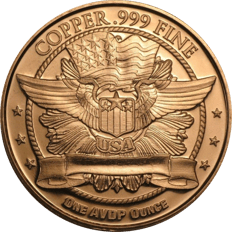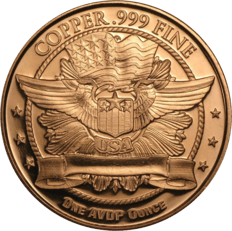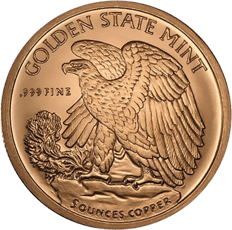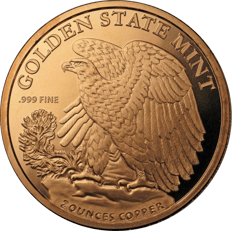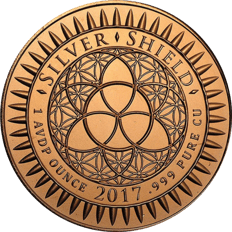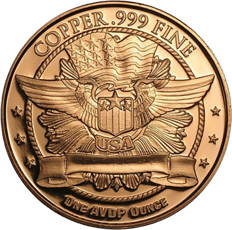
1 Ounce Copper Coin Liberty Head
£8.31
excl. UK import VAT and shipping
Available in 2–3 business days

 More than 300,000
 Over 30 years
 Secure shipping
 Google: 4.9/5


She is regarded as a symbol of American freedom, and she fascinates collectors worldwide: Lady Liberty. What has graced gold and silver coins since 1916 has long been available as an American Liberty copper coin too. This category brings together the finest strikes devoted to the goddess of liberty in warm, reddish-brown copper lustre, from the full-body striding portrait of the Walking Liberty to the majestic eagle design of the Saint-Gaudens. The following guide sheds light on the history, designs, technical features and tax particulars of these special collector's coins.
For many, the USA has always stood for boundless opportunity and unbroken freedom. This ideal is personified, just as it was by the goddess Libertas in Roman antiquity, through the figure of Lady Liberty. Since 1916 she has adorned US circulation coins and modern strikes in gold, silver and copper. Whether as a classic portrait, in a standing or striding pose: these designs are among the most popular collector's items in numismatics, and in their copper version they are often quickly sold out.
The American Liberty copper coins join the broad range of modern copper coins. They combine a culturally charged design with the distinctive charm of a warm material, appealing both to design collectors and to newcomers who want to add to their collection without major financial outlay.
Anyone thinking about investment metals usually has gold, silver, platinum or palladium in mind first. Copper has long stood in the shadow of these precious metals, not least because of its comparatively low price. Yet that is precisely where its appeal lies: as a semi-precious metal, copper offers an uncomplicated way into the world of coins without requiring a large budget.
A Lady Liberty with a flowing robe in gleaming reddish-brown is also a genuine visual highlight. What's more, copper is an industrial metal in strong demand worldwide and plays a central role in the energy transition, electronics and construction. With American Liberty designs, it is also notable that many issues appear only in modest mintages and sell out quickly, a sign of the great popularity of these collector's coins.
Anyone who values this variety of materials can combine the strikes thematically with classic copper bars or with other series such as the Buffalo or the China Panda.
The Statue of Liberty took eleven years to build before it was erected in New York in 1886. Since 1916 the likeness of the goddess of liberty has also appeared on US coins. The individual depictions on the obverse and reverse differ slightly from one another, but the core designs remain recognisable across all issues, regardless of whether the coin is struck in silver, gold or copper.
This continuity is what gives the series its appeal: each coin tells a piece of American history and the art of coinage. Anyone wishing to delve deeper into the subject will find a close thematic connection in the world of American Eagle silver strikes, since many copper designs trace back to famous precious metal originals.
The American Liberty copper coins appear in several classic designs, each tracing back to historical US coinage. Each variant has its own character and its own history.
The full-body depiction of the goddess of liberty striding forward in a flowing robe was the first version of what is today such a popular coin. The original was struck between 1916 and 1947. It stands for the military glory and civic peace of the then still young nation. Visible are laurel and oak branches, the US flag and a sunrise, complemented by the words Liberty, In God We Trust and the year of issue. The reverse shows the bald eagle, the heraldic animal of the USA.
The Walking Liberty was designed by the sculptor Adolph Alexander Weinman, who won the design competition held to redesign the circulation coins. As a copper version, the design is no less sought after: typically with a fineness of 999, a weight of around 28 grams, or one troy ounce, and a diameter of around 39 millimetres. Larger issues also appear as imposing 2-ounce or 5-ounce strikes.
As a portrait, Lady Liberty appears in the form of the so-called Liberty Head Eagle. The US Mint was founded in 1795 to strike this coin as official legal tender. The woman's head on the obverse and the bald eagle on the reverse were repeatedly adjusted slightly over time. Until 1933, the term Eagle served as a collective name for several historical gold coins:
Anyone who comes across a copper coin labelled Coronet Head while searching need not puzzle over it: the term simply refers to the diadem that Lady Liberty wears on the portrait coins. Thematically related is the American Eagle series in gold, which continues the classic depiction of liberty to this day.
Another highlight is the Saint-Gaudens Liberty Eagle, usually with a weight of one ounce and a copper fineness of 999/1,000. Between 1907 and 1933 the original was struck as a gold Double Eagle. The design owes its name not to a small French town, but to its creator, the sculptor Augustus Saint-Gaudens.
Saint-Gaudens, shaped by Greek and Roman artistic traditions, wanted his Liberty coins to have an especially high relief. The effort involved was enormous, however, so that the first issues, apart from officially two examples, were melted down again. A few pieces escaped the melting pot: for an issue from 1933, just under 19 million US dollars were bid at a London auction in 2021, to this day a world record for a coin.
A high relief lends the goddess of liberty an almost sculptural depth; in copper, this effect takes on an entirely distinctive, warm tone.
Despite their different designs, the American Liberty copper coins share several typical characteristics. The fineness is usually 999/1,000 copper, the edge is often reeded, and the 1-ounce issues measure around 39 millimetres in diameter. With larger formats such as the 5-ounce strike, the diameter grows to over 60 millimetres, an impressive showpiece for any display case.
Important to know: with copper coins, the weight is often given in AVDP ounces (avoirdupois). Such an ounce corresponds to about 28.35 grams and thus differs from the troy ounce (31.1 grams) customary for precious metals. When comparing different issues, it is therefore worth taking a close look at the stated measurements.
Historical US issues also carry mint marks: issues struck in Denver or San Francisco are marked accordingly, while a coin without a mark comes from the Philadelphia Mint. These details help collectors with classification and valuation. For safe transport and tidy presentation, suitable coin capsules are recommended.
Copper reacts more sensitively to environmental influences than gold. Oxygen and humidity can cause a darker patina to form over time. For some, this natural ageing is a sign of authenticity, for others a visual flaw. In any case, the original lustre can be preserved for a long time with the right storage.
Storage in airtight coin capsules or in a coin case is recommended, combined with a dry, dark storage location. Direct skin contact should be avoided, as fingerprints can leave traces. Anyone building a larger collection will find suitable solutions in the broad range of accessories, from coin tubes to collector's cases.
Unlike investment gold, copper coins are not exempt from VAT in Germany. The standard VAT rate applies to collector's coins made of copper. For tax purposes, copper is not classed among the traditional investment precious metals, which is why the tax advantages that apply, for example, to gold bullion coins do not apply here.
A note on classification
American Liberty copper coins are primarily collector's and design items, not a conventional investment. Anyone wishing to build up precious metal holdings in a tax-optimised way will find more suitable alternatives in gold coins or silver coins. This information does not replace tax advice.
At the centre is Lady Liberty, the personification of American freedom. Depending on the issue, she appears as a striding full-body figure (Walking Liberty), as a portrait (Liberty Head) or in the high relief of the Saint-Gaudens design. The reverse usually features the bald eagle, the heraldic animal of the USA.
Most American Liberty copper coins are made of 999/1,000 pure copper. The 1-ounce issues have a diameter of around 39 millimetres, while larger formats such as the 5-ounce strike measure over 60 millimetres.
Copper coins are primarily collector's and design items. They offer an affordable entry into numismatics. Anyone wishing to specifically build wealth in precious metal usually turns to gold coins or silver coins, which are also treated differently for tax purposes.
Copper has a warm, reddish-brown lustre that stands out visually from gold and silver. Its low price makes it possible to collect even elaborate designs and large formats without major financial outlay. At the same time, copper is a raw material in strong industrial demand.
Copper reacts to humidity and oxygen by forming patina. For lasting lustre, airtight coin capsules, dry and dark storage, and avoiding direct skin contact are recommended. Suitable accessories, from capsules to cases, help present the collection cleanly.
Copper coins are often specified in AVDP ounces (avoirdupois). One AVDP ounce corresponds to about 28.35 grams, while the troy ounce customary for precious metals weighs about 31.1 grams. When comparing weight specifications, it is therefore worth taking a close look.
 American Liberty
Stay informed with product launches, financial news and exclusive offers. Sign up for our free newsletter today.
By entering your email address and clicking the "Submit" button, you give the following consent: "I agree to be informed by email about new products, financial news and exclusive offers, and therefore consent to the processing of my email address for the purpose of sending the newsletter. I can revoke this consent at any time without giving reasons, with effect for the future. The lawfulness of processing carried out prior to revocation remains unaffected."