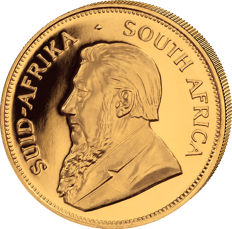
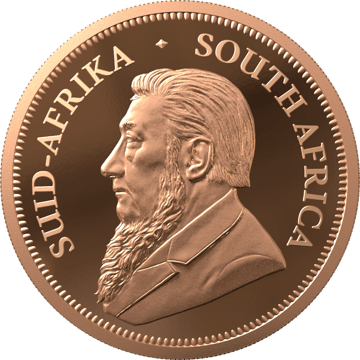
1 Ounce Gold Krugerrand 2026
£2,896.09
VAT-free and excl. shipping
Available in 2–3 business days

 More than 310,000
 Over 30 years
 Secure shipping
 Google: 4.9/5
The Krugerrand coins are the best-selling coins in the world and have been experiencing a strong surge in new interest in recent years due to financial uncertainty. The gold and silver coins of the Krugerrand impress with excellent minting quality. The Krugerrand is also available as a gold and silver coin in many limited special editions.


This is how the coins compare in size. In gold, the 1/10, 1/4, 1/2 and 1 ounce come as bullion coins and in proof, and the 2 ounces in proof. The South African Mint issues the 1/20 and the 1/50 ounce only in its sets. The 5 and 50 ounce coins are special issues.
The silver ounce is larger than the gold ounce: 38.725 compared with 32.69 millimetres.
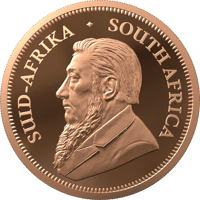
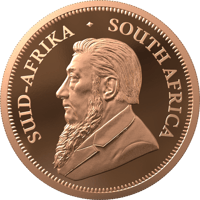
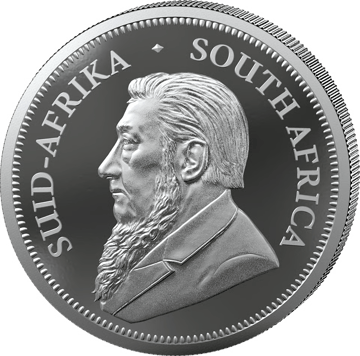
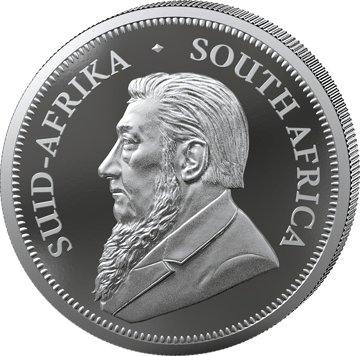
Shown: the portrait sides of the 2026 proof coins and of the 50 ounce coin from 2017. Dimensions according to the South African Mint and the Government Gazette of the Republic of South Africa.
All three measure 32.69 millimetres. They differ in finish and in mintage.
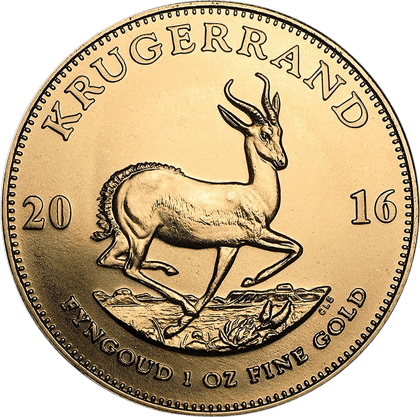
Struck without a fixed mintage, for investors.
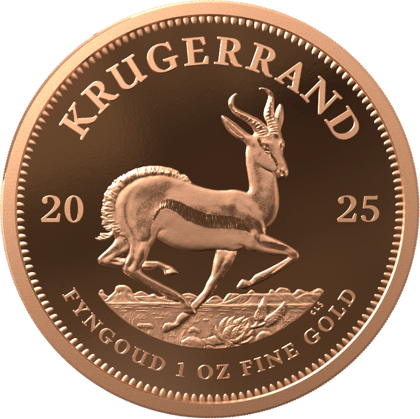
Matte design on a mirror field, in limited mintage and with a certificate of authenticity.
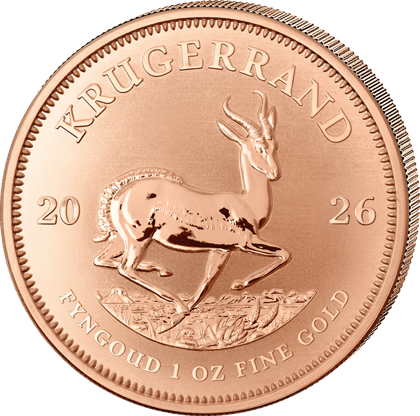
Polished design on a matte field, the inverse of proof. Since 2024.
Both weigh 67.86 grams. The Piedfort has the diameter of the 1 ounce coin and is twice as thick. The wide version has existed since 2018, the Piedfort since 2024.
The South African Mint’s sets build on one another. Each step adds the next larger coin, until all seven sizes come together.
The coins in these sets are struck in proof.
Some issues bear an additional small mark, the Privy Mark. It sits above the springbok’s back. Issues with a Privy Mark usually appear in their own small mintages.
Each of these issues has its own occasion, its own mark or a special finish. All of them are listed here in the category.
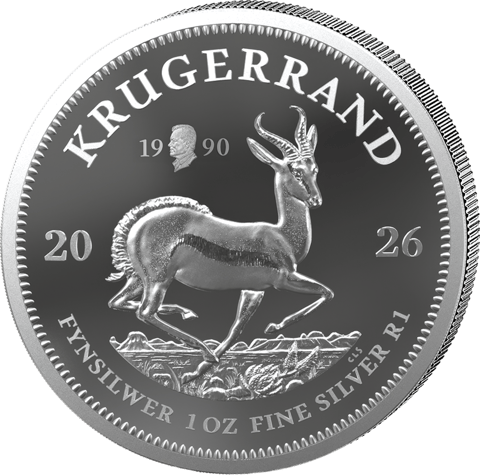 Kettner edition2026Gold and silverWilly BrandtThe Privy Mark above the springbok shows the portrait of Willy Brandt between the numerals 19 and 90. It recalls 1990, the year in which Nelson Mandela was released and Germany was reunited.
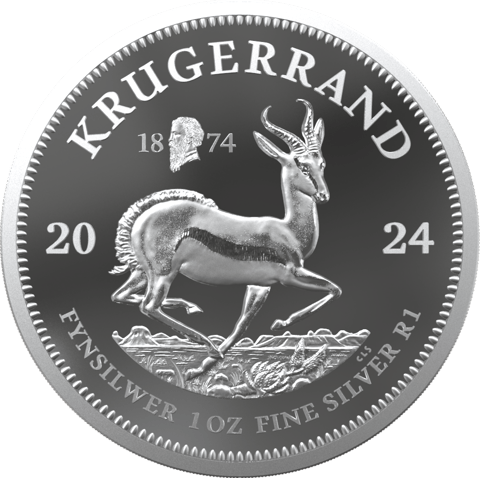 Kettner edition2024Gold and silverBurgers PondThe Privy Mark above the springbok shows President Burgers between the numerals 18 and 74, based on his likeness on the Burgers Pond of 1874. Of this first gold coin made from South African gold, 837 pieces were struck.
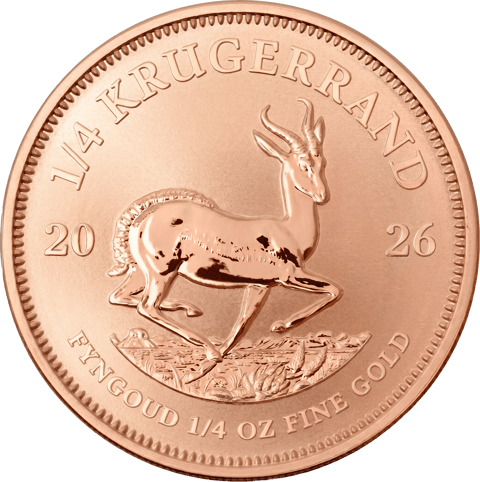 2024 to 2026Gold1/10 to 1 ounce and setsReverse Proof in six sizesUntil 2025, the Reverse Proof in gold was only available as a 1 ounce coin, and in 2026 the 1/10, 1/4 and 1/2 ounce were added. The sets also contain the 1/20 and the 1/50 ounce in this finish, with up to six coins in one case.
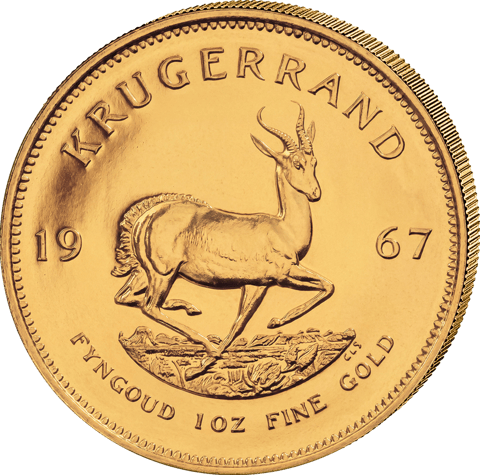 1967Gold1 ounceDated 1967On 3 July 1967, the South African Mint struck the first Krugerrand, at that time only as a 1 ounce coin. This ounce bears the year 1967 and comes in a case with a South African Mint paper sleeve.
More on the history of the coin: The Krugerrand saga
In January, the South African Mint switches the bullion coin dies to the new year.
For bullion coins without a year in their name, for example with the suffix “various years” or “assorted years”, the year of minting is not specified. You can find a particular year with the “Year of minting” filter.
Hardly any gold coin tells such an eventful story as the Krugerrand. Since its first minting on 3 July 1967, it has risen from a bold experiment by the South African Mint to become the best-selling gold coin in the world, a classic that even laypeople recognise at a glance. This guide takes you through its history, denominations, authenticity features, tax treatment and the fascinating world of enhanced special editions that make collectors' hearts beat faster today.
The Krugerrand was the first modern bullion gold coin ever, launched in 1967, and it remained without competition for over a decade. Only afterwards did coins such as the Canadian Maple Leaf or the Austrian Vienna Philharmonic follow. This pioneering role has become deeply ingrained in investors' minds: whoever thinks of a gold coin thinks of the springbok on reddish shimmering gold. To date, well over 60 million troy ounces have been minted, making the Krugerrand the most fungible gold coin in its class.
A major appeal lies in the price: the Krugerrand trades at close to pure material value. The premium over the gold price is comparatively low, and dealers and banks worldwide buy the coin back close to the spot price. Anyone wanting to invest more broadly in physical precious metal will find numerous related options in the range of bullion coins as well as among the classic gold coins.
The name is made up of two components: Kruger and Rand. The portrait shows Paul Kruger, the last president of the South African Transvaal Republic and the namesake of Kruger National Park. The Rand, in turn, has been South Africa's official currency since 1961. The striking portrait is based on a design by the German engraver Otto Schultz from 1892, a historical detail that makes the Krugerrand incomparable to almost any other bullion coin.
Internationally, the coin is traded as the Krugerrand; only in German-speaking countries has the spelling with an umlaut become established. During the years of the apartheid boycotts between 1986 and 1999, circulation dropped drastically: in 1992, only around 1,100 gold coins were minted. These particular years are highly sought after today. Anyone fascinated by this historical depth will find further historically significant coins among the collector's coins.
The gold blanks are produced at the Rand Refinery in Germiston, South Africa, while the actual minting is carried out by the South African Mint in Pretoria. Kettner Edelmetalle is the official German partner of the South African Mint, which means the coins can be sourced directly from the origin. Anyone specifically looking for products from these mints will find what they need in the manufacturer overviews for Rand Refinery and South African Mint.
The obverse has shown the portrait of Paul Kruger unchanged since 1967. The reverse bears South Africa's national animal, the springbok, a slender antelope found in the semi-desert landscape of the Karoo, designed by sculptor Coert Steynberg, whose initials CLS can be found discreetly next to the animal. The design is complemented by the weight unit, the year of minting and the inscriptions FYNGOUD and FINE GOLD.
The characteristic reddish hue is no accident but by design: the Krugerrand consists of a gold-copper alloy with a fineness of 22 carats. This blend makes the coin exceptionally robust and scratch-resistant, a practical advantage over more delicate 999 fine coins.
A Krugerrand is not merely owned, it is recognised: its springbok on reddish gold is one of the most famous images in the precious metals world.

In its first year, 1967, the Krugerrand was issued exclusively as a 1 oz gold coin. Since 1980, three smaller units have supplemented the range, making it possible to get started with a smaller budget too. Despite the 22 carats, each coin contains exactly the stated amount of fine gold; the added copper merely increases the total weight.
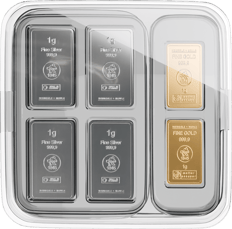
The smaller denominations are somewhat more expensive per gram to purchase, but easier to sell and divide. Anyone who prefers to add gold in bar form will find a wide selection among the gold bars, such as the handy 1 g gold bar or the solid 100 g gold bar. Silver and platinum versions of the Krugerrand are available exclusively in 1 oz with a fineness of 999, available in the range of the silver Krugerrand and the platinum Krugerrand.
Alongside the classic bullion piece, a whole world of strictly limited, premium enhanced editions has developed around the Krugerrand. These coins are aimed at collectors seeking more than pure weight: they combine precious metal with craftsmanship, low mintages and a case along with a certificate. The range of these rarities can be explored compactly in the category Limited enhanced sets as well as on the series page for the Krugerrand.
In the Proof minting quality, the design and springbok appear frosted against a deep black mirrored background, an effect that emphasises every detail. Modern reverse proof versions reverse this interplay, creating new design accents. Mintages of often only a few hundred pieces make these coins highly sought-after collector's items.
Among the most impressive enhanced editions are the heavy 2 oz Krugerrand in Proof quality as well as the particularly thick piedfort coins, which carry twice as much gold at the same diameter. The field is further complemented by special editions with a privy mark, for example to mark the anniversary 200 Years of Paul Kruger or the Burgers Pond design series. These editions appear in mintages of sometimes only 100 to 200 pieces.
Particularly sought after are the fractional sets, which combine several denominations in Proof quality in an elegant box, as well as the extensive prestige sets with up to seven coins. Such sets are often presented in polished wood and come with a numbered certificate documenting the low mintage. A selection of these bundled treasures can be found in the category Limited enhanced sets.
Because the Krugerrand is so widely circulated, counterfeits and misleading restrikes are also in circulation. Since the minting year 2017, the coin has carried a micro-inscription reading "Krugerrand" below the springbok, an effective feature against imitations. The following checks help with authenticity verification:
Kettner Edelmetalle relies on ISO-compliant authenticity verification, so every coin is checked before shipping. For subsequent safe storage, suitable accessories are recommended, such as protective coin capsules or elegant coin cases. Caution is also advised with the Malawi Springbok: this silver coin, issued since 2010, closely resembles the Krugerrand but features a mirrored springbok and the inscription "Silver Investment Coin".
The gold Krugerrand is classified as investment gold in Germany and, under § 25c UStG, is VAT-exempt on purchase, a key advantage over many other tangible assets. If the coin is sold after a holding period of more than one year, the gain is currently exempt from income tax under current law. Different rules apply to the silver and platinum Krugerrand, as these are subject to VAT. On the secondary market, gold coins are often traded between banks as mixed years, which allows entry at attractive conditions.
Tax notice
Investment gold such as the gold Krugerrand is exempt from VAT on purchase. This information does not replace tax advice; the individual treatment should be clarified with a tax advisor.
When it comes to storage, investors can choose between home storage in a safe, a bank safe deposit box or specialised custody solutions. Adequate insurance is essential. The market value is determined almost exclusively by the current gold price, which is influenced by factors such as inflation, interest rate levels and geopolitical tensions. Anyone using gold specifically as an inflation hedge or for retirement provision particularly values the high liquidity of the Krugerrand when it comes to selling later.
In direct comparison, the Krugerrand scores with its robustness and broad market acceptance. Unlike the Maple Leaf made of 999.9 fine gold or the Vienna Philharmonic, it deliberately relies on the scratch-resistant copper alloy. Anyone who prefers smaller value units often compares it with classics such as the Vreneli or the Sovereign. What they all have in common is their status as globally tradeable investment gold; the choice is ultimately a matter of taste, denomination and desired fungibility.
A 1 oz Krugerrand contains exactly 31.103 g of fine gold. Due to the added copper, however, the total weight is 33.93 g, with a fineness of 916.67/1,000 (22 carats).
The Krugerrand was the first modern bullion gold coin and consists of a 22-carat gold-copper alloy. This makes it particularly robust and gives it its typical reddish hue, whereas coins such as the Maple Leaf or the Vienna Philharmonic are struck from pure 999 fine gold.
These are strictly limited collector's editions. Proof refers to a minting quality with a mirrored background and a frosted design. Piedfort coins are twice as thick at the same diameter and accordingly contain more gold. These editions are often minted in quantities of only 100 to 200 pieces and are supplied with a case and certificate.
The gold Krugerrand is classified as investment gold and is exempt from VAT on purchase. If it is sold after a holding period of more than one year, the capital gain is currently tax-free under current law. The silver and platinum Krugerrand are subject to different rules. Individual advice from a tax advisor is recommended.
It helps to check the weight and dimensions, perform a magnet test (genuine gold is not magnetic) and inspect the fine details of the strike under a magnifying glass. Since 2017, every coin has also carried a micro-inscription below the springbok as an additional security feature.
The gold Krugerrand is available in four sizes: 1 oz, 1/2 oz, 1/4 oz and 1/10 oz. The 1 oz variant is the most widely available, while the smaller denominations offer a more affordable entry point and better divisibility. The silver and platinum Krugerrand are minted exclusively as 1 oz coins.
Stay informed with product launches, financial news and exclusive offers. Sign up for our free newsletter today.
By entering your email address and clicking the "Submit" button, you give the following consent: "I agree to be informed by email about new products, financial news and exclusive offers, and therefore consent to the processing of my email address for the purpose of sending the newsletter. I can revoke this consent at any time without giving reasons, with effect for the future. The lawfulness of processing carried out prior to revocation remains unaffected."