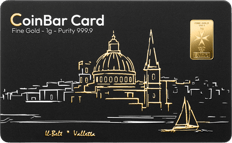
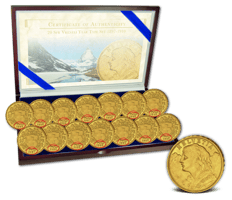
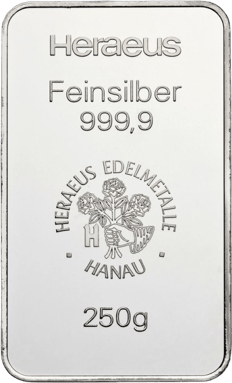
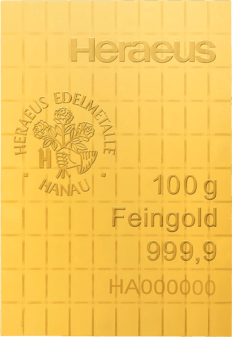
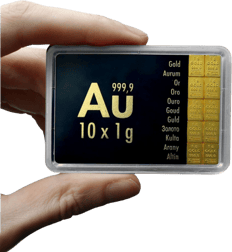
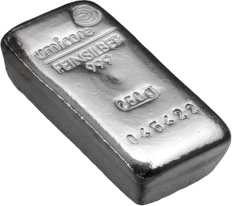
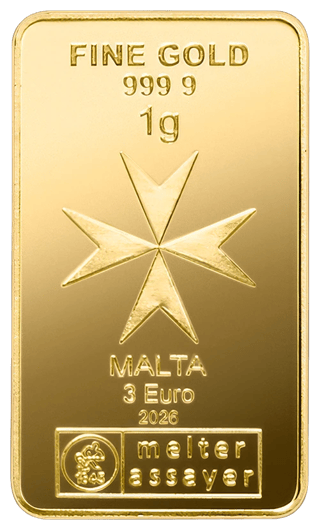
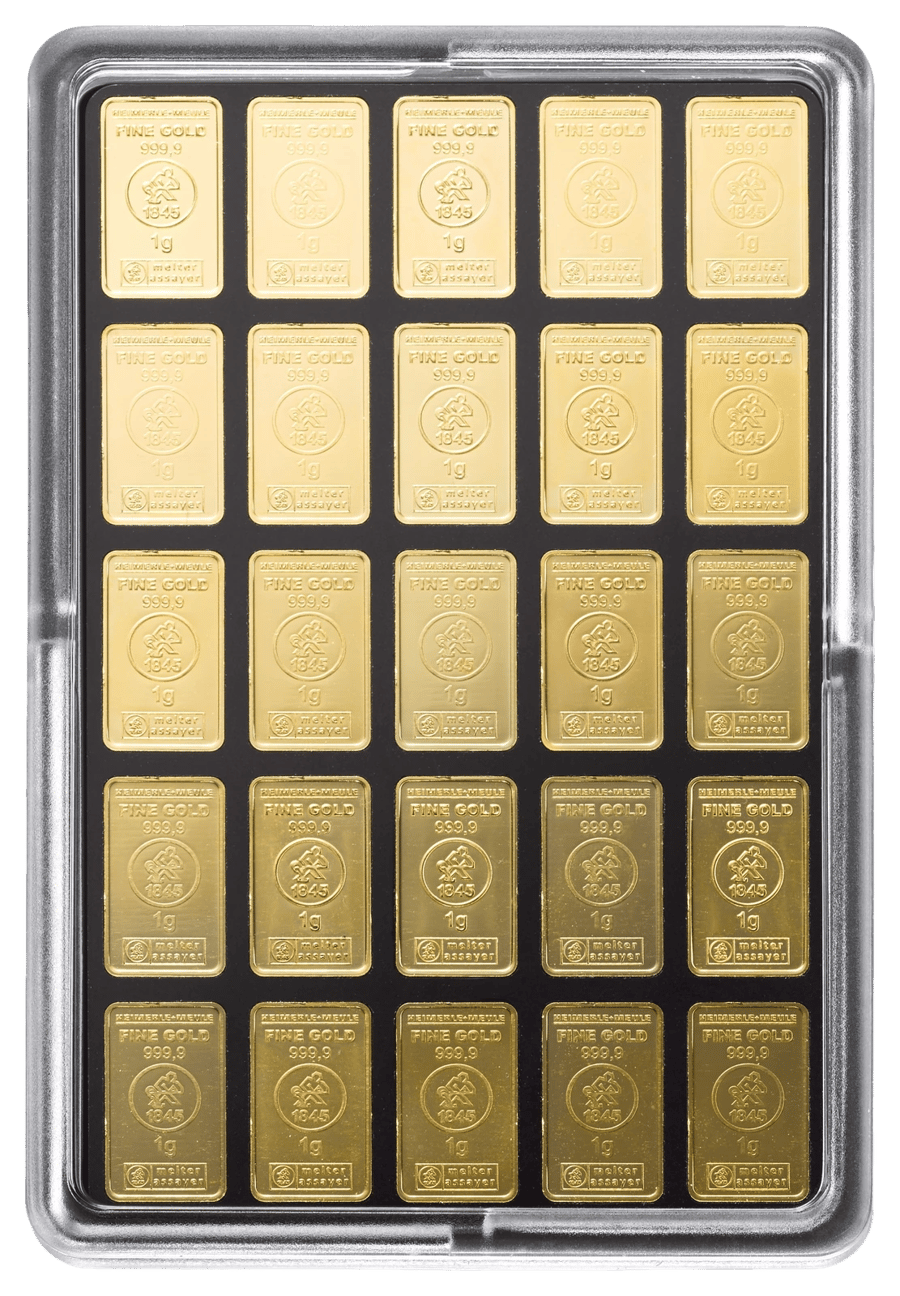
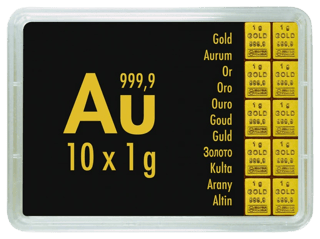
25 x 1g Gold Bar Heimerle und Meule UnityBar
£2,705.13£2,747.04
VAT-free and excl. shipping
Available in 3–4 business days

 More than 310,000
 Over 30 years
 Secure shipping
 Google: 4.9/5
Every year, your money loses value. Just a few years ago, you could do a week's worth of grocery shopping for €70, and now the purchasing power of your money has declined significantly. To prevent your savings from losing further value, you should protect them by investing in value-preserving products such as gold and silver as an inflation hedge.


The Deutsche Bundesbank works out how many euros it took in 2025 to buy what 100 D‑Marks used to buy.
The Bundesbank’s table shows how many euros, on average in 2025, had the same purchasing power as one D‑Mark or one euro of an earlier year. It is based on the official price indices for the standard of living, and since 1994 on the consumer price index. Below, choose a year between 1950 and 2025.
Purchasing power asks a different question from the fixed conversion rate: what the money bought.
In 2025, what 100 D‑Marks bought in 1975 cost about
161 euros
At the fixed conversion rate: 100 D‑Marks = 51.13 euros
Calculation by the Deutsche Bundesbank, as of January 2026. The Bundesbank considers comparisons that start in the years up to 1948 to be of little informative value; the selection here starts in 1950.
How long it takes for prices to double depends on how much they rise each year.
“In the view of the ECB’s Governing Council, price stability is best maintained by aiming for an inflation rate (measured by the HICP) of 2 per cent in the euro area over the medium term.”
Why not zero? The Bundesbank cites, among other things, measurement errors in the statistics and a safety margin against deflation, that is, against falling prices.
Calculated with a rate of inflation that stays the same year after year.
Each increase builds on prices that have already risen. That is why, at 2 per cent a year, prices take not 50 years to double but 35.
Approximate: calculated from the annual averages of the price indices of the Federal Statistical Office (Destatis; up to 1991 price indices for the standard of living, then the consumer price index). The series changes in 1962/63 and 1991/92.
Between 1920 and 1975, five countries took the silver out of their circulation coins, each in its own time and often in stages.
31 March 1920Coinage Act 1920
500/1,000 silver, not 925/1,000
6 November 1946Coinage Act 1946
Cupronickel, not 500/1,000 silver
three quarters copper, a quarter nickel
23 July 1965Public Law 89‑81
Dime and quarter without silver, previously 900/1,000
Half dollar: 4.6 g silver in 11.5 g, calculated as 40 per cent
1968Swissmint
Cupronickel, not 835/1,000 silver
½ to 5 francs; the five‑franc coin of 1969 once again in silver
1 April 1971Swissmint
Silver coins demonetised
extended to 31 March 1972
15 January 1969BGBl. Nr. 439/1968
5 schillings in cupronickel instead of 640/1,000 silver
4.8 g instead of 5.2 g
17 April 1974BGBl. Nr. 174/1974
10 schillings: cupronickel with a pure nickel core, not 640/1,000 silver
6.2 g instead of 7.5 g
1 February 1975Deutsche Bundesbank
5 D‑Marks in Magnimat instead of 625/1,000 silver
10.00 g instead of 11.20 g; the silver coin no longer in circulation since 1 August 1975
Diameters to the same scale
Diameters as given by the Deutsche Bundesbank and the Oesterreichische Nationalbank.
The sources name no common cause. In Great Britain, it paid for a short time in 1920 to melt down the coins, as the Chancellor of the Exchequer recalled in 1946. In Switzerland, the silver value of the ½, 1 and 2‑franc coins exceeded their face value, and the coins were melted down, Swissmint writes.
For 1946, the Chancellor of the Exchequer gave other reasons. For the USA, President Johnson cited the shortage of silver in 1965; for Germany, the Bundesbank cites the sharp rise in the price of silver. For Austria, the catalogue of the Oesterreichische Nationalbank gives no reason.
Under Augustus, the Roman denarius was practically pure silver. The last antoniniani under Gallienus contained less than 5 per cent.
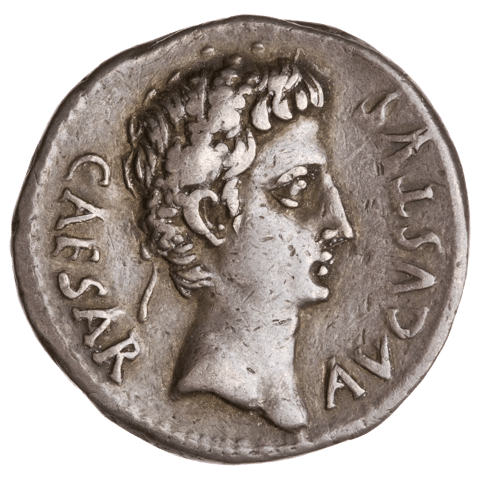
c. 99 per cent
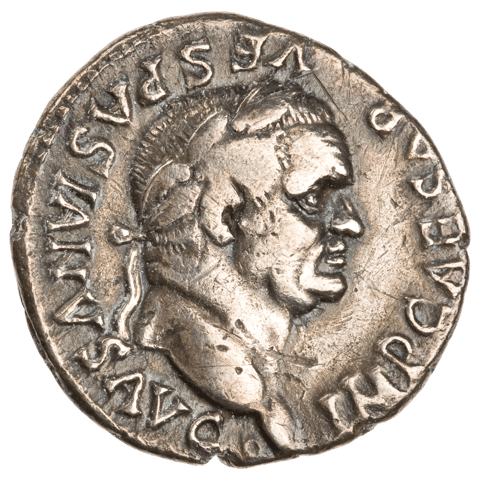
c. 80 to 90 per cent
82 briefly pure silver
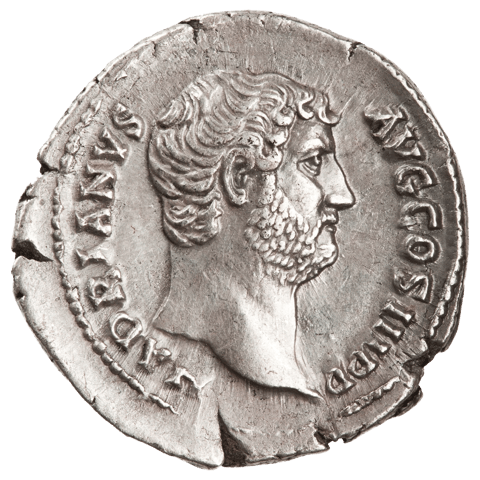
c. 76 to 90 per cent
under Trajan, c. 100, about 80 again
under Hadrian, about 76 on average
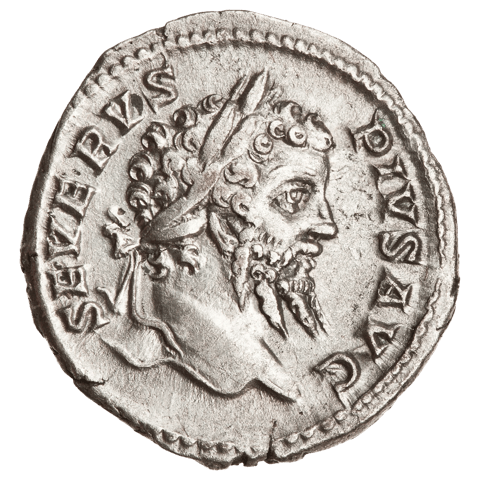
from c. 75 to below 50 per cent
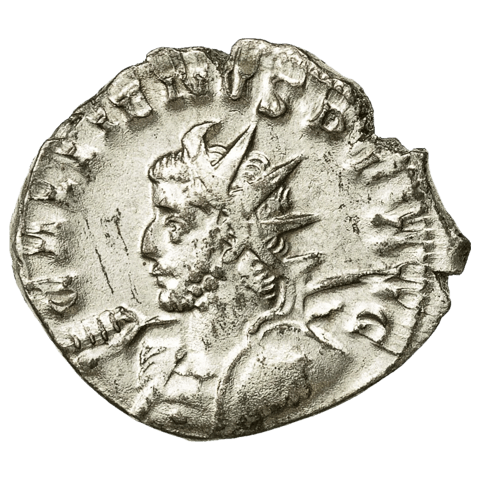
until c. 250, c. 40 to 50 per cent
in the last issues under Gallienus below 5 per cent
The figures come from analyses of the metal inside the coins, mostly from drilled samples; surface measurements read too high. For the denarii, they apply to the mints of Rome and Lyon. Even the coins of a single emperor vary by more than ten percentage points, which is why ranges are shown here. The photos each show one example from the period of the stage.
The path did not run straight downhill. In 64, Nero lowered the silver content to about 80 per cent, and around 68 he raised it again to about 90. In 82, Domitian briefly had pure silver struck again. Butcher and Ponting read it like this: the emperors raised the content again whenever they could.
The antoninianus was added in 214/215 under Caracalla and was worth two denarii.

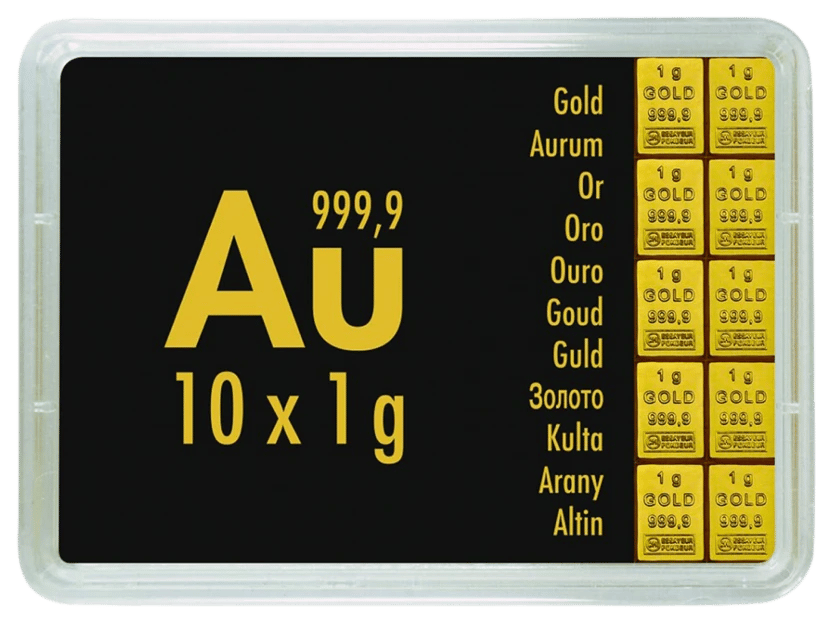
About 222,600 tonnes of gold had been mined by mid‑2026, as estimated by the World Gold Council. That is about 60 years’ worth of mine production.
Measured against the production of 2025: in that year, 3,672 tonnes came from the world’s mines. Almost all the gold ever mined still exists.
So each year adds about 1.5 to 1.6 per cent: production in 2025 divided by the stock, our own calculation with the 3,672 tonnes of the World Gold Council and the estimated 3,300 tonnes of the U.S. Geological Survey.
Every year, savings lose a little more of their purchasing power. What covered a full week's shopping just a few years ago buys noticeably less today. This is exactly where the idea of inflation hedge comes in: structuring wealth so that the creeping devaluation of money cannot erode it. Precious metals such as gold and silver have played a central role in this for thousands of years, as tangible assets that cannot simply be multiplied at will. This guide explains how inflation arises, why it affects everyone, and which forms of investment can realistically protect capital.
Inflation hedge refers to measures that protect one's own wealth from the loss of value caused by rising prices. Cash and balances in a bank account are left defenceless against this loss: if purchasing power falls, their real value shrinks one to one. Tangible assets behave differently. They are tied to real goods and thereby decouple from the pure money supply. Precious metals in particular are considered a proven building block, because they are traded worldwide, can be physically owned, and cannot become subject to insolvency.
A realistic expectation is important here: there is no such thing as one hundred percent protection. Gold, silver, platinum and palladium fluctuate in price and do not follow every wave of inflation in lockstep. Over long periods, however, they have kept their purchasing power remarkably stable, while paper currencies have historically lost value again and again. Anyone approaching this topic should first understand how inflation actually works. The topic pages on value appreciation and retirement planning also offer a deeper introduction.
Prices for goods and services are dynamic and constantly changing. When a general rise in prices occurs over a longer period, economics refers to this as inflation. The consequence: 100 euros buy less than before, the money is worth less in real terms. This effect is measured using a basket of around 750 representative goods, which reflects the consumption habits of an average family. Since this basket of goods varies from country to country, the inflation rate also differs regionally.
Moderate inflation driven by the economy typically arises in three ways:
A low inflation rate of around 2 percent is considered a healthy norm in Germany: it encourages willingness to spend and steady economic growth. Problems arise when prices rise significantly faster than wages. Then existing wealth erodes, building new wealth becomes more difficult, and the middle class bears the main burden.
Depending on the pace, different levels are distinguished. Creeping inflation, with rates below five percent a year, is the norm in industrialised countries. If the cycle of rising prices and catching-up wages spirals out of control, hyperinflation threatens: a self-accelerating downward spiral that can paralyse entire economies. Historical examples such as Hungary after 1945 or Zimbabwe between 2006 and 2009 show how a currency can become practically worthless in the process.
Money is only worth what it can buy; tangible assets, by contrast, retain their intrinsic value across generations.
A central tool for regulating currency devaluation is the key interest rate. When a central bank lowers the rate, banks can borrow money more cheaply, the money supply in circulation increases, and inflation tends to be fuelled. A higher key interest rate makes loans more expensive, slows the money supply, and thereby dampens the rise in prices. This mechanism explains why periods of low interest rates are particularly tricky for savers: if the interest paid on balances is below the inflation rate, money loses real value even though the nominal amount stays the same.
Especially during such low-interest phases, investors look for alternatives that do not depend on the monetary policy of individual states. Bullion coins and gold bars are independent of interest rate decisions and national currencies, one reason why physical precious metals are regularly in stronger demand in uncertain times.
Gold is popularly regarded as the classic inflation hedge par excellence. However, this statement is only true with one important caveat. In the short term, the gold price often moves independently of current inflation developments and does not immediately offset every price increase. Its true strength lies in its long-term performance: over decades and centuries, gold has preserved its purchasing power, while countless paper currencies have disappeared.
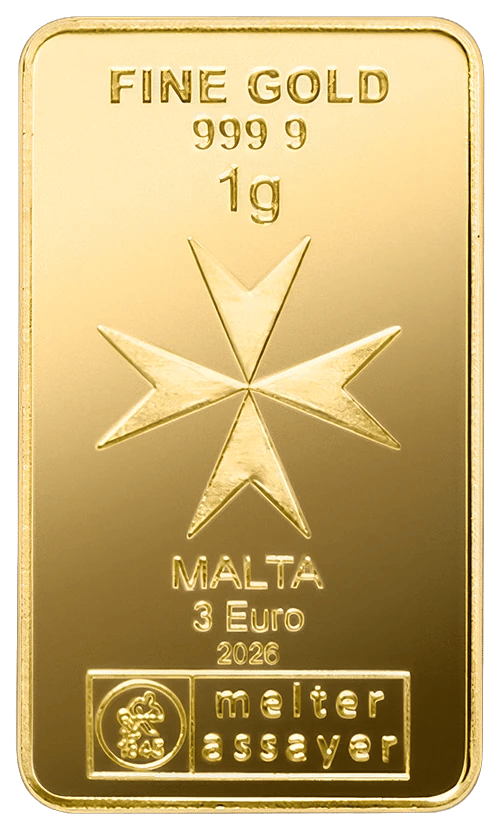
The reason is scarcity. Gold cannot be multiplied at will, it is traded worldwide, and as a universal store of value it enjoys high trust. Independent of inflation in any single country, it remains at a high price level internationally and can be sold at any time. This makes gold less a tool for short-term compensation and more a stable cornerstone for inflation-proof portfolios. Anyone wanting to start small will find a flexible way to build up holdings step by step in denominations such as the 1-gram gold bar or the 10-gram gold bar.
Tax note
In Germany, investment gold is exempt from VAT pursuant to §25c UStG. Profits from the sale of physical gold are tax-free after a holding period of one year. Different rules apply to silver, platinum and palladium products, this note does not replace individual tax advice.
Besides gold, other precious metals come into focus when it comes to tangible-asset diversification. Silver is significantly cheaper per gram and therefore easier to acquire in small steps. It is both an industrial metal and a store of value, which leads to stronger price fluctuations, both an opportunity and a risk. Popular entry-level formats are silver coins and silver bars.
Platinum and palladium are mostly consumed by industry, for example in catalytic converter technology. Their prices therefore depend heavily on the economic cycle and growth, and behave differently from gold. Anyone wanting broad diversification combines several metals to offset individual fluctuations. Ranges such as platinum coins or palladium coins extend a precious metals portfolio specifically beyond gold and silver.
Inflation hedging is always a question of the overall portfolio. Besides precious metals, other asset classes are traditionally used, each with its own strengths and weaknesses.
As a tangible asset, equities are not directly affected by the loss of monetary value, but they react sensitively to inflation developments and interest rate policy. A broadly diversified portfolio of domestic and international stocks can offset inflation in the long run, but is subject to significant price fluctuations.
Property as a capital investment tends to benefit from rising prices, but is not very liquid and requires a large capital outlay. Owner-occupied residential property, on the other hand, offers little inflation protection, since running costs rise too.
Inflation-linked bonds tie their repayment to the rate of inflation, but generally offer lower yields in return. Traditional savings accounts and fixed-term deposits offer no protection: in periods of low interest rates, the loss of value takes hold almost unchecked. A balanced asset allocation therefore spreads capital across several building blocks. Anyone wanting to build up holdings systematically and in small instalments will find a practical entry point in savings plan products, while bundled investor packages are suitable for larger sums.
The advantage of physical precious metals, their tangible real value, comes with a responsibility: secure storage. In principle, there are three options, which can also be combined.
For storage at home, suitable accessories are recommended: coin capsules protect sensitive surfaces from scratches and tarnishing, coin cases keep collections organised. Kettner Edelmetalle always ships its goods 100 % insured and carries out an ISO-compliant authenticity verification, so that the origin of each piece remains traceable.
There is no single investment that guarantees absolute protection. Instead, a well-thought-out mix has proven effective. The following structure is often used as a guide:
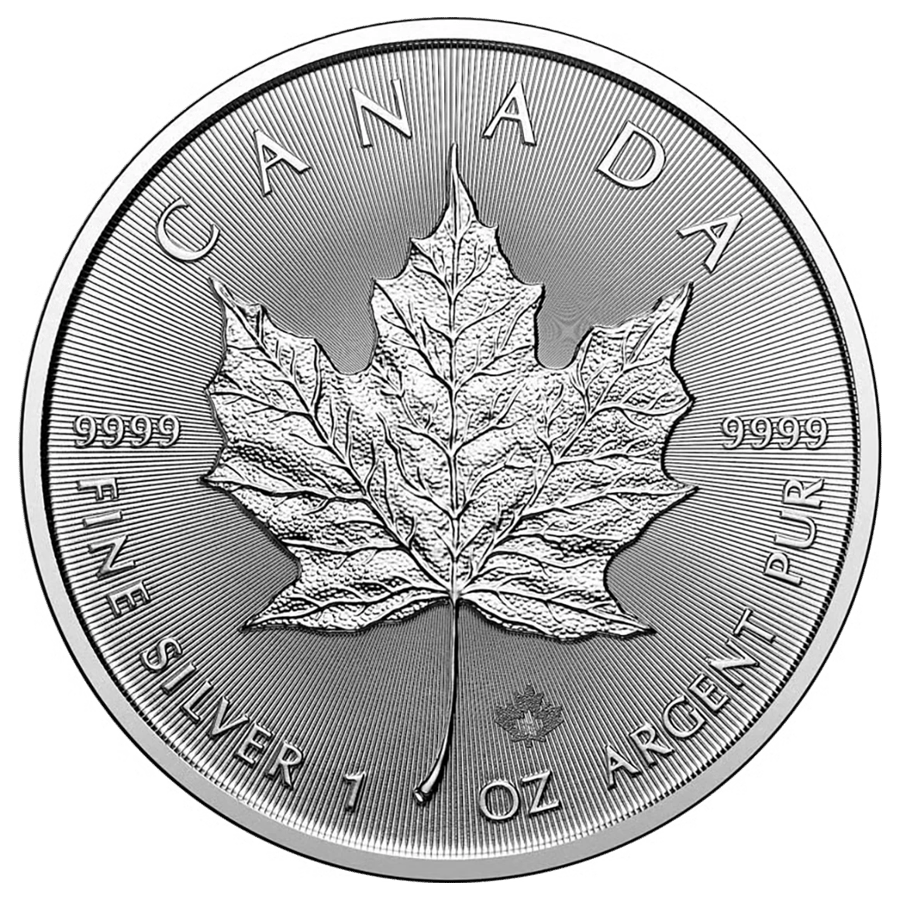
For a quick entry into tangible assets, ready-made crisis protection packages are just as suitable as individual gold bullion coins, such as the globally traded Krugerrand or the Maple Leaf. What matters is not the perfect entry point in time, but a crisis-resistant holding built up over time. Collector's items such as collector's coins can also be added to the mix, though they require specialist knowledge to achieve a fair selling price quickly if needed.
Inflation hedge refers to all measures that protect one's own wealth from a loss of value caused by rising prices. Since cash and bank balances are unprotected against currency devaluation, many investors rely on tangible assets such as precious metals, equities or property, whose value is not tied one to one to the purchasing power of money.
Gold does not always immediately offset short-term price increases, but has kept its purchasing power remarkably stable over long periods. As a scarce, globally traded precious metal, it is therefore considered a long-term anchor of an inflation-proof portfolio, rather than a short-term compensating instrument.
An annual inflation rate of around 2 percent is considered a healthy norm in Germany. It encourages willingness to spend and supports economic growth. Only significantly higher rates, at which prices rise faster than wages, are considered problematic.
Yes, as a complement for diversification. Silver is cheaper and therefore easier to acquire in small steps, but fluctuates more strongly. Platinum and palladium are mainly industrial metals and depend on the economic cycle. Combining several precious metals can offset individual price fluctuations.
Both are tangible assets and are not directly affected by the loss of monetary value. However, equities react sensitively to interest rate and inflation movements, while property is not very liquid and capital-intensive. The most effective approach is a broadly diversified portfolio that combines precious metals, productive assets and, where appropriate, property.
No. If the interest paid on a savings account or fixed-term deposit is below the inflation rate, the balance loses real value, even if the nominal amount stays the same. In periods of low interest rates, this loss of value takes hold almost unchecked, which is why complementary tangible assets are advisable.
Stay informed with product launches, financial news and exclusive offers. Sign up for our free newsletter today.
By entering your email address and clicking the "Submit" button, you give the following consent: "I agree to be informed by email about new products, financial news and exclusive offers, and therefore consent to the processing of my email address for the purpose of sending the newsletter. I can revoke this consent at any time without giving reasons, with effect for the future. The lawfulness of processing carried out prior to revocation remains unaffected."