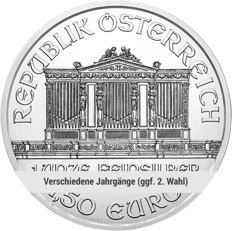
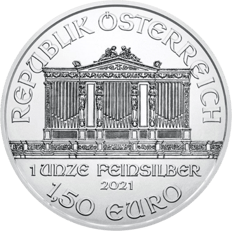
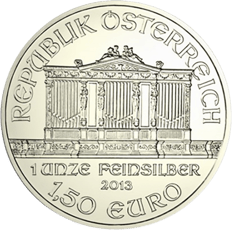
1 Ounce Silver Vienna Philharmonic 2026
£50.12
excl. UK import VAT and shipping
Ships from 27/11/2026
 +49 7930-2699
 More than 310,000
 Over 30 years
 Secure shipping
 Google: 4.9/5


The face value of €1.50 represents a very special format among modern euro commemorative and bullion coins: the 1 oz silver coin with official legal tender status. The best-known representative of this category is the Austrian Vienna Philharmonic in silver, which has been issued with exactly this face value since 2008. This guide explains why a silver coin with a material value well above €50 carries a face value of only €1.50, what denominations and series exist, how authenticity can be verified, and what to bear in mind regarding tax, storage and purchase.
The face value of a bullion coin is the amount at which it is officially recognised as legal tender; it deliberately has nothing to do with the actual material value. For 1 oz of silver (31.103 grams of fine silver), the pure metal value, depending on the silver price, is many times higher than the €1.50 stamped on the coin. The low face value primarily fulfils a legal function: it makes the coin a genuine legal-tender coin and thus distinguishes it from pure medals or bars.
The value of €1.50 was chosen for the Austrian 1 oz silver coin because it clearly identifies the coin as a state-guaranteed means of payment without pretending to an unrealistically high nominal value. Anyone wanting an overview of the full range of official euro coinage will find the matching face-value categories in the overview of euro commemorative coins, from €10 to €100.
With classic collector's commemorative coins, such as the German issues, the face value is roughly aligned with the issue price. For a bullion coin such as the €1.50 silver piece, things are different: here, only the fine silver content counts. The low face value signals that this is an investment product whose price follows the silver market rather than a politically determined value.
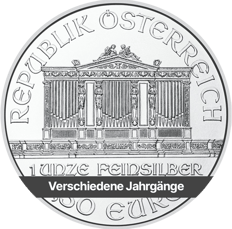
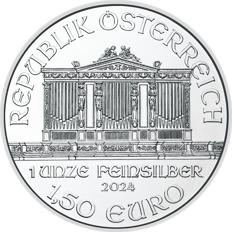
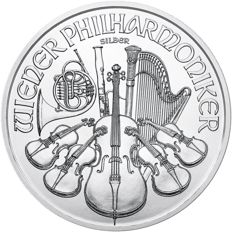
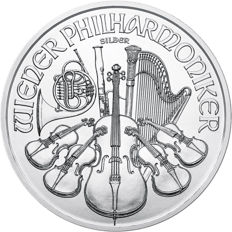
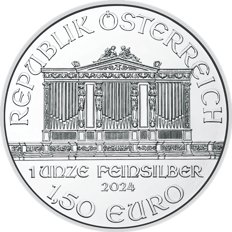
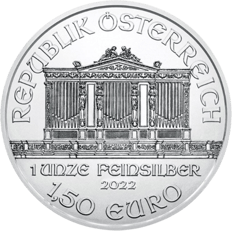
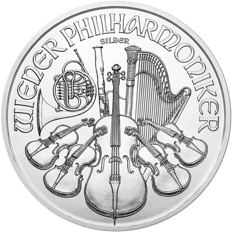
By far the most widely traded coin with a face value of €1.50 is the Vienna Philharmonic in silver from Münze Österreich. Since its introduction as a silver version in 2008, it has ranked among Europe's most popular silver bullion coins. The design shows the great organ of the Vienna Musikverein concert hall, and on the reverse a selection of classical instruments: violin, Vienna horn, bassoon, harp and cellos. Anyone wishing to view the series in full will find the complete range in the Vienna Philharmonic silver coins assortment.
The coin is struck from 999 fine silver with a weight of one troy ounce. It is issued annually with an unchanged design, with only the year changing. This continuity makes it particularly attractive to investors, as it is easily recognisable and tradeable worldwide. As an investment classic, it stands alongside other well-known silver coins such as the Canadian Maple Leaf or the Australian Koala series.
The silver Philharmonic is produced by Münze Österreich in Vienna, one of the world's most traditional mints, with a history going back to the year 1194. The high striking quality and Austria's state guarantee contribute significantly to the coin's international recognition.
Within the Philharmonic family, the face value is closely tied to the weight. The 1 oz silver coin carries €1.50, while the gold versions have different face values. An overview of the most common silver denomination and its characteristics:
Anyone preferring silver in bar form rather than as coins will find comparable fine silver products in the silver bars section. For the gold version of the same design, it is worth looking at the Vienna Philharmonic gold coins, which are issued with higher face values in euro.
The troy ounce has become established internationally as the standard tradeable unit for investment silver. It is divisible enough for gradual wealth building, yet large enough to allow a favourable premium over the pure material value when buying. For regular accumulation, structured savings plan products are also suitable, allowing a silver holding to be built up evenly over months.
Investment silver coins with a high mintage are generally a less frequent target of counterfeiting than high-priced gold coins; nevertheless, careful verification is worthwhile, particularly when buying on secondary markets. The most important verification steps at a glance:
Buying through an established specialist dealer largely eliminates this risk: Kettner Edelmetalle relies on ISO-compliant authenticity verification, so that every coin delivered meets verified standards. For the long-term storage of verified pieces, suitable coin capsules are available, protecting against scratches and environmental influences.
Unlike investment gold, which is exempt from VAT in Germany, investment silver is generally subject to VAT. For silver coins such as the €1.50 piece, the margin scheme usually applies, provided the dealer uses it. In this case, tax is calculated only on the trading margin and not on the full value of the goods, which can lower the final price compared with standard taxation.
Tax notice
Gains from the sale of physical silver coins are generally tax-free after the one-year speculation period has elapsed, in accordance with §23 EStG. This information does not replace individual tax advice; the decisive factor is each individual's personal situation.
Anyone wishing to compare the tax treatment of gold and silver will find further product categories in the silver bullion coins section as well as among the VAT-exempt gold bullion coins.
Silver coins react more sensitively to environmental influences than gold. In particular, humidity and sulphur compounds can cause a dark tarnish layer (patina) to form over the years. This does not affect the material value but can diminish the visual condition and thus the collector's value. Proper storage is therefore important.
For larger holdings, coin tubes and coin cassettes are suitable, offering both order and protection. At Kettner Edelmetalle, shipping is always 100% insured, so the coins are protected even on their way to the buyer.
Silver has been regarded as a store of value and means of payment for millennia. The modern €1.50 silver coin stands in this long tradition, while combining it with the standards of today's investment market. The silver price is subject to greater fluctuations than the gold price, as silver is additionally in demand as an industrial metal, including in electronics, photovoltaics and medical technology.
For many investors, the combination of low face value, high material value and worldwide tradeability is the reason they use silver coins of this category as an addition to a broadly diversified precious metals holding. Maple Leaf silver coins or designs from other international series are also frequently combined with them. As a purely collecting topic, collector's coins also offer numerous design-related issues.
The low face value of a silver bullion coin is not a price tag, but an authenticity stamp from the issuing state.
Several factors should be considered when purchasing in order to achieve a good price-to-value ratio:
Anyone wishing to use silver specifically as a crisis-proofing component will find curated options among the crisis protection packages. For a complete overview of all face-value categories, it is worth returning to the parent category of euro commemorative coins.
The face value serves solely to identify the coin as the legal tender of the issuing state. The actual value is determined by the fine silver content and is significantly higher. The low nominal value marks the coin as an investment product.
The Vienna Philharmonic in silver from Münze Österreich is the best-known coin with a face value of €1.50. It consists of one troy ounce of 999 fine silver and has been struck annually with an unchanged design since 2008.
Weight, diameter, a magnet test and a sound test provide reliable indications. A genuine 1 oz silver coin weighs exactly 31.103 grams and is not magnetic. When buying through a specialist dealer with ISO-compliant authenticity verification, the risk of counterfeiting is largely eliminated.
Unlike investment gold, investment silver is subject to VAT, although coins are frequently taxed under the margin scheme. Gains from private sales are generally tax-free after a one-year speculation period in accordance with §23 EStG. For binding information, individual tax advice is recommended.
A dry, temperature-stable environment in coin capsules or tubes is recommended to avoid tarnishing caused by humidity and sulphur. For larger holdings, coin cassettes and storage in a safe or bank safe-deposit box are suitable.
Buying whole tubes or master boxes generally lowers the unit price compared with individual coins, as the percentage premium over the material value decreases. Structured savings plans are also a sensible alternative for gradually building up a silver holding.
 Commemorative Coins1.50 Euro
Stay informed with product launches, financial news and exclusive offers. Sign up for our free newsletter today.
By entering your email address and clicking the “Submit” button, you give the following consent: “I agree to be informed by email about new products, financial news and exclusive offers, and therefore consent to the processing of my email address for the purpose of sending the newsletter. I can revoke this consent at any time without giving reasons, with effect for the future. The lawfulness of processing carried out prior to revocation remains unaffected.”