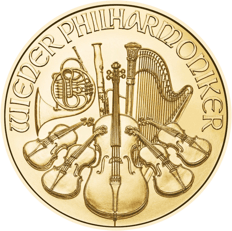
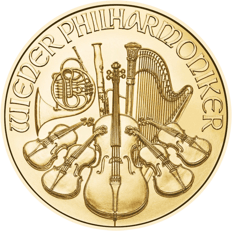
1 Ounce Gold Vienna Philharmonic
£3,140.27
VAT-free and excl. shipping
Available in 2–3 business days

 More than 300,000
 Over 30 years
 Secure shipping
 Google: 4.9/5
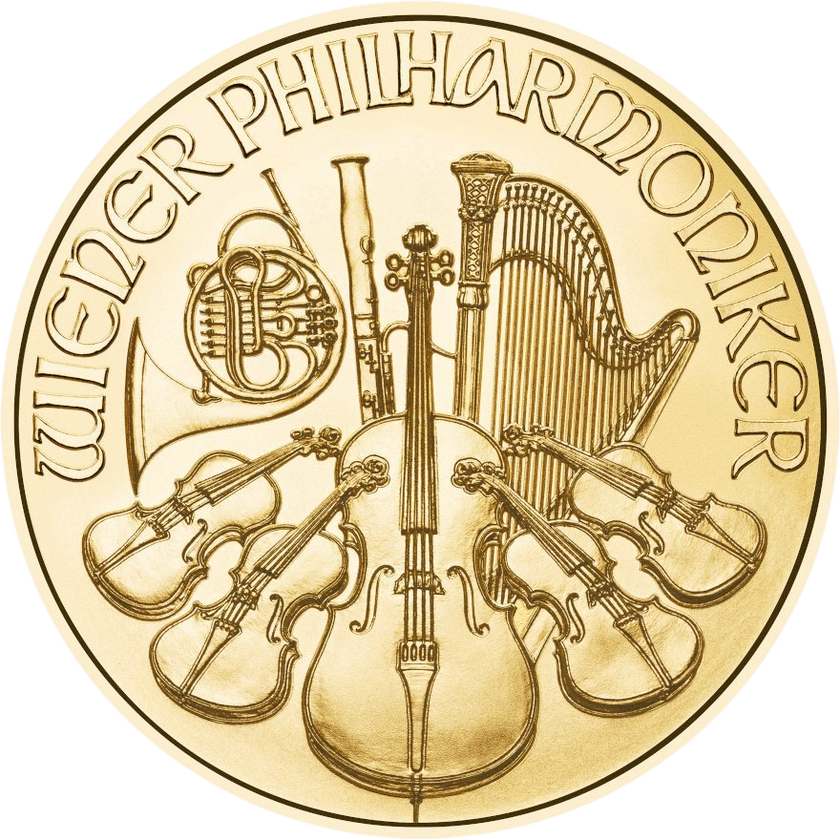
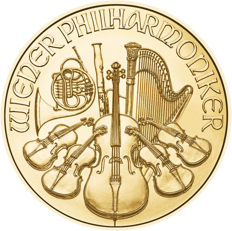
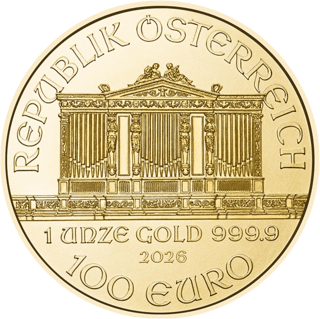
Coins have been struck in Vienna since 1194. Münze Österreich is owned by the Oesterreichische Nationalbank and has been striking the Vienna Philharmonic in gold since 1989.


Originally located near the Hoher Markt, the mint is now situated at the Heumarkt in Austria, where its production facility remains to this day. Münze Österreich AG currently produces approximately 450 million coins per year and also operates internationally as a minting institution. It also produces bars, which are manufactured in Switzerland by Argor-Heraeus. Over the years, numerous well-known coin designers have worked for Münze Österreich, including Edwin Grienauer, Hans Köttenstorfer, and Thomas Pesendorfer.


In 1193/94, the Babenbergs moved their mint from Krems to Vienna. From then on, a pfennig was struck in Vienna too; it is first mentioned in a charter in 1204. The Neue Deutsche Biographie considers it likely that the founding of the Hausgenossen of Vienna is linked to the ransom for Richard the Lionheart.
“The Hausgenossen were a body of 48 Viennese burghers to whom minting, money changing and the trade in precious metals in the Duchy of Austria were reserved.”
Wien Geschichte Wiki of the City of Vienna, article “Hausgenossen”
One figure for each of the 48 Hausgenossen. The number is given by the Wien Geschichte Wiki of the City of Vienna.
The Wiki explains the name like this: the body was regarded as part of the ruling prince’s “house” (Haus), that is, his retinue. The striking itself was the work of a craft, the moneyers. Money was changed by employed changers at benches that stood in the open air, at first on the Hoher Markt.
On 7 June 1522, Ferdinand I dissolved the body. In 1524, the mint became a state office. Until then, according to the Wiki, it had been “a domain of Vienna’s wealthy burghers”.
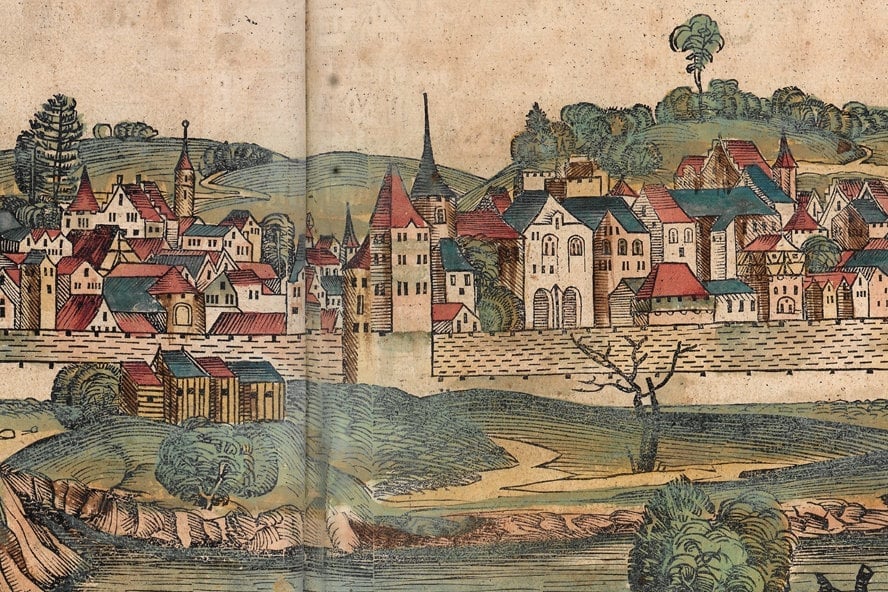
The Vienna Mint has moved many times. The Wien Geschichte Wiki of the City of Vienna lists seven addresses for it. Six lie in the Inner City, the seventh east of the Stadtpark: Am Heumarkt 1.
It started out in the Kammerhof on the Brandstätte; the Wiki says “probably”. Around 1280 it moved into the former residence at Am Hof, and in the late 14th century to the Wollzeile. It stayed there longest, until 1752 according to the Wiki’s list. In 1753, Maria Theresa moved it to the Himmelpfortgasse, to the Winter Palace of Prince Eugene.
There are also two secondary addresses: the Schlagstube in the Landskrongasse, where the moneyers struck the coins, and, from 1621 to 1625, a second mint in the Schenkenstraße.
Years according to the list in the Wien Geschichte Wiki; other sources sometimes give different ones. The bars show the length of the stay, and the positions of the dots are simplified.
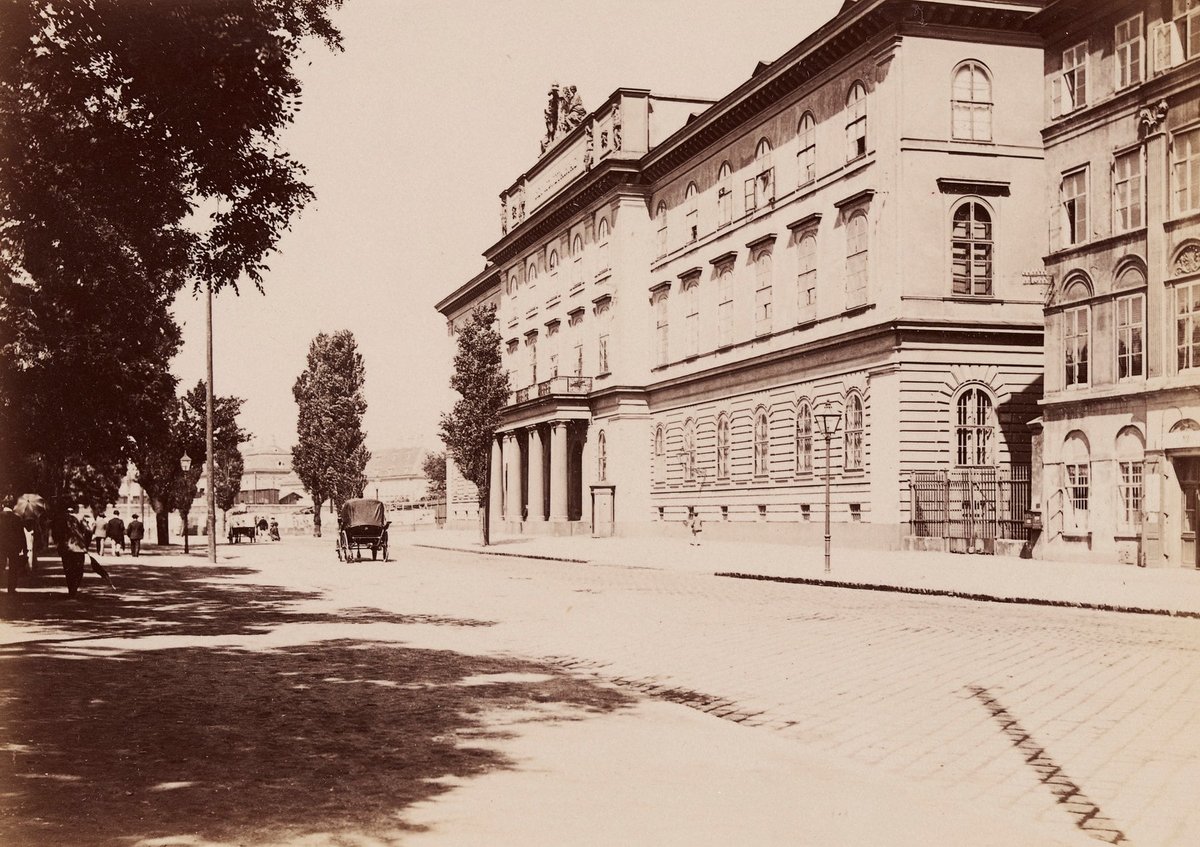
At the end of the line stands the building at Am Heumarkt 1. It is a protected monument. At the top, above the centre of the façade, stand four figures by Joseph Klieber: Hermes, Apollo, Artemis and Aphrodite. They embody the coinage metals zinc, gold, silver and copper.
“The magnificent building is still a place of production and administration.”
Münze Österreich, company history
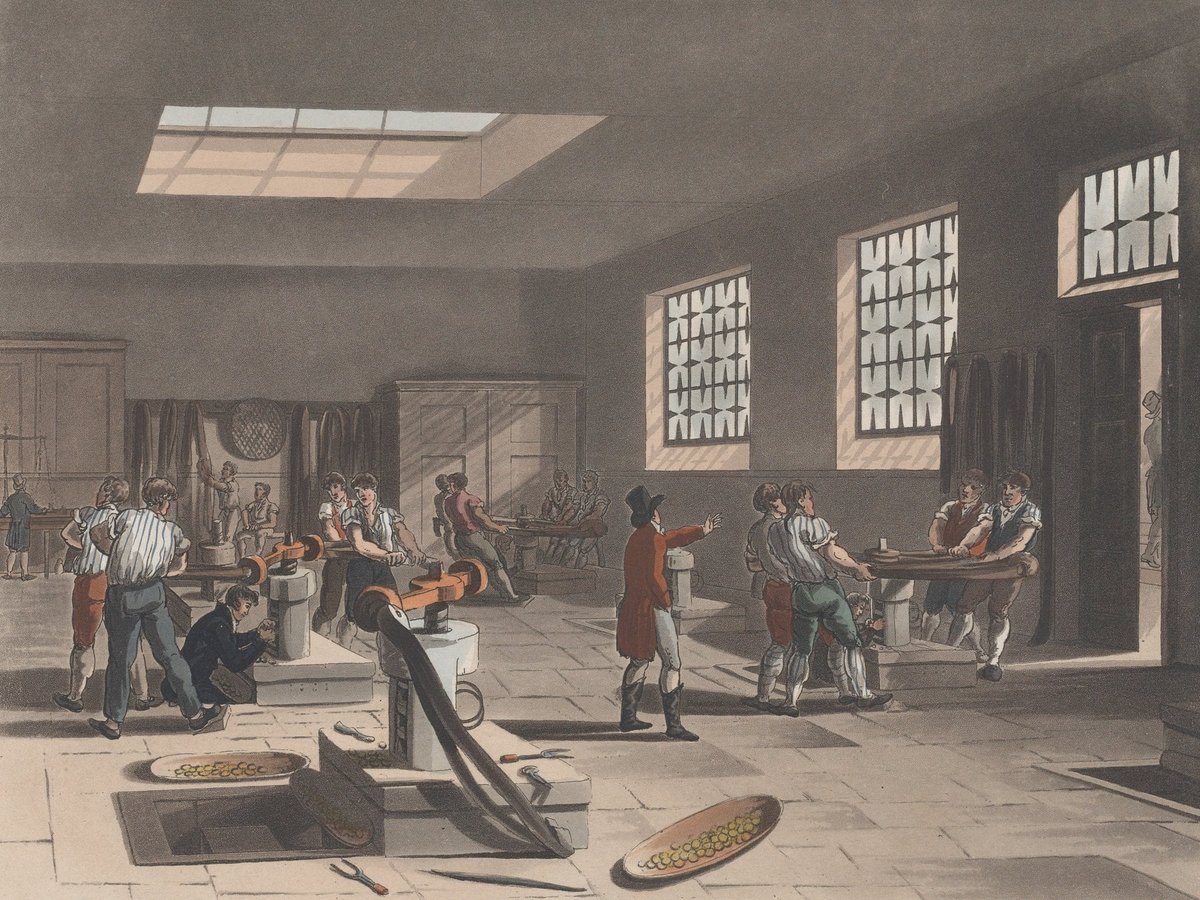
A coining die begins with a large plaster model, made in the mint’s own engraving department. Münze Österreich describes the next step like this:
“First, the plaster model made in the engraving department is scanned with digital technology, and the die is then machined true to the original using a milling cutter.”
Münze Österreich, guide “Werkzeugbau”
Circles and section at the same scale. The model’s measurements are given by the Oberösterreichische Nachrichten (2016). The mint’s silver‑niobium coins, for example, measure 34 millimetres.
In 2016, the newspaper Oberösterreichische Nachrichten reported how large such a model is: 18 centimetres in diameter. According to the same report, the relief may be no more than one millimetre high.
For proof coins, according to the mint, the die alone goes through 22 steps. Münze Österreich calls a coin “Handgehoben” (hand‑lifted) if it is struck as a first strike with a new die, as the first piece of a series. It is packed individually straight after striking.
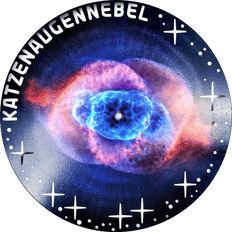
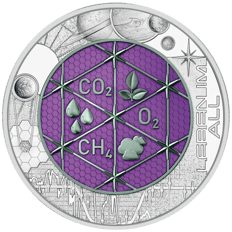
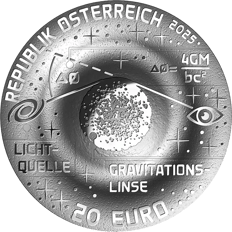
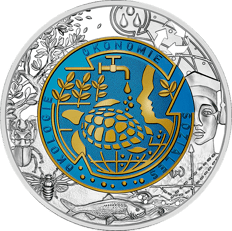
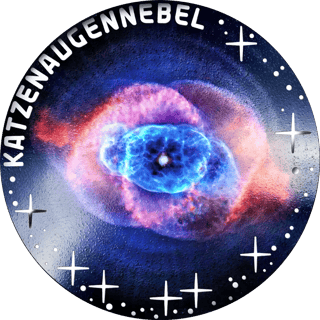
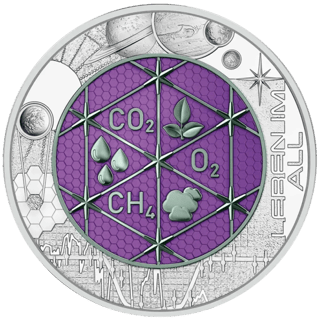
Since 2003, Münze Österreich has struck coins with a core of niobium. On its own, the metal is light grey. Even so, the cores glow, for example in violet on the 2022 coin “Leben im All” (Life in Space). Nothing is coloured in the process:
“What is special is that the colour is not applied. … This technique is called ‘anodic oxidation’. So nothing is lacquered.”
Münze Österreich, information page “Silber‑Niob‑Münzen” (archived version, 2016)
The section is greatly exaggerated in height and not to scale. The layer is transparent; only the reflected light is drawn in violet. Münze Österreich does not give the diameter of the core, so it is drawn only schematically.
When a current is applied, a wafer‑thin, transparent layer of oxide grows on the niobium. Light is reflected at its upper surface, and a second time at the metal beneath. The two rays overlap, and depending on the thickness of the layer, a different colour remains. Physicists call this interference; it is familiar from soap bubbles.
The thickness depends on the voltage. With every volt, the layer grows just over two millionths of a millimetre thicker, according to measurements published by Krzysztof Fitzner and Michał Stępień in 2023 in the journal “Materials”.
For “Leben im All”, Münze Österreich gives these details: a ring of silver 900/1,000 with 9.00 grams of fine silver, inside it the core of niobium, together 16.50 grams, 34 millimetres in diameter, face value 25 euros.
The first of these coins appeared on 29 January 2003. It was preceded by two years of preparatory work, together with the company Plansee from Tyrol.
Every face value comes with a question: who has to accept the coin, and how many of them? In Austria, the answer lies in § 8 (3) of the Scheidemünzengesetz, the coinage act of 1988. Coins are counted per single payment.
The Oesterreichische Nationalbank and Münze Österreich must accept valid coins without limit. The federal government, the states and the municipalities must accept up to one hundred coins, everyone else up to fifty, of which commemorative and gold coins of Münze Österreich only up to ten.
One dot per coin, per single payment, under § 8 (3) of the Scheidemünzengesetz 1988. For all other persons, the limit of ten coins applies to commemorative and gold coins of Münze Österreich, and there is also a maximum amount per payment.
The 2005 amendment added a maximum amount per payment to the limit of ten coins. The government bill gives the reason: with coins of unusually high face value, private individuals in particular can be put at a disadvantage if they cannot accept such a coin at all because of the large “amount of change” required. Moreover, the commemorative and gold coins of Münze Österreich are legal tender only in Austria, not in the other countries of the EU. This does not apply to the 2‑euro commemorative coins, which are valid throughout the euro area.
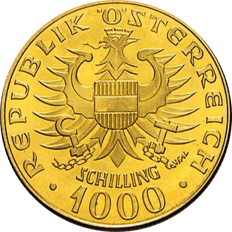
From 1989 to 2001, the Philharmoniker carried a face value in schillings.
The same workshop also strikes the small change. Münze Österreich makes the euro and cent coins for circulation on behalf of the Nationalbank, as required.
The Austrian sides were designed by Josef Kaiser, a professor at the University of Applied Arts Vienna. The three smallest coins show flowers: the gentian on the 1‑cent coin, the edelweiss on the 2‑cent coin and the primrose on the 5‑cent coin. The 20‑cent coin shows Belvedere Palace, the 50‑cent coin the Secession.
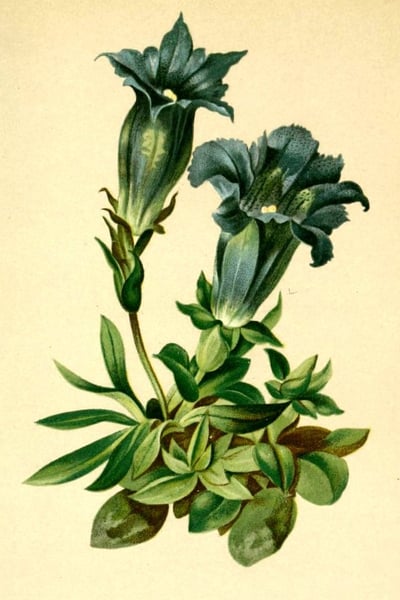 1 cent16.25 mmGentian
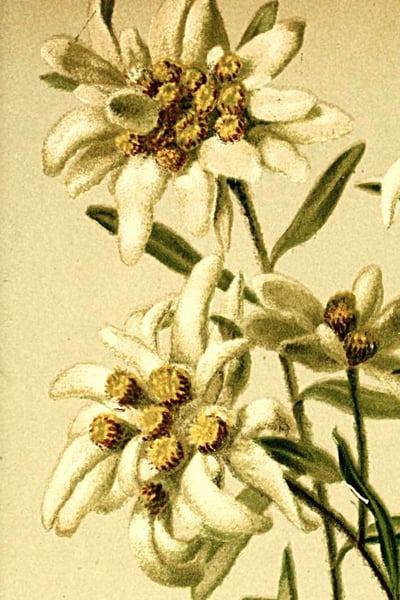 2 cent18.75 mmEdelweiss
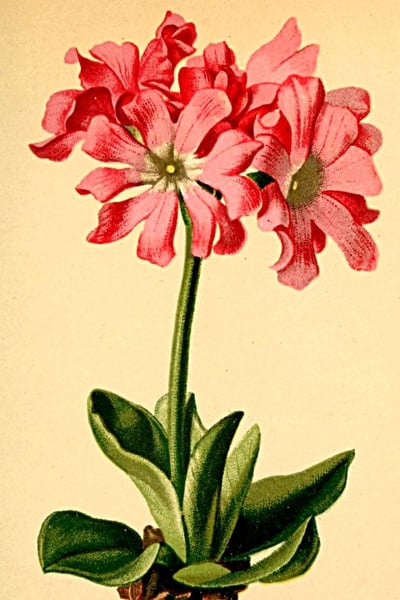 5 cent21.25 mmPrimrose
The circles show only the size of the coins, at the same scale, based on the measurements of the European Central Bank. The plates from Anton Hartinger’s “Atlas der Alpenflora”, Vienna 1882, show plants of the Alps, not the coin designs.
According to Münze Österreich, the face value appears not only on the common side but also on the national side.
“All euro coins struck in the period from 1998 to 2002 bear the year 2002.”
Münze Österreich, “Der Euro”
Authenticity
Every piece bears the mark of Münze Österreich. Before it goes out to you, we check it ourselves.
Every bullion coin bears the design of its mint and the year it was struck, and almost every one its weight and fineness.
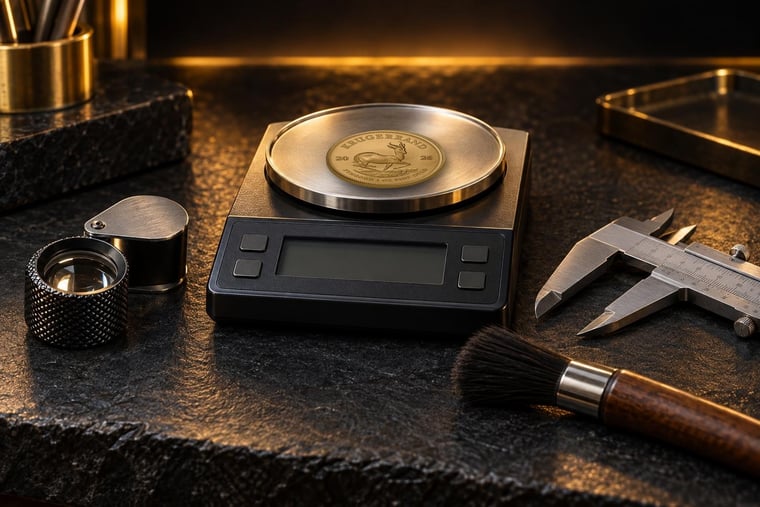
In our CCTV-monitored high-security area, two specialists check every order following the four-eyes principle, including its weight and, by X-ray, its authenticity.
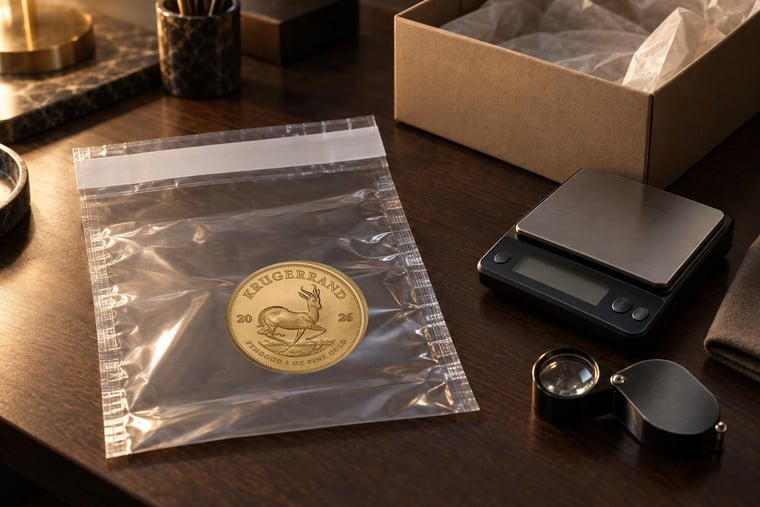
We then seal your order in a security bag that can only be opened once. You will be the first to open it.
Our testing methods
The house
Sources: manufacturer’s details, as of 14 November 2026
 Münze Österreich AG

Personal advice
Our client advisers know the range of Münze Österreich and help you choose, by phone or at an appointment that suits you.
Monday to Friday, 8 am to 8 pm
Stay informed with product launches, financial news and exclusive offers. Sign up for our free newsletter today.
By entering your email address and clicking the "Submit" button, you give the following consent: "I agree to be informed by email about new products, financial news and exclusive offers, and therefore consent to the processing of my email address for the purpose of sending the newsletter. I can revoke this consent at any time without giving reasons, with effect for the future. The lawfulness of processing carried out prior to revocation remains unaffected."