Only 6 left to order
1 oz Silver Swan 10th Anniversary 2026 (Mintage: 1,500)
£251.14
excl. UK import VAT and shipping
Available in 2–3 business days

 More than 300,000
 Over 30 years
 Secure shipping
 Google: 4.9/5
The silver Saltwater Crocodile is one of the most popular new bullion coins of the 21st century, because the mintage is only 1,000,000 pieces per year. The 1-ounce version of the year 2014 was already in particularly high demand before the start of sales.


Hardly any modern bullion coin captures the raw fascination of the Australian wilderness as directly as the Saltwater Crocodile. Since 2014, the renowned Perth Mint has minted the silver coin featuring this prehistoric predator, newly dated each year, strictly limited and carried by an aura that appeals to collectors and investors alike. This guide sheds light on the coin's origin and design, technical data and denominations, the special tax treatment, and why the "Saltie" has become one of the most sought-after animal designs among silver coins today.
Australia came relatively late to minting its own bullion coins: the first gold coin, the Nugget, appeared in 1986, with its silver counterpart, the Kookaburra, following four years later. Since then, the Perth Mint has built a reputation for vivid animal designs that are redesigned every year. With the Australian Saltwater Crocodile, the mint added a particularly striking new chapter to this tradition in 2014.
The design depicts the saltwater crocodile (Latin: Crocodylus porosus), commonly known simply as the "Saltie". It is the largest living reptile on Earth: fully grown specimens reach a length of several metres and a weight of up to one tonne. It is native to northern Australia, Southeast Asia and as far as the east coast of India. Despite its name, the animal by no means lives only in the sea, but equally in brackish and fresh waters, in river mouths, swamps and lakes, a silent hunter lying motionless in murky water, waiting for prey.
A design that does not merely decorate but captures in fine silver the untamed power of one of the oldest predators on Earth.
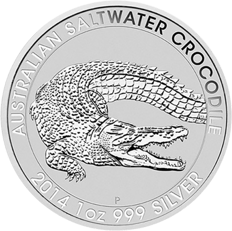
The obverse, designed by artist Natasha Muhl, shows a saltwater crocodile with its jaws wide open set against an open coin background, a composition that gives the reptile the entire space and emphasises its menacing presence. The surrounding inscription carries the name Australian Saltwater Crocodile, the respective year of issue, the fine weight of one troy ounce and the fineness. At the bottom edge is the mint mark P for the Perth Mint.
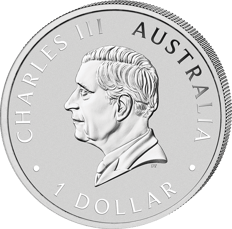
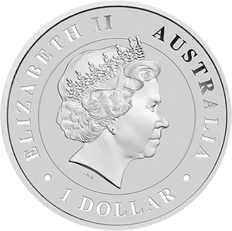
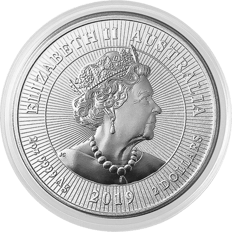
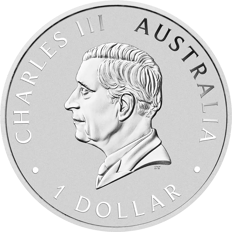
The reverse follows the Australian standard and bears the portrait of Queen Elizabeth II as designed by Ian Rank-Broadley. Also shown around the edge are the Queen's name, the issuing country Australia, and the face value of one Australian dollar. Those who appreciate the visual language of the Perth Mint series will find comparably sculptural animal depictions, for example, on the Koala or in the Lunar Series II.
The Saltwater Crocodile was primarily conceived as a 1 oz coin. The diameter of 40.6 mm matches the classic format of many Australian 1 oz silver coins such as the Kookaburra, Koala or Kangaroo, a deliberately chosen standard size that stacks and stores well.
The 1 oz version is the centrepiece of the series and has been available in every year of issue since 2014. It appeals both to investors who want to hold silver in a convenient, globally recognised unit, and to collectors who value the newly dated design each year.
A 1/2 oz edition was minted exclusively in 2017 and carries a face value of 50 cents, making it a genuine rarity within the series. In addition, a Proof version was released in 2015 with a strictly limited mintage of around 5,000 pieces, which is particularly sought after by enthusiasts due to its mirrored surfaces. Those specifically seeking limited mintages will also find what they are looking for among the partially gilded silver coins.
The regular 1 oz edition is issued with a maximum mintage of one million coins per year of issue. What may sound like a large number at first glance quickly becomes relative in international comparison: established bullion classics such as the Maple Leaf or the Vienna Philharmonic are minted in significantly higher quantities. The fixed annual limit gives each year of issue a clear framework and makes older editions additionally appealing to collectors.
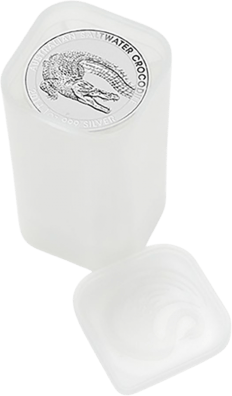
The coins are delivered uncapsuled in plastic tubes of 25 pieces each, with 20 tubes forming a master box of 500 coins. For safe individual storage, suitable accessories such as coin capsules or coin tubes are recommended, as they protect the sensitive silver surface from scratches and tarnishing.
In Germany, silver coins are generally subject to VAT, unlike investment gold, which is exempt from VAT. For silver coins imported from non-EU countries such as Australia, however, the margin scheme may apply, under which tax is levied only on the dealer's trading margin. This generally results in a more favourable final price than the full standard tax rate.
Tax notice
Since the beginning of 2014, silver coins produced within the EU have been subject to the full VAT rate. Imported mintages such as the Saltwater Crocodile, on the other hand, can be traded under the margin scheme. The specific tax treatment depends on the respective dealer and the source of supply; this is general information and not tax advice.
This very tax framework was one of the reasons why the Perth Mint added a pure bullion silver coin with a high mintage to its range in 2014: it was intended to offer German and European silver buyers an attractively priced alternative to domestic mintages. Those wishing to explore the topic of silver as a tangible asset more broadly will find further ranges under 1 oz silver bars.
Around the crocodile design there is a certain risk of confusion that buyers should be aware of. Besides the bullion edition from the Perth Mint described here, there is a series of the same name from the Royal Australian Mint. This collector's edition appears with annually changing, sometimes named crocodile designs, is delivered in a blister pack, and has a considerably lower mintage of around 10,000 pieces. Both share a face value of one AUD and a similar diameter, but differ markedly in character and target audience.
Within the Australian animal kingdom, the Saltwater Crocodile takes its place among a whole range of fascinating designs. Those wishing to explore the breadth will find an equally extraordinary predator design from the Perth Mint in the Funnel-web Spider, both created in the same timeframe and appealing to collectors with a fondness for Australia's wild side. The range of other silver coins is also worth a look.
Since the coins are delivered from the mint without individual capsules in tubes, proper storage plays an important role in long-term preservation. Silver reacts more sensitively to environmental influences than gold and can tarnish if stored unfavourably. A few simple principles help preserve its visual condition:
For the permanent storage of entire collections, coin cassettes or a coin case are suitable, creating order and presenting the individual years of issue clearly. At Kettner Edelmetalle, shipping is always carried out 100% insured, so the coins are protected on their way to the customer.
The series moves appealingly at the intersection of bullion and collector's coin. As 999 fine silver in the common troy ounce unit, it has a clear material value and is tradable worldwide. At the same time, the expressive design, the limited annual mintage and the short issuing history of individual special forms, such as the half ounce from 2017, make the coin particularly interesting for collectors.
Early years of issue are now traded with a noticeable premium over the pure silver value and are therefore regarded more as collector's pieces than as classic bullion silver. Those primarily focused on the lowest possible premium tend to look to the major classics, while those seeking the emotional appeal of a distinctive design will find in the Saltwater Crocodile a true character piece among Australian silver coins. Fitting additions from the same mint are offered, for example, by the Kookaburra.
The Perth Mint has minted the Australian Saltwater Crocodile since 2014. Since then, the 1 oz edition has been issued each year with an updated year of issue, in 999 fine silver.
The regular 1 oz edition is limited to a maximum of one million coins per year of issue. The half ounce was only minted in 2017, and a Proof version was issued in 2015 with around 5,000 pieces.
The Perth Mint issues a high-mintage bullion coin with the same design across multiple years of issue. The Royal Australian Mint, on the other hand, mints a collector's series with annually changing crocodile designs, packaged in a blister and significantly more limited, with around 10,000 pieces.
Imported silver coins can be traded under the margin scheme in Germany, with tax applying only to the trading margin. This is generally more favourable than the full VAT rate. The exact treatment depends on the dealer and does not replace individual tax advice.
Depicted is the saltwater crocodile (Crocodylus porosus), also called Saltwater Crocodile or Saltie. It is considered the largest living reptile on Earth and is native to northern Australia and Southeast Asia.
Since the coins are delivered without individual capsules in tubes, dry storage in coin capsules is recommended to prevent tarnishing and scratches. For entire collections, coin cassettes or coin cases provide clear and protected storage.
 Saltwater Crocodile
Stay informed with product launches, financial news and exclusive offers. Sign up for our free newsletter today.
By entering your email address and clicking the "Submit" button, you give the following consent: "I agree to be informed by email about new products, financial news and exclusive offers, and therefore consent to the processing of my email address for the purpose of sending the newsletter. I can revoke this consent at any time without giving reasons, with effect for the future. The lawfulness of processing carried out prior to revocation remains unaffected."