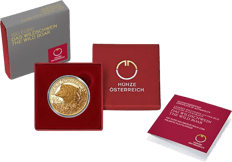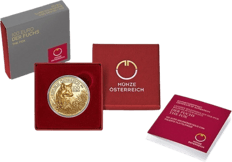
Only 1 left to order
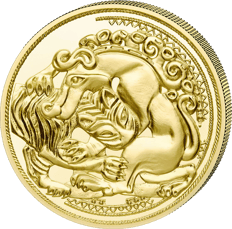
100 Euro Gold The Gold of the Scythians Austria 2022 PP (Mintage: 20,000 | Proof)
£1,753.72
VAT-free and excl. shipping
Available in 2–3 business days

 More than 300,000
 Over 30 years
 Secure shipping
 Google: 4.9/5


In 1193/94, the Babenbergs moved their mint from Krems to Vienna. From then on, a pfennig was struck in Vienna too; it is first mentioned in a charter in 1204. The Neue Deutsche Biographie considers it likely that the founding of the Hausgenossen of Vienna is linked to the ransom for Richard the Lionheart.
“The Hausgenossen were a body of 48 Viennese burghers to whom minting, money changing and the trade in precious metals in the Duchy of Austria were reserved.”
Wien Geschichte Wiki of the City of Vienna, article “Hausgenossen”
One figure for each of the 48 Hausgenossen. The number is given by the Wien Geschichte Wiki of the City of Vienna.
The Wiki explains the name like this: the body was regarded as part of the ruling prince’s “house” (Haus), that is, his retinue. The striking itself was the work of a craft, the moneyers. Money was changed by employed changers at benches that stood in the open air, at first on the Hoher Markt.
On 7 June 1522, Ferdinand I dissolved the body. In 1524, the mint became a state office. Until then, according to the Wiki, it had been “a domain of Vienna’s wealthy burghers”.
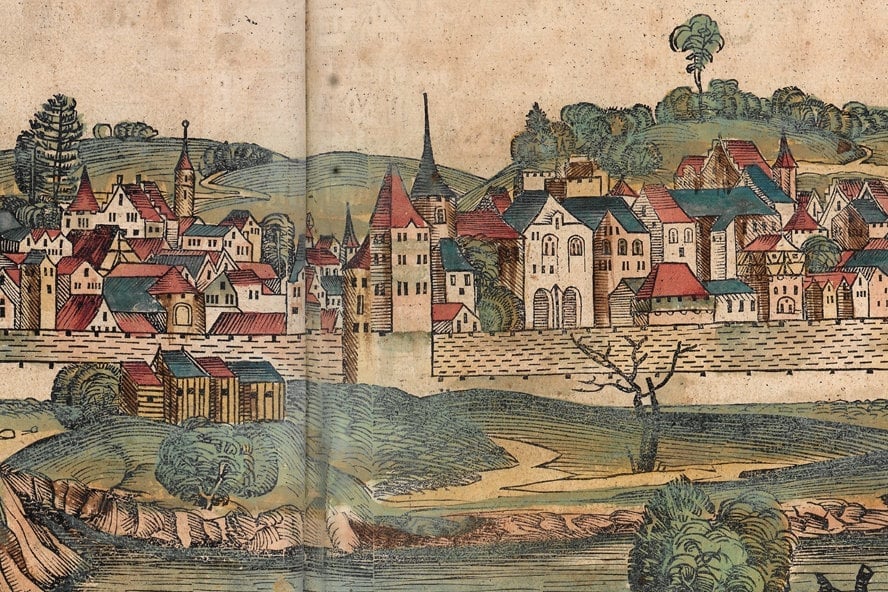
The Vienna Mint has moved many times. The Wien Geschichte Wiki of the City of Vienna lists seven addresses for it. Six lie in the Inner City, the seventh east of the Stadtpark: Am Heumarkt 1.
It started out in the Kammerhof on the Brandstätte; the Wiki says “probably”. Around 1280 it moved into the former residence at Am Hof, and in the late 14th century to the Wollzeile. It stayed there longest, until 1752 according to the Wiki’s list. In 1753, Maria Theresa moved it to the Himmelpfortgasse, to the Winter Palace of Prince Eugene.
There are also two secondary addresses: the Schlagstube in the Landskrongasse, where the moneyers struck the coins, and, from 1621 to 1625, a second mint in the Schenkenstraße.
Years according to the list in the Wien Geschichte Wiki; other sources sometimes give different ones. The bars show the length of the stay, and the positions of the dots are simplified.
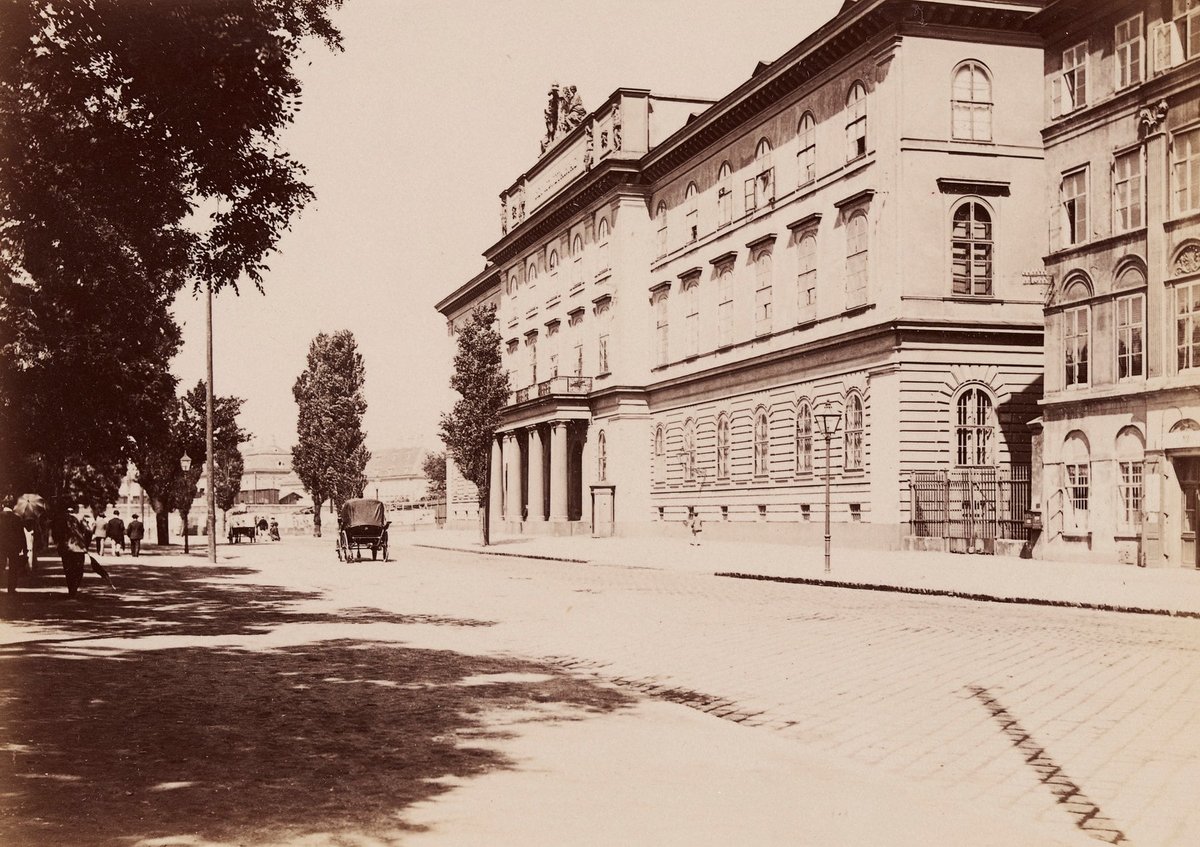
At the end of the line stands the building at Am Heumarkt 1. It is a protected monument. At the top, above the centre of the façade, stand four figures by Joseph Klieber: Hermes, Apollo, Artemis and Aphrodite. They embody the coinage metals zinc, gold, silver and copper.
“The magnificent building is still a place of production and administration.”
Münze Österreich, company history
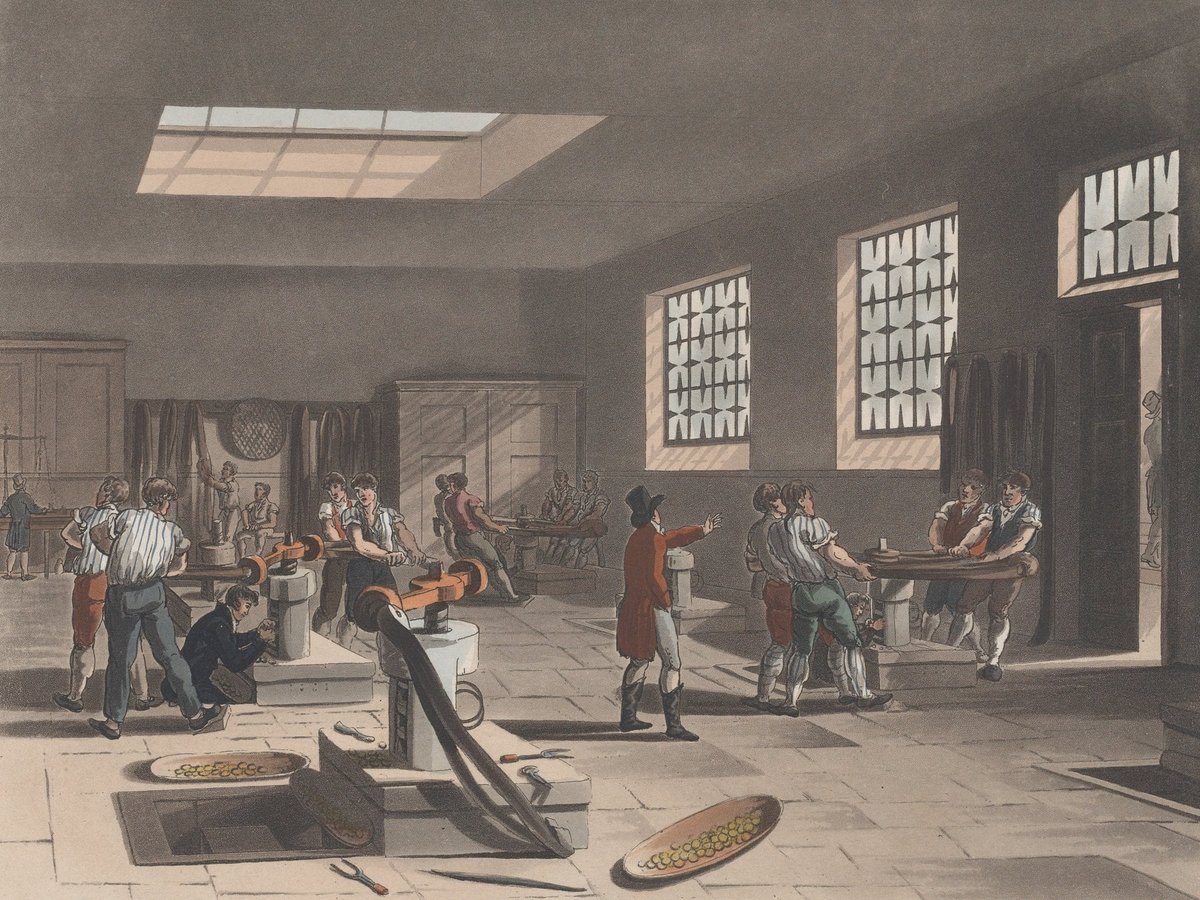
A coining die begins with a large plaster model, made in the mint’s own engraving department. Münze Österreich describes the next step like this:
“First, the plaster model made in the engraving department is scanned with digital technology, and the die is then machined true to the original using a milling cutter.”
Münze Österreich, guide “Werkzeugbau”
Circles and section at the same scale. The model’s measurements are given by the Oberösterreichische Nachrichten (2016). The mint’s silver‑niobium coins, for example, measure 34 millimetres.
In 2016, the newspaper Oberösterreichische Nachrichten reported how large such a model is: 18 centimetres in diameter. According to the same report, the relief may be no more than one millimetre high.
For proof coins, according to the mint, the die alone goes through 22 steps. Münze Österreich calls a coin “Handgehoben” (hand‑lifted) if it is struck as a first strike with a new die, as the first piece of a series. It is packed individually straight after striking.
Since 2003, Münze Österreich has struck coins with a core of niobium. On its own, the metal is light grey. Even so, the cores glow, for example in violet on the 2022 coin “Leben im All” (Life in Space). Nothing is coloured in the process:
“What is special is that the colour is not applied. … This technique is called ‘anodic oxidation’. So nothing is lacquered.”
Münze Österreich, information page “Silber‑Niob‑Münzen” (archived version, 2016)
The section is greatly exaggerated in height and not to scale. The layer is transparent; only the reflected light is drawn in violet. Münze Österreich does not give the diameter of the core, so it is drawn only schematically.
When a current is applied, a wafer‑thin, transparent layer of oxide grows on the niobium. Light is reflected at its upper surface, and a second time at the metal beneath. The two rays overlap, and depending on the thickness of the layer, a different colour remains. Physicists call this interference; it is familiar from soap bubbles.
The thickness depends on the voltage. With every volt, the layer grows just over two millionths of a millimetre thicker, according to measurements published by Krzysztof Fitzner and Michał Stępień in 2023 in the journal “Materials”.
For “Leben im All”, Münze Österreich gives these details: a ring of silver 900/1,000 with 9.00 grams of fine silver, inside it the core of niobium, together 16.50 grams, 34 millimetres in diameter, face value 25 euros.
The first of these coins appeared on 29 January 2003. It was preceded by two years of preparatory work, together with the company Plansee from Tyrol.
Every face value comes with a question: who has to accept the coin, and how many of them? In Austria, the answer lies in § 8 (3) of the Scheidemünzengesetz, the coinage act of 1988. Coins are counted per single payment.
The Oesterreichische Nationalbank and Münze Österreich must accept valid coins without limit. The federal government, the states and the municipalities must accept up to one hundred coins, everyone else up to fifty, of which commemorative and gold coins of Münze Österreich only up to ten.
One dot per coin, per single payment, under § 8 (3) of the Scheidemünzengesetz 1988. For all other persons, the limit of ten coins applies to commemorative and gold coins of Münze Österreich, and there is also a maximum amount per payment.
The 2005 amendment added a maximum amount per payment to the limit of ten coins. The government bill gives the reason: with coins of unusually high face value, private individuals in particular can be put at a disadvantage if they cannot accept such a coin at all because of the large “amount of change” required. Moreover, the commemorative and gold coins of Münze Österreich are legal tender only in Austria, not in the other countries of the EU. This does not apply to the 2‑euro commemorative coins, which are valid throughout the euro area.
From 1989 to 2001, the Philharmoniker carried a face value in schillings.
The same workshop also strikes the small change. Münze Österreich makes the euro and cent coins for circulation on behalf of the Nationalbank, as required.
The Austrian sides were designed by Josef Kaiser, a professor at the University of Applied Arts Vienna. The three smallest coins show flowers: the gentian on the 1‑cent coin, the edelweiss on the 2‑cent coin and the primrose on the 5‑cent coin. The 20‑cent coin shows Belvedere Palace, the 50‑cent coin the Secession.
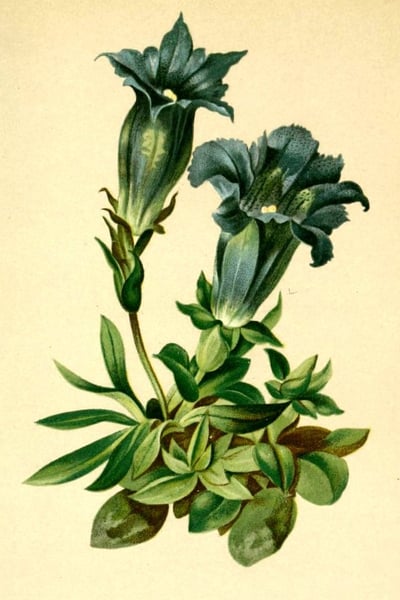 1 cent16.25 mmGentian
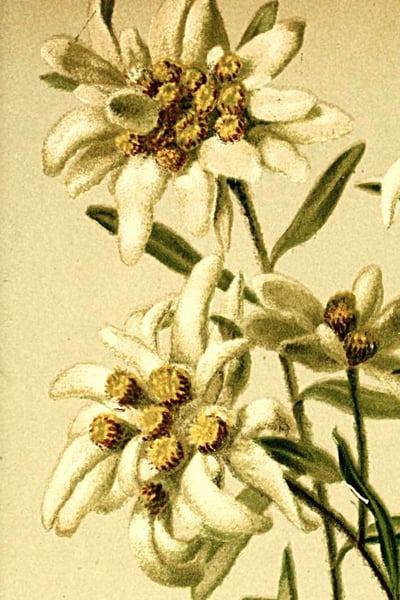 2 cent18.75 mmEdelweiss
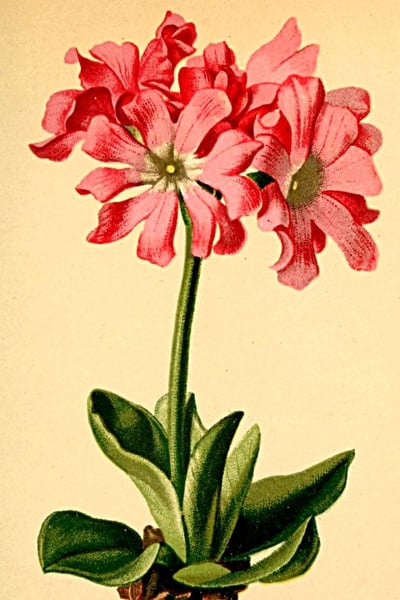 5 cent21.25 mmPrimrose
The circles show only the size of the coins, at the same scale, based on the measurements of the European Central Bank. The plates from Anton Hartinger’s “Atlas der Alpenflora”, Vienna 1882, show plants of the Alps, not the coin designs.
According to Münze Österreich, the face value appears not only on the common side but also on the national side.
“All euro coins struck in the period from 1998 to 2002 bear the year 2002.”
Münze Österreich, “Der Euro”
There are gold coins that are counted in troy ounces and premiums, and there are those you study under a magnifying glass, almost believing you can smell the forest as you do. The series On the Trail of Our Wildlife, better known as Austrian Wildlife, belongs to the latter. Between 2013 and 2018, Münze Österreich struck six 100 euro gold coins, each depicting a native wild animal in its natural habitat. This guide sheds light on the history, designs, technical details, authenticity features, tax treatment, and the question of whether the series is better suited to collecting or investing.
On 30 October 2013, Münze Österreich launched its six-part gold coin series with the official title "On the Trail of Our Wildlife". The underlying idea: to celebrate the diversity of native fauna and put a different animal in the spotlight with each year of issue. The result is one of the most evocative Austrian collector's coin series of recent years, not a sober investment product, but a small gallery in gold.
Each issue appeared in the highest minting quality, Proof, with a mintage of no more than 30,000 pieces per year. Across all six designs, this adds up to a total mintage of around 180,000 pieces, a manageable number that lends the series additional weight. Anyone completing the series ends up holding six works of art and almost three troy ounces of gold. Those wishing to delve deeper into the world of Austrian coinage will find further connections in the classic gold coins of German-speaking countries and with the Vienna Philharmonic.
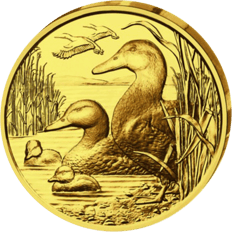
The series follows a clear narrative: each year a new animal took the stage, depicted either as a pair or as a complete family group in its typical environment, the red deer in an open forest, the mallard surrounded by reeds. The chronology of the issues:
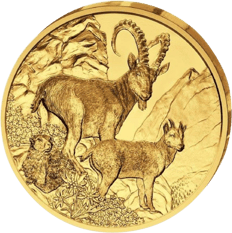
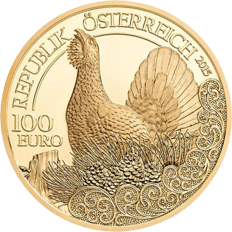
The artistic execution for the first four years of issue was the responsibility of chief engravers Thomas Pesendorfer and Helmut Andexlinger. From 2017, several engravers worked together on each design to achieve even greater depth of detail. The appeal often only reveals itself under magnification: individual hairs in the fur, the feather pattern of the capercaillie, the texture of the rock. Such precision is inconceivable without state-of-the-art engraving technology and makes the Wildlife series a prime example of Austrian minting artistry.
The design side carries the respective animal in a naturalistic scene. The value side, however, comes with a special feature: alongside the inscription "REPUBLIK ÖSTERREICH", the year of issue and the face value "100 EURO", a delicate ornament runs along the lower edge, a recurring design element that appears exclusively on the value side and visually links the six issues together.
A wild animal cannot be ordered, you have to track it down. The series translates exactly this searching and discovering into gold.
The Austrian Wildlife coins deliberately deviate from the usual standards, which is precisely what makes them so distinctive among collectors. Instead of the customary 15.55 g of a half troy ounce, each coin weighs in at 16 grams of fine gold, with a gross weight of 16.23 g. The fineness of 986/1,000 is likewise unusual: this is the traditional ducat gold that Münze Österreich has used for centuries, rather than the 999.9 fineness of classic bullion coins.
The printed face value of 100 euros plays no practical role; the actual value is far higher and is based on the gold price plus a premium for the elaborate production and collector's appeal. Incidentally, there is no silver version of the series; those looking for Münze Österreich in silver are more likely to find what they're after with the silver Vienna Philharmonic.
Behind the series stands one of the most historic mints in the world. Münze Österreich looks back on more than 725 years of history and today resides in the heart of Vienna on Heumarkt. It strikes not only the country's classic bullion coins, chief among them the Vienna Philharmonic, but also circulation coins and high-quality collector's issues such as the Wildlife series.
The gold is processed directly at the Vienna minting facility, and the issue was officially carried out by Münze Österreich. This end-to-end production from a single source is a promise of quality that is evident in the finished piece. Similarly renowned houses such as Münze Österreich AG and the mints behind Maple Leaf or Britannia shape the international market for high-quality gold coinage.
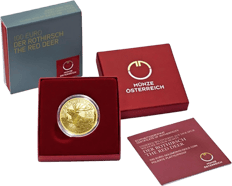
Each coin in the series is delivered individually encapsulated in a Münze Österreich case, accompanied by a numbered certificate of authenticity from the mint. This combination of original case, certificate and traceable numbering is the most important authenticity feature; for collector's coins, complete provenance increases both security and resale value.
For long-term storage, suitable accessories such as coin capsules or a high-quality coin case are recommended. As an option, Münze Österreich at the time offered its own wooden collector's case with an artistic metal plaque, bringing all six designs stylishly together. Those storing several series will find further solutions in the accessories overview.
A closer look at the tax classification is worthwhile, because despite its collector's character, the Wildlife series falls under the regulations for gold coins. Within the EU, investment gold is generally exempt from VAT, provided the criteria for investment gold are met; these include, among other things, a fineness of at least 900/1,000 for gold coins with legal tender status. With its fineness of 986/1,000 and a face value of 100 euros, the series meets this requirement.
Tax note
For private individuals in Germany, the following also applies: if a gold coin is held for longer than one year, any capital gain is tax-free once the speculation period has elapsed. This information is of a general nature and does not replace individual tax advice.
The situation is different for silver, where the margin scheme often applies. Those wishing to make targeted use of the tax advantages of physical gold will find complementary investment options in the retirement provision section and among gold bars.
The honest answer: the Austrian Wildlife series is primarily a collector's item. Proof minting quality, the unusual 16-gram format, the fineness of 986/1,000 and the elaborate design mean a noticeable premium over the pure gold value. Those looking exclusively for the greatest possible amount of fine gold at the lowest price are better served by classic bullion coins such as the Krugerrand or the Maple Leaf.
For collectors and nature lovers, however, the series plays to its full strengths: a closed six-part series, low mintage, outstanding engraving artistry and emotional designs that bring the native forest into the living room. The series reveals its appeal particularly as a valuable gift or as a thematic collecting focus. Related thematic worlds can be found, for example, among the Native Birds or in the Call of the Wild series. As a German precious metals dealer, Kettner Edelmetalle offers such coinage with insured shipping and verified authenticity.
The official series title is "On the Trail of Our Wildlife". The series comprises six 100 euro gold coins, issued by Münze Österreich between 2013 and 2018, one per year.
In chronological order: red deer (2013), wild boar (2014), capercaillie (2015), fox (2016), Alpine ibex (2017) and mallard (2018). Each design shows the animal as a pair or family in its natural habitat.
Münze Österreich deliberately opted for a fine weight of 16 grams, slightly more than the 15.55 g of a half troy ounce. Combined with the fineness of 986/1,000, the traditional ducat gold, this results in a characteristic format that sets the series apart from standard bullion coins.
Owing to the Proof quality, the low mintage and the elaborate design, the collector's character takes centre stage. For a pure gold investment with a low premium, classic bullion coins are usually the more affordable choice. For collectors and nature lovers, however, the series is a visually outstanding collector's item.
Each coin is delivered encapsulated in the original Münze Österreich case with a numbered certificate of authenticity. These documents should always stay with the coin. In addition, weight (16.23 g gross weight), diameter (30 mm) and fineness (986/1,000) can be used for verification.
Yes. As a gold coin with legal tender status, a fineness of 986/1,000 and a face value of 100 euros, the series meets the criteria for investment gold and is therefore exempt from VAT. For private individuals, any capital gain is tax-free once the one-year speculation period has elapsed.
 Wildlife Austria
Stay informed with product launches, financial news and exclusive offers. Sign up for our free newsletter today.
By entering your email address and clicking the "Submit" button, you give the following consent: "I agree to be informed by email about new products, financial news and exclusive offers, and therefore consent to the processing of my email address for the purpose of sending the newsletter. I can revoke this consent at any time without giving reasons, with effect for the future. The lawfulness of processing carried out prior to revocation remains unaffected."