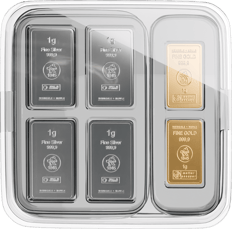
100 x 1g Silver Heimerle und Meule UnityBox
£222.27£230.72
excl. UK import VAT and shipping
Available in 3–4 business days

 More than 310,000
 Over 30 years
 Secure shipping
 Google: 4.9/5


When trust in paper currencies fades, people have sought the same safe haven for thousands of years: gold and silver. Crisis protection with precious metals means shifting part of one's wealth into physical assets that exist independently of banks, central banks and political decisions. This guide explains why precious metals are regarded as the ultimate safe haven in times of crisis, which scenarios make such protection worthwhile, and what really matters when it comes to selection, denomination and storage.
Gold has accompanied humanity as a store of value for over 5,000 years. Unlike banknotes, it cannot be multiplied at will, it does not rust, and its value does not depend on any government's promise. These very qualities make precious metals the classic form of crisis protection: they are recognised worldwide, instantly tradeable, and retain their purchasing power even when currencies lose value. In almost every historical crisis, gold coins and gold bars became the last reliable means of payment for many people.
Silver complements this protection as an affordable entry point. Anyone looking to build broad crisis provisioning with coins for the next crisis often combines both metals: gold for compact value preservation, silver for everyday divisibility. A well-thought-out precious metals portfolio thus works like an insurance policy you hold physically in your hand.
Gold is the only form of money that exists without the counter-promise of another: it owes nothing to anyone.
Crisis protection is not an abstract concept, but a response to real, historically documented events. Precious metals show their protective effect above all in these situations:
When a currency rapidly loses purchasing power, cash in the bank melts away. The German hyperinflation of 1923 is the best-known example: a loaf of bread eventually cost billions of Reichsmarks. Anyone who owned gold at the time was able to preserve their wealth through the crisis, while savings became practically worthless. In such phases, precious metals typically rise in nominal value, because their real material value is preserved: a key argument for protection against inflation.
A currency reform such as the one in Germany in 1948 can sharply devalue savings overnight. Physical precious metals remain unaffected by this, as they are not tied to the old currency. Discussions about cash limits or digital central bank currencies also show many investors how valuable it is to hold a portion of their wealth outside the banking system.
In banking crises such as the one in Cyprus in 2013, savers were called upon directly to foot the bill. Capital controls can restrict access to one's own funds. Anyone who holds part of their wealth as physical gold coins at home or in a safe deposit box is more independent of such interventions. This independence is the true core of any serious crisis provisioning.
Both precious metals have their place in crisis protection, but they fulfil different functions. Gold holds its value better and concentrates high values in the smallest space: a single troy ounce of gold is now equivalent to several months' salary. It is regarded worldwide as the hedging instrument of first choice and can be exchanged for cash anywhere in the world at the current gold price.
Silver, on the other hand, is cheaper per piece and therefore ideal for smaller transactions. Anyone who values everyday divisibility turns to silver coins or small silver bars. From a tax perspective, it should be noted that investment gold is exempt from VAT in Germany, while silver coins are subject to the margin scheme. A mix of both metals combines the strengths of each: compact value preservation through gold, flexible denomination through silver.
Tax note
In Germany, investment gold is exempt from VAT pursuant to §25c UStG. Furthermore, after a holding period of more than one year, capital gains from the sale of physical gold and silver are tax-free. This does not constitute tax advice: a professional advisor should be consulted for individual cases.
One of the most important considerations in crisis protection is denomination. In a crisis where the payment function of familiar money is disrupted, it is not only the total value that counts, but also divisibility. After all, a large coin cannot be cut up to pay the baker.
Small denominations such as the 1/10 oz gold coin or the 1-gram gold bar make it possible to exchange smaller amounts in a targeted way without having to break into an expensive coin. A complete, recognised coin is almost always more popular in a barter transaction than a divided piece. Gold CombiBars, which can be broken into many small individual tablets, are designed for exactly this scenario.
The troy ounce (31.1 grams) is the benchmark in the world of precious metals. Most bullion coins are minted in this size and therefore correspond to the internationally recognised investment standard. Anyone who prioritises value preservation builds the core of their portfolio from 1 oz coins and supplements it with smaller units for flexibility.
Not every coin is equally suitable for crisis provisioning. In demand are globally known classics whose authenticity and value are instantly recognised everywhere. The Krugerrand from South Africa is the most widely traded investment gold coin in the world: minted since 1967 and accepted as a means of payment around the globe. Kettner Edelmetalle is the official German partner of the South African Mint.
Equally well established are the Canadian Maple Leaf and the Austrian Vienna Philharmonic, both made of pure fine gold and in demand internationally. For beginners and anyone who wants to make provisions without lengthy assembly, ready-made gold-silver packages are available, combining proven coins and bars sensibly. Anyone wanting to invest small amounts regularly will find suitable small denominations in the savings plan products section.
Crisis protection is only as good as its storage. Physical precious metals offer the advantage that they can be kept entirely in one's own possession, without dependence on a bank. Many crisis preppers rely on a combination of home storage in a safe and a bank safe deposit box to spread the risk.
Proper storage is important so that coins and bars do not suffer damage. Protective covers such as coin capsules protect the minting from scratches and oxidation, while coin cassettes or discreet diversion safes are suitable for larger collections. For home storage, insurance cover should also be checked. At Kettner Edelmetalle, shipping is always fully insured at 100 percent.
A sound precious metals hedge does not come about overnight, but can be built up systematically and in stages. The following sequence has proven effective:
Anyone thinking long-term does not view precious metals as short-term speculation, but as a building block of retirement provision and long-term value appreciation: a stable anchor for wealth that provides security in turbulent times.
Precious metals cannot be multiplied at will and are not tied to any government's promise. They retain their purchasing power even when currencies lose value and are recognised worldwide as a means of payment. In times of crisis, gold coins and gold bars are therefore considered the ultimate safe haven.
For value preservation, the 1 oz coin forms the core. For possible barter transactions, small units such as the 1/10 oz coin or gram gold bars are important, because they allow smaller amounts to be used in a targeted way without having to break into a large coin. A mix of large and small denominations is ideal.
Physical gold and silver can be sold tax-free after a holding period of more than one year. Investment gold is also exempt from VAT. This information is for general guidance only and does not replace individual tax advice.
There is no blanket recommendation, as this depends on the individual situation. Many crisis preppers regard precious metals as a hedging component alongside other asset classes. What matters is that this portion of wealth remains physically available and outside the banking system.
A proven approach is to spread the risk between home storage in a safe and a bank safe deposit box. Coin capsules and cassettes protect the minting from damage. For home storage, insurance cover should be checked.
Globally known classics such as the Krugerrand, Maple Leaf and Vienna Philharmonic take centre stage, because their authenticity and value are instantly recognised everywhere. Silver coins and ready-made crisis packages that bundle several metals and denominations are also in demand.
 Crisis Protection
Stay informed with product launches, financial news and exclusive offers. Sign up for our free newsletter today.
By entering your email address and clicking the “Submit” button, you give the following consent: “I agree to be informed by email about new products, financial news and exclusive offers, and therefore consent to the processing of my email address for the purpose of sending the newsletter. I can revoke this consent at any time without giving reasons, with effect for the future. The lawfulness of processing carried out prior to revocation remains unaffected.”