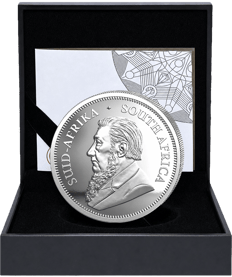
1 Ounce Silver Krugerrand 2026
£53.70
excl. UK import VAT and shipping
Available in 2–3 business days
 +49 7930-2699

 More than 300,000
 Over 30 years
 Secure shipping
 Google: 4.9/5
The silver Krugerrand was first launched in 2017. Since 2018, it has also been available as a bullion coin. With a fineness of 999, the silver coin is available in weights of 1 and 2 ounces, produced by the South African Mint and the Rand Refinery in South Africa. We trade the silver Krugerrand in the finest Premium Mint State (MS) quality, individually in a coin pouch or, from units of 25, also in coin tubes. Here you will find the Krugerrand in gold.


This is how the coins compare in size. In gold, the 1/10, 1/4, 1/2 and 1 ounce come as bullion coins and in proof, and the 2 ounces in proof. The South African Mint issues the 1/20 and the 1/50 ounce only in its sets. The 5 and 50 ounce coins are special issues.
The silver ounce is larger than the gold ounce: 38.725 compared with 32.69 millimetres.
Shown: the portrait sides of the 2026 proof coins and of the 50 ounce coin from 2017. Dimensions according to the South African Mint and the Government Gazette of the Republic of South Africa.
All three measure 32.69 millimetres. They differ in finish and in mintage.
Struck without a fixed mintage, for investors.
Matte design on a mirror field, in limited mintage and with a certificate of authenticity.
Polished design on a matte field, the inverse of proof. Since 2024.
Both weigh 67.86 grams. The Piedfort has the diameter of the 1 ounce coin and is twice as thick. The wide version has existed since 2018, the Piedfort since 2024.
The South African Mint’s sets build on one another. Each step adds the next larger coin, until all seven sizes come together.
The coins in these sets are struck in proof.
Some issues bear an additional small mark, the Privy Mark. It sits above the springbok’s back. Issues with a Privy Mark usually appear in their own small mintages.
Each of these issues has its own occasion, its own mark or a special finish. All of them are listed here in the category.
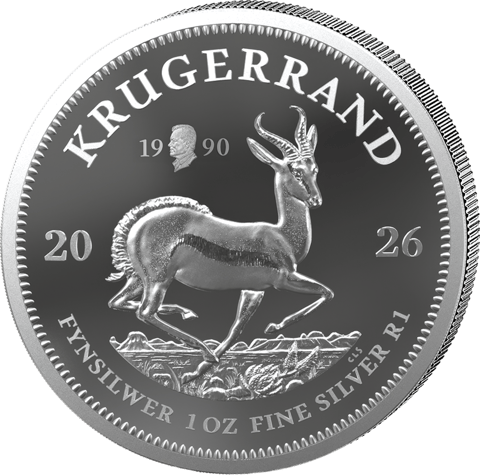 Kettner edition20261, 2 and 5 ouncesWilly BrandtThe Privy Mark above the springbok shows the portrait of Willy Brandt between the numerals 19 and 90. It recalls 1990, the year in which Nelson Mandela was released and Germany was reunited.
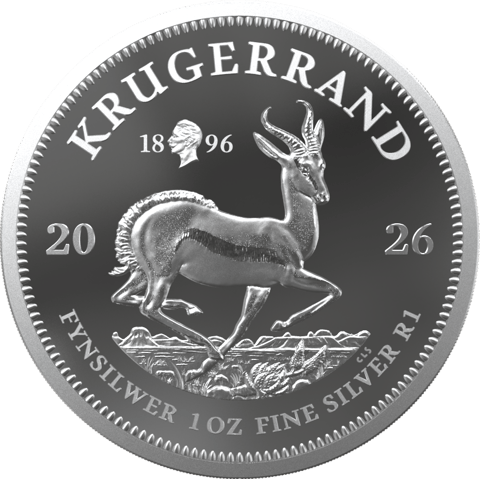 Kettner edition20261 and 2 ouncesEmperor Wilhelm IIThe Privy Mark above the springbok shows a small portrait between the numerals 18 and 96. It recalls the telegram that Emperor Wilhelm II sent to President Paul Kruger in Pretoria in 1896.
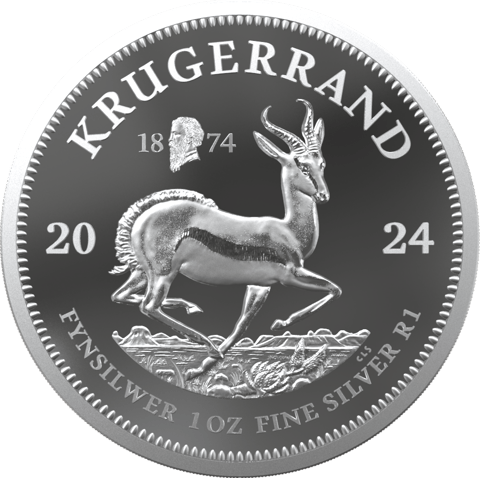 Kettner edition20241 and 2 ouncesBurgers PondThe Privy Mark above the springbok shows President Burgers between the numerals 18 and 74, based on his likeness on the Burgers Pond of 1874. Of this first gold coin made from South African gold, 837 pieces were struck.
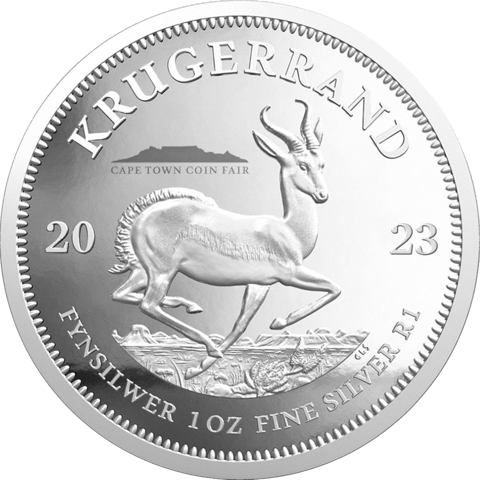 2023 to 20251 ounceCoin fairsFor the coin fairs in Cape Town, Johannesburg and Durban, the silver Krugerrand bears the name of the fair and a motif of the city as a Privy Mark. According to the South African Mint certificate, the 2023 Cape Town issue is limited to 1,000 pieces.
 2022 and 2023sets of 2 × 1 ounceBig Five and KrugerrandEach set combines a 1 ounce coin from the Big Five series with a Krugerrand that bears the animal of that coin as a Privy Mark above the springbok. The South African Mint issues each silver set in a mintage of 1,000 pieces.
More on the history of the coin: The Krugerrand saga
In January, the South African Mint switches the bullion coin dies to the new year.
For bullion coins without a year in their name, for example with the suffix “various years” or “assorted years”, the year of minting is not specified. You can find a particular year with the “Year of minting” filter.
The Silver Krugerrand unites two worlds: the legendary name of the world's most traded bullion coin and the accessibility of the precious metal silver. Since its first issue in the anniversary year 2017, the South African silver coin with the striking springbok has become a firm fixture in many collections and investment holdings. The following overview sheds light on the history, design, denominations, authenticity features, tax treatment and storage of the Krugerrand in silver, compactly and based on facts.
The Krugerrand is regarded as the world's first modern bullion coin. Introduced in gold as early as 1967, it became the benchmark for standardised investment gold and was minted millions of times over the decades. It was not until the 50th anniversary that the South African minting tradition ventured into the white precious metal: in 2017, the first Silver Krugerrand appeared, initially as a collector's edition for the World Money Fair in Berlin. Demand was so great that the Rand Refinery, together with the South African Mint, decided to add the coin to its permanent range.
Since 2018, the Silver Krugerrand has been issued as a classic bullion coin with a large mintage, closely tracking the current silver price. This places it among the world's best-known silver bullion coins, comparable to the Maple Leaf from Canada or the Vienna Philharmonic from Austria. Anyone looking for the original gold variant will find it in the Krugerrand range in gold.
The Krugerrand carries one of the most recognisable designs in the world: in silver, this icon also fits collections with a more modest budget.
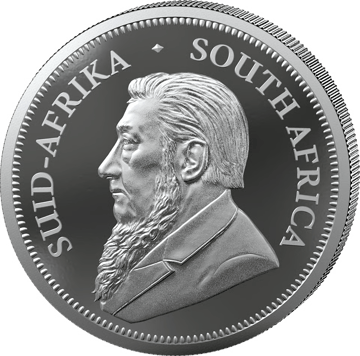
The design of the Krugerrand has remained essentially unchanged for decades and is instantly recognisable worldwide. The obverse shows the profile of Paul Kruger, President of the South African Republic from 1882 to 1902 and namesake of the coin. Kruger was an early champion of nature conservation: the protected area he helped establish later gave rise to the famous Kruger National Park.
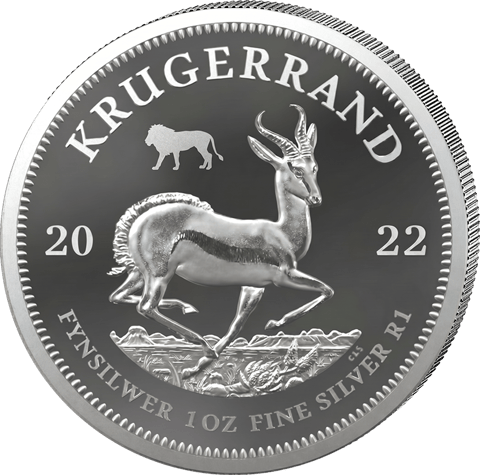
The reverse is adorned with the springbok, South Africa's national animal. The graceful antelope was created by the sculptor Coert Lourens Steynberg; his initials "CLS" are finely embossed next to the design. To the left and right appear the year of minting and the country names "Suid-Afrika" and "South Africa" in Afrikaans and English. The lettering "Krugerrand" above the springbok identifies the coin as an original, a detail that distinguishes it from numerous imitations from other countries.
One key difference from the gold version: the Silver Krugerrand carries a face value of one rand (R1). The classic gold coin, by contrast, has carried no face value since 1967; its value derives solely from its fine gold content and the gold price. At the lower edge of the silver coin, the metal and fine weight are also stated, likewise bilingually.
While the Silver Krugerrand, as a pure bullion coin, traditionally appears in the 1 oz denomination, the South African Mint has expanded the programme for collectors. In addition to the standard ounce, larger formats are now also issued in Proof quality.
The technical key data of the standard ounce at a glance:
| Feature | Detail |
|---|---|
| Fineness | 999/1,000 fine silver |
| Fine weight | 1 troy ounce (31.1 g) |
| Face value | 1 rand (R1) |
| Minting quality | Brilliant Uncirculated / Proof |
| Country of issue | South Africa |
For comparison with a pure investment form, it is worth looking at 1 oz silver bars: bars are generally closer to the pure material value, whereas Krugerrand silver coins offer a globally recognised recognition value and higher liquidity in trading. Anyone who prefers to invest their precious metal in gold will find a tax-differentiated, complementary form of investment with gold bars and the original gold coin.
The standard issue of the Silver Krugerrand is produced in premium Brilliant Uncirculated quality and is aimed at investors who want to acquire the precious metal as close as possible to the silver price. These pieces are sold individually in coin pouches or, in larger quantities, in coin tubes and master boxes.
For collectors, the mint also issues the Krugerrand in Proof (PP) quality, the finest minting quality with mirrored fields and frosted designs. Editions with a privy mark, a small additional mint mark commemorating historical occasions, coin fairs or anniversaries, are particularly sought after. These special editions are released in strictly limited mintages and come in high-quality cases with a certificate. Anyone interested in limited issues and editions will find further pieces in the limited rarities section as well as in the Big Five series in silver, which is partly based on the Krugerrand format.
As the Krugerrand is one of the best-known coins in the world, counterfeits also exist. A few features can help with an initial assessment of authenticity:
Kettner Edelmetalle relies on ISO-compliant authenticity verification and is the official German partner of the South African Mint. Suitable coin capsules are ideal for the safe storage of verified pieces, protecting the sensitive surface from scratches and tarnishing.
Unlike investment gold, which is exempt from VAT in Germany, silver coins are generally subject to VAT. For investment silver coins such as the Krugerrand from non-EU countries, the margin scheme is generally applied on import, so that only the trading margin is taxed; this keeps the premium over the pure silver value comparatively moderate.
Tax notice
For privately held precious metal, Germany applies a one-year holding period: if the coin is held for longer than twelve months, any capital gain on sale is tax-free. This information does not replace tax advice.
Anyone wishing to diversify their portfolio more broadly often combines silver coins with gold coins or with ready-made gold-silver mix packages, in order to benefit from the different tax and price characteristics of the two metals.
Silver coins react more sensitively to environmental influences than gold and can tarnish on contact with moisture or sulphur. Proper storage is crucial for preserving value, especially for Proof editions.
Suitable accessories such as coin cassettes or coin pouches can be found in the accessories range. For larger holdings, secure storage in a safe or bank safety deposit box is also recommended, ideally supplemented by suitable insurance.
The Krugerrand competes against a whole range of established silver bullion coins. Unlike the American Eagle with its fineness of 999/1,000 or the ultra-pure Maple Leaf with 9999/10,000, the Krugerrand scores above all through its globally recognised name and close connection to the original gold coin. Anyone looking for thematically related designs from Africa will also find what they are looking for with the Somalia Elephant or the African Springbok series.
For long-term wealth building, the Silver Krugerrand can easily be integrated into a regular savings plan: the consistent 1 oz denomination makes it a calculable basis. The coin is also popular with many investors as a building block for inflation hedging.
The first Silver Krugerrand appeared in 2017 for the 50th anniversary of the original gold coin, initially as a collector's edition. Since 2018 it has been issued regularly as a bullion coin in fine silver.
The silver coin is struck from 999/1,000 fine silver. The classic 1 oz version thus contains exactly one troy ounce (31.1 grams) of pure silver.
As a pure bullion coin, the Krugerrand traditionally appears in 1 oz. For collectors, additional formats of 2 oz and 5 oz are issued, mostly in Proof quality.
Proof (PP) is the highest minting quality, with mirrored fields and frosted designs. It is aimed at collectors and is usually issued in limited mintages with a case and certificate.
No, unlike investment gold, silver coins are subject to VAT. However, the margin scheme is often applied to imported investment silver coins. After a holding period of more than one year, a private capital gain on sale is tax-free.
Responsible are the South African Mint and the Rand Refinery of South Africa. Kettner Edelmetalle is the official German partner of the South African Mint.
 Krugerrand
Stay informed with product launches, financial news and exclusive offers. Sign up for our free newsletter today.
By entering your email address and clicking the "Submit" button, you give the following consent: "I agree to be informed by email about new products, financial news and exclusive offers, and therefore consent to the processing of my email address for the purpose of sending the newsletter. I can revoke this consent at any time without giving reasons, with effect for the future. The lawfulness of processing carried out prior to revocation remains unaffected."