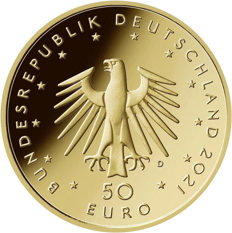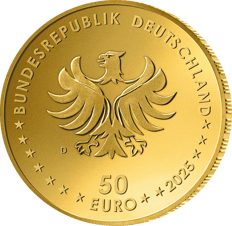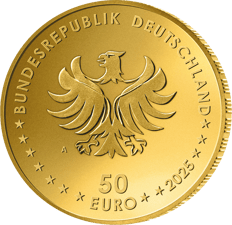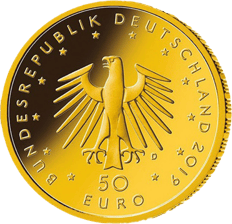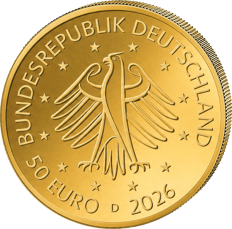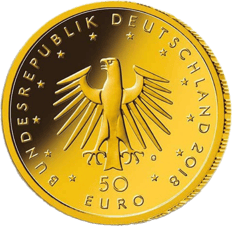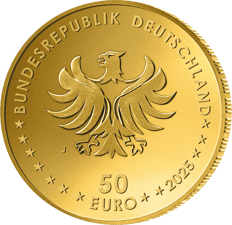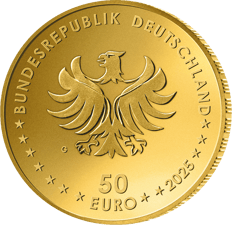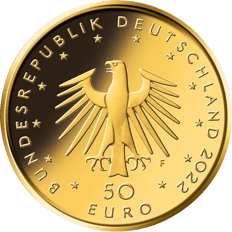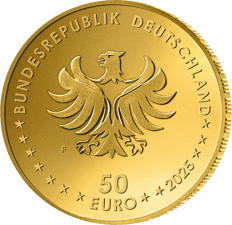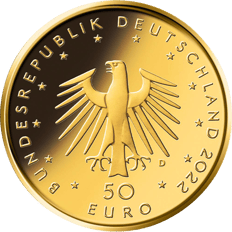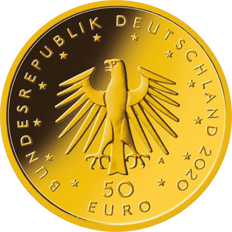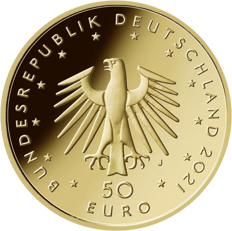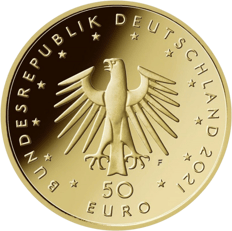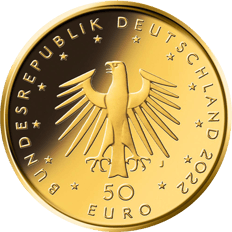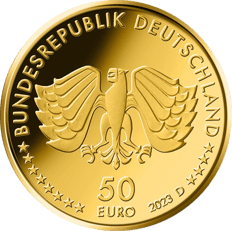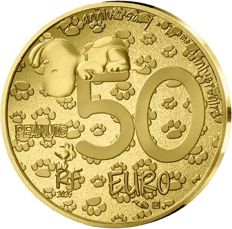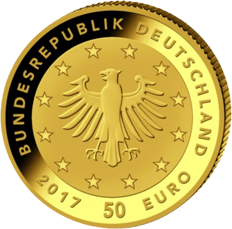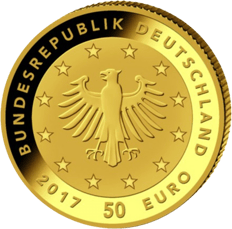
1/4 oz Gold 50 Euro Lutherrose 2017 (Various Letter)
£887.61
VAT-free and excl. shipping
Available in 2–3 business days

 More than 300,000
 Over 30 years
 Secure shipping
 Google: 4.9/5


The 50 Euro gold coin is the best-known German euro gold coin and combines an official face value with the material value of a quarter ounce of fine gold. Issued by the Federal Republic of Germany, each edition is made of 999.9 gold, weighs 7.78 grams and has appeared in thematic series since 2017. The following sections cover the history, series and designs, technical specifications, mints and mint marks, tax treatment, storage, as well as the most important purchase criteria surrounding the 50 Euro gold commemorative coin.
The 50 Euro gold coin is an official German commemorative coin with a euro face value, which is also legal tender. The imprinted face value of 50 euros is already, at the time of issue, well below the actual gold value of the piece: the value therefore derives from the precious metal and collector interest, not from the face value. This sets the edition fundamentally apart from a classic circulation coin and brings it close to internationally known investment gold coins.
Unlike pure investment products, however, the 50 Euro gold coin has a dual character: it is both a collector's item and a precious metals investment. The high fine gold content ensures a stable material value, while the limited mintage and the changing annual designs create the numismatic appeal. Anyone interested in the broader context of German collector coinage will find further face values and themed series in the overarching category of Euro commemorative coins.
The series of 50 Euro gold coins began in 2017. On the occasion of the 500th anniversary of the Reformation, the Federal Republic of Germany issued the first edition of this face value with the Luther Rose. It was originally intended as a one-off issue, but proved so popular with collectors that it developed into an ongoing series with consistent specifications, complementing the already established 100 Euro gold coins at a half ounce and the 20 Euro gold coins at an eighth of an ounce.
The 50 Euro edition thus closed a gap in the range of German euro gold coins and established the quarter ounce as its own collecting area. Since then, at least one new edition has appeared every year, resulting in a cohesive and thematically coordinated range within just a few years. Anyone looking for an entry point into German gold coinage will find complementary editions outside the euro face value in the category of German gold coins.
The range of 50 Euro gold coins is divided into clearly defined themed series. Each series follows a shared design concept, which is what makes a complete set so appealing.

The first 50 Euro gold coin depicts the Luther Rose, the emblem of the Evangelical Lutheran Church, commemorating the anniversary of the Reformation. As the inaugural edition of the entire series, it holds a special place among collectors.
This five-part series honours German instrument making, which has played an outstanding role in Europe since the Middle Ages. The sequence of designs comprises:
Since all five editions share the same technical specifications, the series can sensibly be assembled as a complete collection. Suitable coin cassettes, which neatly hold several years, are ideal for an orderly presentation.
Since 2023, the multi-year series German Craftsmanship has been running, addressing various socially significant craft sectors, including editions on Nutrition, Mobility and Health. The series follows on seamlessly from the musical instruments and maintains the identical specifications. Alongside these official series, modern collector editions with popular designs also appear, as can also be found in the broader field of collector's coins.
All 50 Euro gold coins issued by the Federal Republic of Germany share a uniform technical design. This makes the series particularly easy to follow for collectors and easy to calculate for investors.
| Feature | Specification |
|---|---|
| Face value | 50 euros |
| Material | 999.9 fine gold |
| Weight | 7.78 g (1/4 oz) |
| Diameter | approx. 20-22 mm |
| Minting quality | Mint State (MS) |
| Edge | reeded |
The fine gold content of 999.9 ranks among the highest purity levels common in modern coin minting. The small size of a quarter ounce makes the edition a comparatively accessible entry point into gold coins, noticeably more manageable than, for example, larger one ounce gold bars, which require a higher capital outlay.
A characteristic feature of German circulation and commemorative coins is the mint mark, which identifies the respective mint. The 50 Euro gold coins are produced in equal parts at all five German mints:
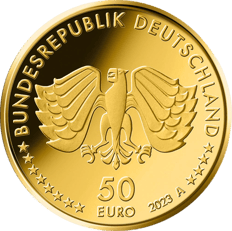
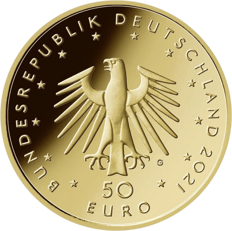
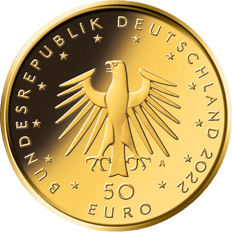
Because the total mintage is divided among the five locations, there is a limited quantity per letter for each year of issue. This creates an additional collecting goal for specialised collectors: the mint mark set, which brings together all five letters of an edition. The obverse traditionally features the federal eagle, the value digit, the year and the twelve stars of Europe. Further official German coins with mint marks can be found under the manufacturer Münze Deutschland.
The mintages of the 50 Euro gold coins are strictly limited and have changed over the years. While the Luther Rose was issued with a six-figure total mintage, later editions were minted in smaller quantities. This limitation is a key factor in collector interest.
The value of a commemorative coin stems from two sources: the actual gold content and the numismatic desirability of its limited mintage.
As a general rule: the lower the mintage and the more complete a series is available, the more the collector premium can rise above the pure material value. However, specific price developments cannot be predicted; historical observations do not constitute a forecast. Anyone who views precious metal primarily as a store of tangible value will find in classic gold bullion coins a complement with a closer link to the current gold price.
An important aspect when buying gold coins is VAT. In Germany, investment gold is exempt from VAT under certain conditions. Coins that meet these criteria are traded without VAT, a clear advantage over many silver products.
Tax note
Investment gold is generally exempt from VAT in Germany. A one-year holding period also applies for the tax-free sale of gains from physical gold. This is general information and does not replace tax advice; binding information is provided by a tax advisor.
When selling privately held gold coins, gains made can remain tax-free after a one-year holding period has elapsed. This rule makes physical gold attractive compared with many other forms of investment. Anyone who regularly builds up smaller amounts could alternatively consider savings plan products, which make gradual acquisition easier.
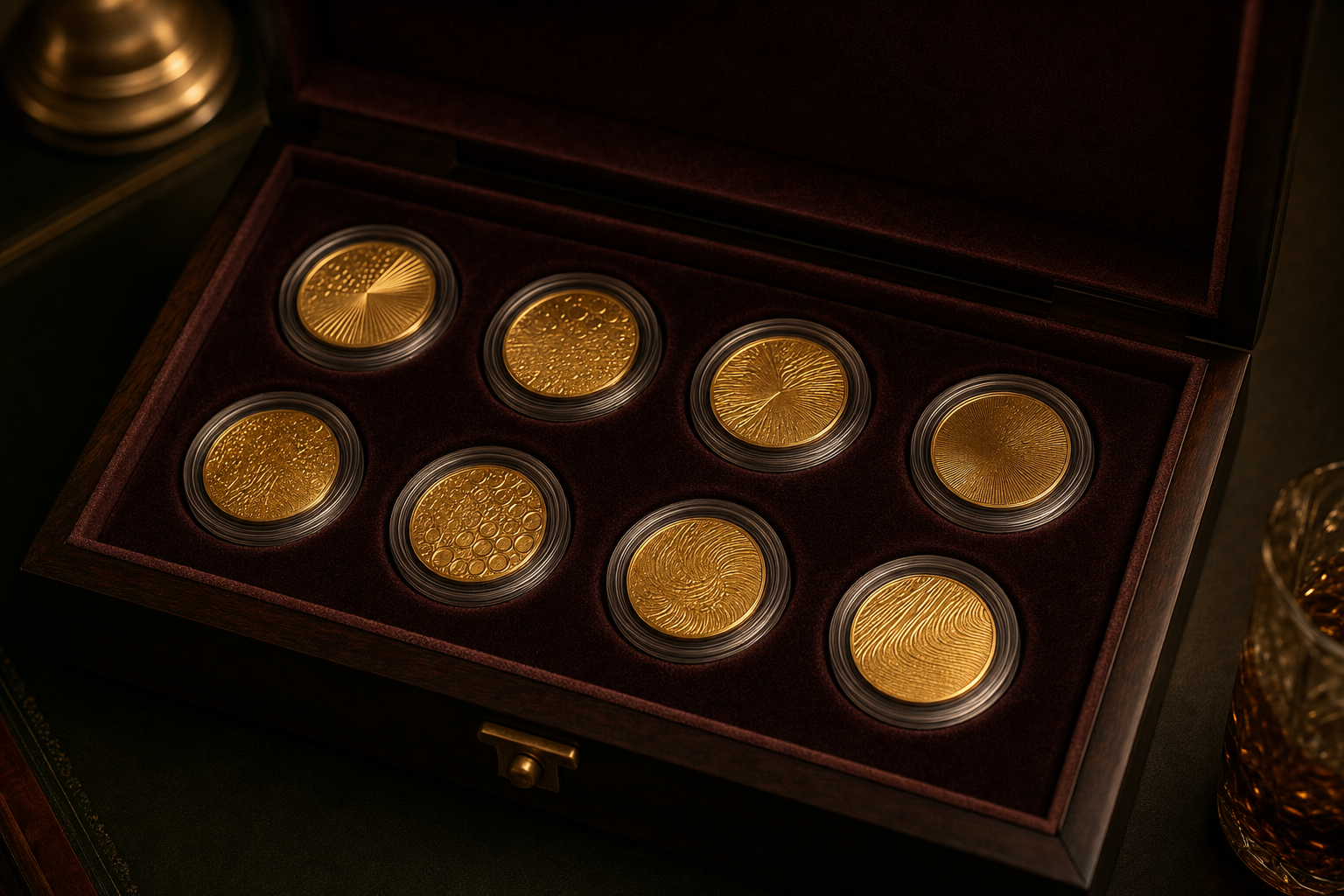
Since the 50 Euro gold coin has both material and collector value, proper storage plays a particularly important role. Even small scratches or fingerprints can reduce the condition and therefore the numismatic value. Storage in the original case or in purpose-made accessories is therefore recommended.
For the long-term storage of several editions, master boxes are also suitable, as they hold capsules and cases together securely. A dry, temperature-stable storage location prevents tarnishing and preserves the shine of the fine gold for years.
When buying a 50 Euro gold coin, it's worth looking at several factors: the desired year of issue, the completeness of a series, the condition, and the presence of a case and certificate of authenticity. Collectors also pay attention to the mint mark, while for buyers focused purely on the gold value, the current price gap to the pure material value is decisive.
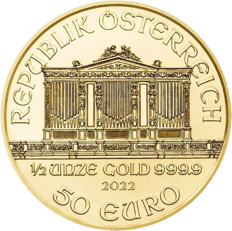
Compared with international investment classics such as the Krugerrand or the Maple Leaf, the German 50 Euro edition scores points with its higher fineness of 999.9 and its national collector appeal. Investment classics, in turn, are available in large quantities and are therefore particularly liquid. Another euro alternative with investment character is the Austrian Vienna Philharmonic, which likewise carries a euro face value. Anyone wishing to further explore the face-value system of German commemorative coinage will find the largest regular edition of this series in the 200 Euro gold coins.
Every 50 Euro gold coin issued by the Federal Republic of Germany is made of 999.9 fine gold and weighs 7.78 grams. This corresponds exactly to a quarter ounce of pure gold.
The Luther Rose formed the opening edition in 2017. It was followed from 2018 to 2022 by the five-part series German Musical Instruments, featuring the double bass, fortepiano, orchestral horn, timpani and concert guitar. Since 2023, the multi-year series German Craftsmanship has been running, with themes such as nutrition, mobility and health.
The letters are mint marks and represent the five German mints: A for Berlin, D for Munich, F for Stuttgart, G for Karlsruhe and J for Hamburg. Each edition is produced in equal parts at all five mints.
Investment gold is generally exempt from VAT in Germany, provided the legal requirements are met. For a binding tax assessment of a specific individual case, a tax advisor should be consulted.
Yes, the coin is official legal tender with a face value of 50 euros. However, its material value is significantly higher than its face value, which is why in practice it is traded as a collector's and investment item rather than being spent.
For collectors, the complete set is often particularly appealing, since a complete series as a whole can be more sought-after than individual pieces. Whether this results in a financial advantage depends on mintage, demand and condition, and cannot be reliably predicted.
 Commemorative Coins50 Euro
Stay informed with product launches, financial news and exclusive offers. Sign up for our free newsletter today.
By entering your email address and clicking the "Submit" button, you give the following consent: "I agree to be informed by email about new products, financial news and exclusive offers, and therefore consent to the processing of my email address for the purpose of sending the newsletter. I can revoke this consent at any time without giving reasons, with effect for the future. The lawfulness of processing carried out prior to revocation remains unaffected."