Only 1 left to order
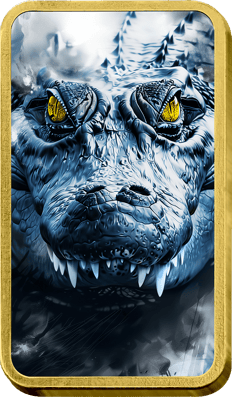
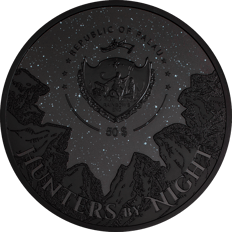
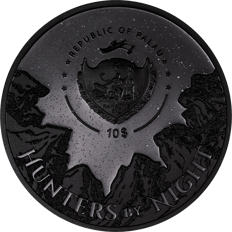
2 oz Silver Hunters of the Night - Caiman 2023 (Mintage: 888 | Obsidian Black | Ultra High Relief)
£506.34
excl. UK import VAT and shipping
Available in 2–3 business days

 More than 310,000
 Over 30 years
 Secure shipping
 Google: 4.9/5


Frogs are amphibians, animals with naked, permeable skin that has to stay moderately moist. Researchers observed, counted and measured on frogs how a nest of foam forms on land, how water gets through the skin and how often in a minute a frog calls, while another hardly calls. The following sections retell what they found.
Frogs do not always lay their eggs in water. Méndez-Narváez and Warkentin wrote in 2022:
Vertebrate colonization of land has occurred multiple times, including over 50 origins of terrestrial eggs in frogs.
In 2004 Gibson and Buley described, from four nests, how the mountain chicken, a large frog, builds its nest on land. The animals in their study came from the island of Montserrat.
Diagram after Gibson and Buley: from a point on the ground, foam, bubbles of different sizes, grows into a flat mound. Building the nest took 9.25 and 14 hours in two nests. Within 24 hours the foam forms a firm, flexible skin, in the diagram the strong line at the edge of the mound.
Diagram
The male whips up the foam: he paddles back and forth in bouts with both hind legs at once, between the bouts the female releases fluid, and so a nest of foam grows in a nesting burrow. In two nests, building took 9.25 hours and 14 hours. Within 24 hours the foam had a firm, flexible skin, so resilient that a female could sit on the nest.
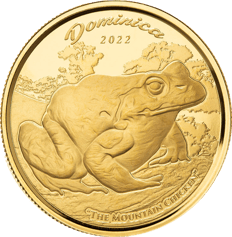
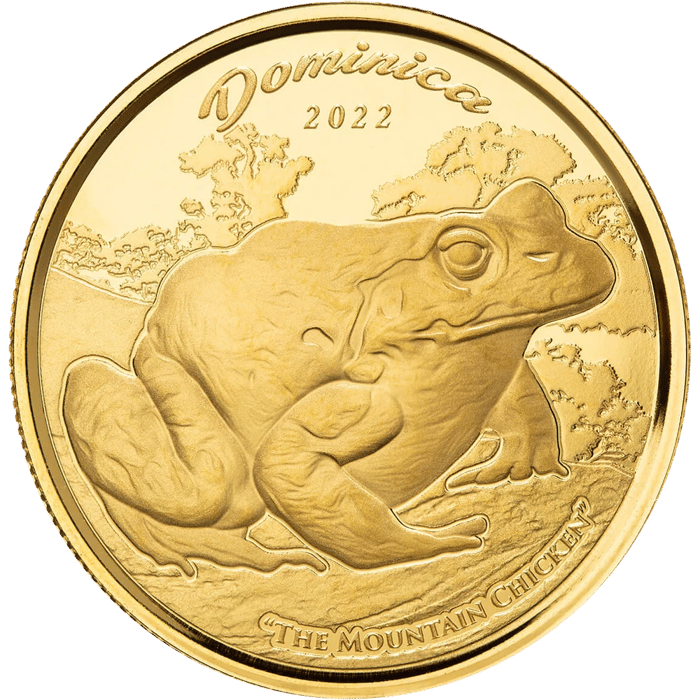
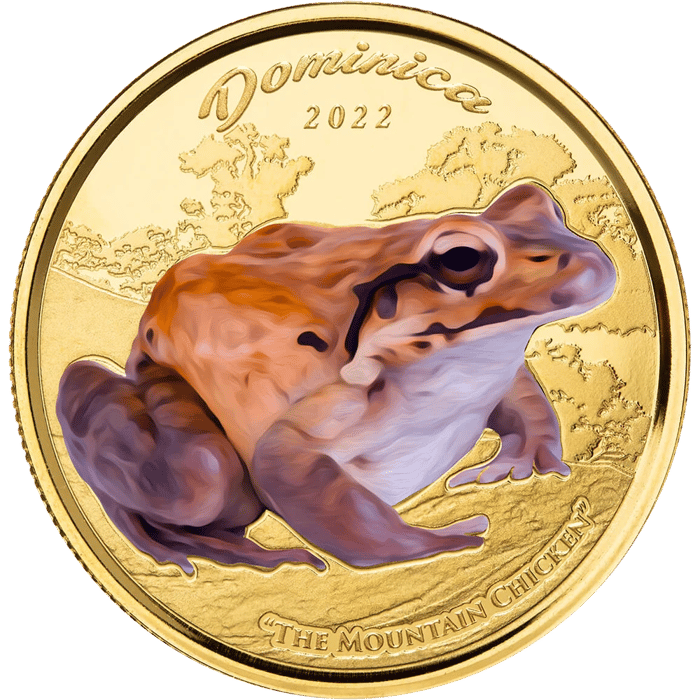
On gold, a large frog in profile, crouching, the hind legs tucked in, with a large eye; behind it trees and shrubs in fine lines.
The larvae, the tadpoles, develop in the foam. The female adds trophic eggs 10 to 13 times, unfertilised eggs on which the larvae live: on average every 3 days, sometimes as early as after one day, once as late as after 11 days. For eight provisionings Gibson and Buley measured how long they took: 15 to 90 minutes. In between, the foam turns thick and shrinks; the movements of the larvae and of the legs of the female renew it. In one nest the larvae grew from about 27 mm on day 12 to about 127 mm on day 33. From the finished nest to metamorphosis, the remodelling of the larva into a frog, 42 to 57 days passed, and in each nest 25 to 43 larvae became young frogs of 1.6 to 3.6 g.
In 2023 Akat Çömden and colleagues described how the skin of amphibians changes in the move from water to land, and wrote:
Amphibian skin is a particularly complex organ that is primarily responsible for respiration, osmoregulation, thermoregulation, defense, water absorption, and communication.
Diagram after Lemenager and colleagues and after Akat Çömden and colleagues: a large drop hangs over a horizontal surface, the belly skin. In the surface lies an oval zone of a stronger tone, the seat patch, an area of the belly skin with a rich blood supply. The drop falls onto the zone, flattens and disappears into it, and the zone darkens in the tone of the water: in most amphibians water comes in through the skin, not through the mouth.
Diagram
Anurans, the group of all frogs, do not drink, according to Lemenager and colleagues: they make up for water losses by taking up water through the skin. Many frogs take it up quickly through the seat patch, an area of the belly skin with a rich blood supply. In most amphibians, according to Akat Çömden and colleagues, water uptake runs through channels made of aquaporins, proteins in the membrane of the cells that let water through, not through drinking with the mouth. Lemenager and colleagues measured six frog species; the red-eyed tree frog was not among them.
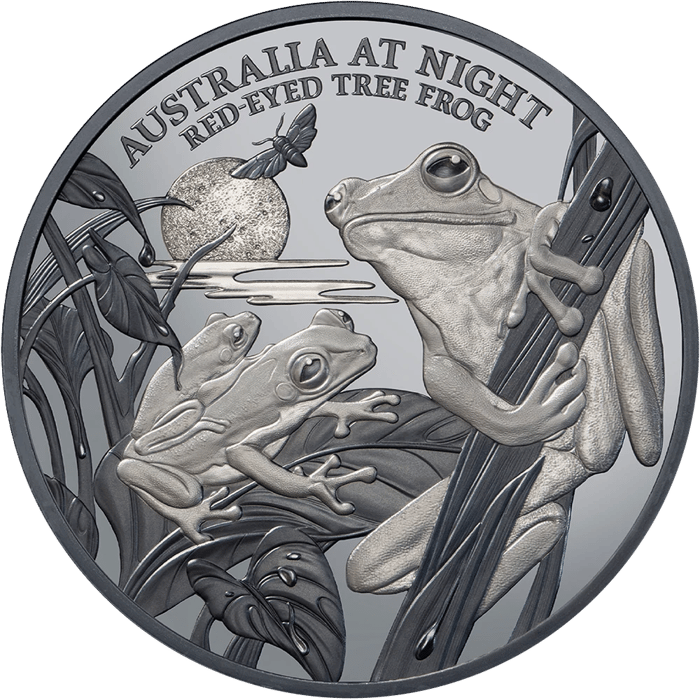
Three tree frogs at night on silver: a large one holds on to a stem, two smaller ones sit on a leaf; with them a full moon and drops on leaves and stem.

Tree frogs hold on with toe pads, broad cushions on the tips of their fingers and toes. In 2006 Federle and colleagues described the skin of the pads: hexagonal cells with small pegs, separated by deep channels into which glands open; a watery film wets the toe pads completely. According to their measurements, close contact and friction strengthen the grip. According to Endlein and colleagues in 2013, a tree frog stretches one or two legs outward from an incline of about 106 degrees, when the surface already overhangs, and all of them from about 131 degrees. Both studies were of White’s tree frog, Litoria caerulea, not of the red-eyed tree frog. Its fingers, according to the frog register FrogID, are joined by webbing for three quarters of their length and its toes almost completely, both with large toe pads.
Not every frog calls to an equal extent. According to New Zealand’s Department of Conservation, New Zealand’s native frogs have no external eardrum, the round patch on the side of the head that other frogs have, and they do not call regularly like most frogs.

Diagram after Gibson and Buley and after New Zealand’s Department of Conservation: three circles of equal size. The first stands for the call of the mountain chicken, 45 to 50 a minute, the second for the faster trill in courtship, 100 to 120 a minute. Both pulse for twelve seconds in their rhythm, then they stand still. The third circle stands for Archey’s frog, which hardly calls, and stays still.
Diagram
In the mountain chicken, Gibson and Buley counted 45 to 50 calls a minute in animals from Montserrat. The males called at all times of day and night, more often in the early morning and the late afternoon. In courtship of a female the call turned into a rapid trill, with 100 to 120 calls a minute, until the female came into the nesting burrow.
In colour on gold: a crouching frog with an orange-brown back, a pale belly and violet-brown legs, behind the eye a dark stripe; behind it trees in fine lines.
According to the Department of Conservation, Archey’s frog is the smallest native frog of New Zealand; it gives a length of up to 37 mm for it, and up to 40 mm in its species profile. Germano and Daglish wrote in 2009 about New Zealand’s native frogs, to which it belongs: they lack the eardrum and parts of the middle ear, and according to the two of them the missing external eardrum is the reason they are mute. Instead of calling, they communicate through chemical signals.
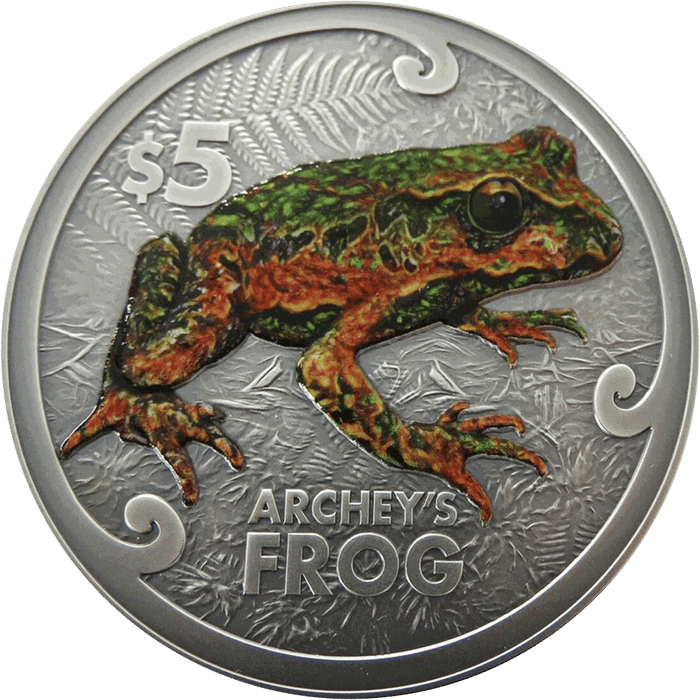
According to the issuer, the frog, up to 37 mm long, appears to scale on the 50 mm coin. Coloured in green, rust red and brown, it sits on foliage, behind it a fern frond, at the edge three spirals.
In animals from Montserrat, Gibson and Buley described a nest of foam that forms on land and develops a firm skin within 24 hours, and they counted up to 120 calls a minute in courtship. According to Lemenager and colleagues, anurans take up water through the skin instead of drinking, and according to Germano and Daglish, Archey’s frog is mute.
Amphibians are among the oldest vertebrates on Earth and have, in recent years, secured a firm place in the world of modern collector's coins. Whether it's a brightly coloured red-eyed tree frog, the rare Archey's frog from New Zealand, or richly detailed toads and newts engraved in intricate high relief: the world of motifs surrounding frogs, toads, salamanders and newts combines zoological fascination with fine minting artistry. This guide highlights the most important series, denominations, minting techniques and authenticity features of amphibian coins and places them in the context of collecting and investment.
Amphibians form their own class within the vertebrates and comprise three major orders: frogs and toads, salamanders and newts, and the worm-like caecilians. Their name derives from the Greek amphibios and roughly means living a double life: a reference to their existence between water and land. It is precisely this in-between world that makes them such a rewarding motif for coin minting, as mints can render their vivid colouring, glossy skin and dynamic body shapes particularly effectively in relief.
Unlike classic bullion coins with their ever-recurring standard motifs, amphibians are minted almost exclusively as thematic collector's editions. They are issued in limited mintages, often featuring colouring, partial gilding or elaborate night designs. Anyone interested in lively animal motifs will also find fitting additions for a theme-based collection in related categories such as snakes or insects.
In many cultures, frogs are regarded as symbols of luck, transformation and fertility. This cultural significance, combined with ecological awareness of endangered species, makes amphibian coins doubly interesting for collectors. Series such as the issues dedicated to endangered and extinct species deliberately take up the theme of species conservation, combining the pleasure of collecting with a connection to nature.
The range of amphibian mintages spans from naturalistic single motifs to entire country and theme series. Some of the best-known issues found in this category and in thematically related ranges include:
Many of these editions come from renowned mints such as Scottsdale Mint or B.H. Mayer. Anyone wishing to collect the entire animal kingdom will find a broad overview of related motif groups in the parent category Land Animals.
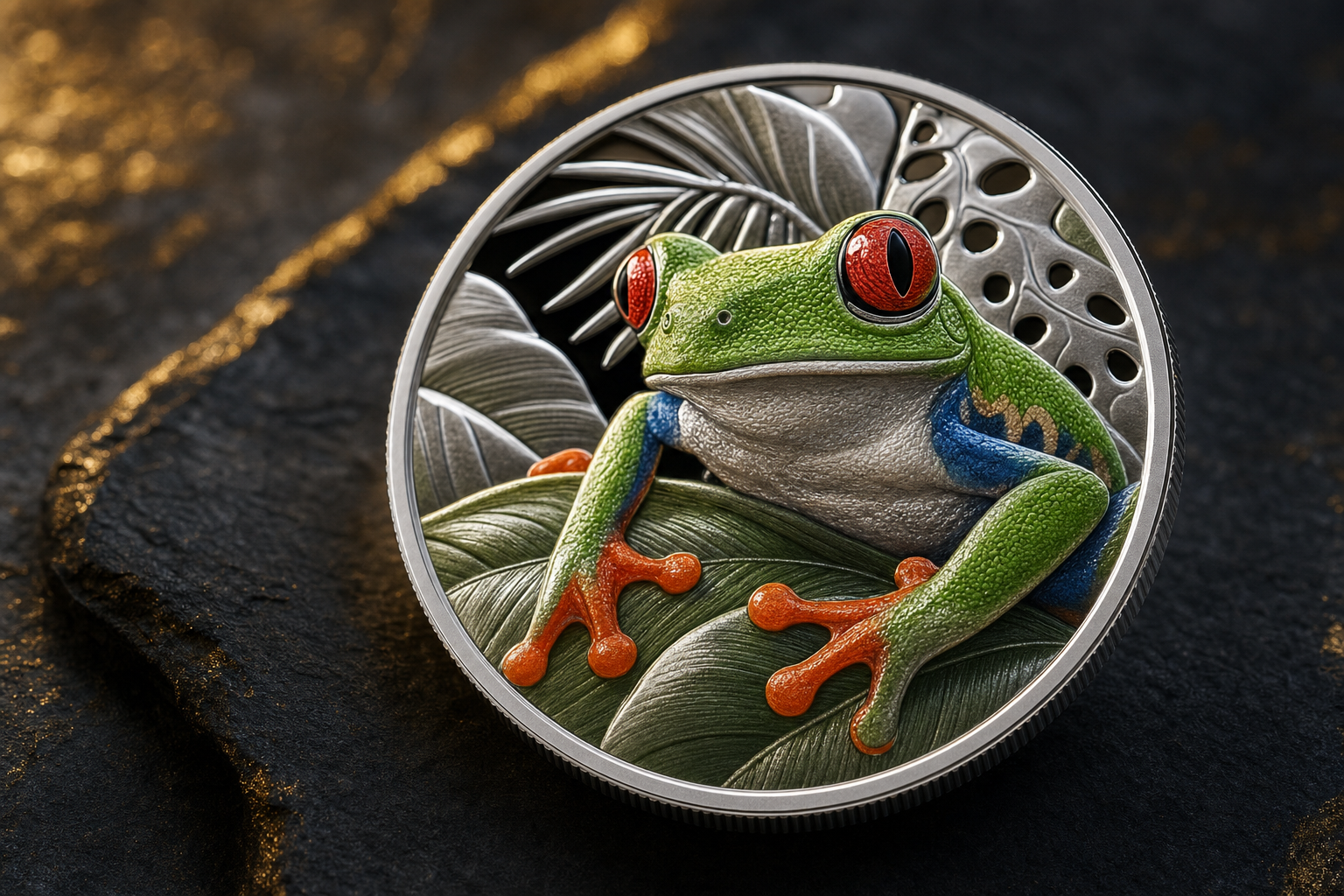
Amphibian coins are minted in various weights, with the classic 1-ounce denomination forming the core of the range. In addition, there are heavier variants with high relief as well as very small gold mintages. The most important formats compared:
| Format | Typical use | Special feature |
|---|---|---|
| 1 oz silver | Standard format for collector series | Ideal surface for colouring and detailed engraving |
| 2 oz silver | Ultra high relief, antique finish | Sculptural depth effect, emphasises the body shape |
| 1 kg silver | Prestige editions in very small mintages | Collector's highlight with high material value |
| 1 oz gold | High-quality individual mintages | VAT-exempt as investment gold |
The 1-ounce silver edition is particularly suitable for beginners, as it offers a balanced ratio of motif surface, material value and price. Anyone wishing to focus on the pure material aspect will find the right bullion classics as a complement to a thematic collection among silver coins and gold coins.
Silver is the dominant metal for amphibian motifs, because its bright surface shows colouring and fine engravings to good effect. Gold mintages of amphibians, by contrast, are rare and usually kept to very small mintages: accordingly, they are among the sought-after pieces. An important difference lies in the tax treatment: investment gold is exempt from VAT in Germany, whereas the margin scheme generally applies to silver coins. Suitable storage solutions for both metals can be found in the range of coin capsules.
The visual effect of an amphibian coin depends largely on the minting technique used. Modern mints combine several processes to capture the vitality of the animals:
The Proof grade of preservation additionally provides mirror-like fields and matte motif areas. Such finishes are also found on other animal series, for example on predators or marine animals, which use similar techniques.
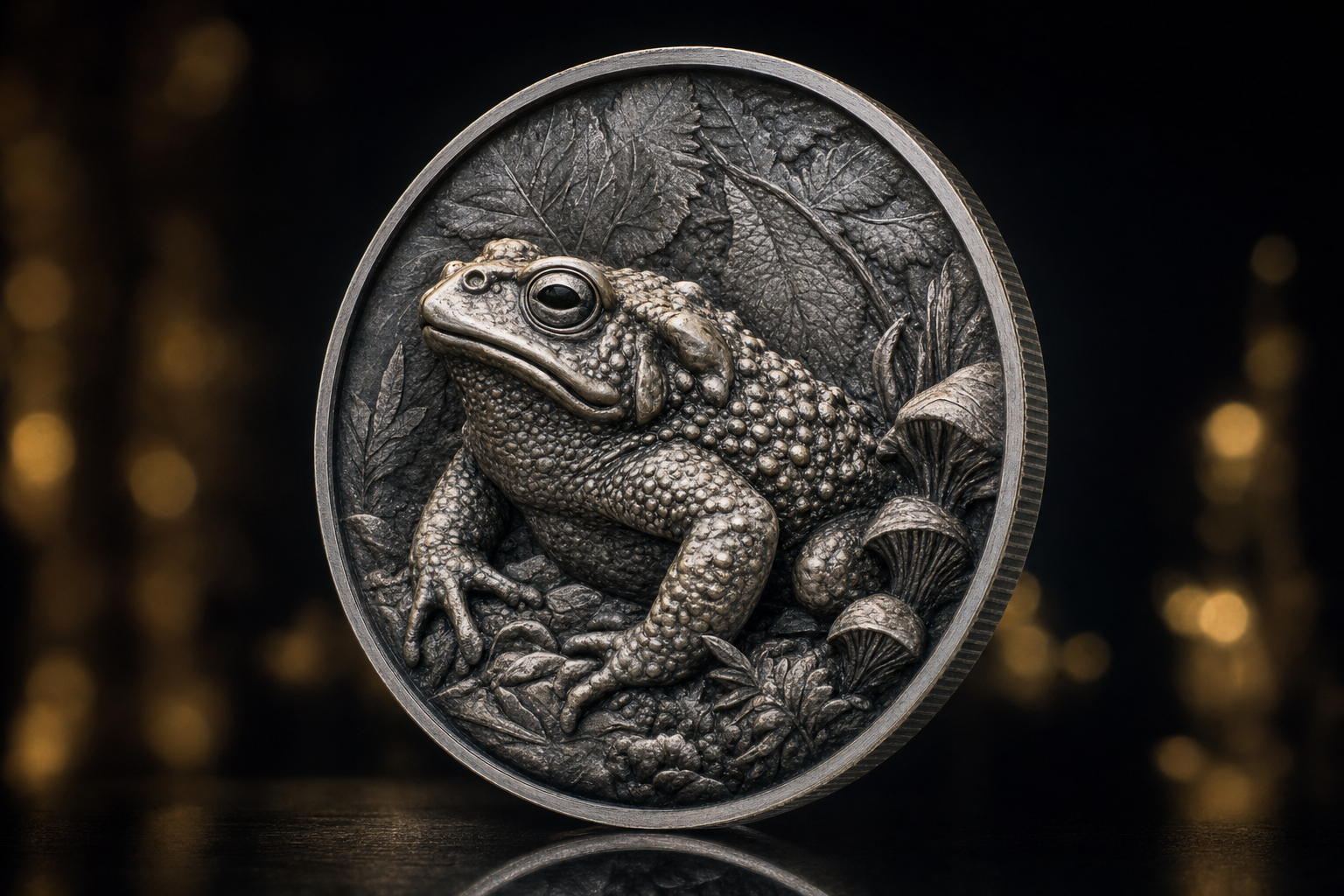
An amphibian coin lives on detail: from the moist sheen of the skin to the precise depiction of the eyes, the minting quality determines the appeal of the collector's piece.
The collector's value of an amphibian coin is strongly determined by the mintage size. Editions of only 100 or 150 pieces are naturally far more sought after than series mintages of 25,000 or 50,000 pieces. Besides the sheer number of pieces, other factors also play a role:
It is important to distinguish between the collector's aspect and the investment aspect. The material value of a silver coin is based on the silver price, while the premium (numismatic value) depends on demand, rarity and condition and is subject to fluctuation. Anyone primarily seeking the metal value is often better served with silver bars; anyone who enjoys the design and motif will find greater appeal in collector's coins. An overview of purely collection-oriented editions is offered by the category collector's coins.
Collector's coins are high-value objects whose condition determines their value. At Kettner Edelmetalle, every precious metals product undergoes an ISO-compliant authenticity verification before being dispatched by insured shipping. A few basic rules apply to private storage:
Practical solutions for orderly storage are offered by coin cassettes and coin cases, which securely hold individual pieces in place and present them clearly. Additional knowledge about grades of preservation can be found in the books section.
When it comes to tax classification, a distinction must be made between gold and silver. Investment gold is exempt from VAT in Germany, which is why gold mintages of amphibians are offered without VAT. Silver coins, by contrast, are generally subject to the margin scheme, under which tax is only charged on the trading margin.
Tax notice
This information is for general purposes only and does not constitute tax advice. The specific tax treatment may change and depends on the individual case. For binding information, expert advice should be obtained.
When buying an amphibian coin, it is worth looking at the following criteria: verified origin and manufacturer, documented mintage size, complete accessories such as case and certificate, and a flawless grade of preservation. Anyone building a collection with a specific focus can include thematically related bird motifs or editions from the prehistoric era category to complete a cohesive nature theme.
Frogs appear most frequently, above all the brightly coloured red-eyed tree frog. In addition, rare species such as New Zealand's Archey's frog or the Caribbean Mountain Chicken are minted. Newts and salamanders are rarer but do appear in individual nature series.
They are primarily collector's coins with a thematic focus. Their value is made up of the precious metal content and a numismatic premium. Anyone wishing to invest primarily in the material value should consider classic bullion coins or bars.
The lower the mintage, the rarer the piece. Editions of 100 to 150 pieces are significantly harder to obtain than series mintages of several thousand pieces. Alongside the motif and the grade of preservation, rarity is a key factor in collector's value.
No. Coloured or finished surfaces should never be cleaned or polished, as even small interventions can damage the minting and significantly reduce the collector's value. Storage in capsules or cases is the best protective measure.
Gold mintages are considered investment gold and are exempt from VAT in Germany. Silver coins are generally subject to the margin scheme. Since regulations may change, this information does not replace individual tax advice.
With ultra high relief, the motif is minted particularly deep and sculptural, creating a pronounced three-dimensional effect. Especially with amphibians, this technique emphasises the body shape and makes the minting a visual highlight. Such editions often appear in heavier denominations such as 2 oz.
 Land AnimalsAmphibians
Stay informed with product launches, financial news and exclusive offers. Sign up for our free newsletter today.
By entering your email address and clicking the "Submit" button, you give the following consent: "I agree to be informed by email about new products, financial news and exclusive offers, and therefore consent to the processing of my email address for the purpose of sending the newsletter. I can revoke this consent at any time without giving reasons, with effect for the future. The lawfulness of processing carried out prior to revocation remains unaffected."