Only 1 left to order
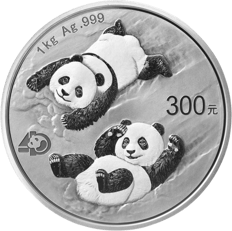
1kg Silver China Panda 2022 PP (Proof | Mintage: 20,000)
£3,612.09
excl. UK import VAT and shipping
Available in 2–3 business days
 +49 7930-2699

 More than 310,000
 Over 30 years
 Secure shipping
 Google: 4.9/5


Hardly any bullion coin combines emotional collecting pleasure and sober silver value as skilfully as the China Panda. Since 1983, the state-owned China Mint has struck the People's Republic's friendly heraldic animal in fine silver, and unlike almost every other bullion coin in the world, the Panda features a new design every year. It is precisely this change that makes the series so vibrant: whoever holds a China Panda silver coin in their hand holds a piece of Chinese minting artistry that will never be issued in exactly the same way again. The following sections shed light on the history, denominations, designs, authenticity features and tax particularities of the series.
The silver Panda made its debut in 1983, just a few years after the launch of the gold variant. It is issued by the People's Bank of China and struck at the state mints of the China Mint in Shenyang and Shenzhen. What began as a small mintage grew into one of the world's most widely collected silver series, carried by the simple idea of depicting a nationally beloved animal instead of a ruler's portrait.
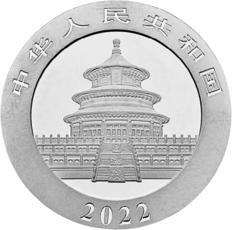
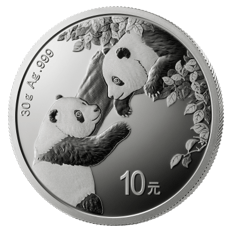
The reverse remained constant over the decades and shows the Temple of Heaven in Beijing, a UNESCO World Heritage Site and symbol of imperial sacrificial ceremonies. The obverse, on the other hand, is the real stage: sometimes a single panda nibbles on bamboo, sometimes a mother and her cub frolic together, sometimes the animal looks directly into the camera. This annual reinterpretation is the hallmark of the series and a key reason for its demand among collectors. Anyone wishing to compare the world of classic bullion coins will find suitable alternatives in the silver coins range, from Maple Leaf to Vienna Philharmonic.
The annual change of design is not a marketing gimmick for the China Panda but a tradition lived for over four decades. Only once, in 2001 and 2002, was the same design repeated, a circumstance still regarded among collectors today as a curiosity. Each year of issue therefore represents an independent work of art.
In addition to the regular strikes, there are numerous enhanced special editions: coloured Pandas, in which the design appears lifelike thanks to colour printing, partially gilded variants and editions with a hologram. These editions appear in strictly limited mintages, sometimes just a few hundred pieces, and are clearly aimed at the collector market. Anyone specifically looking for current strikes will find what they need in the China Panda 2025 category; the gold edition under China Panda Gold also follows the same design concept.
A panda is reinvented every year: that is the appeal of a series that never stands still.
A defining turning point in the series' history was the switch to the metric system in 2016. Until 2015, the standard Panda was struck in 1 troy ounce (31.1 grams), and since then in a round 30 grams. This alignment with the weight system common in China eases domestic trade, but makes older ounce-based years particularly appealing to collectors.
The smaller formats are suitable for gradually building up a silver holding, while the large Proof editions tend to carry the character of a collector's item. Anyone who prefers silver in larger units without an annual change of design will find a bar-based complement in the 1 kg silver bar. For the classic investment perspective, it is also worth taking a look at the silver bullion coins.
China Panda silver coins are made of 999 to 999.9 fine silver and bear on the reverse the official face value in yuan as well as the weight and fineness details. These very minting details are a first criterion for verification: the lettering, edge design and the fine fur texture of the panda are razor sharp on genuine pieces.
Recommended verification steps for a private collection:
Kettner Edelmetalle relies on an ISO-compliant authenticity verification and sources its strikes through established supply chains, so that origin and quality remain traceable. For the safe storage of sensitive Proof editions, suitable coin capsules are recommended, as they prevent scratches and oxidation.
Unlike investment gold, silver coins are subject to VAT in Germany. For investment silver coins from non-EU countries, the margin scheme generally applies, under which tax is charged only on the trading margin and not on the full value of the goods. After a holding period of one year, a private capital gain is also tax-free; this information is general in nature and does not replace individual tax advice.
Note on storage
Silver reacts more sensitively to air and moisture than gold and can tarnish. Dry, dark storage in capsules or a case preserves the minting lustre, especially for coloured and partially gilded editions.
For larger holdings, orderly storage is recommended, for example in a coin case or a capsule safe. This keeps the collection not only secure, but also well organised and stable in value over time.
The decisive difference from many competitors lies in the annual change of design. While the Maple Leaf and the Vienna Philharmonic have kept their fixed design for decades, shining as pure investment products, the Panda combines the silver value with a genuine collecting appeal.
For investors, this means a dual perspective: on the one hand, the material value follows the silver price, while on the other, rare years and limited special editions can develop a collector's potential that goes beyond the pure metal value. This is explicitly not associated with any promise of returns. Anyone who appreciates thematically related, design-rich series will also find strikes with annually changing animal designs under Koala or Kookaburra.
The series appeals to a broad audience. Beginners appreciate the affordable 30-gram denomination as an entry point into silver, experienced collectors chase complete year sets or rare coloured editions, and gift-givers happily reach for the Panda, because the design brings immediate joy even without specialist knowledge.
Suitable gift ideas related to precious metals can be found in the gift ideas category, while entry into the market can be planned via a broadly diversified range of silver products.
The annual change of design has been a tradition of the China Mint since the series began. Only in 2001 and 2002 was the same design shown. Each year of issue therefore represents an independent collector's item, which makes the series particularly lively.
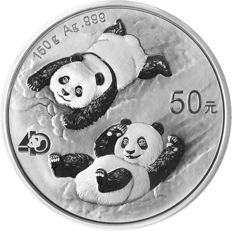
Today's standard is the 30-gram coin. Until 2015, it was struck in 1 troy ounce. For collectors, there are also larger editions in 150 grams and 1 kilogram, usually in Proof quality and strictly limited.
In 2016, China switched the Panda series from the ounce system to the metric system. Instead of 31.1 grams (1 oz), the standard coin has since weighed a round 30 grams. This makes older ounce-based years particularly interesting for collectors.
As a silver coin, the Panda is subject to VAT, often in the form of the margin scheme. After a private holding period of one year, capital gains are tax-free. This information is of a general nature and does not replace individual tax advice.
Genuine pieces are made of 999 to 999.9 fine silver, bear the face value in yuan and show razor-sharp fur texture. Weight, diameter and the absence of magnetism can be easily checked. An established dealer with authenticity verification provides additional security.
Proof (PP) refers to a special minting quality with mirrored surfaces and a matte, raised design. This elaborate production method is particularly common for the large 150-gram and 1-kilogram editions and is aimed at collectors.
 YouTube OffersChina Panda Silver
Stay informed with product launches, financial news and exclusive offers. Sign up for our free newsletter today.
By entering your email address and clicking the “Submit” button, you give the following consent: “I agree to be informed by email about new products, financial news and exclusive offers, and therefore consent to the processing of my email address for the purpose of sending the newsletter. I can revoke this consent at any time without giving reasons, with effect for the future. The lawfulness of processing carried out prior to revocation remains unaffected.”