








100 Old Deutsche Mark Banknote Gold Minted Bar (Mintage: 1,000 | Old Design | Proof)










- Genuine Investment Gold: 999.9 fine gold
- Official Coin: 25 dollar face value
- Secure Shipping: fully insured
- Genuine Investment GoldThe value is based on pure gold and follows the gold price
- Official CoinLegal tender of the Republic of Liberia
- Secure ShippingYour delivery is 100% insured and anonymous
 Price alert set
 share
share
First Bundesbank series, 100 marks
Sebastian Münster,after Christoph Amberger.
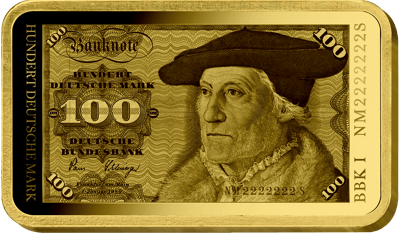
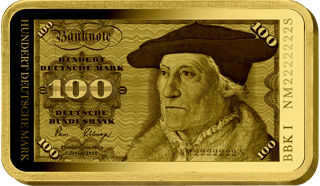
A 1/200 ounce gold bar by Kettner Edelmetalle, just 15 × 8.5 millimetres in size, showing the design of the 100 DM note from the Bundesbank’s first series.
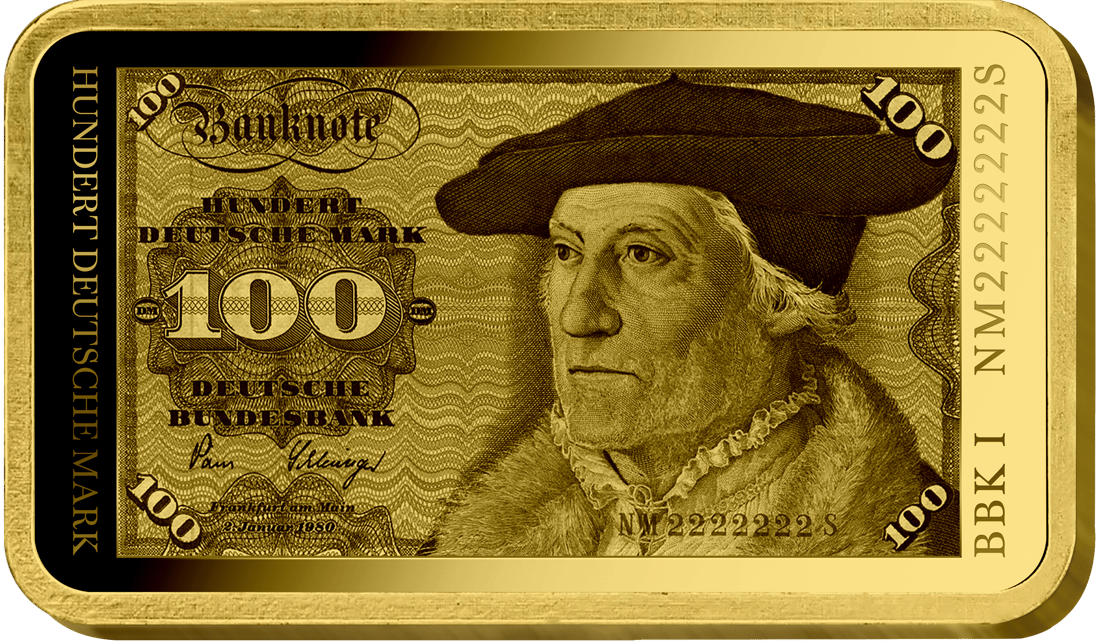
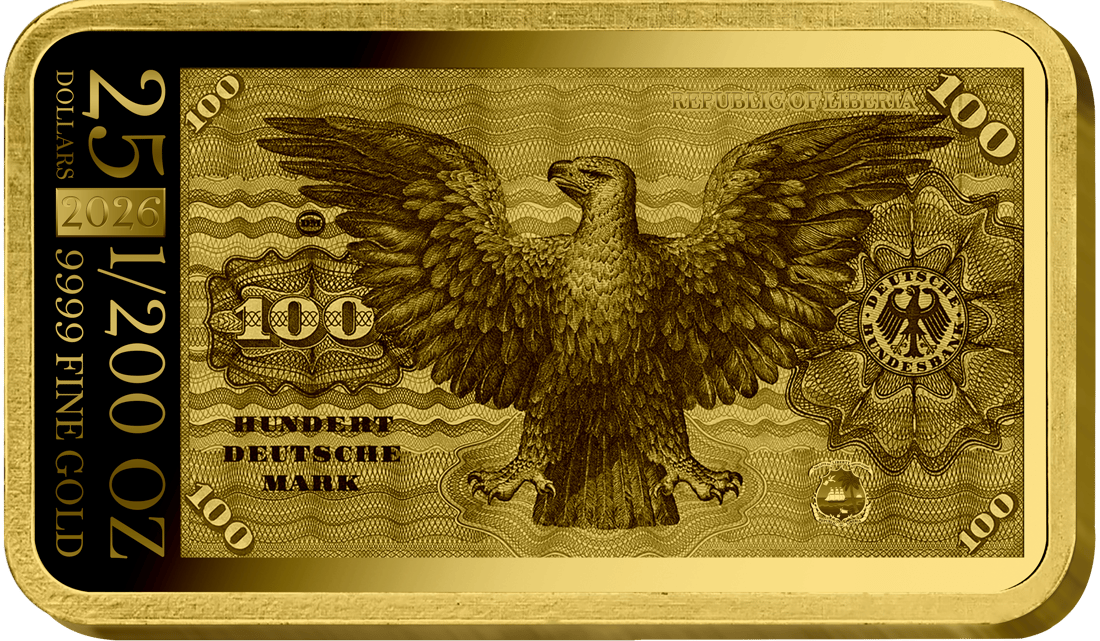
Image greatly enlarged. The bar measures 15 × 8.5 millimetres.
Image of the front of the bar with the design of the 100 DM note: Sebastian Münster

The face of the note
The cosmographer Sebastian Münster
The portrait shows Sebastian Münster after a painting Christoph Amberger made in Augsburg in 1552. The painting is in the Gemäldegalerie in Berlin. Münster lived from 1488 to 1552 and was a Hebraist and cosmographer. In the Bundesbank’s words, his “Cosmographia” won world fame.
The back shows an eagle with outspread wings.
For its first series, the Bundesbank deliberately chose heads from old, recognised paintings. The names of painter and sitter do not appear on the notes, because some were unknown or uncertain.
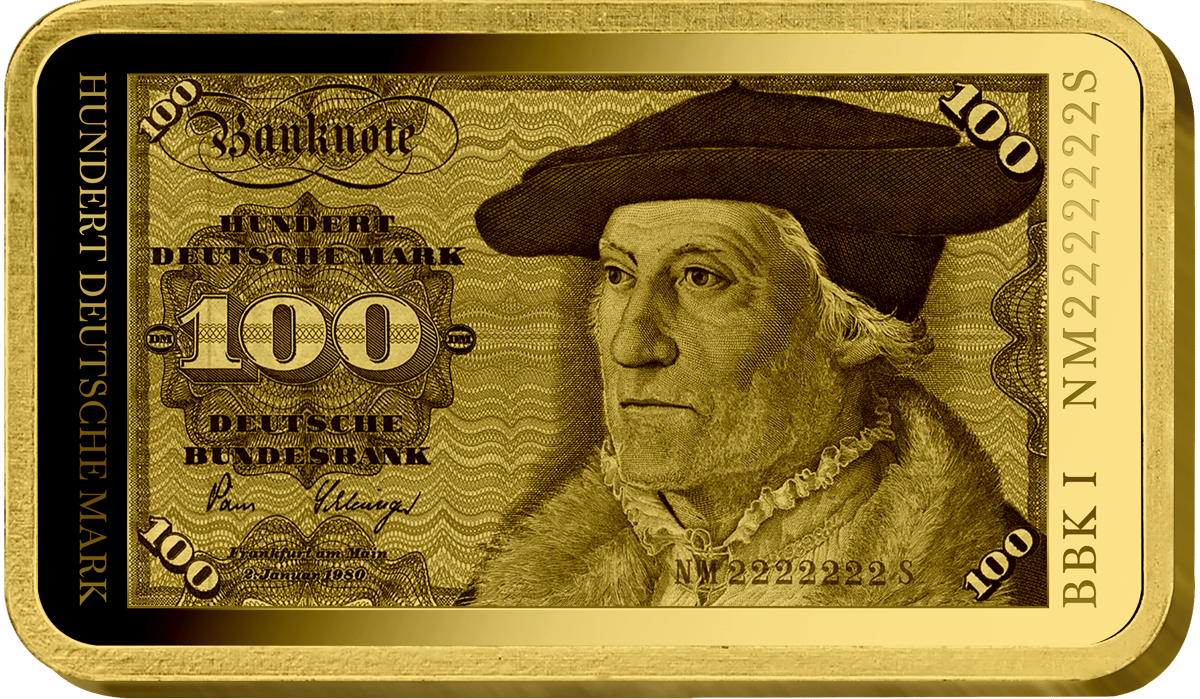
Sebastian Münster
The numeral 100
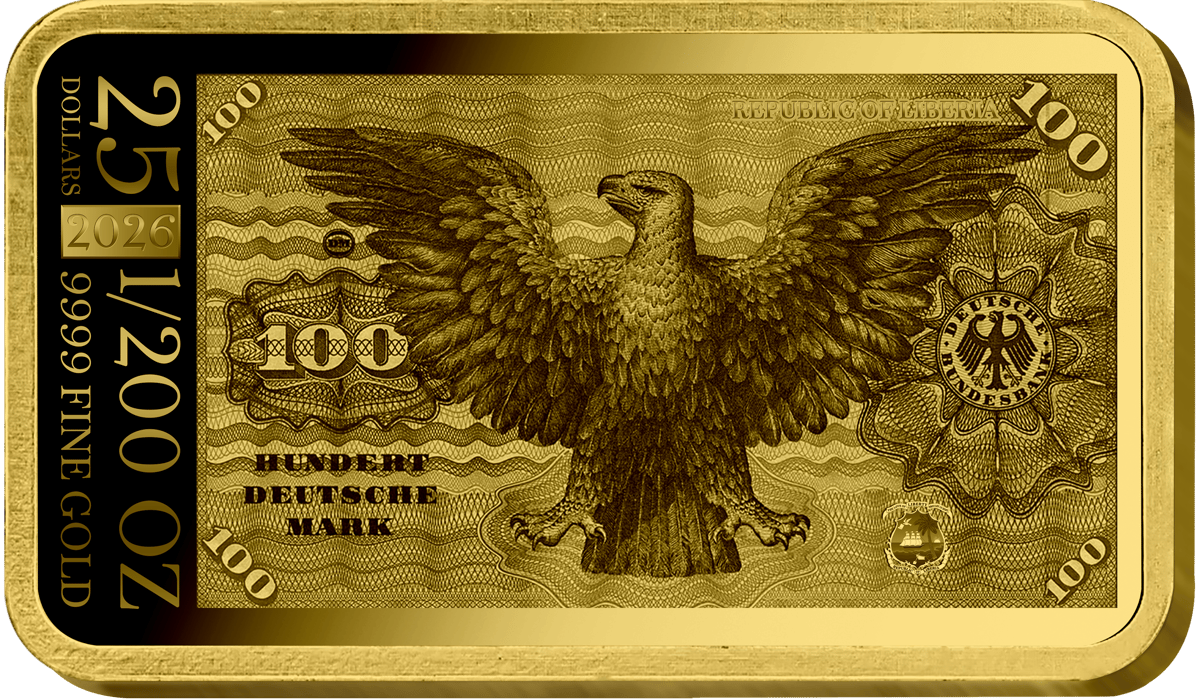
The eagle

The series
Seven notes after old paintings
On 10 February 1961 the Bundesbank issued the first note of its first series, the 20 DM note. By 26 April 1965 the others had followed, last of all the 500 DM note. There were seven values from 5 to 1000 marks; a 200 DM note only came with the last series.
It was designed by Hermann Eidenbenz, chosen after a competition with 140 preliminary designs. The notes were printed by the Bundesdruckerei in Berlin and by Giesecke & Devrient in Munich. Each value was 5 millimetres higher and 10 millimetres longer than the next smaller one.
They remained valid until they were called in on 30 June 1995. Some things lived on in the last series: the colours of the values, the large portraits looking towards the centre and the word “Banknote” in Fraktur, which most notes of the first series already bore.
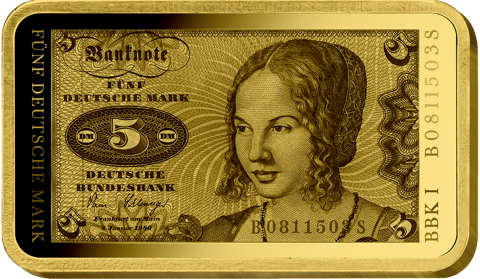
5 DM note1963
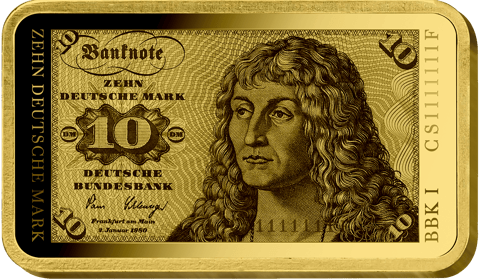
10 DM note1963
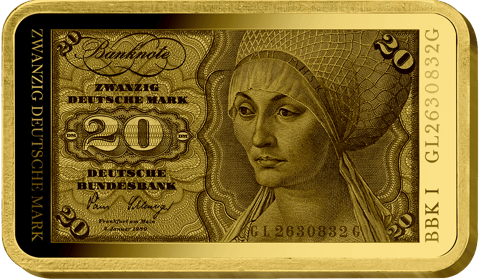
20 DM note1961
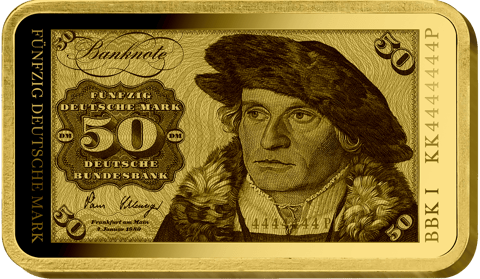
50 DM note1962
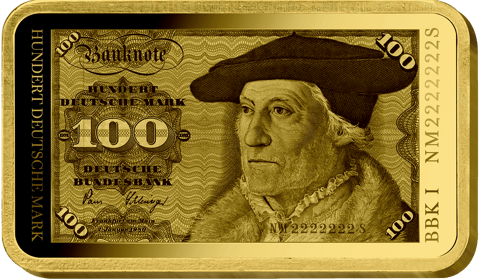
100 DM note1962
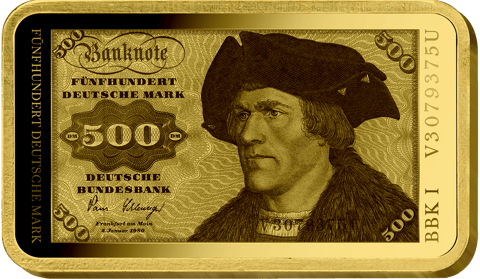
500 DM note1965
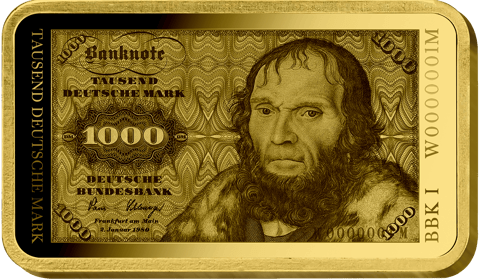
1000 DM note1964

The small format
The design of a note on 15 millimetres of gold
The 100 DM note measured 160 × 80 millimetres. The bar carries its design on a surface narrower than a 1-cent coin.
The paper note was work on the smallest scale. Egon Falz, Hans-Joachim Fuchs and José Lopez engraved the portrait and motif of each note by hand in steel, over months. In intaglio printing, the design stood raised on the paper like a relief.
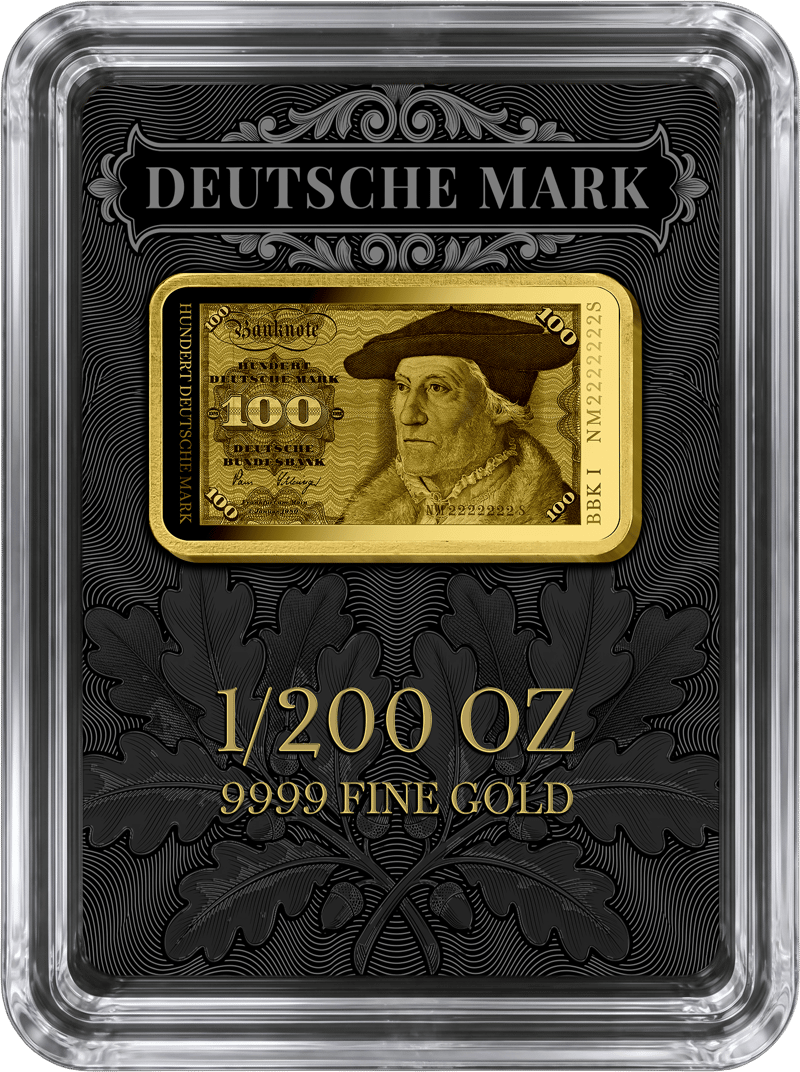
The bar’s finish is proof. The image shows it in a capsule on a black card with DEUTSCHE MARK, 1/200 OZ and 9999 FINE GOLD.
At a glance
- Motif
- 100 DM note, Sebastian Münster
- The Bundesbank’s first series
- Maker
- Kettner Edelmetalle
- Face value
- 25 Dollars
- Liberia
- Weight
- 1/200 ounce
- Fine weight
- 0.16 g
- Fineness
- 999.9/1,000
- Dimensions
- 15.00 × 8.50 mm
- Finish
- Proof
- Mintage
- 1,000 pieces
- Packaging
- Coin capsule
All details except the design as stated in our product specifications. The bars are products of Kettner Edelmetalle, not an issue of the Deutsche Bundesbank.

Faces from old paintings, from 1961 to 1995.
Sebastian Münster on 1/200 ounce of gold.
100 Deutsche Mark Banknote as Gold Minted Bar – strictly limited to only 1,000 pieces
- Strictly limited: capped worldwide at a very low mintage of just 1,000 pieces – an offer with clear scarcity.
- Growth opportunities: the strict limitation combined with sustained demand opens up high appreciation potential.
- Minting quality: the highest possible finish Proof (PP) with a deep black mirrored background and finely matted relief.
- Fine gold as substance: 999.9/1,000 purest fine gold, denomination 1/200 ounce (0.16 g fine weight).
- Iconic design: the legendary "blue hundred" featuring the historic portrait of Sebastian Münster and the German federal eagle.
- Investment goal: With a gold bar you protect your wealth very effectively against currency devaluation.
- Preservation of value: physical gold serves as a proven store of value, securing the real value of your wealth.
- Protection: especially in times of inflation, recession and high government debt, you can solidly protect your wealth with precious metals.
- Manufacturer: minted and issued under the Kettner Edelmetalle brand.
- Country of origin: Republic of Liberia – with a stamped face value of 25 dollars, making it official legal tender.
This minted bar translates one of the most famous banknotes in German history into purest fine gold – and joins our collector's coins with very low mintages as a strictly limited edition of the Kettner "Symbolism" series. What matters here is less the visual appeal than the material core: the nostalgic banknote design is the personal touch, but the actual reason to buy is the fine gold it contains. You are acquiring minted investment gold, whose value is primarily driven by the gold price.
The model is the "blue hundred" from the first banknote series of the Deutsche Bundesbank, which was in circulation for many decades and accompanied entire generations. On the obverse, the cosmographer, humanist and Hebraist Sebastian Münster (1488–1552) gazes at the viewer – designed after a painting by the Augsburg portrait painter Christoph Amberger. The reverse shows the majestic federal eagle with widely spread wings, complemented by the inscription "Hundert Deutsche Mark" (One Hundred Deutsche Mark). The piece is issued by the Republic of Liberia; the stamped face value of 25 dollars gives the rectangular bar the status of an official coin and makes it legal tender in the issuing country. It is precisely this combination of coin stamp and bar shape that characterizes a genuine minted bar.
Gold is the oldest currency in the world and has been a reliable store of value for over 6,000 years. It has intrinsic value, has never been worth zero, and preserves your purchasing power while paper money loses value. This makes such a bar an effective inflation hedge and at the same time a solid crisis protection in economically uncertain times. Physical gold is tradable worldwide, can be resold at any time and is highly liquid – profits from a later sale are generally tax-free in Germany after a holding period of at least one year. It is not without reason that central banks around the globe hold gold as a reserve.
With a mintage of only 1,000 pieces, this edition is among the particularly scarce mintings. While comparable minted bars of this kind often appear in significantly higher quantities of several thousand pieces, the tight limitation here underscores the character of a genuine rarity – and thus the appreciation potential for forward-thinking investors. Those who regularly acquire small amounts of gold build up considerable wealth step by step over the years.
Regarding the technical specifications: the bar weighs 0.16 g (1/200 ounce) with a fineness of 999.9/1,000 and measures a compact 15.00 mm x 8.50 mm. Minted in the highest quality level Proof, the fine gold displays mirrored surfaces and finely detailed, high-contrast design elements – a finish that demands the highest standards of minting technique and care. The piece is delivered as brand-new merchandise, well protected in a coin capsule.
Gold is considered God's money: it has been shining for thousands of years, retains its physical properties, and will never lose its shine. Whether as an entry into physical gold investment, as a building block for long-term wealth accumulation, or as a gift of genuine investment gold for a special occasion – here you receive full-fledged fine gold in Proof quality with the timeless charm of the good old Deutsche Mark.
Product depiction may differ from the final product.
