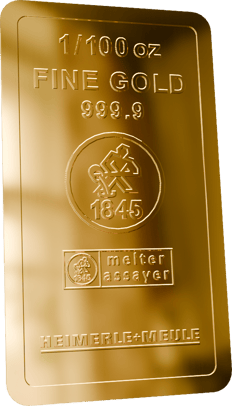
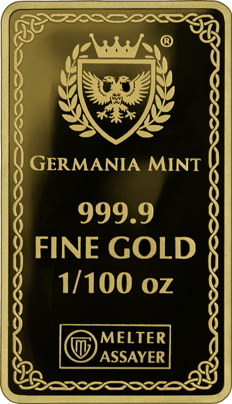
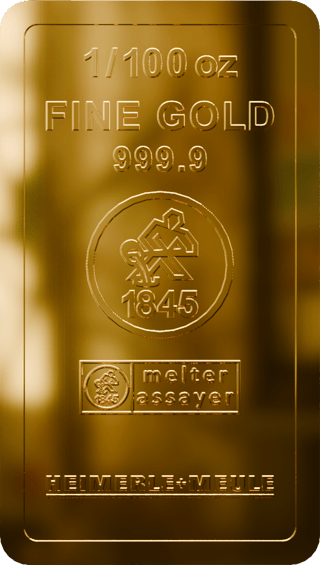
1/100 Ounce Gold Bar Heimerle und Meule (Kettner Edelmetalle)
£47.31
VAT-free and excl. shipping
Available in 2–3 business days

 More than 310,000
 Over 30 years
 Secure shipping
 Google: 4.9/5


The gram was laid down in Paris, in the law of 18 Germinal, Year III, which by our calendar was 7 April 1795. Article 5 reads:
“Gramme, le poids absolu d’un volume d’eau pure égal au cube de la centième partie du mètre, et à la température de la glace fondante.”
Law of 18 Germinal an III (7 April 1795), Article 5
This means the weight of pure water in a cube with edges of one centimetre, at the temperature of melting ice. The kilogram was merely its multiple: Article 7 calls it the weight of a thousand grams.
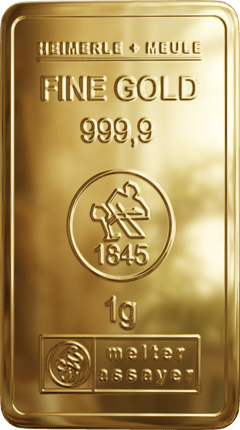
Both at the same scale. The cube shows the gram as defined by the law of 1795. Beside it is a bar of 1 gram by Heimerle + Meule, with the dimensions given by the maker.
Twenty drops of water from a standard dropper together weigh about one gram.
In Germany, the gram has applied since 1 January 1872, as laid down in the Maß‑ und Gewichtsordnung of 17 August 1868, the weights and measures act of the North German Confederation. Article 6 states: “The kilogram is divided into 1,000 grams”. And: “Half a kilogram is called the pound.”
From 1889, the measure was tied to a cylinder of platinum and iridium, the International Prototype of the Kilogram near Paris. The first General Conference on Weights and Measures resolved: “This prototype shall henceforth be considered as the unit of mass.” Germany’s copy, number 52, is kept under two glass bell jars at the Physikalisch‑Technische Bundesanstalt (PTB), the national metrology institute, in Braunschweig.
According to the PTB, the last comparisons showed that the difference between the prototype and its copies had grown to 50 micrograms, “about the same mass as the wing of a fly”. Since 20 May 2019, the kilogram has been tied to a constant of nature, the Planck constant.
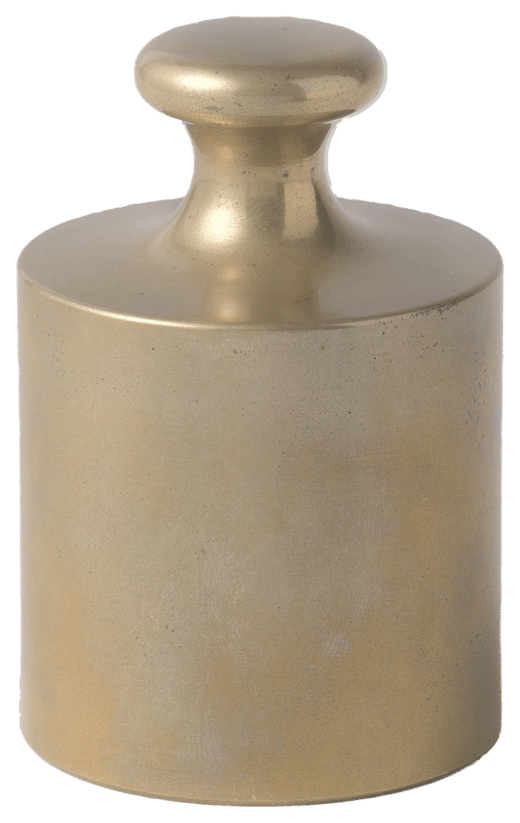
The gram is not the measure for gold everywhere. In Vietnam, people count in lượng and chỉ. A government decree laid this down in 2012: one lượng is 37.5 grams, one chỉ 3.75 grams, both only for weighing gold and silver.
In Hong Kong, the Chinese Gold and Silver Exchange Society trades gold in taels. There, one tael is 37.429 grams.
The troy ounce, in which many coins and bars are weighed, is also built from a smaller measure, the grain: 480 grains make one troy ounce, and one grain weighs 64.79891 milligrams. This is set out in Handbook 44 of NIST, the U.S. National Institute of Standards and Technology.
The values are given by Decree 86/2012 of the Vietnamese government, the Chinese Gold and Silver Exchange Society in Hong Kong and NIST. The troy ounce and the tael are rounded to two decimal places.
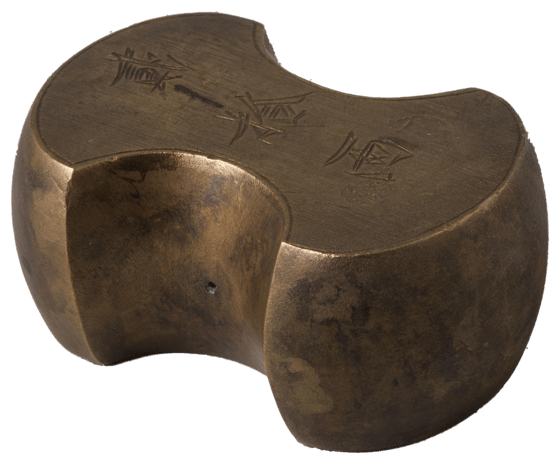
Gold that comes out of the ground today is usually invisible, locked away in the rock. In the second quarter of 2022, the ore processed by gold mines worldwide contained an average of 1.29 grams of gold per tonne. Metals Focus reports this in an article for the World Gold Council.
By calculation, one gram of gold is therefore contained in about 775 kilograms of ore, just over three quarters of a tonne.
Diagram: the square stands for one tonne. Only the golden dot is not to scale. At the same scale, it would be smaller than a pixel.
Ordinary rock holds far less gold still. On average, the Earth’s crust contains 0.004 grams per tonne, according to the U.S. Geological Survey. By calculation, that would be 250 tonnes for one gram.
On the Witwatersrand in South Africa, about 5.87 billion tonnes of rock were mined and milled from 1886 to 2005. On average, they yielded 8.07 grams of gold per tonne.

The Rhine carries gold too, in tiny flakes. The Federal Institute for Geosciences and Natural Resources (BGR) writes:
“In the Rhine, placer gold occurs almost exclusively in the form of the finest flakes up to 0.3 mm in diameter and 0.003‑0.005 mg in weight.”
Federal Institute for Geosciences and Natural Resources, Commodity Top News No. 30, 2009
By calculation, one gram of Rhine gold is therefore 200,000 to about 330,000 flakes.
Both at the same scale. The fine circle only shows where the flake lies. The maximum size of the flakes is given by the Federal Institute for Geosciences and Natural Resources, the dimensions of the bar by Heimerle + Meule.
In 1960, a gravel works near Bruchhausen, south of Karlsruhe, separated 21.3 grams of gold from 50,000 cubic metres of gravel. By calculation, that makes about 2,350 cubic metres of gravel for one gram.
The gold panners had a rule of thumb: for panning to be worthwhile, a shovelful of sand had to contain 10 to 20 flakes near Strasbourg and at least 40 to 50 near Mannheim. Downstream, the flakes become ever finer.
In 1874, the Karlsruhe Mint received its last Rhine gold: 89.8 grams.
How fine gold becomes a small minted bar is described step by step in the reference work Gold Bars Worldwide, based on information from the Perth Mint in Australia. For this, the gold is rolled into a strip.
Before the blanking press runs, individual trial blanks are cut from the strip with a hand press and weighed. If one is too heavy, the strip goes through the rolling mill once more.
Then a press punches the blanks out of the strip, and every single one is weighed. Blanks that are too light or clearly too heavy go back into the melt, as does the webbing left over from the strip.
The blank is struck between two dies, while a ring, the collar, holds its shape. Sometimes it takes more than one strike.
15,000bars of standard quality, at most, can be struck with one die. After about 5,000, it is usually repolished.
Diagram based on information from the Perth Mint.
The 1/100 oz gold bar is the smallest gateway to the world of physical gold: a bar with a fine weight of just 0.311 grams that still puts genuine 999.9 fine gold into your hand. Where a kilo bar ties up a small fortune, this piece fits into any wallet, turning precious metal into a tangible experience. This guide examines weight and fineness, packaging formats, tax particularities, sensible uses, and the question of who the smallest of all gold bars is actually worth it for.
A troy ounce equals 31.1035 grams. A hundredth of that gives the 0.311 grams that define this mini gold bar. Despite the tiny weight, this is full-fledged investment gold with a fineness of 999.9, in other words 24 carat. This format is minted by established refineries whose bars meet the internationally recognised Good Delivery standard, making them tradeable worldwide.
Characteristic of the gold bars in this size class is the minted production: the gold is not cast but shaped under high pressure, which creates sharp contours and a flawless surface. Anyone looking for the next larger format will find it in the 1/200 oz gold bar, in an even smaller version, or in the 0.1 g gold bar as its metric equivalent.
To make classification easier, the following overview shows the key figures of the smallest common ounce bar compared with neighbouring denominations:
| Format | Fine weight | Fineness | Typical form |
|---|---|---|---|
| 1/200 oz | approx. 0.155 g | 999.9 | minted, blister pack |
| 1/100 oz | 0.311 g | 999.9 | minted, card |
| 1/20 oz | approx. 1.555 g | 999.9 | minted, blister pack |
| 1/10 oz | approx. 3.110 g | 999.9 | minted, blister pack |
Anyone who prefers thinking in the metric system is best off comparing the mini bar with the 0.5 g gold bar or the 1 g gold bar: both are very close in weight and are likewise popular starter sizes.
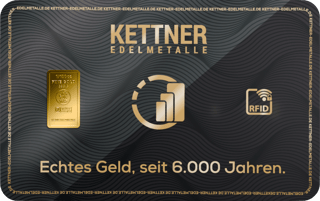
A bar this small would hardly be manageable loose, which is why it almost always comes in tamper-proof card packaging. Well known examples are the Secain Card or CertiCard principle, in which the bar is embedded in a sealed card. This packaging serves several purposes at once:
Anyone collecting several of these cards is best off storing them in an orderly way. Suitable accessories such as coin boxes or coin pouches keep the small treasures organised while also protecting them from environmental influences.
A strong argument for physical gold also applies to the smallest bar: in Germany, investment gold is exempt from VAT pursuant to § 25c UStG. The low fineness threshold for the exemption is clearly exceeded at 999.9. This means no VAT is charged on purchase, unlike with many silver products.
Tax note
Investment gold is exempt from VAT pursuant to § 25c UStG. A later sale from private assets can be tax-free after the one-year speculation period has elapsed. This is general information and does not replace tax advice.
Anyone wishing to build up larger quantities of investment gold will find more cost-effective ways with a lower premium per gram in the broader gold bar range or with classic gold coins such as the Krugerrand.
The 1/100 oz gold bar is not a classic investment in the sense of maximum efficiency: due to the minting process, its premium per gram is noticeably higher than for large bars. Its strength lies elsewhere: in emotion, in accessibility and in its character as a gift.
Hardly any precious metal product is better suited as a small gesture of thoughtfulness. For a birth, a christening, a birthday or as a small present: holding a piece of genuine gold in your hand leaves a lasting impression. More ideas of this kind can be found under gold gifts and in the general gift ideas.
For anyone who first wants to try out the topic of gold, the mini bar is an affordable way in. Anyone who then wants to save systematically can move on to savings plan products or larger denominations such as the 5 g gold bar.
Gold is chemically stable, does not tarnish and retains its shine across generations. Nevertheless, the sealed card deserves protection from mechanical damage, as a broken seal can make resale more difficult. A dry, secure storage location is recommended, be it a home safe, a can safe or a bank safe deposit box.
Since the material value of a single piece is low, the mini bar is also suitable as a crisis-proof pocket reserve. Anyone who wants to consider the topic of lasting value more broadly will find further ranges under inflation hedge and retirement provision.
A troy ounce equals 31.1035 grams. A hundredth of that gives around 0.311 grams of pure fine gold with a fineness of 999.9.
As a pure investment, the premium per gram is comparatively high. The 1/100 oz gold bar scores more as a gift, a starting point or a small crisis reserve. Anyone focused on efficiency is better off with larger denominations.
No. Investment gold is exempt from VAT pursuant to § 25c UStG, as the fineness of 999.9 clearly exceeds the legal threshold.
The bar is housed in sealed card packaging featuring a serial number, weight and fineness details, and the logo of the mint. The seal should remain undamaged to preserve its value.
Credit card style formats such as Secain Card or CertiCard are common, in which the delicate bar is firmly embedded. This protects it from scratches, fingerprints and loss.
Dry and protected, for instance in coin boxes or a can safe. Since the individual value is low, the mini bar is also suitable as a flexible reserve on the go.
 1/100 oz Gold Bars
Stay informed with product launches, financial news and exclusive offers. Sign up for our free newsletter today.
By entering your email address and clicking the "Submit" button, you give the following consent: "I agree to be informed by email about new products, financial news and exclusive offers, and therefore consent to the processing of my email address for the purpose of sending the newsletter. I can revoke this consent at any time without giving reasons, with effect for the future. The lawfulness of processing carried out prior to revocation remains unaffected."