Offer -£0.85

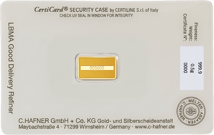
0.5g Gold Bar Heimerle und Meule
£67.22£68.07
VAT-free and plus shipping costs
Available in 3–4 business days

 More than 280,000
 Over 30 years
 Secure shipping
 Google: 4.9/5


The gram was laid down in Paris, in the law of 18 Germinal, Year III, which by our calendar was 7 April 1795. Article 5 reads:
“Gramme, le poids absolu d’un volume d’eau pure égal au cube de la centième partie du mètre, et à la température de la glace fondante.”
Law of 18 Germinal an III (7 April 1795), Article 5
This means the weight of pure water in a cube with edges of one centimetre, at the temperature of melting ice. The kilogram was merely its multiple: Article 7 calls it the weight of a thousand grams.
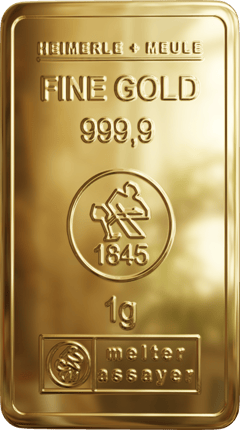
Both at the same scale. The cube shows the gram as defined by the law of 1795. Beside it is a bar of 1 gram by Heimerle + Meule, with the dimensions given by the maker.
Twenty drops of water from a standard dropper together weigh about one gram.
In Germany, the gram has applied since 1 January 1872, as laid down in the Maß‑ und Gewichtsordnung of 17 August 1868, the weights and measures act of the North German Confederation. Article 6 states: “The kilogram is divided into 1,000 grams”. And: “Half a kilogram is called the pound.”
From 1889, the measure was tied to a cylinder of platinum and iridium, the International Prototype of the Kilogram near Paris. The first General Conference on Weights and Measures resolved: “This prototype shall henceforth be considered as the unit of mass.” Germany’s copy, number 52, is kept under two glass bell jars at the Physikalisch‑Technische Bundesanstalt (PTB), the national metrology institute, in Braunschweig.
According to the PTB, the last comparisons showed that the difference between the prototype and its copies had grown to 50 micrograms, “about the same mass as the wing of a fly”. Since 20 May 2019, the kilogram has been tied to a constant of nature, the Planck constant.
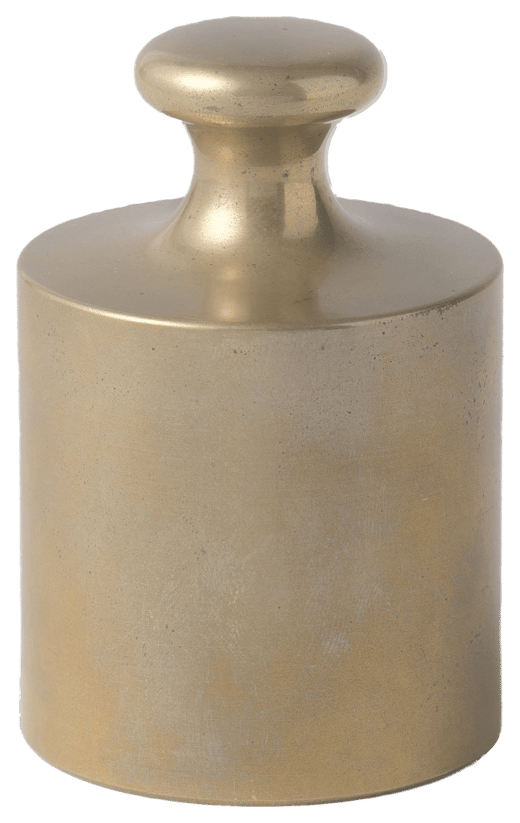
The gram is not the measure for gold everywhere. In Vietnam, people count in lượng and chỉ. A government decree laid this down in 2012: one lượng is 37.5 grams, one chỉ 3.75 grams, both only for weighing gold and silver.
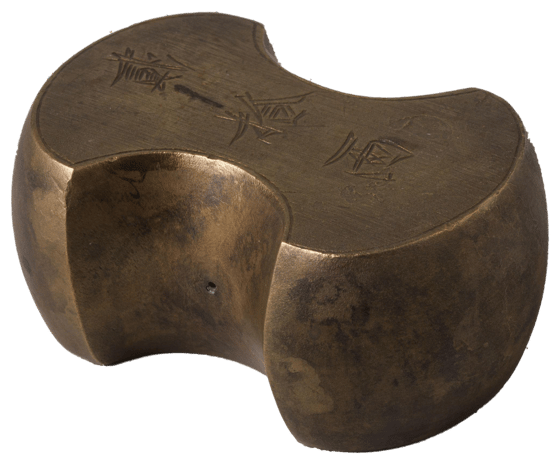
In Hong Kong, the Chinese Gold and Silver Exchange Society trades gold in taels. There, one tael is 37.429 grams.
The troy ounce, in which many coins and bars are weighed, is also built from a smaller measure, the grain: 480 grains make one troy ounce, and one grain weighs 64.79891 milligrams. This is set out in Handbook 44 of NIST, the U.S. National Institute of Standards and Technology.
The values are given by Decree 86/2012 of the Vietnamese government, the Chinese Gold and Silver Exchange Society in Hong Kong and NIST. The troy ounce and the tael are rounded to two decimal places.
Gold that comes out of the ground today is usually invisible, locked away in the rock. In the second quarter of 2022, the ore processed by gold mines worldwide contained an average of 1.29 grams of gold per tonne. Metals Focus reports this in an article for the World Gold Council.
By calculation, one gram of gold is therefore contained in about 775 kilograms of ore, just over three quarters of a tonne.
Diagram: the square stands for one tonne. Only the golden dot is not to scale. At the same scale, it would be smaller than a pixel.
Ordinary rock holds far less gold still. On average, the Earth’s crust contains 0.004 grams per tonne, according to the U.S. Geological Survey. By calculation, that would be 250 tonnes for one gram.
On the Witwatersrand in South Africa, about 5.87 billion tonnes of rock were mined and milled from 1886 to 2005. On average, they yielded 8.07 grams of gold per tonne.

The Rhine carries gold too, in tiny flakes. The Federal Institute for Geosciences and Natural Resources (BGR) writes:
“In the Rhine, placer gold occurs almost exclusively in the form of the finest flakes up to 0.3 mm in diameter and 0.003‑0.005 mg in weight.”
Federal Institute for Geosciences and Natural Resources, Commodity Top News No. 30, 2009
By calculation, one gram of Rhine gold is therefore 200,000 to about 330,000 flakes.
Both at the same scale. The fine circle only shows where the flake lies. The maximum size of the flakes is given by the Federal Institute for Geosciences and Natural Resources, the dimensions of the bar by Heimerle + Meule.
In 1960, a gravel works near Bruchhausen, south of Karlsruhe, separated 21.3 grams of gold from 50,000 cubic metres of gravel. By calculation, that makes about 2,350 cubic metres of gravel for one gram.
The gold panners had a rule of thumb: for panning to be worthwhile, a shovelful of sand had to contain 10 to 20 flakes near Strasbourg and at least 40 to 50 near Mannheim. Downstream, the flakes become ever finer.
In 1874, the Karlsruhe Mint received its last Rhine gold: 89.8 grams.
How fine gold becomes a small minted bar is described step by step in the reference work Gold Bars Worldwide, based on information from the Perth Mint in Australia. For this, the gold is rolled into a strip.
Before the blanking press runs, individual trial blanks are cut from the strip with a hand press and weighed. If one is too heavy, the strip goes through the rolling mill once more.
Then a press punches the blanks out of the strip, and every single one is weighed. Blanks that are too light or clearly too heavy go back into the melt, as does the webbing left over from the strip.
The blank is struck between two dies, while a ring, the collar, holds its shape. Sometimes it takes more than one strike.
15,000bars of standard quality, at most, can be struck with one die. After about 5,000, it is usually repolished.
Diagram based on information from the Perth Mint.
Receive a free and individual precious metals offer matching your financial goals within just a few minutes.
 Request offer now
Ein halbes Gramm Gold liegt fast schwerelos in der Hand – und doch steckt darin ein Stück echter Wertbeständigkeit. 0,5 g Goldbarren gehören zu den kleinsten geprägten Goldformaten am Markt und öffnen den Einstieg in die Welt des physischen Goldes für nahezu jedes Budget. Dieser Ratgeber beleuchtet, was den 0,5-Gramm-Barren ausmacht: Herstellung, Feingehalt, die wichtigsten Prägestätten, steuerliche Besonderheiten, Aufbewahrung und die Frage, für wen sich das kleinste Goldformat wirklich lohnt.
Der 0,5 g Goldbarren ist ein Anlageprodukt aus reinem Feingold mit einem Feingehalt von 999,9 (24 Karat). Trotz seiner winzigen Maße – meist nur wenige Millimeter Kantenlänge – trägt jeder Barren die vollständigen Prägemerkmale eines großen Anlagebarrens: Herstellerlogo, Gewichtsangabe, Feingehalt und häufig eine individuelle Seriennummer. Damit ist auch das kleinste Goldformat ein vollwertiges Stück Edelmetall, das weltweit gehandelt wird.
Gerade als Einstieg in die Welt der Goldbarren ist dieses Format beliebt: Es erlaubt den Kauf von physischem Gold ohne großen Kapitaleinsatz und eignet sich hervorragend, um Schritt für Schritt ein Edelmetallvermögen aufzubauen. Wer größere Mengen anstrebt, findet in den Geschwisterformaten wie dem 1 g Goldbarren oder dem 5 g Goldbarren die nächste Stufe.
Goldbarren dieser Größe werden ausnahmslos geprägt und nicht gegossen. Beim Prägen wird ein Goldplättchen unter hohem Druck in Form gebracht, wodurch eine glatte, gleichmäßige Oberfläche mit gestochen scharfen Konturen entsteht. Das Ergebnis wirkt edel und präzise – ein deutlicher Unterschied zu den rustikaleren gegossenen Barren, die erst ab größeren Gewichten üblich sind. Viele Hersteller liefern den 0,5-Gramm-Barren eingeschweißt in einer Blisterkarte mit Zertifikat aus, was Echtheit und Erhaltungszustand schützt.
Die Qualität eines kleinen Goldbarrens steht und fällt mit dem Hersteller. International anerkannte Scheideanstalten garantieren den deklarierten Feingehalt und sorgen für weltweite Handelbarkeit. Zu den bekanntesten Namen zählen:
Ein entscheidendes Qualitätsmerkmal ist die LBMA-Zertifizierung. Die London Bullion Market Association führt eine Liste anerkannter Hersteller, deren Barren als Good Delivery gelten und ohne erneute Prüfung gehandelt werden können. Wer Wert auf reibungslosen Wiederverkauf legt, achtet auf einen Barren aus dieser Liste. Neben Goldbarren führen viele dieser Prägestätten auch Silberbarren und Platinbarren im Programm.
Ein 0,5 g Goldbarren besteht aus 999,9 Feingold, also nahezu reinem Gold ohne nennenswerte Beimischung. Dieser Feingehalt ist international standardisiert und auf jedem Barren eingeprägt. Die geringen Maße machen das Format handlich, stellen aber zugleich besondere Anforderungen an die Echtheitsprüfung.
Bei Kettner Edelmetalle durchläuft jedes Produkt eine ISO-konforme Echtheitsprüfung, bevor es das Hochsicherheits-Logistikzentrum verlässt. So ist sichergestellt, dass jeder Barren dem entspricht, was auf der Prägung steht.
Ein wesentlicher Vorteil von Anlagegold: Der Kauf von Goldbarren ist in Deutschland von der Umsatzsteuer befreit. Anders als Silber, Platin oder Palladium unterliegt Anlagegold keiner Mehrwertsteuer – das gilt auch für das kleinste 0,5-Gramm-Format.
Steuerlicher Hinweis
Anlagegold ist in Deutschland gemäß §25c UStG von der Umsatzsteuer befreit. Wird physisches Gold nach einer Haltedauer von mehr als einem Jahr veräußert, ist ein etwaiger Gewinn nach aktueller Rechtslage zudem einkommensteuerfrei. Dies ist eine allgemeine Information und ersetzt keine individuelle Steuerberatung.
Diese steuerliche Behandlung macht Gold gegenüber anderen Edelmetallen besonders attraktiv. Wer das Thema vertiefen möchte, findet im Bereich der Anlagemünzen Gold weitere steuerbefreite Goldprodukte wie den Krügerrand oder den Maple Leaf.
So klein der 0,5 g Goldbarren ist, so sorgfältig sollte er aufbewahrt werden – gerade weil winzige Barren leicht verlegt werden können. Die unbeschädigte Originalverpackung schützt nicht nur vor Kratzern, sondern bewahrt auch den Sammler- und Wiederverkaufswert.
Praktisches Zubehör wie Münzkapseln, Münzkassetten oder ein Dosensafe hilft dabei, die kleinen Barren geordnet und geschützt zu lagern.
Der 0,5 g Goldbarren spricht eine breite Zielgruppe an. Für Einsteiger ist er der niedrigschwellige Weg, erstmals physisches Gold zu besitzen, ohne gleich größere Summen zu binden. Sparer nutzen ihn, um kontinuierlich kleine Mengen anzusammeln – ein Prinzip, das sich gut mit den Angeboten im Bereich Sparplan Produkte verbinden lässt.
Ein zweiter, oft unterschätzter Aspekt: der emotionale Wert. Ein kleiner Goldbarren ist ein beliebtes Geschenk zu Geburt, Taufe, Kommunion oder Jubiläum – ein Präsent mit echtem, bleibendem Gegenwert, das über Jahrzehnte seine Bedeutung behält.
Gold in der Hand zu halten, vermittelt ein Gefühl von Beständigkeit, das kein digitaler Kontostand ersetzen kann.
Zu bedenken ist der höhere Aufgeld-Anteil: Je kleiner der Barren, desto größer der prozentuale Aufschlag auf den reinen Goldwert, da Herstellung und Verpackung pro Stück nahezu gleich teuer sind. Wer rein auf den Materialwert pro Euro schaut, fährt mit größeren Einheiten günstiger – etwa dem 10 g Goldbarren oder dem 100 g Goldbarren. Der kleine Barren punktet dafür mit maximaler Teilbarkeit und Flexibilität.
Ein 0,5 g Goldbarren besteht aus 999,9 Feingold, also 24 Karat reinem Gold. Dieser Feingehalt ist international standardisiert und auf jedem Barren eingeprägt.
Ja. Anlagegold ist in Deutschland gemäß §25c UStG von der Umsatzsteuer befreit. Das gilt auch für das kleinste 0,5-Gramm-Format. Beim Wiederverkauf nach mehr als einem Jahr Haltedauer sind Gewinne nach aktueller Rechtslage zudem einkommensteuerfrei.
Herstellung, Prägung und Verpackung verursachen pro Barren nahezu gleiche Kosten – unabhängig vom Gewicht. Bei einem 0,5-Gramm-Barren verteilen sich diese Fixkosten auf sehr wenig Material, weshalb der prozentuale Aufschlag auf den Goldwert höher ausfällt als bei größeren Einheiten.
Etablierte Scheideanstalten wie Heimerle und Meule, Valcambi, Heraeus, Argor-Heraeus oder Degussa stehen für gleichbleibende Qualität. Barren von LBMA-anerkannten Herstellern lassen sich weltweit ohne erneute Prüfung handeln.
Sehr gut sogar. Durch den geringen Preis und die ansprechende Blisterverpackung ist der kleine Barren ein beliebtes Präsent zu Geburt, Taufe, Kommunion oder Jubiläum – ein Geschenk mit echtem, bleibendem Gegenwert.
Ja. Die unbeschädigte Blisterkarte mit Seriennummer und Zertifikat dokumentiert Echtheit und Erhaltungszustand und erleichtert den späteren Wiederverkauf. Der Barren sollte möglichst nicht aus der Verpackung gelöst werden.
 0,5g Goldbarren
Stay informed with product launches, financial news and exclusive offers. Sign up for our free newsletter today.
By entering your email address and clicking the "Submit" button, you give the following consent: "I agree to be informed by email about new products, financial news and exclusive offers, and therefore consent to the processing of my email address for the purpose of sending the newsletter. I can revoke this consent at any time without giving reasons, with effect for the future. The lawfulness of processing carried out prior to revocation remains unaffected."