Offer -£0.85

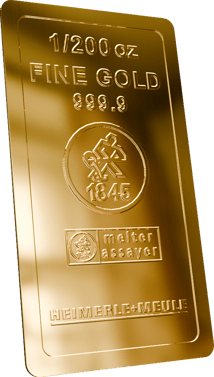
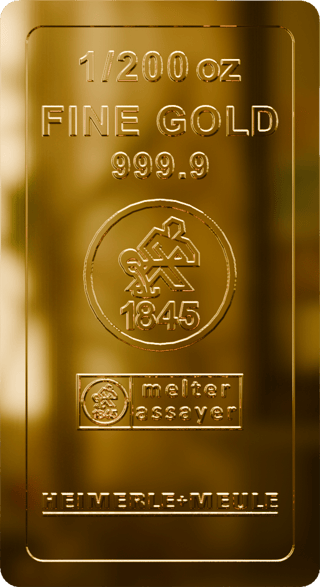
1/200 oz Gold Bar Heimerle und Meule
£27.46£28.31
VAT-free and plus shipping costs
Available in 2–3 business days

 More than 280,000
 Over 30 years
 Secure shipping
 Google: 4.9/5


The gram was laid down in Paris, in the law of 18 Germinal, Year III, which by our calendar was 7 April 1795. Article 5 reads:
“Gramme, le poids absolu d’un volume d’eau pure égal au cube de la centième partie du mètre, et à la température de la glace fondante.”
Law of 18 Germinal an III (7 April 1795), Article 5
This means the weight of pure water in a cube with edges of one centimetre, at the temperature of melting ice. The kilogram was merely its multiple: Article 7 calls it the weight of a thousand grams.
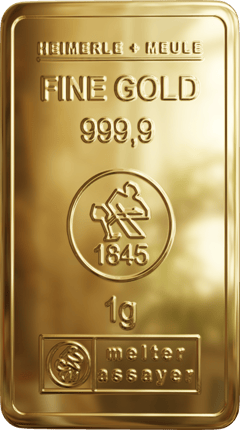
Both at the same scale. The cube shows the gram as defined by the law of 1795. Beside it is a bar of 1 gram by Heimerle + Meule, with the dimensions given by the maker.
Twenty drops of water from a standard dropper together weigh about one gram.
In Germany, the gram has applied since 1 January 1872, as laid down in the Maß‑ und Gewichtsordnung of 17 August 1868, the weights and measures act of the North German Confederation. Article 6 states: “The kilogram is divided into 1,000 grams”. And: “Half a kilogram is called the pound.”
From 1889, the measure was tied to a cylinder of platinum and iridium, the International Prototype of the Kilogram near Paris. The first General Conference on Weights and Measures resolved: “This prototype shall henceforth be considered as the unit of mass.” Germany’s copy, number 52, is kept under two glass bell jars at the Physikalisch‑Technische Bundesanstalt (PTB), the national metrology institute, in Braunschweig.
According to the PTB, the last comparisons showed that the difference between the prototype and its copies had grown to 50 micrograms, “about the same mass as the wing of a fly”. Since 20 May 2019, the kilogram has been tied to a constant of nature, the Planck constant.
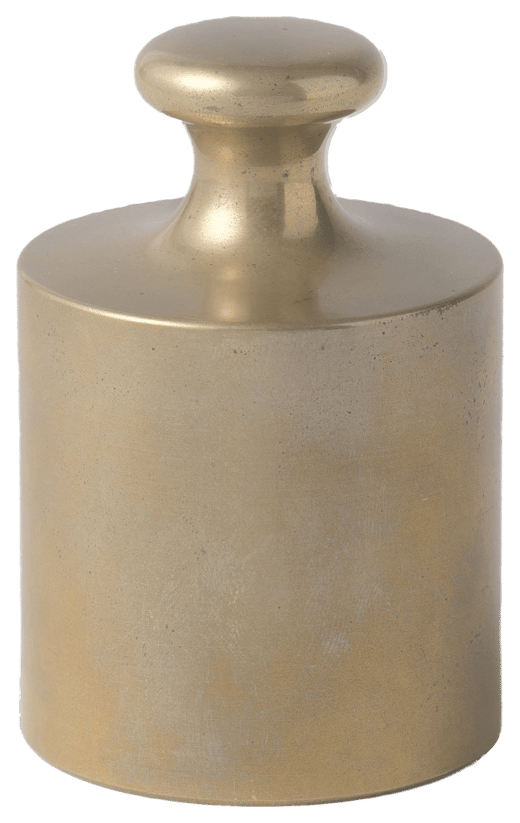
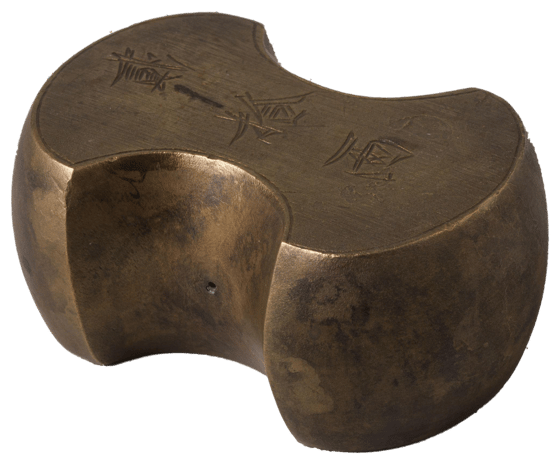
The gram is not the measure for gold everywhere. In Vietnam, people count in lượng and chỉ. A government decree laid this down in 2012: one lượng is 37.5 grams, one chỉ 3.75 grams, both only for weighing gold and silver.
In Hong Kong, the Chinese Gold and Silver Exchange Society trades gold in taels. There, one tael is 37.429 grams.
The troy ounce, in which many coins and bars are weighed, is also built from a smaller measure, the grain: 480 grains make one troy ounce, and one grain weighs 64.79891 milligrams. This is set out in Handbook 44 of NIST, the U.S. National Institute of Standards and Technology.
The values are given by Decree 86/2012 of the Vietnamese government, the Chinese Gold and Silver Exchange Society in Hong Kong and NIST. The troy ounce and the tael are rounded to two decimal places.
Gold that comes out of the ground today is usually invisible, locked away in the rock. In the second quarter of 2022, the ore processed by gold mines worldwide contained an average of 1.29 grams of gold per tonne. Metals Focus reports this in an article for the World Gold Council.
By calculation, one gram of gold is therefore contained in about 775 kilograms of ore, just over three quarters of a tonne.
Diagram: the square stands for one tonne. Only the golden dot is not to scale. At the same scale, it would be smaller than a pixel.
Ordinary rock holds far less gold still. On average, the Earth’s crust contains 0.004 grams per tonne, according to the U.S. Geological Survey. By calculation, that would be 250 tonnes for one gram.
On the Witwatersrand in South Africa, about 5.87 billion tonnes of rock were mined and milled from 1886 to 2005. On average, they yielded 8.07 grams of gold per tonne.

The Rhine carries gold too, in tiny flakes. The Federal Institute for Geosciences and Natural Resources (BGR) writes:
“In the Rhine, placer gold occurs almost exclusively in the form of the finest flakes up to 0.3 mm in diameter and 0.003‑0.005 mg in weight.”
Federal Institute for Geosciences and Natural Resources, Commodity Top News No. 30, 2009
By calculation, one gram of Rhine gold is therefore 200,000 to about 330,000 flakes.
Both at the same scale. The fine circle only shows where the flake lies. The maximum size of the flakes is given by the Federal Institute for Geosciences and Natural Resources, the dimensions of the bar by Heimerle + Meule.
In 1960, a gravel works near Bruchhausen, south of Karlsruhe, separated 21.3 grams of gold from 50,000 cubic metres of gravel. By calculation, that makes about 2,350 cubic metres of gravel for one gram.
The gold panners had a rule of thumb: for panning to be worthwhile, a shovelful of sand had to contain 10 to 20 flakes near Strasbourg and at least 40 to 50 near Mannheim. Downstream, the flakes become ever finer.
In 1874, the Karlsruhe Mint received its last Rhine gold: 89.8 grams.
How fine gold becomes a small minted bar is described step by step in the reference work Gold Bars Worldwide, based on information from the Perth Mint in Australia. For this, the gold is rolled into a strip.
Before the blanking press runs, individual trial blanks are cut from the strip with a hand press and weighed. If one is too heavy, the strip goes through the rolling mill once more.
Then a press punches the blanks out of the strip, and every single one is weighed. Blanks that are too light or clearly too heavy go back into the melt, as does the webbing left over from the strip.
The blank is struck between two dies, while a ring, the collar, holds its shape. Sometimes it takes more than one strike.
15,000bars of standard quality, at most, can be struck with one die. After about 5,000, it is usually repolished.
Diagram based on information from the Perth Mint.
Receive a free and individual precious metals offer matching your financial goals within just a few minutes.
 Request offer now
Ein Gramm Gold lässt sich teilen, bis fast nichts mehr übrig bleibt -- und genau an dieser Grenze steht der 1/200 oz Goldbarren. Mit einem Feingewicht von rund 0,1555 Gramm zählt er zu den kleinsten Goldeinheiten, die der Markt überhaupt anbietet. Diese Kategorie zeigt, was hinter dem winzigen Stück echtem Feingold steckt: warum es vor allem als Geschenk und Einstieg ins Goldsparen begeistert, wie es geprägt und eingefasst wird, was beim Aufgeld zu beachten ist und wie es sich von größeren Stückelungen unterscheidet.
Eine Feinunze entspricht 31,1035 Gramm. Der 1/200 oz Goldbarren bildet davon den zweihundertsten Teil ab und wiegt damit nur etwa 0,1555 Gramm -- weniger als ein Reiskorn. Trotz der geringen Masse handelt es sich um vollwertiges Anlagegold mit einem Feingehalt von 999,9/1000, also reinstem 24-karätigem Gold. Der Reiz dieser Stückelung liegt im emotionalen Wert: Sie macht echtes Gold für nahezu jedes Budget greifbar und verwandelt einen Anlassmoment in ein bleibendes Andenken.
Solche Kleinstbarren werden von renommierten Scheideanstalten wie Heimerle & Meule oder anderen LBMA-zertifizierten Prägestätten hergestellt. Wer das Sortiment der übergeordneten Goldbarren-Kategorie kennt, erkennt schnell: Der 1/200 oz Barren ist der Einstiegspunkt einer Stückelungs-Familie, die bis zum 1 kg Goldbarren reicht.
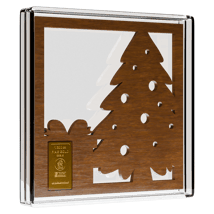
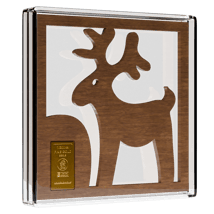
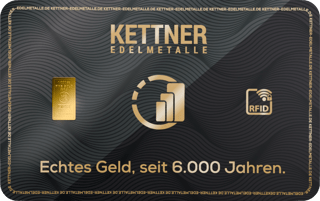
Aufgrund seiner Winzigkeit wird der Barren fast immer fest eingefasst geliefert -- typischerweise in einer scheckkartengroßen Schutzhülle, die das Stück sicher fixiert und gleichzeitig die Echtheitsangaben trägt. Die reinen Barrenmaße liegen je nach Hersteller bei etwa 15 x 8,5 Millimetern.
Kaum eine andere Goldform eignet sich so gut zum Verschenken wie der Kleinstbarren. Gold zur Geburt, zur Taufe oder zum runden Geburtstag -- die scheckkartengroße Einfassung trägt häufig ein passendes Motiv und macht aus dem Barren ein persönliches Präsent mit echtem Materialwert. Anders als eine Glückwunschkarte verliert dieses Andenken seinen Substanzwert nicht.
Ein Stück Gold zur Geburt verschenken heißt, einem Menschen etwas mitzugeben, das über Jahrzehnte Bestand hat.
Auch als Einstieg für Kinder und Jugendliche ins Thema Edelmetalle hat der kleine Barren seinen Platz. Wer früh Begeisterung für echtes Gold wecken möchte, findet hier eine greifbare, haptische Form -- weit emotionaler als eine reine Zahl auf einem Sparbuch. Für die langfristige Vermögensbildung lohnt sich später der Blick auf das Thema Altersvorsorge mit größeren Einheiten.
Beim Kauf von Kleinstbarren ist ein Punkt entscheidend: das Aufgeld (Prägekosten und Handelsspanne über dem reinen Materialwert). Je kleiner die Stückelung, desto höher fällt dieser prozentuale Aufschlag aus -- denn Prägung, Einfassung und Verpackung kosten pro Stück annähernd gleich viel, unabhängig vom Goldgewicht. Bei einem 1/200 oz Barren steht dem winzigen Materialwert ein vergleichsweise hoher Fixaufwand gegenüber.
Daraus folgt eine klare Einordnung: Der 1/200 oz Goldbarren ist primär ein Geschenk- und Sammlerobjekt, kein Vehikel zur effizienten Vermögensanlage. Wer Gold gezielt zur Werterhaltung und zum Inflationsschutz erwerben möchte, fährt mit größeren Stückelungen wie dem 5 g Goldbarren oder dem 10 g Goldbarren deutlich günstiger, weil sich das Aufgeld dort auf mehr Material verteilt.
Faustregel zum Aufgeld
Je kleiner die Einheit, desto höher der prozentuale Aufschlag pro Gramm. Kleinstbarren überzeugen durch ihren ideellen und gestalterischen Wert -- für reine Gewichtseffizienz sind größere Barren oder gängige Anlagemünzen die bessere Wahl.
Die feste Einfassung in einer versiegelten Karte erfüllt einen doppelten Zweck: Sie schützt das empfindliche Stück vor Verlust und Beschädigung und dient zugleich als Echtheitsnachweis. Auf der Karte sind Gewicht, Feingehalt und meist der Name der Prägestätte vermerkt. Eine unbeschädigte Versiegelung gilt im Handel als wichtiges Vertrauensmerkmal.
Bei Kettner Edelmetalle durchlaufen Edelmetallprodukte eine ISO-konforme Echtheitsprüfung, bevor sie das vollautomatisierte Hochsicherheits-Logistikzentrum verlassen. Der Versand erfolgt zu 100 % versichert. Wer mehrere kleine Barren sammelt, sollte sie in der originalen Einfassung belassen -- passendes Zubehör zur Aufbewahrung hilft, eine wachsende Sammlung übersichtlich und geschützt zu lagern.
Ein gewichtiger Vorteil gilt für Gold unabhängig von der Größe: Anlagegold mit einem Feingehalt von mindestens 995/1000 ist in Deutschland gemäß § 25c UStG von der Umsatzsteuer befreit. Der 1/200 oz Goldbarren mit seinen 999,9/1000 erfüllt diese Voraussetzung problemlos. Beim Verkauf greift zudem die Spekulationsfrist: Nach einer Haltedauer von mehr als einem Jahr ist ein etwaiger Veräußerungsgewinn für Privatpersonen steuerfrei.
Diese Rahmenbedingungen machen physisches Gold grundsätzlich attraktiv. Hinweise hierzu sind allgemeine Informationen und ersetzen keine individuelle Steuerberatung. Wer den Steuervorteil voll ausnutzen will, kombiniert ihn idealerweise mit einer gewichtseffizienten Stückelung aus dem Bereich der Anlagemünzen Gold.
Innerhalb der kleinen Stückelungen gibt es ein fein abgestuftes Angebot. Der 1/200 oz Barren markiert das untere Ende, gefolgt von etwas größeren Einheiten, die jeweils ein besseres Verhältnis von Material zu Aufgeld bieten.
| Stückelung | Feingewicht (ca.) | Typische Verwendung |
|---|---|---|
| 1/200 oz | 0,1555 g | Geschenk, Andenken |
| 1/100 oz | 0,311 g | Geschenk, Kleinsparen |
| 1/20 oz | 1,555 g | Einstieg Anlage |
| 1/10 oz | 3,11 g | Anlage, Teilung |
Wer zwischen den Größen abwägt, findet die nächstgrößeren Varianten beim 1/100 oz Goldbarren sowie beim 1/20 Unze Goldbarren und beim 1/10 Unze Goldbarren. In Gramm gerechnet sind auch der 0,5 g Goldbarren und der 1 g Goldbarren beliebte Einstiegsformate.
Der 1/200 oz Goldbarren spricht eine klar umrissene Zielgruppe an. Er ist die Antwort auf die Frage, wie sich echtes Gold mit minimalem Einsatz verschenken oder sammeln lässt.
Steht hingegen der reine Vermögensaufbau im Vordergrund, lohnt der Blick auf größere Goldbarren oder klassische Goldmünzen wie den Krügerrand -- dort ist das Verhältnis von Materialwert zu Kaufpreis günstiger. Für regelmäßiges Ansparen bieten sich zudem Sparplan-Produkte an.
Ein 1/200 oz Goldbarren wiegt rund 0,1555 Gramm reines Feingold. Das entspricht dem zweihundertsten Teil einer Feinunze (31,1035 Gramm) und macht ihn zu einer der kleinsten verfügbaren Goldeinheiten.
Der Barren besteht aus 999,9/1000 Feingold, also reinstem 24-karätigem Gold. Damit erfüllt er die Anforderungen an Anlagegold und ist von der Umsatzsteuer befreit.
Prägung, Einfassung und Verpackung verursachen pro Stück nahezu gleiche Kosten, unabhängig vom Goldgewicht. Bei einer winzigen Stückelung verteilt sich dieser Fixaufwand auf sehr wenig Material, wodurch der prozentuale Aufschlag pro Gramm steigt.
Aufgrund des hohen prozentualen Aufgelds ist der Kleinstbarren vor allem als Geschenk- und Sammlerobjekt gedacht. Für eine gewichtseffiziente Anlage sind größere Barren oder gängige Anlagemünzen die wirtschaftlichere Wahl.
Der Barren ist fest in einer versiegelten Karte eingefasst, die Gewicht, Feingehalt und Prägestätte ausweist. Eine unbeschädigte Versiegelung gilt als Vertrauensmerkmal. Bei Kettner Edelmetalle durchläuft jedes Produkt zusätzlich eine ISO-konforme Echtheitsprüfung.
Nein. Der Barren sollte in der originalen, versiegelten Einfassung verbleiben. Sie schützt das winzige Stück vor Verlust und Beschädigung und erhält den Echtheitsnachweis sowie den Wiederverkaufswert.
 1/200 oz Goldbarren
Stay informed with product launches, financial news and exclusive offers. Sign up for our free newsletter today.
By entering your email address and clicking the "Submit" button, you give the following consent: "I agree to be informed by email about new products, financial news and exclusive offers, and therefore consent to the processing of my email address for the purpose of sending the newsletter. I can revoke this consent at any time without giving reasons, with effect for the future. The lawfulness of processing carried out prior to revocation remains unaffected."