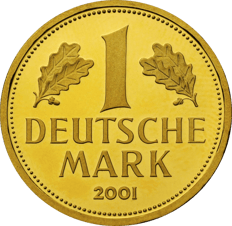
12g Gold Mark 1 DM 2001
£1,325.80
VAT-free and excl. shipping
Available in 2–3 business days

 More than 310,000
 Over 30 years
 Secure shipping
 Google: 4.9/5
The end of the Deutsche Mark was marked by the turn of the year from 2001 to 2002. This is why the Goldmark also bears the mint year 2001 and serves as a commemorative piece of Germany's "old currency". Exactly 1,000,000 times was the gold coin minted in Germany and it sold out within just a few days. Thanks to the active trading of the coin, we repeatedly have the opportunity to offer you the Goldmark. The collector's value has risen significantly in recent years.


1950 to 2001
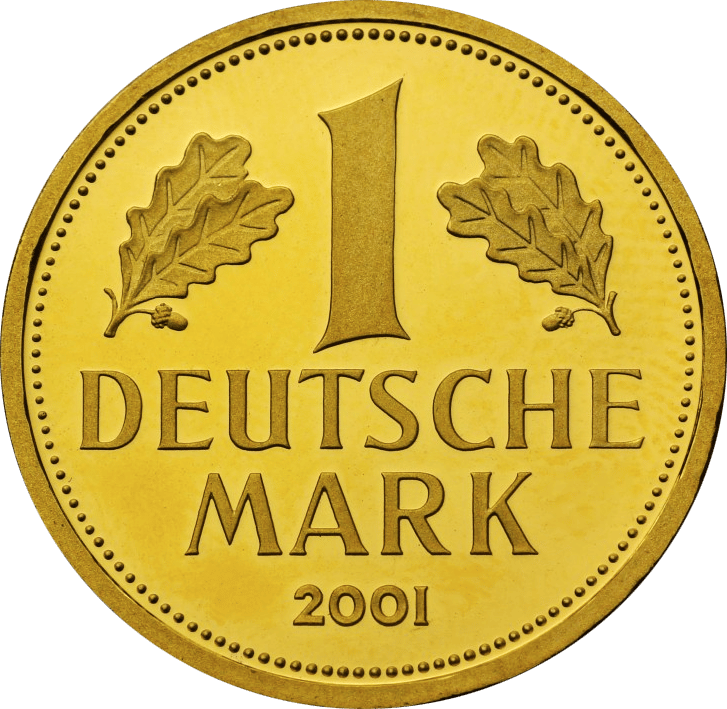
The one‑mark piece with the two oak branches came out in 1950, designed by Josef Bernhart of Munich. Everyone held it in their hand, at the baker’s, at the kiosk, in the piggy bank.
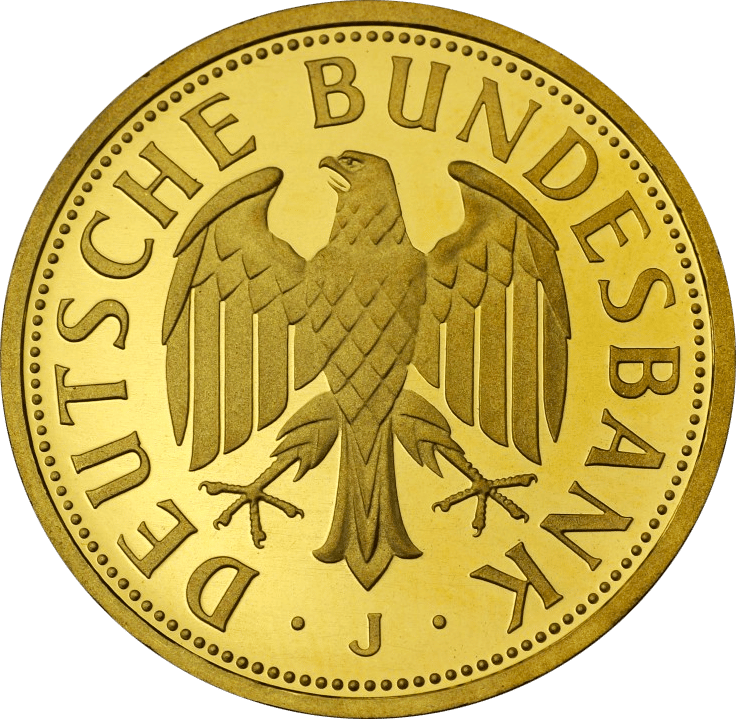
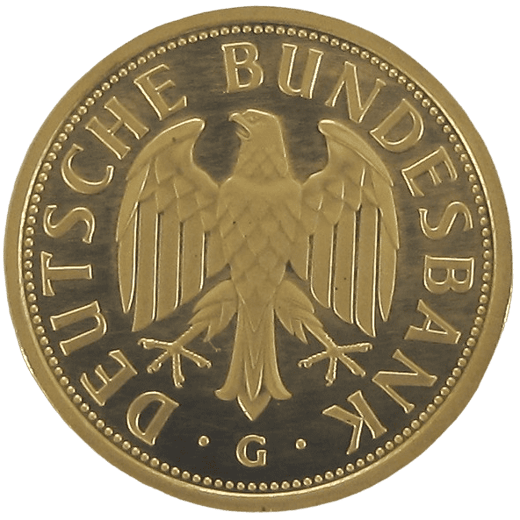
A special law allowed the Bundesbank, as a farewell, to issue the same design in gold, in its own name. That is why the eagle side reads DEUTSCHE BUNDESBANK instead of BUNDESREPUBLIK DEUTSCHLAND. It is the only official D‑Mark coin in gold: 12 grams, 999.9 fine.
June 1948
20
Sunday
The currency reform
The Deutsche Mark arrives in the three Western zones. Each person receives a per-capita allowance of 40 D‑Marks, and later another 20.
July 1990
1
Sunday
The monetary union
Even before reunification, the D‑Mark becomes the currency of the GDR. Wages and salaries are converted one to one.
December 2001
31
Monday
The last day
The D‑Mark is legal tender for the last time. To this day, the Bundesbank exchanges it for euros free of charge and with no time limit.
The 2001 gold mark was struck at all five German mints, 200,000 pieces at each. The letter below the eagle shows which one it was.
The original
The Bundesbank’s gold mark of 2001, 12 grams, 999.9 fine.
View the 2001 gold mark
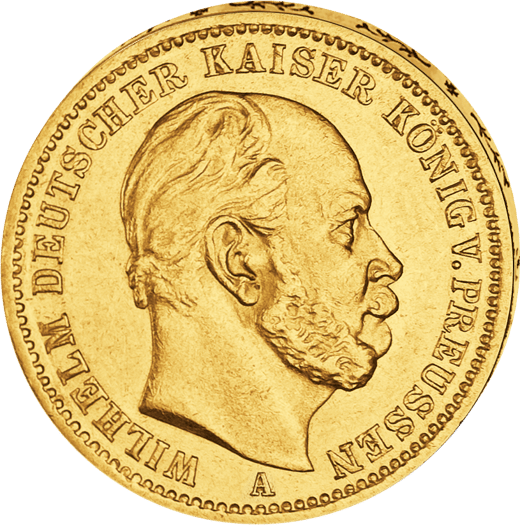
The beginning
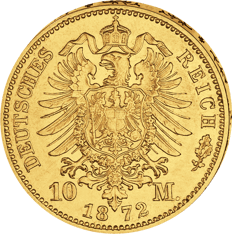
Ten marks in gold from Prussia, with Emperor Wilhelm I. The mark began with gold coins like this in 1871.
View the Prussian 10‑mark piece
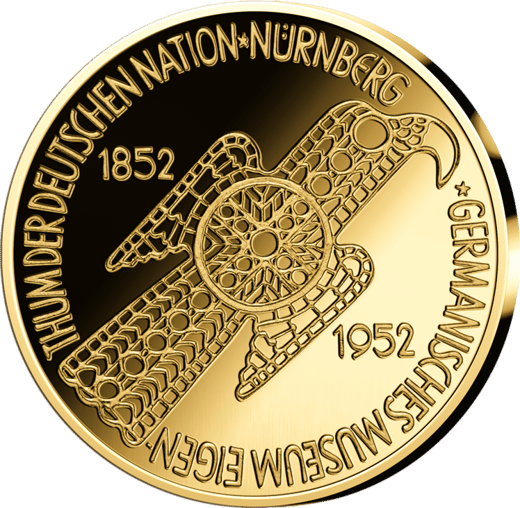
The restrike
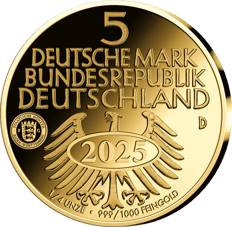
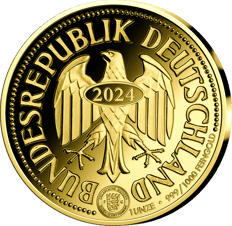
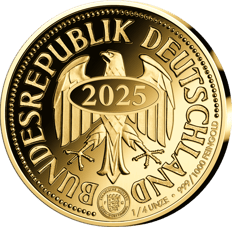
The design of the Federal Republic’s first commemorative coin of 1952, restruck as a quarter ounce of gold. A collector’s piece, not legal tender.
View the restrike
The D‑Mark came in 1948. It went in 2001. In gold, it stayed.
Details based on the Act on the Minting of a 1-DM Gold Coin of 27 December 2000, the Deutsche Bundesbank’s press release of 15 June 2001, its pages on the currency reform, on DM circulation and commemorative coins, and on exchanging marks, its Monthly Report of March 2002, the act ending the legal tender status of the DM, the Federal Agency for Civic Education, the Imperial Act concerning the Minting of Imperial Gold Coins of 4 December 1871, the Decree on the Naming of the Imperial Gold Coins of 17 February 1875 and photographs of the pieces shown.
The Goldmark is the first and only gold coin with the face value of 1 Deutsche Mark, a golden closing chord to the currency that meant prosperity and trust to the people of Germany for half a century. Issued to mark the farewell of the D-Mark, the 1-DM gold coin from the year 2001 combines a piece of contemporary history with 12 grams of the finest fine gold. This guide examines the history, design, mints, fineness, special tax aspects, as well as the question of why the Goldmark today ranks among the most sought-after German collector's and bullion coins.
The turn of the year from 2001 to 2002 marked the end of an era: on 1 January 2002, the euro replaced the D-Mark as cash currency. To duly honour the largest currency changeover of its time, Germany decided to issue a gold coin, the Goldmark. It deliberately bears the minting year 2001 and thus serves as a lasting memento of the old currency. Since the last imperial gold coins of the German Empire, whose minting lasted until 1918, it was the first gold coin of the Federal Republic with a Mark face value, a true first.
The coin was issued on 26 July 2001. Demand was enormous: millions of collectors and investors wanted the new gold coin, and stocks sold out within the shortest time. Because the mintage was limited relative to demand, the market price exceeded the original issue price of 250 DM significantly in some cases as early as the issue date. Anyone interested in further German coinage will find a broad overview in the German Gold Coins category.
A legal peculiarity makes the Goldmark even more interesting: the Deutsche Bundesbank was not originally authorised to mint coins at all, this right lay with the federal government. For this reason, a special Act on the Minting of a 1-DM Gold Coin and the Establishment of the Money and Currency Foundation was passed. Only this cleared the way. The proceeds from the sale flowed into the aforementioned foundation, which is dedicated to the stability of money and currency. In this way, a nostalgic farewell also became a piece of monetary policy symbolism.
The Goldmark was produced in equal parts by all five state German mints. The familiar design of the 1-DM circulation coin with its oak leaves and the federal eagle served as the template. One detail caused surprise among collectors at the time: instead of the usual country designation "Federal Republic of Germany", the gold coin bears the inscription "Deutsche Bundesbank", a direct reference to the issuing institution and at the same time an important authenticity feature.
The value side shows the face value 1 Deutsche Mark with the year of minting, framed on the left and right by an oak leaf each. The motif side bears the federal eagle, the edge inscription "Deutsche Bundesbank" and below it the mint mark of the respective mint. The coin was designed by Josef Bernhart from Munich. Minted in Mint State (MS), it is strictly speaking a commemorative coin and not a classic bullion coin, even though today it fulfils both roles.
| Feature | Specification |
|---|---|
| Face value | 1 Deutsche Mark |
| Material / fineness | Gold 999.9/1,000 |
| Fine weight | 12 grams |
| Diameter | 23.50 mm |
| Thickness | 1.75 mm |
| Minting quality | Mint State (MS) |
| Year of issue | 2001 |
| Total mintage | 1,000,000 pieces |
With a fineness of 999.9/1,000, the Goldmark consists of almost pure gold, a higher degree of purity than, for example, the classic Krugerrand, which is minted with 22 carats and a copper alloy. The material value is based on the current gold price, and the Goldmark often carries an additional collector's premium.
Germany is the only country in the eurozone that has its coins produced by several minting institutions. The total mintage of one million Goldmark was divided equally, with 200,000 pieces each, among the five state mints. Each minting bears its own mint mark:
Among collectors, the minting with the mint mark "A" from Berlin enjoys a special status and is often traded at a premium, as the mint of the federal capital it is considered particularly sought-after. Anyone wishing to collect mint marks specifically will find complete sets of five as well as individual letters. It is also worth taking a look at the historical gold coins of the German Empire, which are likewise distinguished by mint.
The term Goldmark is older than the coin from 2001. In the German Empire, from 1871 it designated a gold-backed currency: paper money could be exchanged at any time for a fixed quantity of gold. The circulating gold coins of that era, such as the 10 and 20 Mark pieces, consisted of 900/1,000 gold and were recognised far beyond the borders of the Empire. The reverse displayed the imperial eagle with the face value, while the obverse showed the portrait of the respective monarch or the coat of arms of the Free and Hanseatic Cities.
In particular, the Prussian issues remain widespread to this day because they were minted in the millions. Important for understanding: the Goldmark of the German Empire and the 1-DM gold coin from 2001 should not be confused, they are two completely different mintages from two different eras. Those interested in history will find the fitting classics in the range of gold coins of the German Empire.
Already on the issue date, the market price of the Goldmark exceeded the original issue price, and demand remained high over the years. Two factors drive the value: the gold content of 12 grams of fine gold and the collector demand for a piece of German monetary history. In phases of rising precious metal prices, the trading price moves closer to the pure material value, while the collector's premium becomes relatively smaller in times of high prices.
The Goldmark is more than an investment, it is a tangible memento of the currency that accompanied generations through half a century of German history.
As a purely investment-oriented alternative, classic bullion products with a low premium are also suitable, such as the Vienna Philharmonic, the Maple Leaf or divisible gold bars in various weights. The Goldmark, by contrast, combines material value with emotional and numismatic appeal, a combination that sets it apart from pure bullion coins.
Tax Note
Investment gold is exempt from VAT in Germany. As a coin with a high fineness, the Goldmark meets the criteria for tax-free investment gold. Furthermore, after a holding period of more than one year, any capital gain is exempt from income tax for private individuals. This is general information and does not replace tax advice.
Precisely because the Goldmark is so popular, counterfeits repeatedly appear in trade and on online platforms. A classic example: copper-nickel circulation coins subsequently gold-plated and passed off as genuine Goldmark coins. The much-cited "Pfennig in gold" also belongs to the realm of legend, an official golden Pfennig has never existed. The following features help with verification:
Kettner Edelmetalle relies on ISO-compliant authenticity verification, so that every coin traded is checked for its authenticity. For safe storage, suitable coin capsules or a coin case are recommended, protecting the sensitive Mint State surface from scratches and fingerprints.
Since the Goldmark is minted in Mint State quality, careful storage is particularly important, even the slightest contact or moisture can affect the surface. Some pieces are known to develop reddish spots, which can result from minimal copper content in the minting process or unfavourable storage. These do not reduce the pure gold value, but they can diminish the visual impression.
For larger collections, coin cases are recommended, which hold several mint marks in a clear and protected way. Further suitable accessories round off proper storage.
The Goldmark appeals equally to two groups. Collectors value it as a historical document of German monetary history and as the concluding chapter of the D-Mark era. Investors see in it 12 grams of fine gold in a divisible, easily tradable denomination that fits into a broader precious metals portfolio. It is also popular as a gift with sentimental value, for example for milestone birthdays of generations who still grew up with the Mark.
Anyone wishing to diversify their wealth more broadly across precious metals often combines the Goldmark with internationally recognised classics. A look at the overarching gold coins category shows the full range of bullion and collector's coins, while the savings plan products are suitable for regular saving.
The Goldmark consists of 12 grams of gold with a fineness of 999.9/1,000, in other words almost pure fine gold. The diameter is 23.50 mm with a thickness of 1.75 mm.
The mint mark "A" stands for the State Mint Berlin. As this is the mint of the federal capital, this variant is particularly sought-after among collectors and is often traded at a premium compared to the other mint marks.
Yes. As a gold coin with a high fineness, the Goldmark meets the criteria for tax-free investment gold and is exempt from VAT in Germany. A capital gain is exempt from income tax for private individuals after a holding period of more than one year. This information does not replace individual tax advice.
The most reliable features are the exact weight of 12 grams and the inscription "Deutsche Bundesbank" on the motif side. Gold-plated copper-nickel circulation coins, on the other hand, bear "Bundesrepublik Deutschland" and differ significantly in weight. Purchasing from verified dealers provides additional security.
The Goldmark 2001 is a modern 1-DM commemorative coin made of 999.9 gold marking the farewell of the D-Mark. The "Goldmark" of the German Empire, by contrast, refers to the gold-backed currency from 1871 onwards, with circulating coins made of 900 gold. Apart from the name, the two have little in common.
A total of 1,000,000 pieces were minted, evenly distributed across the five state mints with 200,000 pieces each. Despite this mintage, the coin quickly sold out due to high demand.
 Gold Mark
Stay informed with product launches, financial news and exclusive offers. Sign up for our free newsletter today.
By entering your email address and clicking the "Submit" button, you give the following consent: "I agree to be informed by email about new products, financial news and exclusive offers, and therefore consent to the processing of my email address for the purpose of sending the newsletter. I can revoke this consent at any time without giving reasons, with effect for the future. The lawfulness of processing carried out prior to revocation remains unaffected."