





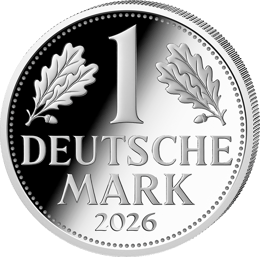


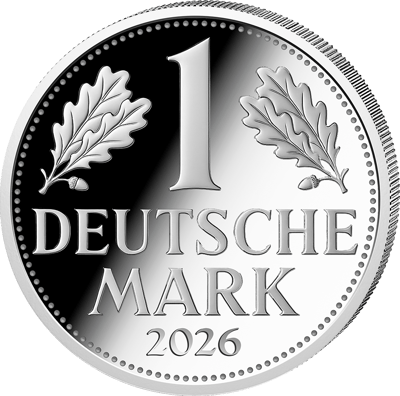


1/50 oz Silver Deutsche Mark 2026 (Proof)










- Legendary Design: trusted since 1950
- Mirror Finish: black meets silver
- Highest Purity: no substitute metal
- Legendary DesignThe one in oak leaves, designed by Josef Bernhart
- Mirror FinishMirrored fields and a razor-sharp relief
- Highest PurityPrecious metal with a fineness of 999/1,000
 Price alert set
 share
shareDeutsche Mark · 2026 Edition
The coin that passed through our hands for half a century.When memory turns to silver.
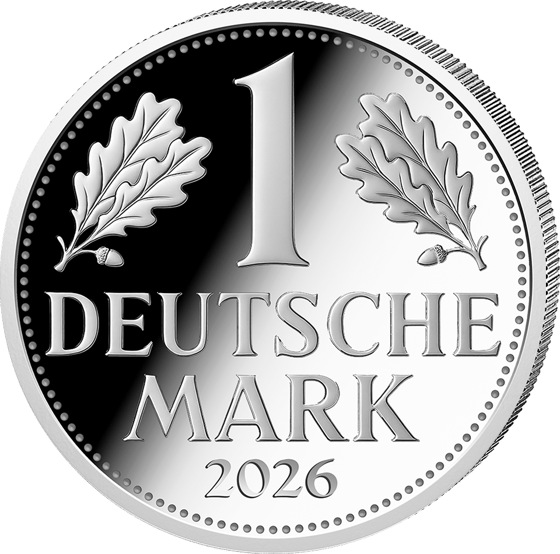
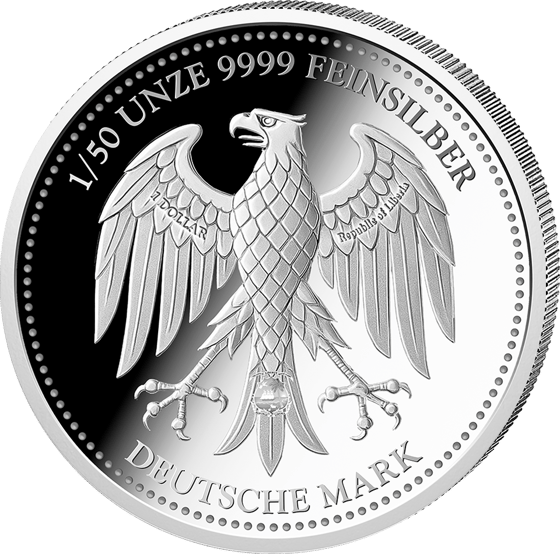
You are looking at the value side.
It jingled in coat pockets, lay on shop counters and in piggy banks. The One between the oak twigs went through millions of hands until the farewell of the D-Mark. Now its image returns as a homage, struck in fine silver.
- Proof
- 0.62 g
It was never just money. It was a promise.
On 20 June 1948, every resident of the three western zones exchanged 40 Reichsmarks for 40 D-Marks, the “Kopfgeld” or per-head quota. The very next day, shop windows were full to bursting. The new currency set off the economic miracle.
In the Bundesbank’s words, the D-Mark enjoyed trust from its first day and kept it to the very end. Over five decades it also became an international symbol of stable money.
12 billion
Some never fully let go of it: according to the Bundesbank, around twelve billion D-Marks have still not been exchanged, more than half of them in coins.
From the Kopfgeld to the farewell
Half a century of the Mark
1948
A new beginning
On 20 June the currency reform takes effect. From the next day, the Deutsche Mark is the only legal tender in the three western zones.
1950
The One with the oak leaves
At the end of 1950 the one-mark coin enters circulation, designed by Josef Bernhart of Munich. Its motif remains unchanged until the farewell of the D-Mark.
1951
The Heiermann
Albert Holl’s silver five-mark coin is struck for the first time and circulates from May 1952. It remains the only circulation coin of the Federal Republic made of silver.
1957
The Bundesbank
On 1 August the Deutsche Bundesbank takes over from the Bank deutscher Länder, which had issued the first D-Marks in 1948.
1990
One Mark for everyone
“If the D-Mark comes, we stay. If it doesn’t, we’ll go to it” was a slogan at the Monday demonstrations. On 1 July 1990 it came to the GDR, even before German reunification.
2001
The farewell
In farewell, the Deutsche Bundesbank issues the One as a gold coin, one million pieces in fine gold. Since 1 January 2002 Germans have paid in euros.
The motif
An image everyone knows
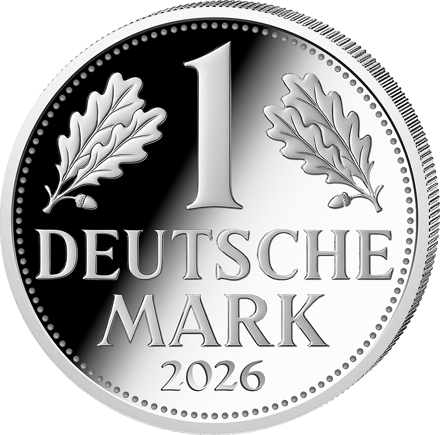
The value side follows the one-mark coin of the past. Anyone who once held the Mark recognises it at once.
- The large One
- Clear and unadorned, it stands in the centre, just as on the one-mark coin designed by the Munich artist Josef Bernhart.
- Two oak twigs
- To the left and right, two oak twigs with acorns frame the numeral. Oak leaves already graced the pfennig coins, and the German 1, 2 and 5 cent coins still show them today.
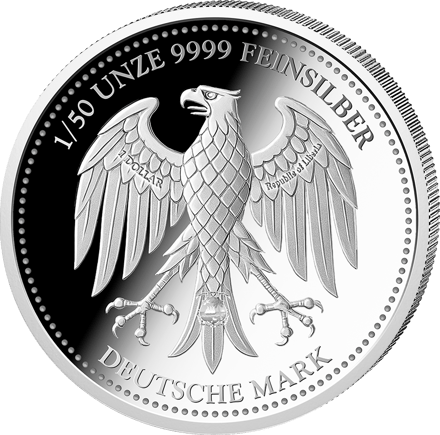
- The eagle
- On the other side the eagle spreads its wings, worked down to the last feather. The wings carry the face value and Republic of Liberia in small letters.
The finish
Two ways to catch the light
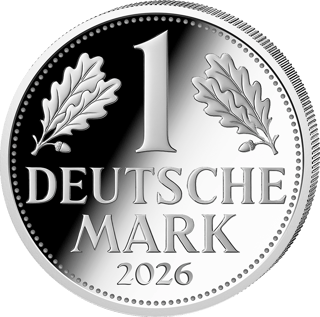
Proof
The field shines deep like a mirror, the motif lies on it in matte relief. With this finish, dies and blanks are specially polished and the blanks are fed into the press one by one.
Reverse Proof
Here it is the other way round: the field is frosted, the motif gleams like a mirror. Every leaf vein and every feather catches the light.
Some things pass.
The memory remains.
The D-Mark is history. Its image in precious metal remains, for you and for those you will one day pass it on to.
0.62 g fine silver · 999/1.000 · 16.50 mm · Proof · Coin capsule
An own edition by Kettner Edelmetalle, not an issue of the Federal Republic of Germany or the Deutsche Bundesbank. The issuing country is the Republic of Liberia, hence the face value in dollars.
1/50 oz Silver Deutsche Mark 2026 – German Currency History in Proof Quality
- Minting quality: The highest possible minting quality, Proof (PP) – mirror-smooth fields meet a razor-sharp relief.
- Precious metal: 0.62 g of pure silver with a fineness of 999/1,000 – genuine fine silver, no substitute metal.
- Format: Denomination 1/50 oz with a diameter of 16.50 mm – a compact format that sits comfortably in the hand.
- Obverse design: the iconic value number “1” between two oak branches with finely detailed acorns, below it “DEUTSCHE MARK” and the year of issue 2026.
- Reverse: the majestic eagle with widely spread wings and richly detailed plumage.
- Issue: year of issue 2026, issued for the Republic of Liberia with a face value of 1 dollar.
- Origin & delivery: country of origin Germany, manufacturer Kettner Edelmetalle – brand new, protected in a perfectly fitted coin capsule and shipped via insured shipping.
Some designs need no explanation. The value number “1” framed by oak leaves is known to virtually everyone in Germany – for more than half a century, it stood for reconstruction, thrift, and stable money. The Deutsche Mark was legal tender from June 1948 until the end of December 2001, before the euro followed. The 1/50 oz Silver Deutsche Mark 2026 revives this legacy – not merely as a keepsake, but as physical fine silver whose value lies in the metal itself.
The design: the legendary “1” between two oak branches
The historic 1-DM circulation coin was minted from 1950 to 2001; its design came from Josef Bernhart and showed the value number “1” amid oak leaves, with the federal eagle on the other side. The 2026 annual issue takes up exactly this visual language. The left oak branch stands out against deep black, while its counterpart shines in bright silver – a contrast that lends the design remarkable depth. A fine beaded circle frames both sides. The reverse inscription states the denomination and fine silver content, along with the face value “1 Dollar” and the issuing state “Republic of Liberia”.
Proof: the most demanding refinement stage in the art of minting
The Proof finish is achieved through multiple strikes with polished dies. The result: surfaces that act like a mirror, with design elements emerging from them in striking relief. Collectors value this quality because every detail – down to a single leaf vein – remains visible. Please handle the coin only by its capsule, so the mirror finish is preserved permanently.
Fine silver as a tangible asset – wealth preservation you can hold
Silver has served as coinage metal, means of payment, and store of value for thousands of years. It carries intrinsic value because it is traded worldwide as a raw material and used in electronics, solar technology, and medical technology – unlike paper money, which relies solely on trust in institutions. Anyone investing in silver coins holds a tangible asset that cannot be increased by decree.
- Limited supply: Silver is finite, while industrial demand grows alongside new technologies – a combination that supports long-term value stability.
- Divisibility: Small units like this one are designed as a means of exchange for manageable transactions, especially in times of currency instability.
- Durability: Silver does not age; it retains its physical properties across generations – ideal for passing on wealth.
- Liquidity: Silver coins are recognized worldwide, easy to verify, and can be exchanged for cash at any time.
- Tax framework: Under current law, profits from the sale of silver are generally tax-free, provided the holding period is at least one year.
As part of a broadly diversified precious metals portfolio, physical silver contributes to inflation hedging; in turbulent times, many investors also value coins and bars as crisis protection. Gold is considered mankind's oldest currency and has outlasted every paper money system – silver has accompanied it since antiquity as the everyday money metal of the people.
Comparison: 1/50 oz versus larger denominations
A classic one-ounce bullion coin naturally brings more metal to the scale, but also requires significantly more capital per piece. This issue reverses that ratio: a low entry price, but many units – offering flexibility for a later sale. Compared to a plain small bar, the Deutsche Mark 2026 combines material value with an elaborately designed motif, the character of a commemorative coin, and the fine execution in Proof quality. Anyone already collecting classics like the Krugerrand, Maple Leaf, or Britannia can consciously add a chapter of German monetary history here.
A gift with substance: for a birthday, a christening, or as a first building block for long-term wealth accumulation. What remains is the shine of genuine fine silver.
Product depiction may differ from the final product.
