











1 oz Gold Deutsche Mark 2026 (Mintage: 50 | Reverse Proof)









- Rarity: only a few left in stock
- Iconic design: oak leaves and eagle
- Mirror finish: on a silky matte ground
- RarityOnly a few pieces of this tiny mintage left in stock
- Iconic designThe familiar image, fine down to each leaf vein
- Mirror finishThe gleaming relief stands out in vivid depth
 Price alert set
 share
shareDeutsche Mark · 2026 Edition
The coin that passed through our hands for half a century.When memory turns to gold.
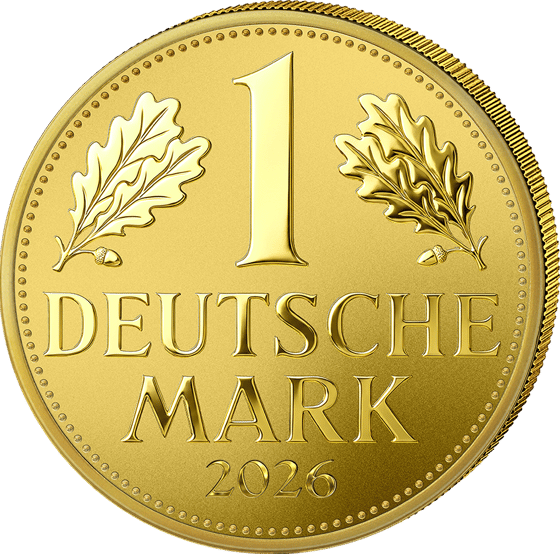
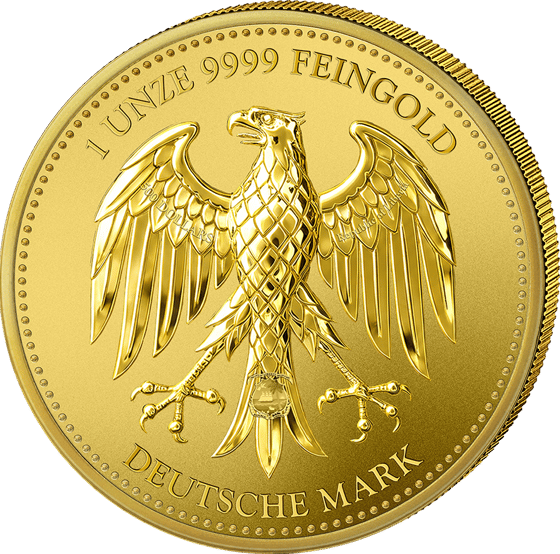
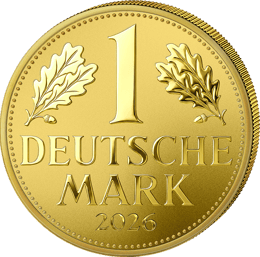
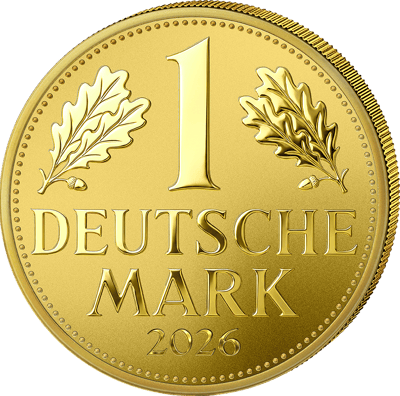
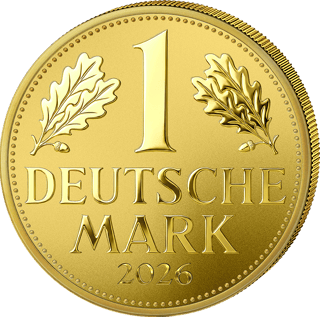
You are looking at the value side.
It jingled in coat pockets, lay on shop counters and in piggy banks. The One between the oak twigs went through millions of hands until the farewell of the D-Mark. Now its image returns as a homage, struck in fine gold.
- Mintage 50 pieces
- Reverse Proof
- 31.1 g
It was never just money. It was a promise.
On 20 June 1948, every resident of the three western zones exchanged 40 Reichsmarks for 40 D-Marks, the “Kopfgeld” or per-head quota. The very next day, shop windows were full to bursting. The new currency set off the economic miracle.
In the Bundesbank’s words, the D-Mark enjoyed trust from its first day and kept it to the very end. Over five decades it also became an international symbol of stable money.
12 billion
Some never fully let go of it: according to the Bundesbank, around twelve billion D-Marks have still not been exchanged, more than half of them in coins.
From the Kopfgeld to the farewell
Half a century of the Mark
1948
A new beginning
On 20 June the currency reform takes effect. From the next day, the Deutsche Mark is the only legal tender in the three western zones.
1950
The One with the oak leaves
At the end of 1950 the one-mark coin enters circulation, designed by Josef Bernhart of Munich. Its motif remains unchanged until the farewell of the D-Mark.
1951
The Heiermann
Albert Holl’s silver five-mark coin is struck for the first time and circulates from May 1952. It remains the only circulation coin of the Federal Republic made of silver.
1957
The Bundesbank
On 1 August the Deutsche Bundesbank takes over from the Bank deutscher Länder, which had issued the first D-Marks in 1948.
1990
One Mark for everyone
“If the D-Mark comes, we stay. If it doesn’t, we’ll go to it” was a slogan at the Monday demonstrations. On 1 July 1990 it came to the GDR, even before German reunification.
2001
The farewell
In farewell, the Deutsche Bundesbank issues the One as a gold coin, one million pieces in fine gold. Since 1 January 2002 Germans have paid in euros.
The motif
An image everyone knows
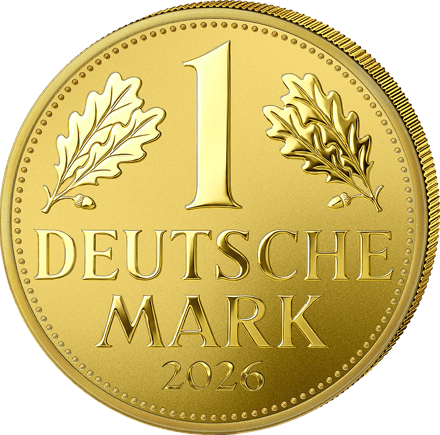
The value side follows the one-mark coin of the past. Anyone who once held the Mark recognises it at once.
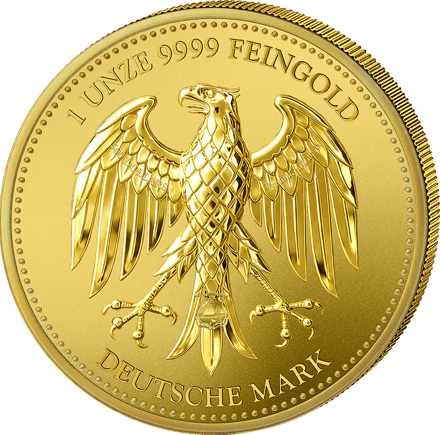
- The large One
- Clear and unadorned, it stands in the centre, just as on the one-mark coin designed by the Munich artist Josef Bernhart.
- Two oak twigs
- To the left and right, two oak twigs with acorns frame the numeral. Oak leaves already graced the pfennig coins, and the German 1, 2 and 5 cent coins still show them today.
- The eagle
- On the other side the eagle spreads its wings, worked down to the last feather. The wings carry the face value and Republic of Liberia in small letters.
The finish
Two ways to catch the light
Proof
The field shines deep like a mirror, the motif lies on it in matte relief. With this finish, dies and blanks are specially polished and the blanks are fed into the press one by one.
Reverse Proof
Here it is the other way round: the field is frosted, the motif gleams like a mirror. Every leaf vein and every feather catches the light.
Some things pass.
The memory remains.
The D-Mark is history. Its image in precious metal remains, for you and for those you will one day pass it on to.
50
pieces in the edition
31.1 g fine gold · 999,9/1.000 · 40 mm · Reverse Proof · Case
An own edition by Kettner Edelmetalle, not an issue of the Federal Republic of Germany or the Deutsche Bundesbank. The issuing country is the Republic of Liberia, hence the face value in dollars.
1 Ounce Gold Deutsche Mark 2026 – Reverse Proof with a Mintage of Only 50 Pieces
- Strictly limited: A tiny mintage of only 50 pieces worldwide – a number that speaks for itself.
- Growth opportunities: Very high potential for value appreciation due to the strict limitation and the sustained high demand for D-Mark designs.
- Rarity: An extremely rare collector's coin, one you'll hardly ever see offered again in this exact constellation.
- Investment goal: A true collector's product, whose appeal stems from its iconic design, minting artistry, and minimal mintage.
- Design: The legendary "1 Deutsche Mark" with oak leaves and acorns on one side, the majestic eagle on the other.
- Material & fineness: 31.1 g fine gold in the highest purity of 999.9/1,000 – a full ounce of solid precious metal, 40.00 mm in diameter.
- Quality: Reverse Proof, the mirror-image sister of the Proof finish.
- Manufacturer: Exclusive in-house minting by Kettner Edelmetalle.
- Country of origin: Germany – issued for the Republic of Liberia with a face value of 500 dollars.
- Delivery: Protected in a high-quality case, ideal for storage and display.
Some designs never truly disappear. The "1 Deutsche Mark" is one of them – and this edition brings it back in a form that makes even seasoned collectors take notice: 40 millimeters in diameter, a full ounce of gold, and a mintage that could hardly be smaller. Among all current gold coins in the Symbolism series, this piece marks the pinnacle of the pyramid.
The Design: Digit, Oak Leaves, and Eagle
At the center of the obverse stands the large digit "1", flanked by two oak branches, each bearing a sculpturally formed acorn. Oak leaves have for generations served as a German symbol of steadfastness; here they are rendered down to each individual leaf vein. Below is the inscription "DEUTSCHE MARK" together with the year 2026. The other side belongs to the eagle: widely spread wings, finely layered plumage, an open beak. Encircling the design, the gold coin states "1 OUNCE 9999 FINE GOLD" along with the issuing details of the Republic of Liberia. A fine beaded border frames both sides, and the reeded edge completes the design.
Reverse Proof – Minting Artistry at Its Finest
In classic Proof coins, the fields are mirror-polished while the relief appears frosted. With Reverse Proof, it's exactly the opposite: the design shines with a mirror finish, while the background remains silky matte. This reversed contrast makes the eagle and oak leaves seem to truly rise from the surface. Every feather, every leaf vein becomes a play of light – and because the technique is more elaborate, it is almost always reserved for small series.
A Design with History
The design draws on more than a hundred years of German monetary history: from the Goldmark of the German Empire to the D-Mark, which shaped the everyday lives of millions of people for over five decades, up to the official 1-DM gold coin of the year 2001. Anyone who once carried the Mark in their own wallet will recognize this image instantly. It is precisely this emotional recognition that makes the series – also available in silver – so sought after among collectors.
Why This Rarity Excites Collectors
In the collector's market, mintage decides almost everything. With a limitation of 50 pieces worldwide, the math is simple: there can never be enough pieces for everyone interested. This is what fuels the potential for value appreciation of this edition. Highly sought-after tiny mintages, as experience shows, tend to migrate into permanent collections – and rarely resurface afterward.
- Double substance: Collector value thanks to the very low mintage, material value thanks to a full ounce of fine gold.
- Tax-attractive: Investment gold is exempt from VAT; after a holding period of at least one year, profits from the sale are generally tax-free.
- Globally tradable: Gold is recognized on every continent and remains liquid at all times.
- Worth collecting: an iconic design in the largest denomination of the series, crafted using the most elaborate minting technique.
- Perfect as a gift: presented in a case – a piece of contemporary history in a jewelry box.
Gold is the oldest currency in the world. It has outlived all others, possesses intrinsic value, and will never lose its shine.
Compared to Similar Editions
The Deutsche Mark 2026 was also issued in Proof quality with 99 pieces, as well as in smaller denominations with mintages of 5,000 pieces. This version clearly stands apart: it is the only one featuring the Reverse Proof technique and, with just 50 pieces, sits at the lower end of all mintages in the series. Compared to classics such as the Krugerrand, the difference is even more striking – there, bullion coins are minted in the millions, while here there are barely a dozen handfuls. The only drawback of such a rarity is obvious: those who hesitate will be too late.
Substance That Endures
For over 6,000 years, gold has served as a store of value. Its supply is limited, its value has never been zero, and the largest holdings rest with central banks. This foundation underpins every collector's piece made of fine gold – and physical precious metal also fulfills the role of inflation hedge and crisis protection. Here, however, the focus is on collector appeal: a legendary design, the highest minting quality, and a mintage that makes this specimen a solitaire. Secure a piece of German monetary history before the last remaining pieces disappear into permanent collections.
Product depiction may differ from the final product.
