





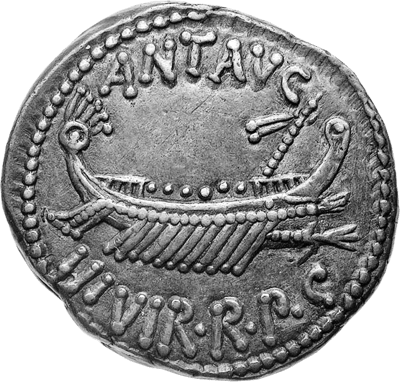

Silver Legionary Denarius (31-32 BC | Roman Republic | Marcus Antonius)
- Collector coin: Especially interesting for collectors
- Secure shipping: 100% insured & anonymous delivery
- Collector coinEspecially interesting for collectors
- Secure shipping100% insured & anonymous delivery







- Collector coin: Especially interesting for collectors
- Secure shipping: 100% insured & anonymous delivery
 Price alert
 Share
Legionary Denarius of Marcus Antonius – the Pay Before the Battle of Actium
Some coins are collected. Others tell world history. This denarius made of silver belongs to the second category. It was minted in 32-31 BC on the orders of Marcus Antonius, commonly known in German as Marc Anton and internationally as Mark Antony. With these coins he paid his legions in the decisive power struggle against Octavian. On 2 September 31 BC, the decision was made at Actium: Octavian won the victory, Mark Antony lost everything. But his coins outlived him by centuries, and today you can hold one of them in your hands.
Money for an Entire Army: The History of the Legionary Denarii
In the late 30s BC, Mark Antony armed himself in the eastern Mediterranean for the final civil war of the Roman Republic. Above all, he needed money for the pay, equipment, and provisioning of his soldiers. The answer was the largest silver issue of the late Republic. In the standard reference work by Michael H. Crawford ("Roman Republican Coinage"), the series is listed as RRC 544, with a total of 39 variants. The mint is believed to have been a field mint, presumably in the Greek city of Patrae, which served Antonius as a military base.
What is striking is what is missing: a portrait. On earlier coinages, Mark Antony could still be seen alongside Cleopatra. On the legionary denarii, the triumvir from the Gens Antonia deliberately dispensed with any likeness. Historians interpret this as a clear message to his troops. Here spoke a Roman general, not a follower of an Egyptian queen.
Obverse: the War Galley
The obverse shows a galley facing right with a row of oars and an angled mast. At the bow sits a sceptre wrapped with a fillet. The inscription ANT AVG III VIR R P C stands for "Antonius Augur, Triumvir Rei Publicae Constituendae": Antonius, Augur and member of the triumvirate for ordering the state. A beaded border frames the coin design. The galley represents the fleet on which Antonius placed his hopes.
Reverse: Legionary Eagle Between Two Standards
On the reverse, the Aquila, the legionary eagle, rises between two standards. Below, the legend LEG names the number of a legion from I to XXIII. There are also special issues for the Praetorian cohorts and for the cohort of scouts. Our illustration shows, as an example, a specimen of LEG XIX. This variety makes the legionary denarius, Latin denarius, an appealing field for collecting. Some legion numbers occur significantly more rarely than others. Those with ambition thus try to assemble as many legions as possible.
Why These Coins Remained in Circulation for Centuries
The silver content of the legionary denarii was slightly lower than that of the Roman city denarii from the same period. This is precisely what secured their survival, as melting them down was hardly worthwhile. It is believed that after his victory, Octavian even paid his own soldiers with the coins of his opponent. Under Emperor Vespasian (69–79 AD), they still made up around a fifth of all denarii circulating in Greece. Heavily worn pieces appear in hoard finds right up to the 3rd century AD. One example is the British Shapwick Hoard with 260 legionary denarii.
Condition: Every Trace Is a Piece of History
These pieces are circulated currency and bear corresponding traces: darker patina, individual centring, nicks, wear, and in some cases weaker areas of the legend. This is exactly what makes them appealing. Since the year of minting, mint, and reverse variant can vary, the specimen delivered will differ from the illustration. You receive an original, not a mass-produced item.
Please understand, therefore, that the illustration in the shop is an example. Due to historical circumstances, the item delivered may differ individually in appearance and condition. The illustration of the reverse may also differ. Each of these coins was hand-struck. An off-centre coin design is therefore not a flaw, but a typical feature of ancient craftsmanship.
Technical Data at a Glance
- Denomination: Denarius
- Issuing authority: Marcus Antonius (Mark Antony), Roman Republic
- Minting period: 32-31 BC
- Metal: Silver
- Gross weight: approx. 3.5 g
- Diameter: approx. 18 mm
- Reference: Crawford RRC 544
- Production: hand-struck
- Condition: circulated, degree of preservation varies
Silver with History: Collector's Item and Value Anchor
Those who buy silver coins usually think of modern bullion coins. The legionary denarius is different. Its value derives primarily from its provenance, its authenticity as an ancient original, and the unbroken interest of collectors in antiquity. Nevertheless, it shares something fundamental with every ounce of investment silver, namely the metal itself. For thousands of years, silver has been money, a medium of exchange, and a sign of wealth. It is durable, tradeable worldwide, and has an intrinsic value that does not depend on a government's promise. This is why many people value it as an inflation hedge and as crisis protection.
In addition, there is strong industrial demand from electronics, photovoltaics, and medical technology, while supply remains limited. For tax purposes in Germany: profits from the private sale of physical silver are generally tax-free after a holding period of at least one year. A denarius like this is also well suited to passing on both wealth and history together to the next generation.
Legionary Denarius or Modern Silver Coin? A Comparison
A modern bullion coin such as the Maple Leaf or the Vienna Philharmonic contains one troy ounce of fine silver and is traded close to its material value. The legionary denarius contains significantly less metal, but over 2,000 years of history instead. Compared to other ancient denarii, such as those of Julius Caesar or Augustus, it is remarkably accessible thanks to its enormous mintage. It is therefore ideal for anyone starting out in ancient numismatics.
- Advantage: a genuine original from the time of Antony and Cleopatra
- Advantage: each specimen is unique, with its own patina and fine toning
- Advantage: 39 variants offer an exciting collecting goal
- To note: As a collector's item, it is not primarily valued for its silver weight.
A legionary denarius is more than a coin. It was the pay of a legionary who backed Mark Antony before Actium. Today it is a piece of the Roman Republic that you yourself can own.
Product image may differ from the actual product.
