





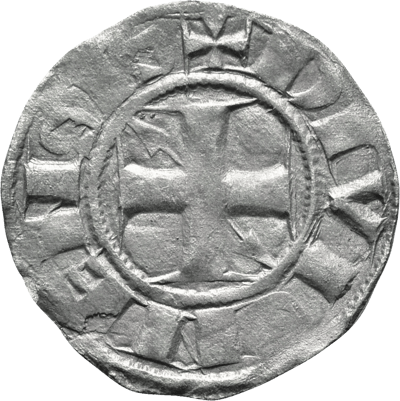

Silver Denier Kingdom of France (1079-1103 | Duchy of Burgundy | High Middle Ages)
- Collector coin: Especially interesting for collectors
- Secure shipping: 100% insured & anonymous delivery
- Kettner Bullion: Already over 300,000 satisfied customers
- Collector coinEspecially interesting for collectors
- Secure shipping100% insured & anonymous delivery
- Kettner BullionAlready over 300,000 satisfied customers







- Collector coin: Especially interesting for collectors
- Secure shipping: 100% insured & anonymous delivery
- Kettner Bullion: Already over 300,000 satisfied customers
 Price alert
 Share
A Denier from the High Middle Ages: Burgundy at the Time of the Crusades
Silver was money par excellence in 11th-century Europe. Anyone paying for bread, cloth, or harness in Dijon at that time did so with small, thin coins like this one: a denier from the Duchy of Burgundy, attributed to the reign of Duke Odo I (1079–1103). The piece weighs around 0.9 grams. And yet it carries almost a thousand years of history within it.
The denar, French denier and known in German-speaking regions as the pfennig, had been the backbone of the monetary system since Charlemagne's Carolingian coinage reform: 240 deniers made up a pound, 12 deniers a shilling. Larger silver denominations simply did not exist in 11th-century Burgundy. This original coin was therefore not a showpiece for a treasury, but a genuine circulating coin, everyday money for the market, tolls, and wages.
Duke Odo I: Capetian, Monastery Founder, Crusader
Odo I, called Borel or "the Red," came from the House of Capet and was a great-grandson of the French king Robert II. In 1079 he took over the duchy from his brother Hugh I, who withdrew to the Abbey of Cluny. Burgundy was bound to the French crown under feudal law. Hence its classification under "Kingdom of France."
His life reads like a chivalric romance. In 1086 Odo traveled to Spain to assist his uncle Alfonso VI of Castile against the Moors. He supported the founding of the Abbey of Cîteaux, the birthplace of the Cistercian Order. Finally, he joined the Crusade of 1101 and died around 1102/1103 in Tarsus in Cilicia; he found his final resting place in Cîteaux. Campaigns of this kind consumed enormous sums, and knights, weapons, and provisions were paid for in that era with exactly such silver deniers.
The Coin Design: Anille, Cross, and the Name Dijon
The example shown depicts the typical Burgundian iconography. On one side appears the anille, two mirror-image curved shapes often interpreted as a stylized wall anchor, with a dot above and below. The legend names the ruling authority: ODO DVX, "Duke Odo." The other side bears an equal-armed cross, surrounded by the legend DIVIONENSIS, a reference to Dijon, the dukes' seat of power.
Of interest to connoisseurs: because the legend names only "Duke Odo," and successful coin designs in the Middle Ages were often struck almost unchanged for generations (so-called immobilized or frozen types), some scholarly literature also attributes comparable pieces to Odo II (1143–1162). It is precisely this numismatic detective work that makes medieval coins so appealing.
Key Facts at a Glance
- Denomination: Denier
- Issuing authority: Duchy of Burgundy, Kingdom of France, period 1079–1103
- Material: Silver, fineness varies for historical reasons
- Gross weight: approx. 0.9 g
- Diameter: approx. 18 mm
- Production: hand-struck (hammer-struck)
- Year of issue, mint, variant: various
- Condition: circulated coin, grade of preservation varies
Condition: Not Flaws, but Biography
These pieces are circulated coins, and they look the part. Darker patina, individual centering, small nicks, wear, and legend sections struck more weakly in places: these are not flaws, but biography. Every trace comes from hands that, centuries ago, used them to settle goods, freight, or debts.
Since the year of issue, mint, and reverse variant can vary, the piece delivered may differ from the picture shown. Please understand the photo in the shop explicitly as a representative image: appearance, exact weight, and condition vary from piece to piece for historical reasons. You are purchasing an original.
Why Historical Silver Fascinates So Much
Modern silver coins stand for value preservation. Medieval coinage offers something additional that no new minting can provide: tangible history. Silver has outlasted kings, dukes, and entire currencies, and this denier proves how enduring the metal remains across the centuries. Many investors value silver as an inflation hedge and as crisis protection, because its value does not depend on a government's promise, but resides in the coin itself.
- Intrinsic value: Silver is a globally traded commodity, in demand for electronics, solar, and medical technology.
- Limited supply: The metal cannot be multiplied at will, unlike paper money.
- Tradition as a monetary metal: For millennia, silver has served as a medium of exchange, particularly for smaller amounts.
- Heirloom piece: A denier nearly a thousand years old is an heirloom with history.
- Tax advantage: In Germany, profits from the sale of physical silver are generally tax-free after a minimum holding period of one year.
- Affordable: A genuine piece of the Middle Ages, without having to be a gold coin.
In Comparison: Burgundian Denier, Roman Denarius, and Bullion Coin
A Roman denarius is older, heavier, and far better known. Burgundian feudal coins, on the other hand, are a specialist field that appeals to collectors with an eye for the unusual, and with Odo I, the piece has a crusader and monastery founder behind it. Compared to a modern bullion ounce, pure metal value matters less here than historical collector's value; the ounce, in turn, delivers a predictable silver content. Those who want both can simply combine the two: modern bullion coins as the foundation, an original from the age of the Crusades as the centerpiece of the collection.
A duke, a crusade, a small silver disc from Dijon – and now perhaps in your hands.
Secure this original silver denier from the Duchy of Burgundy and bring the High Middle Ages into your collection.
Product image may differ from the actual product.
