





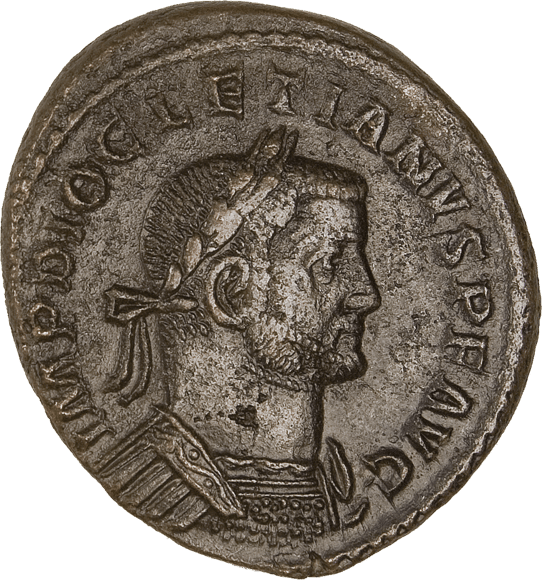


Bronze Large Follis Emperor Diocletian (284-305 AD | Age of the Tetrarchy)












- Genuine Original: around 1,700 years old
- Reform Emperor: Rome's great reformer
- One of a Kind: every coin is different
- Genuine OriginalNo reprint, but real money from the Roman Empire
- Reform EmperorHe restructured state and currency, resigned in 305
- One of a KindPatina and traces tell the story of your piece
 Price alert
  Share
ShareAncient original
The tetrarchyLarge follis of Diocletian
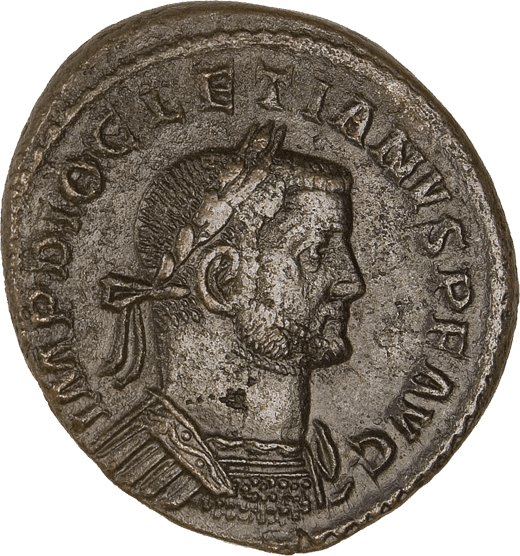
You are looking at the front.
Between the day someone struck this piece with a single hammer blow and the day you hold it, there are roughly
1,750years
- Struck by hand
- Original, not a restrike
- 27 mm across
- 30 days return policy
Where it belongs
Eleven epochs, a thousand years, one shelf.
Diocletian ended the crisis with a radical rebuild: four rulers, two Augusti and two Caesares, each for one part of the empire. With it came a new, heavy bronze coin, the follis. The portraits of these years are deliberately interchangeable; what was meant to be seen was the office, not the person.
7th to 5th century BC
Archaic Greece
5th to 4th century BC
Classical Greece
6th century to 330 BC
Achaemenid Persia
5th to 2nd century BC
Carthage
336 to 30 BC
The hellenistic age
3rd to 1st century BC
Celtic tribes
27 BC to AD 235
The Roman empire
AD 235 to 284
Crisis of the third century
AD 284 to 313
The tetrarchy
Your piece
AD 306 to 363
The Constantinian dynasty
AD 395 to 1453
The eastern Roman empire
Keeping it
First things first: do not clean it.
The dark layer on bronze and the matte grey on silver are called patina. It has grown over centuries and collectors treat it as a mark of authenticity. Polishing it away does not give you a nicer piece, it gives you a damaged one: auction houses regularly value a brightly cleaned coin below the same coin with its patina intact.
Hold it by the edge
Fingerprints contain acid and salt. Take the piece between thumb and forefinger by the rim, over a soft surface.
Store it dry and dark
Moisture is the only real enemy. A pouch or a capsule in a dry place is enough; PVC sleeves are not, they attack the surface.
No agents, no brush
No vinegar, no silver cloth, no ultrasound. If you want a crust removed, let a conservator do it, not the kitchen sink.
Bronze Large Follis of Emperor Diocletian – an original from the birth of the Tetrarchy
Hardly any coin from the Roman imperial era tells so much history on so little surface area as the large follis of Emperor Diocletian. It sits heavy and solid in the hand: around 10 grams raw weight, approximately 27 mm diameter, a substantial flan made of copper-rich bronze. Whoever holds this piece holds a means of payment that changed hands roughly 1,700 years ago in the markets of Trier, Rome, Siscia, or Alexandria. No reprint. No modern re-strike. A genuine original from the Roman Empire.
Diocletian (284–305 AD): The reformer who reordered Rome
Diocletian took over an empire on the brink of collapse. Civil wars, usurpations, pressure on the Rhine, Danube, and Euphrat frontiers – and a currency that had lost trust through continued debasement. His response was radical: in the year 293 he appointed two Caesares, Constantius Chlorus and Galerius, thereby creating the Tetrarchy, the four-emperor system consisting of two Augusti and two Caesares. In 301 followed the famous Edict on Maximum Prices against galloping inflation. On 1 May 305, Diocletian voluntarily abdicated – a unique event in the history of Roman emperors.
The follis: Diocletian's new leading coin against currency devaluation
Around 294, the follis was introduced as part of the coinage reform. It was cut to 1/32 of a Roman pound – roughly 10 grams – struck in bronze and coated with a thin layer of silver, the so-called silver wash. Its diameter ranged between 27 and 30 mm, and the weight of surviving folles between approximately 9 and 13 g. Upon introduction, the coin was valued at 12.5 nummi, and with the reform of 1 September 301 it was revalued to 25. The follis thus became the most important new copper/bronze coin of late antiquity – the everyday money of an entire era.
Design: Imperial portrait and the Genius of the Roman People
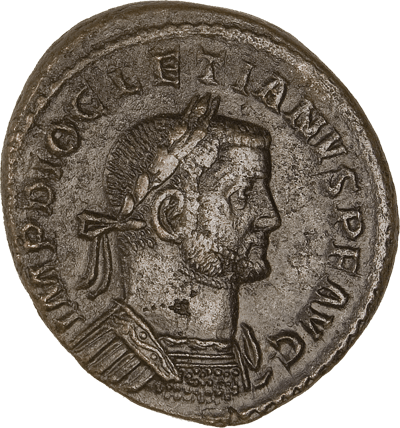
- Obverse: Bust or head of Diocletian with laurel wreath facing right, surrounding legend in the style of IMP DIOCLETIANVS P F AVG.
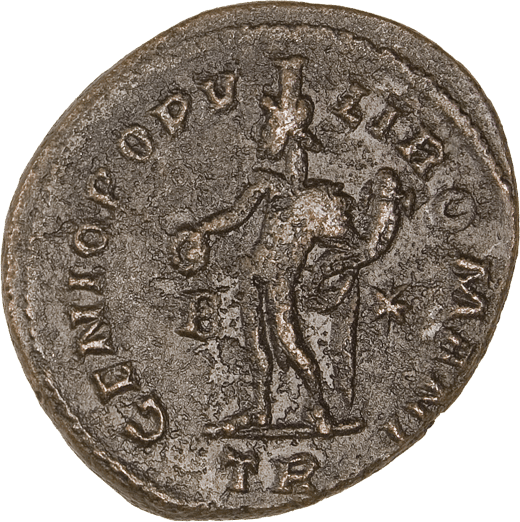
- Reverse: The classic main type GENIO POPVLI ROMANI – the Genius of the Roman People, draped in a cloak, holding a sacrificial dish (patera) and cornucopia (Cornucopiae).
- Mint mark: depending on the piece, roughly TR (Trier), ALE (Alexandria), SIS (Siscia), or ANT (Antioch), along with officina and value marks in the field.
- Face value: Follis · Country: Roman Empire · Raw weight: 10 g · Diameter: 27 mm.
Condition: circulated money with authentic traces
These pieces are circulated means of payment and bear corresponding traces: darker patina, individual centering, nicks, wear, and sometimes weaker areas of the legend. This is exactly what makes them appealing. Since the year of minting, mint, and reverse variant can vary, the delivered specimen will differ from the image shown – you receive an original, not a mass-produced item. Please understand that the image in the shop represents an example and may individually differ from the delivered item in terms of appearance and condition due to historical circumstances.
Who this follis is suited for
- Newcomers to ancient numismatics: a large-format, easily legible type with a clear attribution to one of the most significant emperors in world history.
- Thematic collectors: ideal as a starting point for a collection organized by mints, officinae, or tetrarchs.
- History enthusiasts and gift-givers: a tangible piece of late antiquity that immediately brings any narrative about Rome to life.
- Those interested in tangible assets: as a historical tangible asset, a collector's addition alongside classic investment products.
Gold is humanity's oldest currency and has outlasted all others. The follis tells the other half of this story: what happens when a state continually dilutes its money – and why real value in hand has always created trust.
In comparison: Follis, Antoninianus, and Argenteus
The Antoninianus of the preceding decades is smaller, lighter, and in its late phase low in silver content – historically fascinating, but often visually unremarkable. The Argenteus, Diocletian's high-quality silver coin, is significantly rarer and correspondingly more challenging to acquire. The large follis sits precisely in between: substantial size, strong relief, and wide availability in various conditions. Anyone collecting ancient coins will find here the best compromise of presence, design quality, and historical significance. As a pure metal investment, however, a bronze follis is not intended – its appeal lies in collector's value and history. For inflation hedging and crisis protection in the narrower sense, investors turn to bullion coins and bars made of gold and silver; the follis complements such a portfolio with the historical dimension.
An ancient original, struck under an emperor who reinvented the Roman Empire – and a coin that literally cast the transition from the Principate to late antiquity in bronze. Secure your personal specimen while supplies last.
Product depiction may differ from the final product.
