





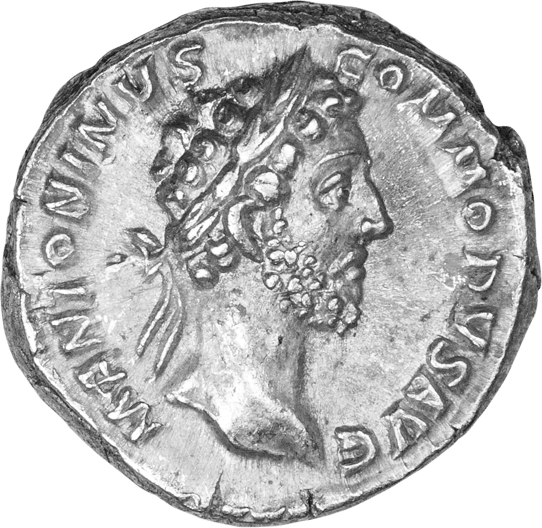


Silver Denarius Emperor Commodus (180-192 AD | An Emperor as Gladiator)












- Genuine Original: around 1,850 years old
- Emperor's Portrait: with laurel wreath
- Antonine Series: crowns your collection
- Genuine OriginalA genuine means of payment from everyday life in ancient Rome
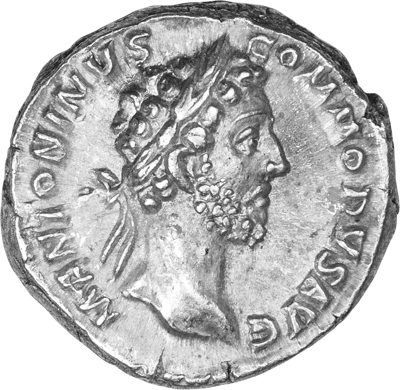
- Emperor's PortraitSculpted curls, full beard and Latin inscription
- Antonine SeriesSon of Marcus Aurelius and last ruler of the Antonines
 Price alert
  Share
ShareAncient original
The Roman empireDenarius of Commodus
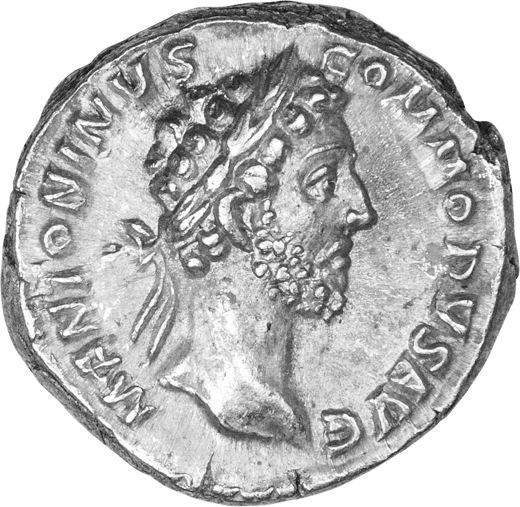
You are looking at the front.
Between the day someone struck this piece with a single hammer blow and the day you hold it, there are roughly
1,850years
- Struck by hand
- Original, not a restrike
- 18 mm across
- 30 days return policy
Where it belongs
Eleven epochs, a thousand years, one shelf.
For more than two hundred years the denarius was the leading currency of the Mediterranean and paid for the army and administration of an empire reaching from Scotland to the Euphrates. Under Augustus a legionary earned 225 denarii a year. On the reverse the emperor advertised himself: his victories, his piety, his wife.
7th to 5th century BC
Archaic Greece
5th to 4th century BC
Classical Greece
6th century to 330 BC
Achaemenid Persia
5th to 2nd century BC
Carthage
336 to 30 BC
The hellenistic age
3rd to 1st century BC
Celtic tribes
27 BC to AD 235
The Roman empire
Your piece
AD 235 to 284
Crisis of the third century
AD 284 to 313
The tetrarchy
AD 306 to 363
The Constantinian dynasty
AD 395 to 1453
The eastern Roman empire
Keeping it
First things first: do not clean it.
The dark layer on bronze and the matte grey on silver are called patina. It has grown over centuries and collectors treat it as a mark of authenticity. Polishing it away does not give you a nicer piece, it gives you a damaged one: auction houses regularly value a brightly cleaned coin below the same coin with its patina intact.
Hold it by the edge
Fingerprints contain acid and salt. Take the piece between thumb and forefinger by the rim, over a soft surface.
Store it dry and dark
Moisture is the only real enemy. A pouch or a capsule in a dry place is enough; PVC sleeves are not, they attack the surface.
No agents, no brush
No vinegar, no silver cloth, no ultrasound. If you want a crust removed, let a conservator do it, not the kitchen sink.
Silver Denarius of Emperor Commodus – genuine hand-to-hand money from 2nd-century Rome
Barely larger than a modern one-cent coin, weighing around 3 grams – and yet the denarius was the backbone of the greatest economic power of antiquity. This specimen bears the portrait of Emperor Commodus, son of the philosopher-emperor Marcus Aurelius. For anyone who sees silver not merely as a metal but as a told story, this is an original held in the hand: minted around 1,850 years ago, passed through the hands of merchants, soldiers and legionary scribes.
Commodus – the son who did everything differently
Born on 31 August 161 in Lanuvium, he was already elevated to co-emperor in AD 177 alongside his father. After Marcus Aurelius's death in 180, he ruled alone – until his assassination on 31 December 192 in Rome. With him ended the Antonine dynasty, the line of rulers that had given the Roman Empire its most stable decades. Commodus broke with his father's stoic style: he had himself celebrated as Hercules Romanus, appeared in the arena himself, and thus became the most flamboyant figure of the late Antonine era. Generations later, Hollywood turned him into a film character – collectors around the world have long prized his denarii as key pieces of Roman numismatics.
What the sample image shows
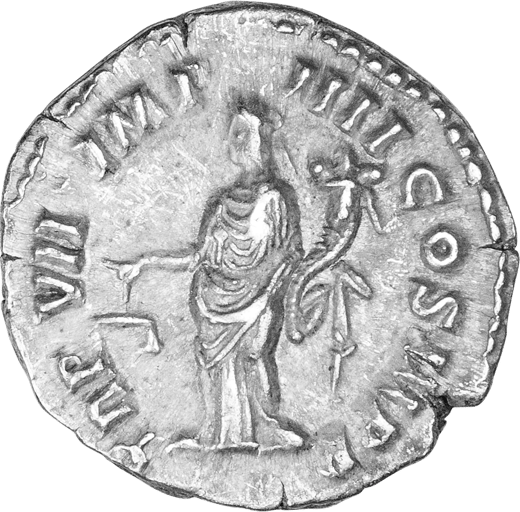
On the obverse you can see the laureate head facing right, surrounded by the legend M ANTONINVS COMMODVS AVG. The reverse carries the titulature TR P VII IMP IIII COS III P P – tribunician power for the seventh time, imperator for the fourth time, consul for the third time, father of the fatherland. These abbreviations date the depicted piece quite precisely to the years 181/182 AD and flank a standing personification, as used by the Rome mint as visual propaganda for luck, care and wellbeing.
Key facts about this piece at a glance
- Face value: Denarius
- Country/Origin: Roman Empire
- Precious metal: Silver, fineness varies – the denarius of the Antonine period had a silver content of roughly 70 to 75 percent
- Gross weight: approx. 3 g
- Diameter: approx. 18 mm
- Year of minting, mint, reverse design: varies (reign 180–192 AD, co-emperor from 177)
- Condition: circulated, degree of preservation varies
- Series: History · Collector's item · Fixed-price item · Shipped as insured value shipment
Preservation: not flaws, but biography
These pieces are circulated coins – and they look the part. Darker patina, individual centring, small nicks, wear, and in places weaker legend impressions: these are not flaws, but biography. Every trace comes from hands that, centuries ago, used it to settle goods, freight or debts. Because the year of minting, mint, and reverse variant may vary, the specimen delivered will differ from the image shown. Please understand the photo in the shop explicitly as a sample image: appearance, exact weight and condition vary from piece to piece for historical reasons. You are purchasing an original.
Silver: the monetary metal that carried Rome's everyday life
The denarius was Rome's principal silver coin for over four centuries – a means of payment accepted throughout the empire, from Britain to Syria. Herein lies the timeless message of this small piece: precious metal has an intrinsic value that does not depend on trust in a government. Fiat money lives on a promise; silver lives on its physical properties.
- Tax advantage: Profits from the sale of silver are generally tax-free, provided the holding period is at least one year.
- Industrial demand: Electronics, solar technology and medical technology create sustained demand for silver – against limited supply.
- Small units: Especially in times of currency instability, divisible silver values are practical as a means of exchange.
- Preservation of value across generations: Silver is durable, liquid worldwide, and suitable for passing on wealth within the family.
- Inflation hedge and crisis protection: Tangible assets hold their ground when paper promises falter.
Rome diluted its denarius further and further over the centuries. The silver itself has outlasted the fall of the empire – and now lies in your hand.
Denarius, antoninianus, or modern silver coin?
A comparison is worthwhile. The later antoninianus, minted as a double denarius from Caracalla onward, is larger and often appears more impressive – but proportionally contains significantly less silver and is frequently struck less sharply. The bronze sestertius scores with format and pictorial surface, but is not a precious metal. And modern silver coins such as the Maple Leaf or Vienna Philharmonic offer precise fine weight in 999 quality, but no patina that tells a two-thousand-year story. The Commodus denarius sits deliberately in between: a collector's item with numismatic appeal, whose price depends not solely on the silver price, but on history, condition and demand for ruler portraits.
Who this piece is made for
For newcomers to ancient numismatics seeking their first genuine imperial portrait. For collectors wishing to complete an Antonine series from Antoninus Pius through Marcus Aurelius to Commodus. And for anyone who wants to add a story that can be told to their precious metal holdings. A denarius of this kind is a gift with weight – both literally and figuratively.
Product depiction may differ from the final product.
