


Sold out

1 oz Silver Lunar I Dog 2006 (partially gold-plated)
£37.56
excl. UK import VAT and shipping
currently not available

 More than 310,000
 Over 30 years
 Secure shipping
 Google: 4.9/5
The Lunar Series I was the beginning of a great, tradition-rich series by the Perth Mint. With the 12 Chinese zodiac signs as annually changing designs, the manufacturer opened up a gigantic market with high demand. The coins of Lunar Series I are now so scarce that their collector's value continues to rise. Unfortunately, due to their scarcity, we only have a few coins available.
With the Lunar Series I, one of the world's most popular silver coin success stories began in 1999: year after year, the Australian Perth Mint dedicated a coin edition to one of the twelve Chinese zodiac signs. What started out as a bullion coin with collector appeal is now a sought-after rarity, as the comparatively low mintages have long since sold out, and many years are traded well above the pure silver value. This guide looks at the history, designs, denominations, mintages, authenticity features and tax treatment of the first Australian Lunar series.
The silver edition of the Lunar Series I was minted between 1999 and 2010 by the Perth Mint in Australia, the country's oldest still-active mint. The series thus appeared three years after its gold counterpart, which had already launched in 1996. This time lag gives rise to a peculiarity that distinguishes the Lunar Series I from most other Lunar series to this day.
Unlike usual, the first silver series does not begin with the Year of the Rat, but with the Year of the Rabbit. The Chinese lunar calendar traditionally starts its cycle with the Rat, but the delayed silver premiere forced the Perth Mint into an elegant workaround. The cultural basis remains the same: an old legend tells how twelve animals answered an invitation and, in the order of their arrival, each received dominion over one year. Anyone interested in the continuation of this world of designs will find it in the Lunar Series II as well as in the current Lunar Series III.
The Perth Mint is considered one of the most renowned mints in the world and is also responsible for classics such as the Koala and the Kookaburra. The first issue from 1999, the Year of the Rabbit, carries the special mint mark P100, a reference to the mint's 100th anniversary that year. Such details make individual years especially appealing to collectors.
The heart of the series are the twelve animal designs that change every year. Each coin shows on the design side the respective zodiac sign, the corresponding Chinese character, the year of minting, as well as details of fine weight and material. An unmistakable identifying feature is the surrounding border of 120 decorative dots that frames every issue in the series.
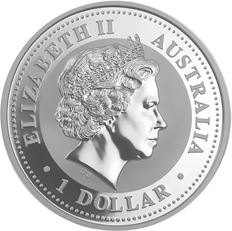
On the value side, the portrait of Queen Elizabeth II, designed by Ian Rank-Broadley, adorns every coin, surrounded by the Queen's name, the country of origin Australia and the respective face value. The animal designs of the silver Lunars deliberately differ from the depictions of the gold series, which can be found in the category Lunar Series I in Gold.
Because the Lunar Series II was scheduled to begin as early as 2008 with the Year of the Rat, while the silver Series I still owed three designs, the Perth Mint decided in 2007 to take an unusual step: the designs Mouse (2008), Ox (2009) and Tiger (2010) were all issued in advance in 2007, recognisable by the additional year 2007 struck on the value side. As a result, these three animals exist in both Series I and Series II, a curiosity that makes the series particularly fascinating for numismatists.
The silver Lunars of the first series were issued in a remarkable range of sizes, from the handy collector's format to the impressive kilo coin. All issues are made of fine silver with a fineness of 999/1,000 and feature a reeded edge.
Complete year sets can be assembled above all in the 1 oz, 2 oz and 1 kg denominations, as only these were minted every year. The 1 oz coin is the classic entry point; anyone wishing to invest more broadly in physical silver will find numerous other series in the silver coins category, and it is also worth looking at silver bars for pure material value.
Finishes at a glance
The Lunar Series I was issued predominantly in the standard Mint State (MS) finish. In significantly lower mintages, it was also joined by the Proof finish, popular with collectors, as well as gilded and coloured variants, the latter of which can now be found in the coloured silver coins category.
The particular appeal of the Lunar Series I lies in its comparatively low mintages. While the later Series II reached an annual minting limit of 300,000 pieces for the 1 oz coin, the actual mintage figures for Series I were often significantly lower. The first year, 1999, reached only around 63,600 pieces in the 1 oz variant, while the later years 2009 and 2010 saw figures of as little as around 52,000 to 56,000 pieces.
The rarity becomes even more dramatic with the large formats: across the entire series, only a few hundred pieces exist of the 10 kilogram edition. This scarcity means that many years today carry a noticeable collector premium above the pure silver value. This sets the Lunars apart from pure bullion classics such as the Vienna Philharmonic or the Maple Leaf, which are minted in the millions.
The Lunar Series I unites two worlds that rarely come together elsewhere: the tangible material value of a bullion coin and the collecting appeal of a time-limited design series.
It remains important to keep a sober perspective: past performance is no guarantee of future results, and collector premiums can fluctuate. Anyone focusing purely on the precious metal content is more likely to view the series as part of a more broadly diversified holding of silver bullion coins.
Precisely because certain years are in high demand, it is worth taking a look at the typical authenticity features. The Lunar Series I offers several clues that make an initial assessment easier:
At Kettner Edelmetalle, every coin undergoes an ISO-compliant authenticity verification before it is shipped. For the secure storage of verified pieces, suitable accessories such as coin capsules are available, protecting the sensitive surface from scratches and tarnishing.
In Germany, silver coins are subject to different tax rules than investment gold. While investment gold is exempt from VAT, imported silver coins such as the Lunar Series I are generally subject to margin scheme taxation, where VAT is calculated only on the dealer's trading margin, not on the full value of the goods. This keeps the effective premium on purchase lower than under full standard taxation.
For private individuals, the one-year holding period rule also applies: if a silver coin is sold again after a holding period of more than one year, any potential profit remains tax-free. This information does not replace professional tax advice, but it provides an initial point of orientation.
Note on storage
Fine silver is sensitive to moisture and touch. For long-term preservation of value, dry storage and protective packaging are recommended, such as coin cassettes for complete year sets or a can safe for discreet storage at home.
Within the Lunar family, Series I marks the origin. The subsequent Lunar Series II relied on significantly higher mintages from 2008 onwards, thereby becoming a pure mass-market bullion coin, while the Lunar Series III has offered modern special editions such as high-relief and gilded variants since 2020. Collectors particularly value the manageable mintage figures and the historic charm of these pioneering issues in the first series.
Thematically related animal coins from the Perth Mint, such as the Koala, or internationally popular series such as the China Panda with its annually changing designs, also appeal to a similar group of collectors. Anyone who appreciates design series often combines the Lunars with these ranges to form a thematically coherent collection.
The Chinese lunar calendar traditionally starts with the Year of the Rat, but the silver edition of Series I did not begin until 1999, three years after the gold series. That is why the Rabbit is the first design. The missing years, Mouse, Ox and Tiger, were issued retroactively in 2007.
All issues of the Lunar Series I are made of fine silver with a fineness of 999/1,000. The 1 oz coin weighs 31.103 grams, has a diameter of 40.6 millimetres and features a reeded edge.
The mintages of Series I were low compared to later Lunar series and other bullion coins. This scarcity leads to a collector premium for sought-after designs and large denominations. However, past performance is no guarantee of future results.
Series I was minted from 1999 to 2010 with relatively low mintages and begins with the Rabbit. The Lunar Series II started in 2008 with the Year of the Rat and significantly higher mintages of up to 300,000 pieces per year for the 1 oz coin. The animal designs also differ in detail.
Imported silver coins are generally subject to margin scheme taxation, under which VAT is applied only to the trading margin. After a holding period of more than one year, any profit on sale remains tax-free for private individuals. This information does not replace individual tax advice.
The series was issued in 1/2 oz, 1 oz, 2 oz, 5 oz, 10 oz as well as 1/2 kg, 1 kg and 10 kg. Only the 1 oz, 2 oz and 1 kg issues were minted every single year; the remaining sizes were minted only in individual years, which increases their rarity.
 Lunar Series I
Stay informed with product launches, financial news and exclusive offers. Sign up for our free newsletter today.
By entering your email address and clicking the "Submit" button, you give the following consent: "I agree to be informed by email about new products, financial news and exclusive offers, and therefore consent to the processing of my email address for the purpose of sending the newsletter. I can revoke this consent at any time without giving reasons, with effect for the future. The lawfulness of processing carried out prior to revocation remains unaffected."