





1/200 oz Gold Brachiosaurus 2025 (Mintage: 5,000 | Proof)
- Finest Gold: 999.9/1,000 fineness
- German Minting: exclusive to Kettner
- Secure Shipping: 100% insured
- Finest GoldStruck from fine gold with a fineness of 999.9/1,000
- German MintingMinted exclusively for Kettner Edelmetalle in Germany
- Secure ShippingFully insured and anonymous delivery to you




- Finest Gold: 999.9/1,000 fineness
- German Minting: exclusive to Kettner
- Secure Shipping: 100% insured
 Price alert
 Share

Brachiosaurus
From the rock into the light.The Brachiosaurus 2025 in gold.
1/200 ounce of gold, in proof quality, issuing country Liberia. Brachiosaurus lived 152 to 145 million years ago.
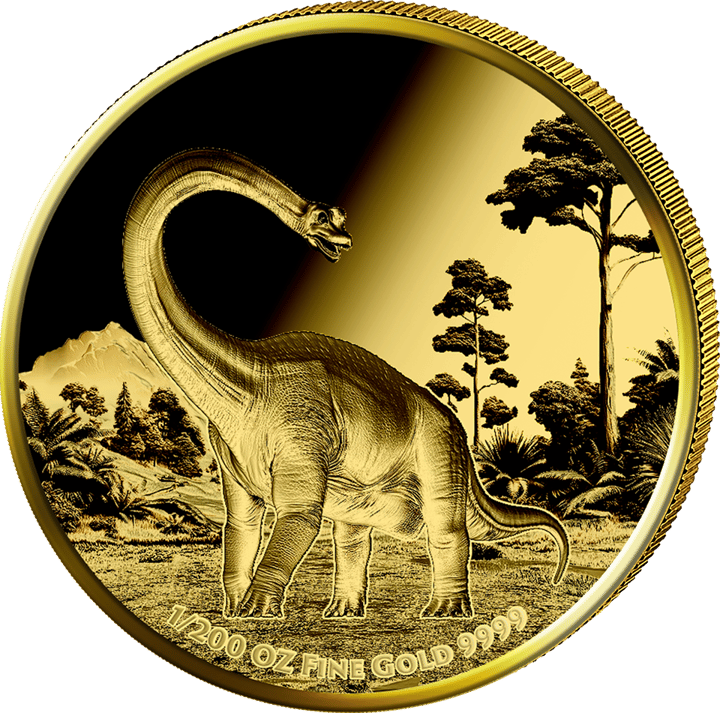
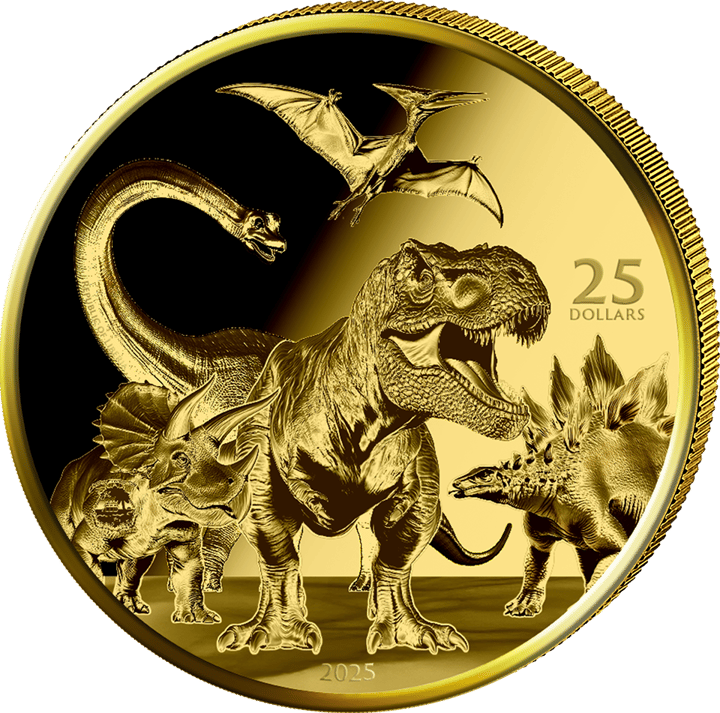
Brachiosaurus on 1/200 ounce of gold, reverse, image
1/200 ounce of gold, in proof quality, issuing country Liberia. Brachiosaurus lived 152 to 145 million years ago.

From the rock
It owes its name to its forelimbs, which were longer than its hind limbs.
The skeleton of its relative Giraffatitan stands in the Museum für Naturkunde Berlin. According to Guinness World Records, it is the largest mounted dinosaur skeleton in the world.
No human has ever seen this animal alive: the age of the dinosaurs ended 66 million years ago, and the human genus has existed for about 2.8 million years.
Sources: Natural History Museum, London; Museum für Naturkunde Berlin
The timeline
From the Devonian to the last Ice Age
Each animal stands in its geological period. The sections show the order, not the duration.
Devonian
about 420 to 359 million years ago
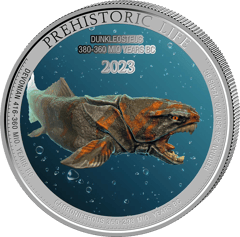 DunkleosteusArmoured fish
Carboniferous
about 359 to 299 million years ago
Permian
about 299 to 252 million years ago
Triassic
about 252 to 201 million years ago
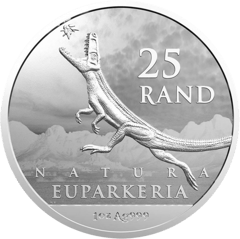 ArchosaursAnimal group
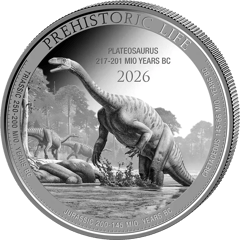 PlateosaurusDinosaur
Jurassic
about 201 to 143 million years ago
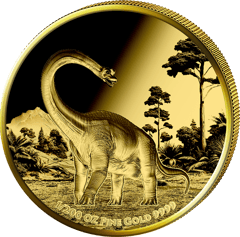 BrachiosaurusDinosaur
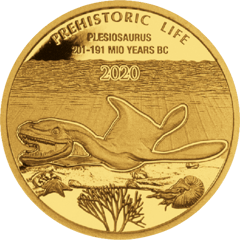 PlesiosaurusMarine reptile
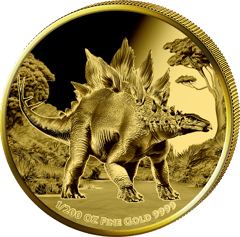 StegosaurusDinosaur
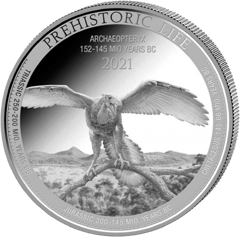 ArchaeopteryxEarly bird
Cretaceous
about 143 to 66 million years ago
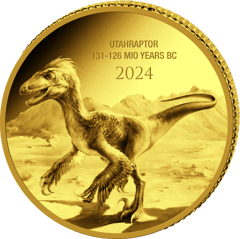 UtahraptorDinosaur
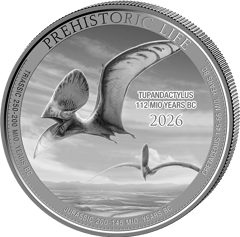 TupandactylusPterosaur
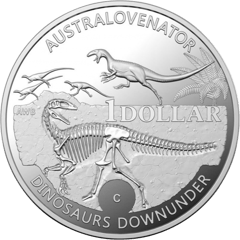 AustralovenatorDinosaur
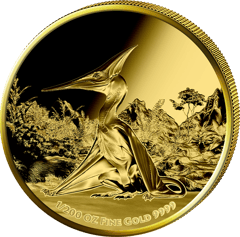 PteranodonPterosaur
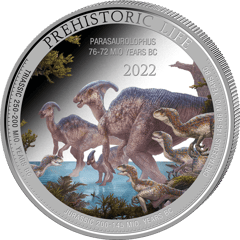 ParasaurolophusDinosaur
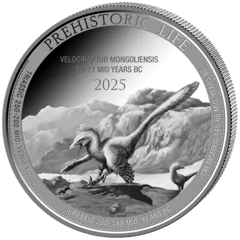 VelociraptorDinosaur
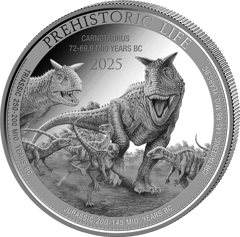 CarnotaurusDinosaur
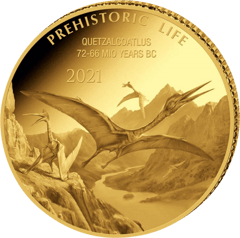 QuetzalcoatlusPterosaur
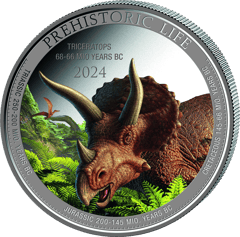 TriceratopsDinosaur
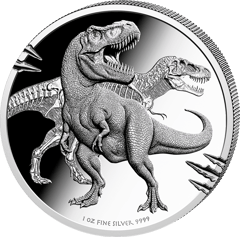 T. rexDinosaur
- The age of the dinosaurs ends 66 million years ago.
Palaeogene
66 to about 23 million years ago
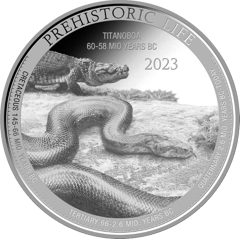 TitanoboaSnake
Neogene
about 23 to 2.6 million years ago
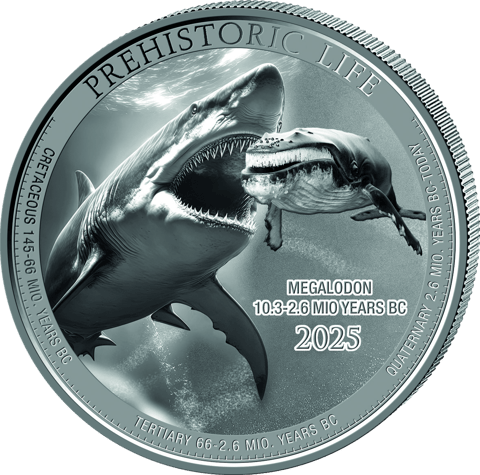 MegalodonShark
- The human genus begins about 2.8 million years ago.
Pleistocene
about 2.6 million to 11,700 years ago
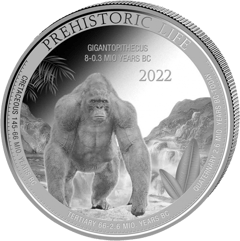 GigantopithecusGreat ape
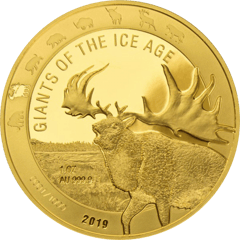 Giant deerMammal
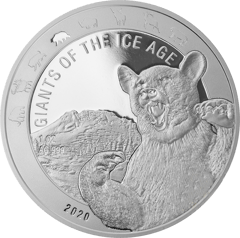 Cave bearMammal
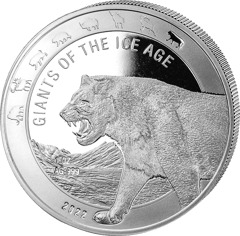 Cave lionMammal
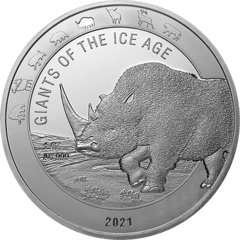 Woolly rhinocerosMammal
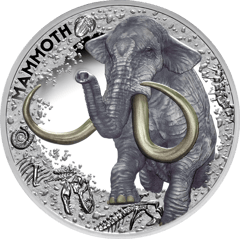 MammothMammal
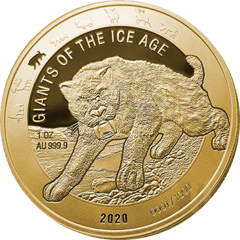 Sabre-toothed catMammal
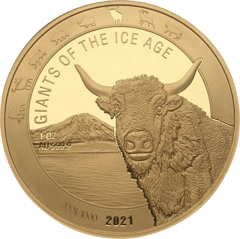 AurochsMammal
- Homo sapiens has existed for about 300,000 years.
- People enter the Chauvet Cave about 36,500 years ago.
Not to scale. Dates according to the International Commission on Stratigraphy, rounded.
The coin
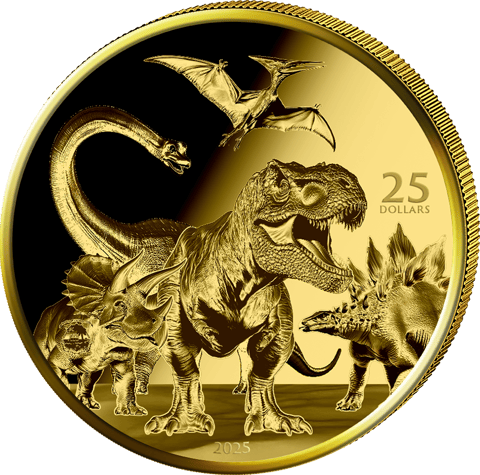
5 animals, one obverse
The reverse shows Brachiosaurus in its landscape, along with 1/200 OZ FINE GOLD 9999.
The shared obverse shows all five animals of the series with 25 DOLLARS and the coat of arms of Liberia.
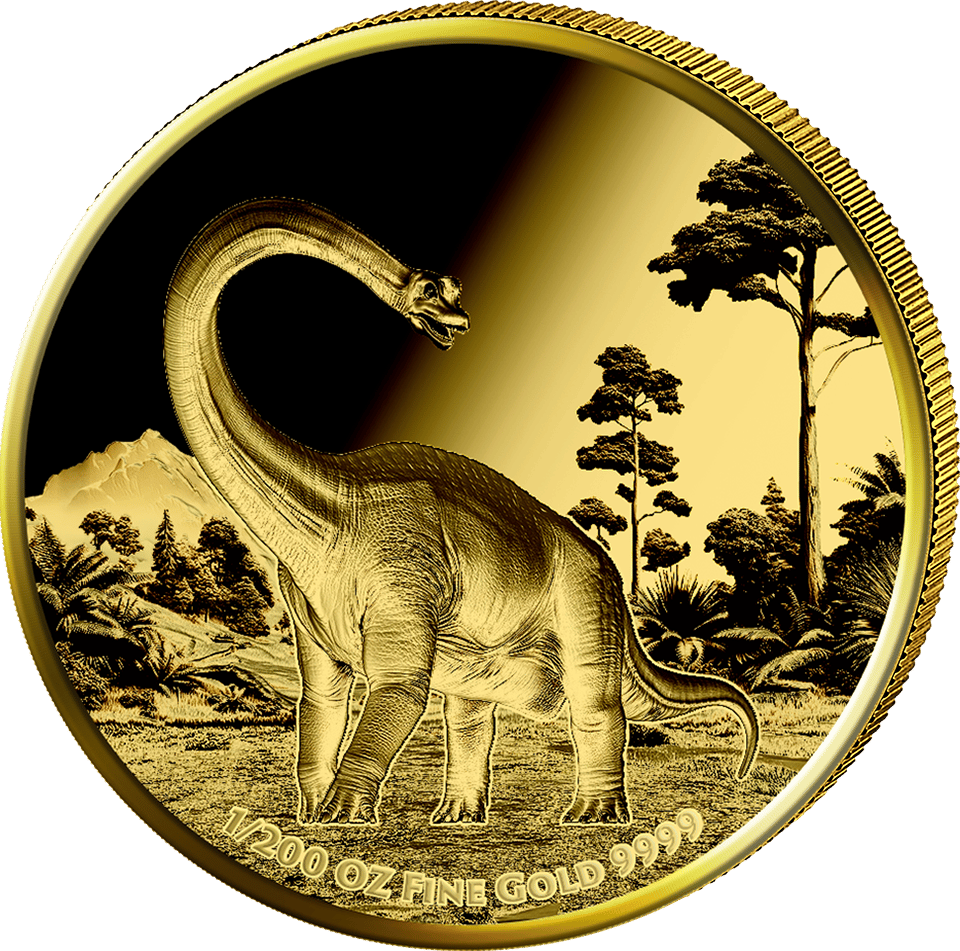
Fineness1/200 OZ FINE GOLD 9999
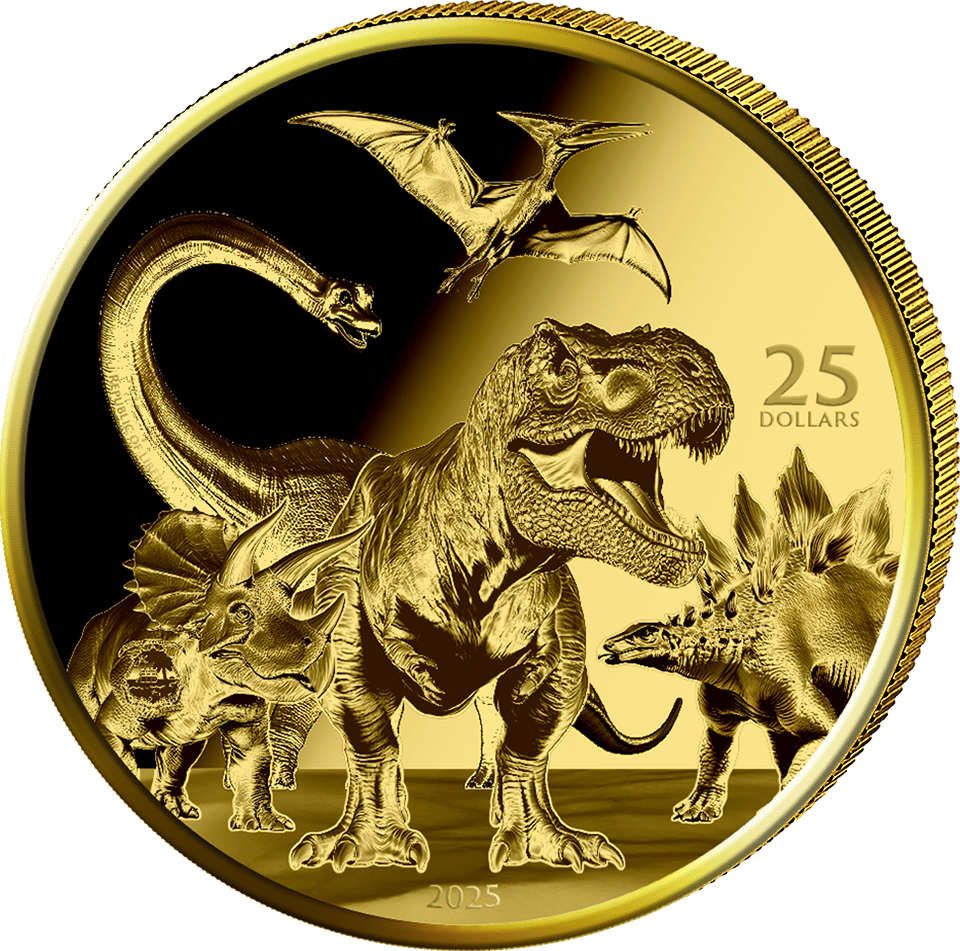
Face value25 DOLLARS on the obverse
The image up close
At a glance
- Issuing country
- Liberia
- Face value
- 25 dollars
- Metal
- gold
- Weight
- 1/200 ounce
- Diameter
- 14 mm
- Quality
- Proof
- Fineness
- 999.9/1,000
- Mintage
- 5,000 pieces
- Year
- 2025
The dinosaurs live on in the birds.
1/200 oz Gold Brachiosaurus 2025 – when prehistoric times meet real fine gold
Around 150 million years of Earth's history, captured on 14.00 mm of purest fine gold: the 1/200 oz Gold Brachiosaurus 2025 combines the fascination of the dinosaur era with the lasting substance of physical gold. The real reason to buy is not the design, but the precious metal it contains – the value of this issue is based on its fine gold content and moves with the gold price.
- Strictly limited: a strictly limited worldwide mintage of only 5,000 pieces
- Growth opportunities: high value appreciation potential due to the tight mintage limit and lively demand
- Rarity: a rare, sought-after collector's coin from the Prehistoric series
- Minting quality: the highest possible finish, Proof (PP), with a mirrored field and frosted relief
- Material / fineness: 999.9/1,000 fine gold – virtually pure, high-quality investment gold
- Investment objective: a physical gold investment whose value tracks the gold price and remains tradable at any time
- Design: a majestic Brachiosaurus against an authentic Jurassic backdrop, with prehistoric giants gathered on the reverse
- Manufacturer: exclusively minted for Kettner Edelmetalle
- Country of origin: official issuing country Liberia, minted in Germany
A sauropod in purest gold
The obverse belongs entirely to the Brachiosaurus. The sauropod stretches its characteristically long neck upward, while in the background tall trees, ferns and tropical plants depict the landscape of the Jurassic period – right down to a delicate mountain silhouette. The frosted relief of the dinosaur stands out brilliantly against the mirrored gold background; along the lower edge, the inscription "1/200 OZ FINE GOLD 9999" reveals the high fineness. The reverse of this gold coin stages an entire prehistoric scene: alongside the long-necked sauropod appear a massive Tyrannosaurus Rex, a horned Triceratops, a Stegosaurus, and a pterosaur. Also shown are the face value "25 Dollars", the year of issue "2025", and a reference to the Republic of Liberia as the issuing country.
Strictly limited – rarity with substance
What makes this gold coin so interesting beyond its design is the consistent scarcity. The issue is limited to 5,000 pieces worldwide – a genuine rarity, whose very low mintage forms the basis for its value appreciation potential. Small mintages and steady demand have always been important value drivers in the market for gold coins. Those who act early secure a piece from a tightly limited series that embodies exactly this combination of fine gold and strict limitation.
Highest minting quality: Proof
The coin was minted in the top quality Proof. For this PP finish, hand-selected blanks are struck multiple times with polished dies – the result is the striking contrast between the deep-black mirrored field and the velvety frosted motif. This allows the anatomical details of the Brachiosaurus, from skin texture to body proportions, to come through with precision. The coin is delivered protected in an elaborately designed coincard that evocatively picks up on the prehistoric theme.
Why physical gold?
Gold is the world's oldest currency and a proven store of value for over 6,000 years. It has an intrinsic, globally recognised value, has never had a price of zero, and protects against the gradual loss of purchasing power. This makes the precious metal a solid inflation hedge and a crisis hedge in uncertain times. Physical gold is scarce, durable, tradable worldwide and highly liquid – it can be converted back into cash at any time. It is no coincidence that central banks are among the largest gold holders in the world. A pleasant side effect for investors: profits from the sale of physical gold are generally tax-free after a holding period of at least one year.
Gold has shone for thousands of years – and will not lose its shine in the future either. Built up in small steps, even modest amounts of gold add up over the years to a considerable fortune.
It is precisely the compact 1/200 oz format that makes it easy to get started with physical gold investment, and it is excellently suited to building wealth piece by piece or passing it on across generations. Would you like to give real investment gold on a special occasion such as a birthday, christening or Christmas? Then with the Brachiosaurus you are not handing over a mere decorative item, but a tangible asset – minted fine gold whose value tracks the gold price, with the prehistoric design merely adding the personal touch.
Key facts at a glance
- Precious metal: gold, fineness 999.9/1,000
- Fine weight: 0.16 g (1/200 oz)
- Diameter: 14.00 mm
- Face value: 25 Dollars
- Issuing country: Liberia (minted in Germany)
- Year of issue: 2025
- Grade: Proof (PP)
- Mintage: 5,000 pieces worldwide
- Series: Prehistoric
- Packaging: coincard
Product image may differ from the actual product.
