


Sold out

1 oz Platinum Noble Isle of Man
£1,679.13
excl. UK import VAT and shipping
currently not available

 More than 310,000
 Over 30 years
 Secure shipping
 Google: 4.9/5
The Platinum Noble of the Isle of Man is a legend among collectors and investors: minted in 1983, it is considered the world's first platinum bullion coin ever produced. Its Viking ship in full sail tells of the rugged seafaring tradition of a small island in the Irish Sea, and turns the coin into a piece of numismatic history that remains available today at remarkably fair prices. The following overview looks at the origin, design, denominations, minting qualities, mintages and the special tax treatment of the Isle of Man's platinum coins.
Before Canada, the United States or Australia discovered platinum for the investment market, a small mint dared to take the first step: the privately run Pobjoy Mint in the English county of Surrey. On behalf of the Isle of Man government, it released the first Platinum Noble in 1983, years before the Platinum Maple Leaf or the American Platinum Eagle followed. In doing so, an island of roughly 600 square kilometres with just a few tens of thousands of inhabitants wrote coin history.
The Isle of Man lies between England and Ireland and, as a so-called Crown Dependency, falls directly under the British Crown, yet is not itself part of the United Kingdom. It has its own administration and its own coinage law; only the minting itself had to be outsourced, as the island had no mint of its own. From 1983 to 1989 the Platinum Noble was issued regularly, after which only isolated issues followed up to 1997. Just when the series seemed complete, a late special edition in the 1/10 oz denomination surprised collectors in 2016. Anyone with a general interest in this rare precious metal will find further historic designs throughout our entire range of platinum coins.
The coin's face value is not stated in pounds but in Nobles, a deliberate nod to a medieval English gold coin of the 14th century that circulated chiefly in maritime trade. Its historical predecessor had a fineness of around 995/1,000 and a face value of six shillings and eight pence. From this tradition the platinum coin still carries its resonant nickname today and is occasionally also traded as the Old Noble.
One Noble corresponds to ten Isle of Man pounds, or equally ten British pounds, as both currencies are fixed at a 1:1 ratio. The face value is simply based on the denomination:
A few large-format Nobles with fine weights of five and ten ounces were also produced, which today rank among the most sought-after rarities of the series.
What could be more fitting for an island than a ship? The consistently designed obverse is dedicated to the Vikings, who shaped the Isle of Man for centuries. It depicts a typical Scandinavian sailing ship steering straight towards the viewer. Stylised wave lines suggest the open sea, while schematically rendered seagulls fly on either side of the sail that fills the coin. This composition earned the coin its second nickname: the Viking.
At the top sits the coat of arms of the Isle of Man with the triskelion, an originally Celtic symbol made up of three bent, armoured legs joined into an equilateral triangle. Below it, the inscription 1 OZ PLATINUM FINE ONE NOBLE reveals weight, fineness and face value. At the bottom edge is the PM mint mark of the Pobjoy Mint.
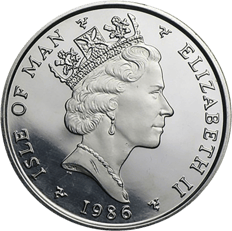
The reverse shows the profile of Queen Elizabeth II, who as ruler of the island held the title Lord of Man. For the minting years 1983 and 1984, the official portrait by Arnold Machin was used. From 1985 it gave way to a design by Raphael Maklouf, which shows the Queen, adjusted for her more advanced age, wearing a crown, earring and necklace, facing right. The portrait is framed by the inscriptions ISLE OF MAN, ELIZABETH II and the year of issue.
All issues share a uniform fineness of 999.5/1,000 platinum. The range of formats spans from the delicate 1/20 oz piece to the classic ounce; the following overview summarises the key figures:
| Denomination | Fine weight | Diameter × thickness | Face value |
|---|---|---|---|
| 1/20 oz | 1.555 g | 13.90 × 0.90 mm | 1/20 Noble |
| 1/10 oz | 3.110 g | 16.50 × 0.94 mm | 1/10 Noble |
| 1/4 oz | 7.775 g | 22.00 × 1.32 mm | 1/4 Noble |
| 1/2 oz | 15.551 g | 27.00 × 1.75 mm | 1/2 Noble |
| 1 oz | 31.103 g | 32.70 × 2.38 mm | 1 Noble |
For investors, the 1 oz Brilliant Uncirculated (BU) issue is the obvious choice, offering the greatest platinum content at the lowest premium per gram. The smaller denominations and the later issues in collector's quality, on the other hand, appeal more to the hearts of enthusiasts. Those who prefer to hold platinum in bar form will find a more understated alternative in our platinum bars, while history-conscious collectors often also turn to classic British gold classics.
Between 1983 and 1987, the Platinum Noble was minted predominantly in Brilliant Uncirculated (BU) quality, the classic finish for investment purposes. From 1988 production shifted to the Proof quality favoured by collectors, with its mirror-like fields and frosted relief.
Two special editions make the series particularly appealing to numismatists:
Such variations set the Platinum Noble apart from purely industrially conceived bullion coins and place it close to genuine collector's coins. Thematically related, modern platinum designs can be found in our range around the Platinum Maple Leaf and the Vienna Philharmonic in platinum.
The total mintage of all Platinum Noble coins is estimated at only around 13,000 pieces, as precise figures are not officially available. This makes the series one of the most limited on the market and explains the esteem in which experienced collectors hold it.
The Brilliant Uncirculated issues of the standard ounce break down roughly as follows:
In addition there are the Proof vintages of 1988 and 1989, each with around 3,000 pieces, as well as a few rare early Proof strikes. It is precisely these low mintages that make up the appeal: unlike continuously re-minted bullion coins, the stock here is effectively closed. Many editions of the thematically related Cook Islands platinum coins are similarly limited.
Unlike modern bullion coins, the Platinum Noble is no longer re-minted: what is in circulation today remains in circulation.
Platinum is significantly rarer than gold and silver: global mining output is low, while industry, above all the automotive sector with its catalytic converters, consumes a considerable share of the annual supply. This combination of scarce availability and broad industrial demand makes platinum bullion coins a comparatively rare phenomenon.
Then there is the appearance: the silvery-white gleaming metal looks cool and noble at the same time. As an addition to a classic portfolio of gold bars and silver coins, platinum brings an extra facet to a precious metals portfolio. The fourth investment-relevant precious metal, palladium, is often unfairly overlooked in this context.
A key difference from investment gold: while investment gold is exempt from VAT in Germany, platinum coins are subject to VAT. In practice, used or traded Platinum Nobles are often offered under the margin scheme, while new items may be subject to the full tax rate.
Tax notice
The VAT exemption applicable to investment gold does not apply to platinum coins in Germany. Depending on the issue, either the standard tax rate or the margin scheme applies. This text does not replace tax advice; for your individual situation, consulting a tax advisor is recommended.
Anyone wishing to understand the overall tax framework for precious metals will find, with the classic investment gold coins, the VAT-exempt counterpart to the platinum segment.
Platinum is an extremely resistant precious metal that does not oxidise and does not develop tarnish colours. Even so, the sensitive minted surface, particularly in Proof quality, should be protected from scratches and fingerprints. Well-fitting coin capsules, which secure each coin individually, as well as high-quality coin cassettes for organised collection care, have proven effective.
For the long-term storage of larger holdings, a home safe or a bank safe deposit box are suitable options. In any case: keep the original packaging and any certificates carefully, as a fully preserved collector's item achieves a significantly better price on the market. Those who invest in precious metals regularly can also do so through structured savings plan products.
The Platinum Noble was minted in 1983 by the Pobjoy Mint for the Isle of Man, years before comparable platinum coins such as the Platinum Maple Leaf or the American Platinum Eagle. This made it the first issue designed as a bullion coin from the precious metal platinum.
The obverse shows a Viking ship in full sail, surrounded by wave lines and seagulls, hence the nickname Viking. At the top, the triskelion from the Isle of Man's coat of arms can be seen. The reverse bears the portrait of Queen Elizabeth II.
For investment purposes, the 1 oz Brilliant Uncirculated (BU) issue is most suitable, as it offers the highest platinum content at the lowest premium. Smaller denominations and Proof issues are of greater interest to collectors.
All denominations have a fineness of 999.5/1,000 platinum. A 1 oz coin weighs 31.103 grams and has a diameter of 32.7 millimetres.
No. Unlike investment gold, platinum coins are not exempt from VAT in Germany. Depending on the issue, either the standard VAT rate or the margin scheme applies. For an individual assessment, a tax advisor is the right person to consult.
The total mintage of all Isle of Man Nobles in platinum is estimated at around 13,000 pieces. Exact official figures do not exist, which makes the series an additional numismatic rarity.
 Isle of Man
Stay informed with product launches, financial news and exclusive offers. Sign up for our free newsletter today.
By entering your email address and clicking the "Submit" button, you give the following consent: "I agree to be informed by email about new products, financial news and exclusive offers, and therefore consent to the processing of my email address for the purpose of sending the newsletter. I can revoke this consent at any time without giving reasons, with effect for the future. The lawfulness of processing carried out prior to revocation remains unaffected."