





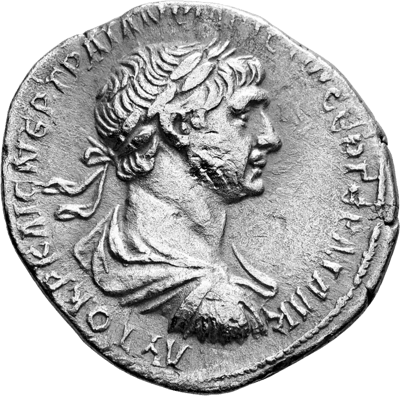

Silver Denarius Emperor Trajan (106-117 AD | Rome's Most Successful Ruler)
- Genuine Original: from ancient Rome
- Emperor's Portrait: with laurel wreath
- Rome's Golden Age: valuable coin silver
- Genuine OriginalHand-struck and in circulation 1,900 years ago
- Emperor's PortraitHailed by the Senate as the best ruler ever
- Rome's Golden AgeMinted before Rome sharply cut the silver content
Unfortunately, this item is currently out of stock. We will be happy to send you an email as soon as this product becomes available again.
- Genuine Original: from ancient Rome
- Emperor's Portrait: with laurel wreath
- Rome's Golden Age: valuable coin silver
 Price alert
 Share
Denarius of Emperor Trajan – 1,900 Years of World History in Your Hand
Hand-struck, circulated, genuine: this denarius made of silver was once an entirely ordinary means of payment in the Roman Empire. It changed hands in markets, paid soldiers, bought wine, grain and road tolls. It was minted under Marcus Ulpius Traianus – the emperor the Senate hailed as optimus princeps, the best ruler of all. Whoever holds this coin holds an original from the golden age of the Roman imperial era.
Optimus Princeps: Why Trajan Is Considered Rome's Most Successful Emperor
Trajan reigned from January 98 until his death in August 117 AD. He came from Italica in Hispania and was thus the first Roman emperor to hail from a province. Under him, the Roman Empire reached its greatest territorial extent – a record no successor ever surpassed.
- Dacian Wars, 101/102 and 105/106 AD: The victory over Decebalus brought the resource-rich province of Dacia and vast quantities of precious metal to Rome.
- Province of Arabia, 106 AD: The annexation of the Nabataean Kingdom was expressly proclaimed and celebrated on the emperor's coinage.
- Parthian War, 113–117 AD: Armenia and Mesopotamia came under Roman control, pushing the empire's border far to the east.
- Trajan's Column and Forum Traiani: The forum, built between 107 and 113 by Apollodorus of Damascus, far exceeded all previous imperial forums in size.
- Adoptive emperorship: With Nerva and Trajan began the era of the Nerva–Antonine dynasty, regarded as the most glorious phase of the empire.
On 8 August 117, Trajan died in Selinus in Cilicia; he was succeeded by his adopted son Hadrian. His reputation outlived him by centuries: later rulers were still wished to be "happier than Augustus and better than Trajan."
Design: Imperial Portrait and Varying Reverses
The obverse always shows Trajan's laureate portrait in profile, encircled by the imperial titulature. The reverses, by contrast, are delightfully varied: victory goddesses, personifications such as Pax, Fortuna or Arabia, military standards – or, as in the example pictured from the eastern half of the empire, a striding dromedary symbolizing the province of Arabia Petraea, established in 106 AD. Which variant you receive is a matter of historical chance.
The Denarius: 500 Years as Rome's Benchmark Silver Currency
For roughly five centuries, the denarius was Rome's most important silver coin. Introduced towards the end of the 3rd century BC, it initially weighed about 4.55 g with a very high fineness. Over the course of the imperial era, both weight and silver content were reduced several times; by around 200 AD, the silver content was only about 40 to 50 percent, and later the denomination collapsed entirely. A denarius of Trajan thus still dates from the period when this coin was high-quality legal tender – a point that collectors of ancient silver coins know very well.
Compared to Other Imperial Denarii
Compared with a denarius of Emperor Hadrian (117–138), the Trajan denarius scores with the aura of the conqueror and the empire's greatest territorial extent; Hadrian, by contrast, stands for consolidation and architecture. Pieces minted considerably later, such as those from the time of Septimius Severus, are often cheaper to obtain but carry noticeably less coin silver in the blank. Those wishing to combine historical significance with material quality turn to the adoptive emperors – and Trajan is the most prominent name among them.
Key Facts at a Glance
- Country: Roman Empire
- Face value: Denarius
- Minting period: 106–117 AD, year of issue, mint and reverse vary
- Precious metal: Silver, ancient coin alloy without a modern fineness specification
- Gross weight: approx. 3.2 g
- Diameter: approx. 18 mm
- Production: hand-struck hammer coinage
- Condition: circulated coin, grade varies
- Purpose: collector's item, "History" series, shipped as insured value shipment
Condition: Circulated Currency with Character
These pieces are circulated currency and bear the corresponding traces: darker patina, individual centering, nicks, wear, and in places weaker legend details. That is precisely what makes them appealing. Because the year of issue, mint and reverse variant can vary, the piece you receive will differ from the picture shown – you receive an original, not a mass-produced item. Please understand that the image in the shop serves as an example and the delivered item may differ individually in appearance and condition due to historical circumstances. Each of these coins was struck by hand.
Ancient Silver as a Tangible Asset
Silver has been a monetary and coinage metal for millennia, a symbol of wealth and prestige – and a store of value with intrinsic worth. Unlike fiat money, whose purchasing power depends solely on trust in governments, silver carries its value in the material itself. Added to this is real demand from electronics, solar and medical technology, combined with limited availability and limited supply. Physical precious metal thus remains a classic building block for inflation hedging and crisis protection.
A denarius of Trajan survived the fall of the Western Roman Empire, countless currency reforms, and every paper money crisis. The coin is still here today – trust in the currencies that came after it, mostly is not.
A note for collectors: profits from the sale of silver are generally tax-free in Germany, provided a minimum holding period of one year is observed. Silver is also durable, easily divisible and liquid – qualities that make it attractive for smaller transactions as well as for passing on wealth across generations.
Who This Denarius Is Suited For
For newcomers to ancient numismatics, the Trajan denarius is an ideal starting point: a well-known emperor, a clear portrait, an accessible entry. Collectors of the Roman imperial era can use it to close the gap between Nerva, Hadrian and Marcus Aurelius. And for anyone wishing to pass tangible assets on to children or grandchildren, this is an heirloom that tells a story – each piece a one-of-a-kind item, struck by a hand that turned to dust almost two millennia ago.
Product image may differ from the actual product.