





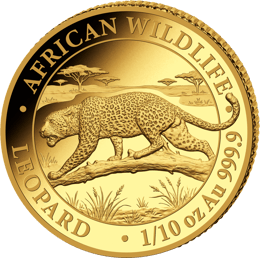


1/10 Unze Gold African Wildlife Leopard 2026 (Auflage: 3.000)
- Top Investment: A true investment classic
- Secure shipping: 100% insured & anonymous delivery
- Top InvestmentA true investment classic
- Secure shipping100% insured & anonymous delivery







- Top Investment: A true investment classic
- Secure shipping: 100% insured & anonymous delivery
 Price alert
 Share

African Wildlife · Somalia 2026
Rosette and spot, two coats for two worlds.


African Wildlife Leopard 2026, 1/10 ounce gold, picture side
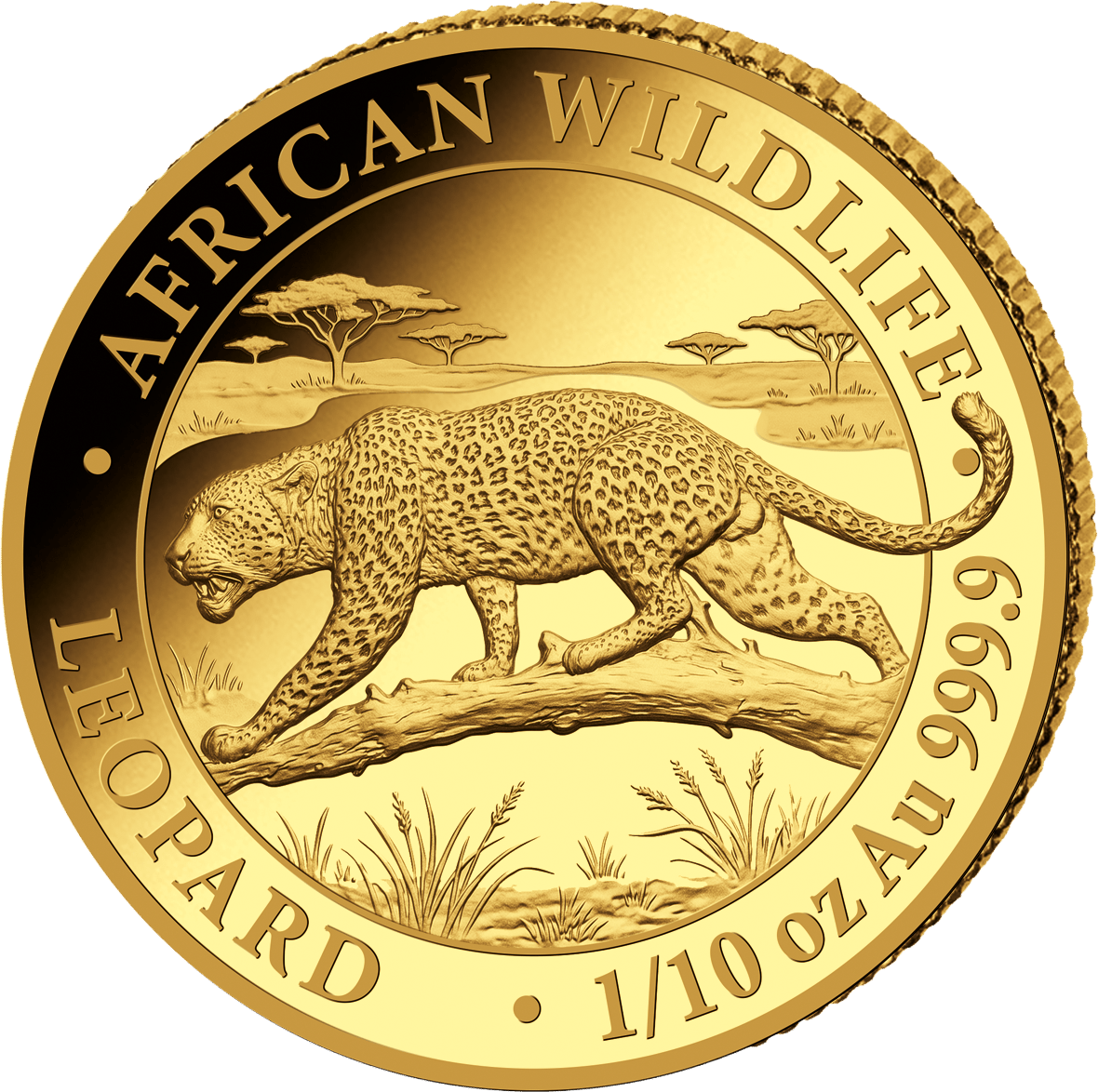
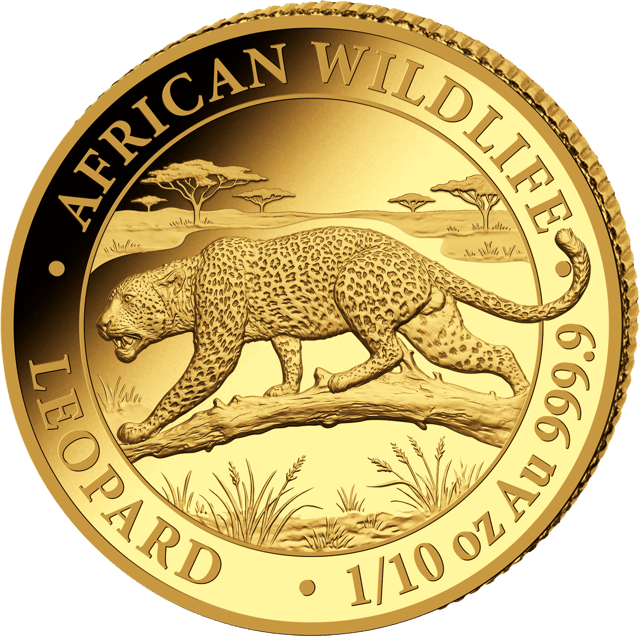
The leopard’s coat suits its life in trees, in the forest and at night. The 2026 coin shows the leopard walking over a fallen tree trunk, acacias behind it.

The leopard
From the desert to the rainforest
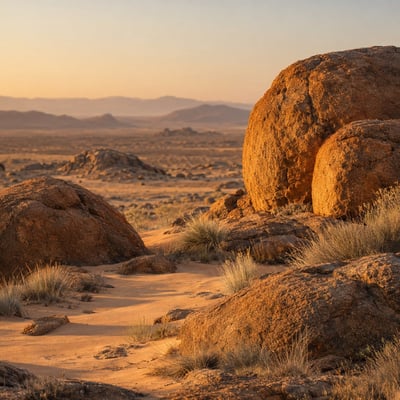 Desert
 Mountain forest
 Rainforest
No other big cat is as widespread: leopards live in some 62 countries across Africa and Eurasia, in deserts, savannas, mountains and rainforests.
They prefer rocky ground with dense bush and riverine forest. The leopard climbs well, spends much of its time in trees and is mostly active at night, as a loner.
Its coat carries dark, irregular spots, the rosettes; the base colour ranges from pale yellow in warm, dry regions to reddish orange in dense forests. Instead of purring, it calls with a rough, rasping sound.

The cheetah
The only one of its genus
Its genus, Acinonyx, has no other living member today. The cheetah needs wide, open land and is mostly active by day, unlike many other cats.
Its coat carries solid, round or oval black spots from 1.9 to 3.8 centimetres; only the throat and belly stay white. The tail ends in four to six black rings.
Cheetahs do not roar; their most common call is a chirp. Females live alone, while males often join up in groups.
Why two patterns
The coat often suits where the cat lives
Rosette
For trees, forest and night.
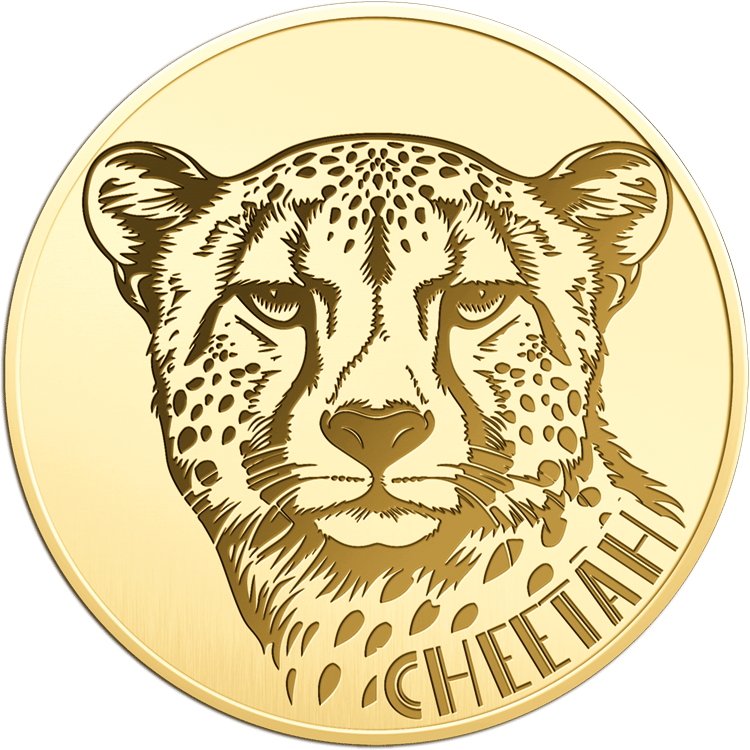
Spot
Black, without a ring.
A study of 35 cat species shows that whether a coat is patterned is linked to the habitat. How intricate and irregular the pattern is also relates to life in trees and to activity at night.
Over the course of evolution, such camouflage adapts comparatively quickly to a way of life. In the grey grass where cheetahs often live, their spots can take up the shadows of the blades and let the animals merge with their surroundings.
Allen et al. 2011, Proceedings of the Royal Society B
Rosette
For trees, forest and night.
Spot
Black, without a ring.
Allen et al. 2011, Proceedings of the Royal Society B

Rare coats
A black panther can be a leopard
Leopards with melanism, that is with almost black fur, are often called black panthers. Black cheetahs, by contrast, are not known.
In the rare king cheetah, the spots merge into blotches and stripes. It is not a species of its own but carries a rare variant of the gene Taqpep, which shapes the variations of the tabby pattern in domestic cats.
Young cheetahs wear a coat of their own as well: a thick, silvery grey mantle along the back, which they shed at about three months of age.

African Wildlife · Somalia
The leopard on both sides
Somalia’s coat of arms of 1956 shows a gold-framed shield held by two leopards standing on spears. So each of these coins shows the leopard on both sides: as the motif of the picture side and twice over as a supporter of the shield on the value side.


Two leopardsTwo leopards hold the arms of Somalia
Leopard and cheetah in more series
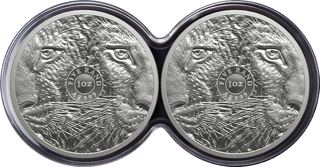 Big FiveTwo coins side by side make one whole face.
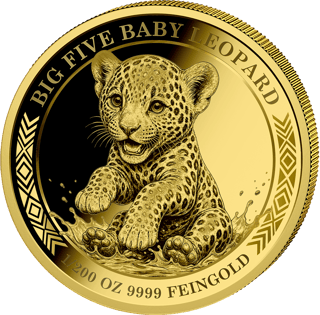 LiberiaLeopards in gold and silver, exclusively for Kettner Edelmetalle.
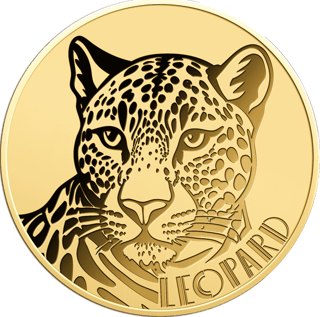
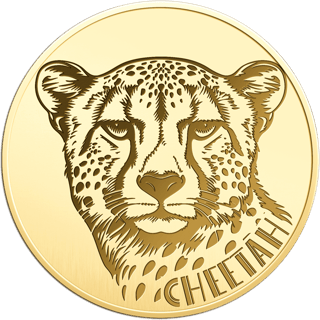 1/1,000 ounce of goldRosette and spot in the same format.
At a glance
- Series
- African Wildlife
- Metal
- gold
- Weight
- 1/10 ounce
- Fineness
- 999.9/1,000
- Country of issue
- Somalia
- Face value
- 100 Shillings
- Year
- 2026
- Mintage
- 3,000 pieces
- Struck in
- Germany
- Packaging
- coin capsule
Leopard and cheetah
Both are listed as vulnerable on the IUCN Red List.
1/10 oz Gold African Wildlife Leopard 2026 – First Edition with Only 3,000 Pieces
- Strictly limited: worldwide, this tenth-ounce coin is released with a mintage of only 3,000 pieces.
- Growth opportunities: high value appreciation potential thanks to the sharp limitation and the traditionally high demand for the series.
- Investment goal: collector's item with a genuine investment core – fine gold you can hold instead of paper promises.
- Rarity for enthusiasts: first edition of the Leopard in the 1/10 oz format – a collecting field that is only just beginning.
- Design: a stalking leopard on a tree trunk, with the acacia savannah behind it – the design changes year by year.
- Material / fineness: 3.11 g of pure fine gold; the design side bears the inscription "1/10 oz Au 999.9".
- Manufacturer: struck by the renowned Bavarian Main Mint in Germany.
- Country of origin: Germany – the issuing country is the Republic of Somalia, face value 100 Shillings.
- Features: Brilliant Uncirculated quality, reeded edge, 20.00 mm diameter, individually housed in a protective coin capsule.
With this Gold African Wildlife collector's coin, a true rarity enters the market. While the major bullion series are issued in almost unlimited quantities, this one is capped at just 3,000 pieces. Anyone who has ever tried to buy an earlier Leopard edition after the fact knows the problem: the pieces disappear into collections and vaults – and rarely come back.
The design: Africa's most elegant big cat in gold
The design side shows a fully grown leopard stalking gracefully over a fallen tree trunk. Tufts of grass in the foreground, a wide savannah with umbrella acacias in the background, and a gaze that leaves no doubt as to who is hunting here. Around the wide rim are the inscriptions "AFRICAN WILDLIFE" and "LEOPARD", along with the weight and fineness "1/10 oz Au 999.9".
The value side bears the coat of arms of the Republic of Somalia: a shield with a five-pointed star, held up by two rearing leopards, with two crossed spears and palm leaves below. Around the rim are the inscriptions "SOMALI REPUBLIC", the year of issue 2026, and the face value "100 SHILLINGS". This value side remains the same every year – the animal depiction is redesigned annually.
African Wildlife: a series with history
The Somalia Elephant has defined the series since 2004 and is among the most popular bullion coins of all. In 2018, the Leopard was added as a sister series – from the outset struck in significantly smaller quantities. The 1-ounce gold coin, for example, is minted in only 1,000 pieces per year of issue. Production is handled by the Bavarian Main Mint, which produces these agency issues in Germany on behalf of Somalia.
A comparison is worthwhile
- Compared to the Somalia Elephant: same series family, same minting quality – but the Elephant tenth-ounce coin is issued without limitation, while the Leopard is strictly limited.
- Compared to classic bullion coins such as the Krugerrand, Maple Leaf, or the Australian Nugget: similarly good tradability, but with the appeal of a changing design and a very low mintage.
- Compared to the silver issues of the series: gold concentrates value more densely, while silver requires a multiple of the space for the same equivalent value.
- Small denomination: the tenth-ounce coin is the affordable entry point into a collecting field that would otherwise quickly run into four-digit prices.
Gold: the store of value that has outlived every currency
Gold is humanity's oldest currency. Over 6,000 years of history, countless failed paper money systems – and the shine has remained. Gold has never had a value of zero, because its value lies in the metal itself, not in trust in a government. The fact that central banks themselves are the largest gold holders in the world speaks volumes about their trust in their own fiat money.
Gold is scarce, recognized worldwide, and liquid at all times – which is why it has served generations as a store of value, not as a passing trend.
For investors, there are tangible advantages as well: the purchase of investment gold is exempt from VAT, and profits from its sale are generally tax-free after a holding period of at least one year. As inflation hedge and as crisis protection, physical metal preserves purchasing power when paper assets fluctuate. Gold coins like this one are especially practical in this regard: they can be sold, gifted, or passed on individually – there's no need to touch an entire ounce at once.
Who benefits most from this gold coin
Collectors buy in because the first edition of a new denomination always marks a date in the series' history. Investors appreciate the fine gold core and worldwide fungibility. And anyone who combines both gets a collector's coin that brings together lasting value preservation and numismatic appeal. However, with a limitation of this scale, the rule applies: those who wait often end up only watching from the sidelines.
Product image may differ from the actual product.
