





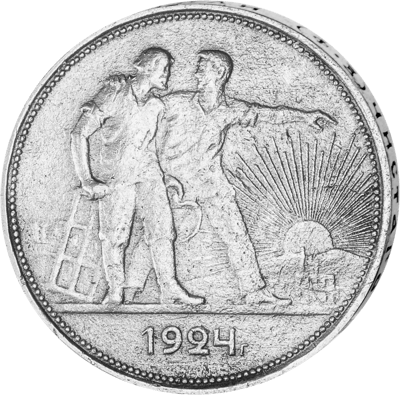

1 Ruble Silver Peasant and Worker (1924 | USSR)
- Collector coin: Especially interesting for collectors
- Secure shipping: 100% insured & anonymous delivery
- Kettner Bullion: Already over 310,000 satisfied customers
- Collector coinEspecially interesting for collectors
- Secure shipping100% insured & anonymous delivery
- Kettner BullionAlready over 310,000 satisfied customers




- Collector coin: Especially interesting for collectors
- Secure shipping: 100% insured & anonymous delivery
- Kettner Bullion: Already over 310,000 satisfied customers
 Price alert
 Share
A Ruble Like a Poster: Worker, Peasant and the Rising Sun
The Soviet Union was founded in December 1922. However, it had to wait for its own coinage: it was not until the decree of 22 February 1924 that the minting of silver and copper coins of Soviet design was regulated. The crowning piece of this first coin set was the 1 Ruble of 1924, struck from silver with a fineness of 900/1,000. The coin weighs 20 grams, 18 grams of which are pure precious metal. It was minted in Leningrad, at the venerable mint on the Neva that had already produced the rubles of the tsars.
Whoever holds this ruble in their hand holds more than a piece of precious metal. It is a document of those years in which a new state cast its self-image in metal.
Real Silver Money After Hyperinflation
The historical background makes this coin special. Civil war and hyperinflation had rendered the paper money of the early Soviet era almost worthless. The currency reform from 1922 to 1924 was meant to restore trust, and part of that answer was silver. A state that wanted to break away from the old regime thus relied, of all things, on the oldest principle of trust there is: money that carries its value within itself.
The Design: Two Men, One Path
The reverse is designed like a propaganda poster of the 1920s. A young worker puts his arm around the peasant's shoulder and points with an outstretched hand towards the rising sun on the horizon. Its rays fill almost half of the coin's field. In the background, factory buildings with chimneys stand out, and below the ground line is the date "1924 г.". Russian specialist authors like to call the scene "New Life". It referred to the "smychka" propagated at the time, the alliance between town and country.
The obverse shows the state emblem of the USSR: a hammer and sickle over the globe, framed by ears of wheat and crowned by a star. The letters of the abbreviation СССР are arranged to the left and right. Around the edge runs the famous motto "ПРОЛЕТАРИИ ВСЕХ СТРАН, СОЕДИНЯЙТЕСЬ!", beneath which the value "ОДИН РУБЛЬ" is shown in large letters.
“Workers of all countries, unite!”: the inscription on the obverse, struck into 18 grams of fine silver.
A detail that connoisseurs love is found on the edge. The incuse edge lettering reads "ЧИСТОГО СЕРЕБРА 18 ГРАММ (4 З. 21 Д.)", meaning "pure silver 18 grams (4 solotnik 21 doli)". The old Russian unit of weight is included right alongside. The finishing touch is formed by the initials П•Л of the mint master Pyotr Latyshev.
Technical Details at a Glance
- Face value: 1 ruble
- Country: USSR (Soviet Union)
- Year of issue: 1924
- Mint: Leningrad Mint
- Metal: silver, fineness 900/1,000
- Gross weight: 20.00 g
- Fine weight: 18.00 g
- Diameter: 34.00 mm
- Edge: incuse edge lettering stating the fine silver content
- Mintage: around 12.998 million pieces according to specialist literature
- Condition: circulated coin, condition varies
Condition: A Circulated Coin With Its Own History
These pieces are circulated coins, and that is exactly how they look. Darker patina, individual centring, small nicks, wear and areas where parts of the legend are less sharply struck are not flaws. They are history. Every mark comes from hands that, around a hundred years ago, used this ruble to pay for goods, freight or debts.
Because the die variety, reverse details and condition can vary, the coin you receive may differ from the picture shown. Please understand the photo in the shop explicitly as an example image. For historical reasons, appearance, exact weight and condition vary from piece to piece. You are purchasing an original.
In Comparison: Tsarist Ruble, RSFSR Ruble and Poltinnik
What is fascinating is the continuity. The Soviet ruble of 1924 adopted exactly the coin standard of the tsarist ruble: 900 silver, 20 grams gross weight, 18 grams fine weight. A ruble of Nicholas II and this ruble therefore contain the same amount of precious metal, only the imagery could hardly be more different. The ruble of the RSFSR from 1921 and 1922, with its five-pointed star, also followed this standard, but did not yet bear the emblem of the Union.
The little brother is the poltinnik of 50 kopecks with the blacksmith. It contains half the amount of silver. Anyone looking for the iconic design with the peasant and the worker cannot avoid the larger ruble, because this silver ruble of the USSR exists only with the year 1924. There are also a few specimens in Proof, made for collectors. These are great rarities and rarely come onto the market. Modern silver coins with a fineness of 999 lack one thing: real, lived history. That is exactly what this ruble brings, even if it does not have their flawless uniformity.
Why Silver in Historical Form Is Convincing
Silver was money for thousands of years, in ancient Rome just as in the Hanseatic towns and the tsarist empire. This ruble shows that even a revolutionary state relied on trust in precious metal. For investors and collectors, it combines both: material value and collector appeal.
- Tangible asset: Unlike fiat money, silver has an intrinsic value that does not depend on a government's promise.
- Inflation hedge: As a physical precious metal, silver has always been regarded as a means of preserving value when paper money loses purchasing power. The history of this ruble tells exactly that story.
- Crisis protection: In politically and economically turbulent times, silver is in demand. In small units, it can be used well as a medium of exchange.
- Sought-after raw material: Electronics, solar technology and medical technology need silver, and supply is limited.
- Tax advantage: Profits from the sale of physical silver are, in principle, tax-free in Germany after a holding period of at least one year.
- Affordable and liquid: Silver is cheaper than gold and can be traded worldwide. It can be passed on easily, including to the next generation.
A Piece of Russian Coin History for Your Collection
The 1 Ruble "Peasant and Worker" of 1924 fits into many collections: as an entry point into Soviet numismatics, as a complement to a collection of tsarist rubles, or as a gift for history enthusiasts. It is a tangible piece of world history. Precious metal with lasting value stability, an unmistakable poster-style design and a hundred years of circulation history come together in this original piece from the early days of the USSR, available from Kettner Edelmetalle.
Product image may differ from the actual product.
