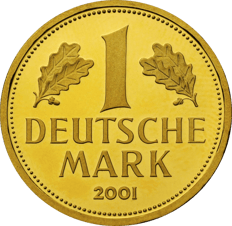
12g Gold Mark 1 DM 2001
£1,325.80
VAT-free and excl. shipping
Available in 2–3 business days

 More than 310,000
 Over 30 years
 Secure shipping
 Google: 4.9/5
The end of the Deutsche Mark was marked by the turn of the year from 2001 to 2002. This is why the Goldmark also bears the mint year 2001 and serves as a commemorative piece of Germany's "old currency". Exactly 1,000,000 times was the gold coin minted in Germany and it sold out within just a few days. Thanks to the active trading of the coin, we repeatedly have the opportunity to offer you the Goldmark. The collector's value has risen significantly in recent years.


1950 to 2001
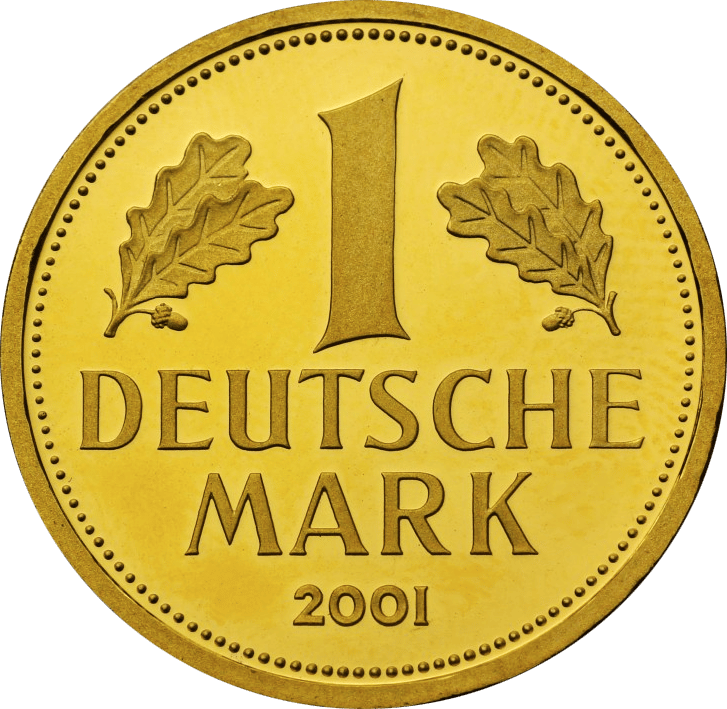
The one‑mark piece with the two oak branches came out in 1950, designed by Josef Bernhart of Munich. Everyone held it in their hand, at the baker’s, at the kiosk, in the piggy bank.
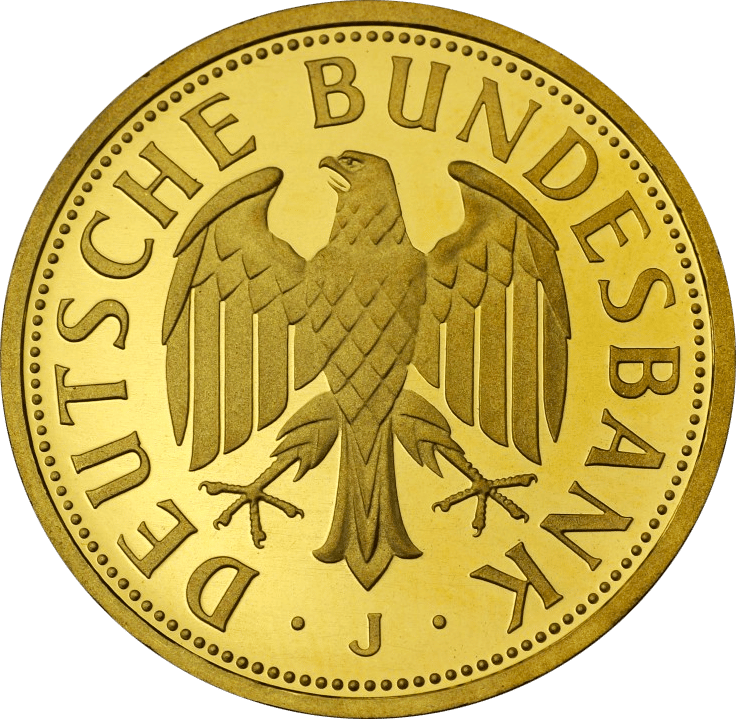
A special law allowed the Bundesbank, as a farewell, to issue the same design in gold, in its own name. That is why the eagle side reads DEUTSCHE BUNDESBANK instead of BUNDESREPUBLIK DEUTSCHLAND. It is the only official D‑Mark coin in gold: 12 grams, 999.9 fine.
June 1948
20
Sunday
The currency reform
The Deutsche Mark arrives in the three Western zones. Each person receives a per-capita allowance of 40 D‑Marks, and later another 20.
July 1990
1
Sunday
The monetary union
Even before reunification, the D‑Mark becomes the currency of the GDR. Wages and salaries are converted one to one.
December 2001
31
Monday
The last day
The D‑Mark is legal tender for the last time. To this day, the Bundesbank exchanges it for euros free of charge and with no time limit.
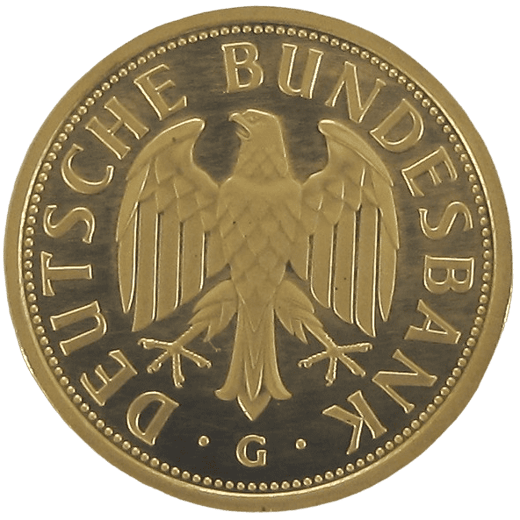
The 2001 gold mark was struck at all five German mints, 200,000 pieces at each. The letter below the eagle shows which one it was.
The original
The Bundesbank’s gold mark of 2001, 12 grams, 999.9 fine.
View the 2001 gold mark
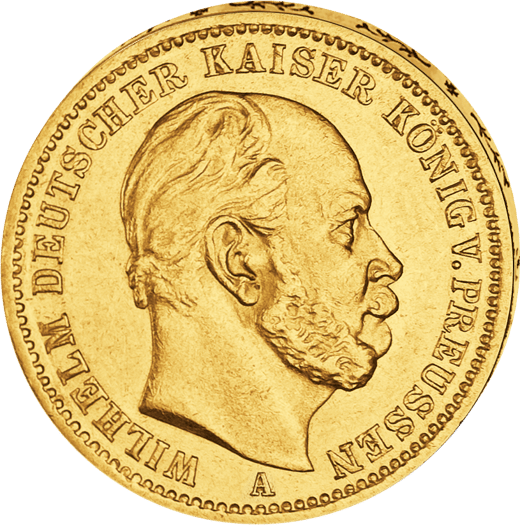
The beginning
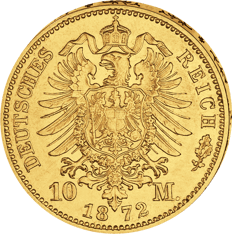
Ten marks in gold from Prussia, with Emperor Wilhelm I. The mark began with gold coins like this in 1871.
View the Prussian 10‑mark piece
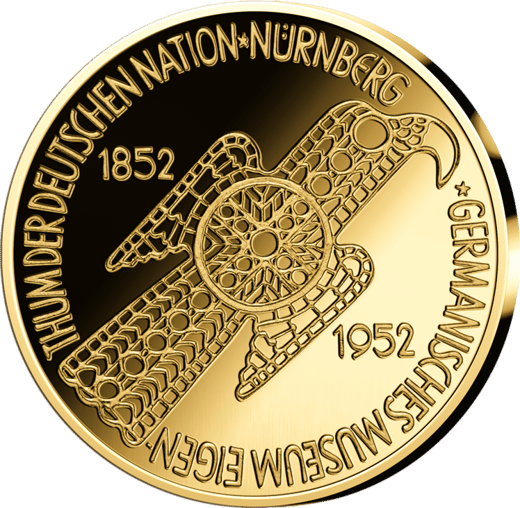
The restrike
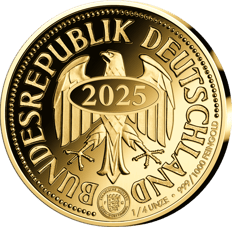
The design of the Federal Republic’s first commemorative coin of 1952, restruck as a quarter ounce of gold. A collector’s piece, not legal tender.
View the restrike
The D‑Mark came in 1948. It went in 2001. In gold, it stayed.
Details based on the Act on the Minting of a 1-DM Gold Coin of 27 December 2000, the Deutsche Bundesbank’s press release of 15 June 2001, its pages on the currency reform, on DM circulation and commemorative coins, and on exchanging marks, its Monthly Report of March 2002, the act ending the legal tender status of the DM, the Federal Agency for Civic Education, the Imperial Act concerning the Minting of Imperial Gold Coins of 4 December 1871, the Decree on the Naming of the Imperial Gold Coins of 17 February 1875 and photographs of the pieces shown.
The 1 DM gold coin from 2001, known as the Goldmark, was the last issue of the Deutsche Mark: 12 grams of pure gold bearing the design of the familiar Mark coin, issued by the Deutsche Bundesbank shortly before the introduction of euro cash. At Kettner, you can buy the 1 DM gold coin, as well as new editions of the D-Mark in gold and the Goldmark of the German Empire. Here you will find out what the coin is worth, how to recognise a genuine one, and how to order it and later sell it back.
We offer the 12 g Goldmark 1 DM 2001 in Mint State (MS) quality. Each coin contains 12 grams of fine gold. Because you know exactly how much gold you own with this coin, it is suitable both as an investment and as a gift for anyone who grew up with the D-Mark. You cannot choose the mint mark of the minting facility with us; it makes no difference to the gold value.
| Characteristic | 1 DM Gold Coin |
|---|---|
| Face value | 1 Deutsche Mark |
| Fineness | Gold 999.9/1,000 |
| Fine weight | 12 g |
| Diameter | 23.5 mm |
| Quality | Mint State (MS) |
| Year of issue | 2001 |
| Mintage | 1,000,000 pieces |
| Mints | A, D, F, G, J |
The base value is determined by the gold: 12 grams of fine gold, multiplied by the current gold price per gram. If the gold price rises, the value of the coin rises with it. On top of that comes a collector's value, since the last coin before the euro remains sought after to this day. You can see the current daily price above in the product list.
For context: the Bundesbank sold the 1 DM gold coin in 2001 at an issue price of 250 DM, equivalent to just under 128 euros. It had set the price based on the gold price on the day before the issue plus a customary premium. Anyone who bought the coin back then benefits today mainly from the increased gold price. You can read more about the price development and the new editions in our article Goldmark 2001: Value and New Edition.
With the currency changeover on 1 January 2002, the euro replaced the D-Mark as cash. As a farewell, there was to be a coin made of gold. Because the right to mint coins lies with the federal government, the Bundestag passed its own law for this purpose: the Act on the Minting of a 1 DM Gold Coin and the Establishment of the Money and Currency Foundation of 27 December 2000. It permitted a mintage of up to one million pieces and stipulated that the Bundesbank would sell the coins.
The net proceeds up to 100 million DM went to the newly founded Money and Currency Foundation, with the remainder going to the Prussian Cultural Heritage Foundation for the restoration of Berlin's Museum Island. Demand was so great that the coins quickly sold out. The 1 DM gold coin was legal tender until 31 December 2001.
The gold coin adopts the design of the 1 DM circulation coin, created by Josef Bernhart. The value side shows the face value 1 Deutsche Mark between two oak leaves, with the year 2001 below. The other side bears the federal eagle and the mint mark of the minting facility. One detail distinguishes it from the circulation coin: instead of BUNDESREPUBLIK DEUTSCHLAND, it reads DEUTSCHE BUNDESBANK, the name of the issuing bank.
The mintage of one million coins was divided equally among the five state mints, each striking 200,000 pieces. Their mint mark appears on every coin:
The gold content and weight are identical for all five. Some collectors put together a complete set with all five mint marks.
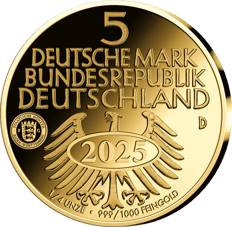
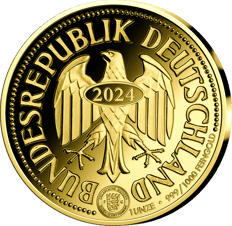
The Goldmark of 2001 remains unique of its kind. Since then, other issues have taken up the design, for example the 1/4 oz Gold 5 Deutsche Mark Germanic Museum 2025 in Proof quality with a mintage of 499 pieces, or the 1/200 oz Gold "Gold Mark" 2026 with a mintage of 5,000 pieces. These are not issues of the Bundesbank. Which new editions are currently available is shown in the product list above.
The name Goldmark is older than the 2001 coin. In the German Empire, from 1871 the gold-backed currency bore this name; its gold coins of 10 and 20 Mark were made of gold with a fineness of 900/1,000. Apart from the name, they have little in common with the coin from 2001. Available from us, for example, is the 10 Mark Prussia Wilhelm I from 1872 with a total weight of 3.98 grams in a Coincard. You can find further coins from this period under Gold Coins of the German Empire.
Common counterfeits are gold-plated circulation coins. The 1 DM coin made of copper-nickel has the same diameter of 23.5 millimetres but weighs only 5.5 grams. So check the following:
The best protection is buying from an established dealer. Our guide to authenticity verification explains further methods.
The Goldmark is struck in Mint State (MS) quality, and its surface shows every fingerprint. Only touch it by the edge and leave it in its coin capsule. For several coins, coin cassettes are suitable. Some specimens show reddish spots. These do not affect the gold content. Do not clean or polish the coin, as this lowers its collector's value.
You can order your Goldmark online at any time: add the product to your basket and pay at checkout. If you prefer to order by phone, you can reach us at 07930-2699, Monday to Friday from 8 am to 8 pm. You can also request a personal offer online.
If you would like to sell your 1 DM gold coin, use our buy-back portal. For items you bought from us, you select them directly from your orders, so you do not need an invoice. For pieces bought elsewhere, we require the purchase invoice. The buy-back price is determined by the item, quantity and current demand; you usually receive a response within 24 hours.
For sending the item in, you receive an insured DHL label, free of charge from an offer value of 500 €. Send the coins in with their capsule, if one was supplied. After receipt, our experts check every piece, and settlement is based on the gold price on the day of receipt. A sale from Switzerland and Liechtenstein is not currently possible.
We offer the 1 DM gold coin 2001 free of VAT.
Gold coins that qualify as investment gold are exempt from VAT in the EU (§ 25c UStG). The requirements include, among others, a fineness of at least 900/1,000, a minting year after 1800, and the status of legal tender in the country of origin, even if this was only the case in the past. For other items, the product tile and product page show whether VAT applies.
For private sales, the following applies: after a holding period of more than twelve months, profits are tax-free (§ 23 EStG). This is a general note and not tax advice.
Anyone looking for coins minted in Germany will find further issues under German Gold Coins, including the gold euro coins from Germany. If your main interest is the gold value, gold bullion coins such as the Krugerrand, Maple Leaf and Vienna Philharmonic, or gold bars, are the obvious choice. All series at a glance can be found under Gold Coins, and products for regular saving under Savings Plan Products.
12 grams of gold with a fineness of 999.9/1,000, in other words almost pure fine gold. The diameter is 23.5 millimetres.
Its value follows the gold price for 12 grams of fine gold, plus a premium driven by demand from collectors. You can see the current price in the product list above.
A total of 1,000,000 pieces, 200,000 each from the five mints with the mint marks A, D, F, G and J. All of them bear the year 2001.
Yes, the 1 DM gold coin 2001 qualifies as investment gold, and we offer it free of VAT. After a holding period of more than twelve months, a private capital gain is tax-free.
By the weight and the inscription: the genuine coin weighs 12 grams and bears DEUTSCHE BUNDESBANK. A gold-plated circulation coin weighs 5.5 grams and bears BUNDESREPUBLIK DEUTSCHLAND.
The Goldmark 2001 is the 1 DM gold coin made of 999.9 gold, issued to mark the farewell to the D-Mark. In the German Empire, from 1871, the term Goldmark referred to the currency itself; its gold coins of 10 and 20 Mark are made of 900 gold.
 Gold Mark
Stay informed with product launches, financial news and exclusive offers. Sign up for our free newsletter today.
By entering your email address and clicking the “Submit” button, you give the following consent: “I agree to be informed by email about new products, financial news and exclusive offers, and therefore consent to the processing of my email address for the purpose of sending the newsletter. I can revoke this consent at any time without giving reasons, with effect for the future. The lawfulness of processing carried out prior to revocation remains unaffected.”