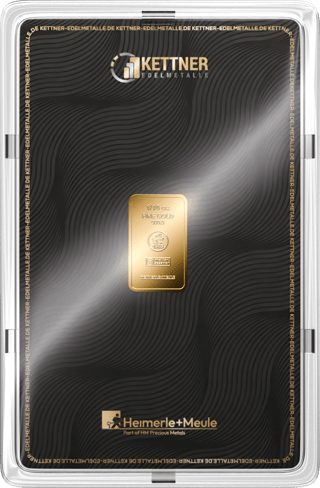
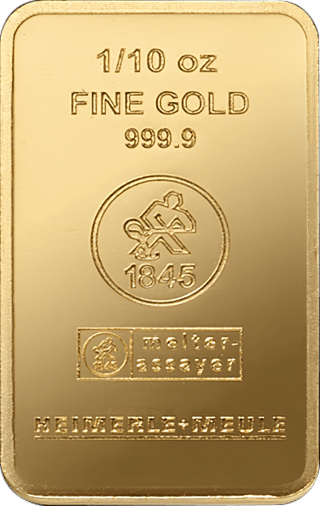
20 x 1/10 oz Gold Bar Heimerle und Meule Unity Box
£6,841.15
VAT-free and excl. shipping
Available in 3–4 business days

 More than 310,000
 Over 30 years
 Secure shipping
 Google: 4.9/5


The gram was laid down in Paris, in the law of 18 Germinal, Year III, which by our calendar was 7 April 1795. Article 5 reads:
“Gramme, le poids absolu d’un volume d’eau pure égal au cube de la centième partie du mètre, et à la température de la glace fondante.”
Law of 18 Germinal an III (7 April 1795), Article 5
This means the weight of pure water in a cube with edges of one centimetre, at the temperature of melting ice. The kilogram was merely its multiple: Article 7 calls it the weight of a thousand grams.
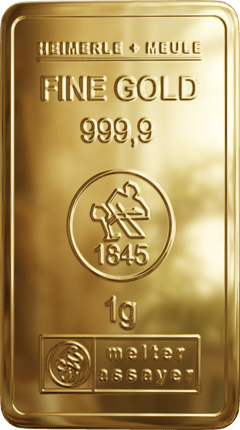
Both at the same scale. The cube shows the gram as defined by the law of 1795. Beside it is a bar of 1 gram by Heimerle + Meule, with the dimensions given by the maker.
Twenty drops of water from a standard dropper together weigh about one gram.
In Germany, the gram has applied since 1 January 1872, as laid down in the Maß‑ und Gewichtsordnung of 17 August 1868, the weights and measures act of the North German Confederation. Article 6 states: “The kilogram is divided into 1,000 grams”. And: “Half a kilogram is called the pound.”
From 1889, the measure was tied to a cylinder of platinum and iridium, the International Prototype of the Kilogram near Paris. The first General Conference on Weights and Measures resolved: “This prototype shall henceforth be considered as the unit of mass.” Germany’s copy, number 52, is kept under two glass bell jars at the Physikalisch‑Technische Bundesanstalt (PTB), the national metrology institute, in Braunschweig.
According to the PTB, the last comparisons showed that the difference between the prototype and its copies had grown to 50 micrograms, “about the same mass as the wing of a fly”. Since 20 May 2019, the kilogram has been tied to a constant of nature, the Planck constant.
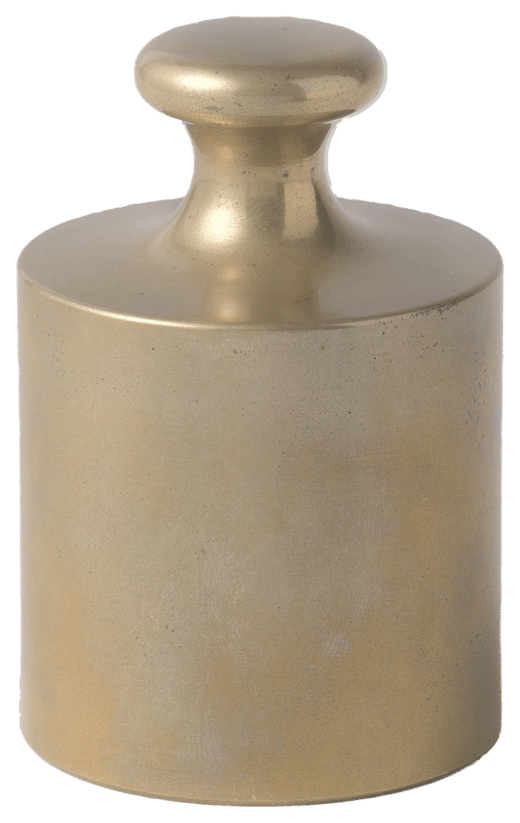
The gram is not the measure for gold everywhere. In Vietnam, people count in lượng and chỉ. A government decree laid this down in 2012: one lượng is 37.5 grams, one chỉ 3.75 grams, both only for weighing gold and silver.
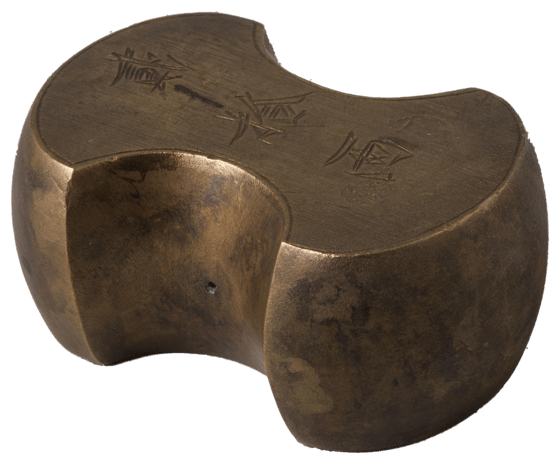
In Hong Kong, the Chinese Gold and Silver Exchange Society trades gold in taels. There, one tael is 37.429 grams.
The troy ounce, in which many coins and bars are weighed, is also built from a smaller measure, the grain: 480 grains make one troy ounce, and one grain weighs 64.79891 milligrams. This is set out in Handbook 44 of NIST, the U.S. National Institute of Standards and Technology.
The values are given by Decree 86/2012 of the Vietnamese government, the Chinese Gold and Silver Exchange Society in Hong Kong and NIST. The troy ounce and the tael are rounded to two decimal places.
Gold that comes out of the ground today is usually invisible, locked away in the rock. In the second quarter of 2022, the ore processed by gold mines worldwide contained an average of 1.29 grams of gold per tonne. Metals Focus reports this in an article for the World Gold Council.
By calculation, one gram of gold is therefore contained in about 775 kilograms of ore, just over three quarters of a tonne.
Diagram: the square stands for one tonne. Only the golden dot is not to scale. At the same scale, it would be smaller than a pixel.
Ordinary rock holds far less gold still. On average, the Earth’s crust contains 0.004 grams per tonne, according to the U.S. Geological Survey. By calculation, that would be 250 tonnes for one gram.
On the Witwatersrand in South Africa, about 5.87 billion tonnes of rock were mined and milled from 1886 to 2005. On average, they yielded 8.07 grams of gold per tonne.

The Rhine carries gold too, in tiny flakes. The Federal Institute for Geosciences and Natural Resources (BGR) writes:
“In the Rhine, placer gold occurs almost exclusively in the form of the finest flakes up to 0.3 mm in diameter and 0.003‑0.005 mg in weight.”
Federal Institute for Geosciences and Natural Resources, Commodity Top News No. 30, 2009
By calculation, one gram of Rhine gold is therefore 200,000 to about 330,000 flakes.
Both at the same scale. The fine circle only shows where the flake lies. The maximum size of the flakes is given by the Federal Institute for Geosciences and Natural Resources, the dimensions of the bar by Heimerle + Meule.
In 1960, a gravel works near Bruchhausen, south of Karlsruhe, separated 21.3 grams of gold from 50,000 cubic metres of gravel. By calculation, that makes about 2,350 cubic metres of gravel for one gram.
The gold panners had a rule of thumb: for panning to be worthwhile, a shovelful of sand had to contain 10 to 20 flakes near Strasbourg and at least 40 to 50 near Mannheim. Downstream, the flakes become ever finer.
In 1874, the Karlsruhe Mint received its last Rhine gold: 89.8 grams.
How fine gold becomes a small minted bar is described step by step in the reference work Gold Bars Worldwide, based on information from the Perth Mint in Australia. For this, the gold is rolled into a strip.
Before the blanking press runs, individual trial blanks are cut from the strip with a hand press and weighed. If one is too heavy, the strip goes through the rolling mill once more.
Then a press punches the blanks out of the strip, and every single one is weighed. Blanks that are too light or clearly too heavy go back into the melt, as does the webbing left over from the strip.
The blank is struck between two dies, while a ring, the collar, holds its shape. Sometimes it takes more than one strike.
15,000bars of standard quality, at most, can be struck with one die. After about 5,000, it is usually repolished.
Diagram based on information from the Perth Mint.
Small, fine and surprisingly powerful: the 1/10 oz gold bar weighs in at a mere 3.11 grams of pure gold, fitting into any pocket, yet it carries the entire myth of the yellow precious metal within it. For many investors, this handy format is precisely the first step into the world of physical gold: affordable to start with, divisible at any time and a genuine medium of exchange in times of crisis. This guide explains what makes the tenth-ounce special, what matters when buying, how fineness, packaging and authenticity work together, and what tax particularities apply to investment gold in Germany.
A troy ounce equals 31.1035 grams, so a tenth of that amounts to around 3.11 grams of fine gold. This makes the tenth-ounce one of the smallest practical denominations among gold bars, bridging the gap between mini formats and classic gram bars. The decisive appeal lies in the low capital outlay: instead of tying up a large sum in one heavy bar, wealth can be built up piece by piece in many small units.
Practically all common 1/10 oz bars are made of 999.9 fine gold, the highest purity commercially available. They are mostly minted, not cast, and come in a protective coin capsule or a sealed blister pack that shields the precious metal from scratches and abrasion. Anyone wishing to compare this small format with a bullion coin will find similarly divisible classics among the gold coins, such as the Krugerrand in its small denominations.
Gold has accompanied humanity for over 6,000 years as a store of value and is considered the oldest currency in the world. While heavy bars once dominated the picture, demand for small, everyday units has driven manufacturers to produce precise micro bars. It is only modern minting technology that makes it possible to produce such a small gold weight with razor-sharp engraving and exact fineness.
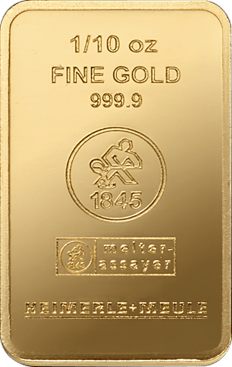
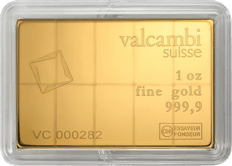
In the German market, the tenth-ounce often comes from Heimerle + Meule, Germany's oldest gold and silver refinery, with roots dating back to 1845. Such traditional mints stand for strict quality controls and a globally recognised brand. Anyone who values the manufacturer's origin will find the full range among the bars from Heimerle und Meule; internationally renowned mints also include Valcambi, whose CombiBars can be broken into individual segments.
Gold has been a proven store of value for over 6,000 years: a timeless treasure that has never become worthless.
The greatest advantage of small bars is their flexibility. Anyone who later wants to convert part of their gold into cash does not have to sell an entire one-ounce or kilo bar, but only as many tenth-ounces as necessary. This divisibility is a strong argument, especially in uncertain times.
This is offset by a well-known drawback: the premium effect. The smaller a bar, the higher the percentage mark-up over the pure material value, because minting and packaging weigh more heavily per gram. A tenth-ounce therefore carries a higher premium than a 100 g gold bar. Anyone looking purely at the lowest price per gram is better off with large units; anyone who values denomination and tradability is well served by the small format.
Many investors deliberately combine several sizes: a solid core of large bars, supplemented by a handful of small units for flexibility. This also fits well with regular gold purchases via savings plan products.
Trust is essential with such a sought-after precious metal. Reputable 1/10 oz bars carry the details of weight, fineness and manufacturer directly in the minting and are delivered in a sealed blister pack with a certificate. This original packaging should remain as undamaged as possible for later resale.
Important authenticity features and verification methods:
As a German family business, Kettner Edelmetalle carries out an ISO-compliant authenticity verification and supplies only goods from checked sources. Anyone wishing to additionally protect their gold from abrasion will find suitable solutions for long-term storage in the coin capsules section.
A weighty argument for physical gold is its tax treatment. Investment gold is exempt from VAT in Germany, provided it meets the legal criteria for fineness and form, which is the case with 999.9 bars. This applies in contrast to silver, which is regularly subject to VAT on purchase.
Tax note
Investment gold is exempt from VAT on purchase. If physical gold is resold after a holding period of more than one year, any capital gain is exempt from income tax for private individuals. This is general information and does not replace individual tax advice.
This combination of a tax-free purchase and, after the holding period has elapsed, a tax-free sale makes gold a popular building block for retirement provision and inflation hedging.
Despite its small size, a gold bar deserves careful storage. Gold is chemically very stable and does not tarnish, but the delicate minting and packaging should remain protected. The bar is best kept in its original coin capsule or sealed blister pack: this preserves its shine and secures the full value on resale.
For home storage of several units, a small safe or a can safe are suitable; alternatively, a bank safe deposit box offers additional security. Anyone wishing to present a small collection neatly will find suitable storage in coin cases, while coin pouches take care of transporting several bars. In any case, 100% insured shipping on purchase is essential, standard at Kettner Edelmetalle.
The small format appeals to very different kinds of people. Beginners appreciate the low price per unit, which allows a first gold purchase without a large budget. Savers use the tenth-ounce to continuously accumulate gold over the months. And gift-givers like to choose it as a lasting, value-stable gift for births, communions or anniversaries: a small bar feels more refined and personal than a banknote and retains its value across generations.
The small format also makes sense as part of a more broadly diversified precious metals portfolio: it supplements larger gold bars and bullion coins with a flexible component that can be sold at any time. Anyone focused on crisis preparedness will find tailored combinations among the crisis protection packages.
A tenth of a troy ounce equals around 3.11 grams of fine gold. A full troy ounce measures 31.1035 grams, so a tenth of that is about 3.11 grams at a purity of 999.9/1,000.
Minting, packaging and handling incur roughly the same costs per bar; with a low gold weight, these are spread over fewer grams. This increases the percentage mark-up over the pure material value. Larger denominations such as the 100 g bar therefore have a lower premium.
Yes. Investment gold with a fineness of 999.9 is exempt from VAT in Germany. On private resale after a holding period of more than one year, any profit is also exempt from income tax. Please note that this does not constitute individual tax advice.
It is best to keep the bar in its original coin capsule or sealed blister pack to protect the minting and shine. For several units, a safe, can safe or bank safe deposit box are suitable; coin cases and coin pouches help with organisation and transport.
Look for clean minting with weight and fineness details, the correct manufacturer's logo and an undamaged, sealed blister pack with a certificate. A precision scale confirms the 3.11 grams. The safest protection is to buy from an established dealer with verified sources of supply.
Yes, its compact size in particular makes it a popular gift. A small gold bar in elegant packaging feels more personal than cash, retains its value in the long term, and is suitable for occasions such as births, christenings, communions or milestone birthdays.
 1/10 oz Gold Bars
Stay informed with product launches, financial news and exclusive offers. Sign up for our free newsletter today.
By entering your email address and clicking the "Submit" button, you give the following consent: "I agree to be informed by email about new products, financial news and exclusive offers, and therefore consent to the processing of my email address for the purpose of sending the newsletter. I can revoke this consent at any time without giving reasons, with effect for the future. The lawfulness of processing carried out prior to revocation remains unaffected."