









Silver Tetradrachm Cassius Longinus Monogram (85-42 BC | Chief Conspirator Against Julius Caesar)









- Antique Original: hand-struck
- Royal Portrait: in bold high relief
- From Antioch: metropolis of Syria
- Antique OriginalOver 2,000 years old and each piece a unique specimen
- Royal PortraitPhilip I with diadem and curly hair, plus Zeus with Nike
- From AntiochStruck on the Orontes under Roman administration
 Price alert set
 share
shareSilver Tetradrachm of Cassius Longinus – A Witness to the Ides of March
There are coins you simply buy. And there are coins where, upon first touching them, you can feel the breath of world history. This ancient tetradrachm belongs to the second category: it bears the monogram of the man considered the strategic mastermind behind antiquity's most famous conspiracy – Gaius Cassius Longinus (85–42 BC), brother-in-law of Brutus and leader of the plot against Gaius Julius Caesar. It was struck in Antioch on the Orontes, the wealthy metropolis of Syria, under Roman administration, and in the name and types of the long-deceased Seleucid king Philip I Philadelphus. A piece of silver that bundles the Republic, the Seleucid Empire, and the emerging Roman Empire into a single coinage.
The Design: Royal Portrait and Enthroned Zeus
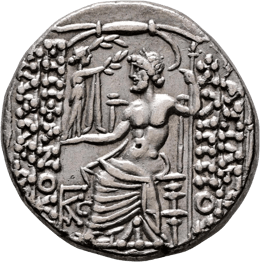
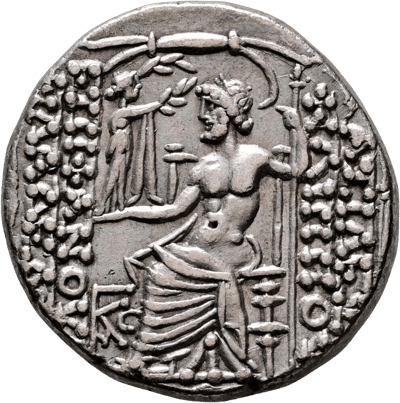
The obverse shows the head of Philip I facing right, wearing the royal diadem, its ribbons falling onto the neck. Striking are the lush, spiraling corkscrew curls that frame the forehead, ear, and neck – Hellenistic portrait art in bold high relief, enclosed by a beaded border. The reverse is pure state artistry: Zeus Nikephoros is enthroned facing left, holding the winged goddess of victory, Nike, in his outstretched right hand, and the long scepter in his left. Around it runs the Greek inscription ΒΑΣΙΛΕΩΣ ΦΙΛΙΠΠΟΥ ΕΠΙΦΑΝΟΥΣ ΦΙΛΑΔΕΛΦΟΥ, the whole framed by a wreath. And in the field lies the decisive detail – the monogram that attributes this coinage to Cassius's tenure in Syria.
- Obverse: diademed ruler's portrait facing right, curly hairstyle, beaded or linear border
- Reverse: Zeus with Nike and scepter, enthroned facing left, within a wreath
- Legend: ΒΑΣΙΛΕΩΣ ΦΙΛΙΠΠΟΥ ΕΠΙΦΑΝΟΥΣ ΦΙΛΑΔΕΛΦΟΥ
- Monogram: abbreviation of Gaius Cassius in the field – the numismatic centerpiece of this coin
The Man Behind the Monogram
His military rise began in 53 BC. During the war against the Parthians, after the defeat of Marcus Licinius Crassus at the Battle of Carrhae, Cassius saved the remnants of the Roman army and successfully defended the province of Syria. After being appointed praetor and subsequently senator, he always acted prudently and with great political skill. When Caesar had himself elevated to \"Dictator perpetuus\" – dictator for life – Longinus considered it his duty to save the Republic and escape tyranny by restoring the old, republican order.
He convinced the skeptics and acted out of pragmatic, political calculation. Despite his advice, the conspirators spared Mark Antony, Caesar's close confidant – and Antony turned the expected joy among the people into mourning. This was followed by the flight of Longinus and Brutus to the east of Rome, where both raised a large army. In 42 BC, the decisive Battle of Philippi took place in Macedonia against the Caesarians Marcus Antonius and Octavian. When Longinus lost the flank battle against Antony and mistakenly believed that Brutus had fallen, he took his own life.
Circulated Coinage: Every Specimen a Unique Piece
These pieces are circulated currency and bear corresponding traces: darker patina, individual centering, nicks, wear, and sometimes weaker areas of the legend. This is precisely what makes them appealing. Each of these coins was hand-struck – the flan is irregularly round, the edge wavy, and the strike at the rim sometimes weak. Since the year of minting, mint, and reverse variant can vary, the specimen delivered will differ from the image shown: you receive an original, not a mass-produced product. Please understand that the image in the shop serves as an example and may individually differ from the delivered item in terms of appearance and condition due to historical circumstances.
The Facts at a Glance
- Face value: 4 drachmas (tetradrachm)
- Precious metal: silver, fineness 950–980/1,000
- Fine weight: 15.5 g – gross weight 15.5 g
- Diameter: approx. 30–35 mm
- Mint / origin: Antioch
- Year of issue: varies, ancient hand-struck
- Condition: circulated (used), standard trade quality
- Delivery: in a velvet pouch, as insured shipping
Tetradrachm, Denarius & Co. – Putting It in Context
For centuries, the tetradrachm was the leading coin of the Greek world: four drachmas, around 15 to 16 grams of silver, the backbone of long-distance trade from Athens to Antioch. In the Roman East, tetradrachms were roughly equated with four denarii in daily use and continued to circulate alongside the Roman imperial currency. The comparison is worthwhile: a republican denarius is smaller, lighter, and more common – but the large flan format of the tetradrachm in high relief appears considerably more impressive and offers far more surface area for portrait art. Anyone collecting numismatics gets both in one piece here: Hellenistic imagery and Roman power politics.
Silver as a Tangible Asset – and as a Collector's Item
Silver has been a coinage metal, means of payment, and symbol of wealth and prestige for thousands of years. Its intrinsic value stems from its physical properties and worldwide demand as a raw material: electronics, solar technology, and medical technology all rely on it continuously, while supply remains limited. Unlike fiat money, which depends on trust in governments, silver requires no external guarantee. It is durable, retains its properties over centuries – this coin has proven so for over 2,000 years – and is liquid worldwide. As a tangible asset, physical precious metal serves many investors as an inflation hedge and as crisis protection, especially in times of political or monetary turmoil.
Gold is humanity's oldest currency and has outlived all others – and silver has accompanied it since antiquity as the money of everyday life.
Relevant for investors in Germany: profits from the sale of physical silver are, under current law, generally tax-free provided the minimum holding period of one year is observed. This allows silver coins to be used as a building block for wealth preservation and passed down through generations.
Who This Tetradrachm Is Suited For
Anyone familiar with modern bullion coins is used to consistent quality and fixed mintages. An ancient tetradrachm works differently: no catalog year, no Mint State perfection – but instead a biography spanning over two millennia, cast in metal. Where a contemporary silver bar is purely a matter of weight, this piece adds historical and numismatic appeal. Ideal, therefore, for collectors of ancient coins, enthusiasts of Roman and Hellenistic history, and anyone wishing to add a piece with genuine storytelling value to their precious metal holdings. A gift you never have to explain twice.
Product depiction may differ from the final product.
