





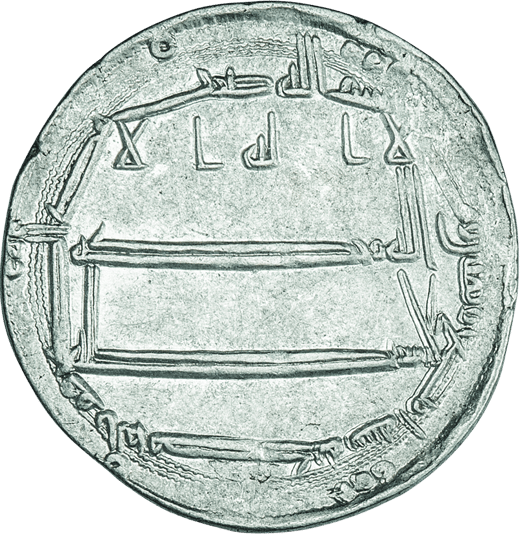


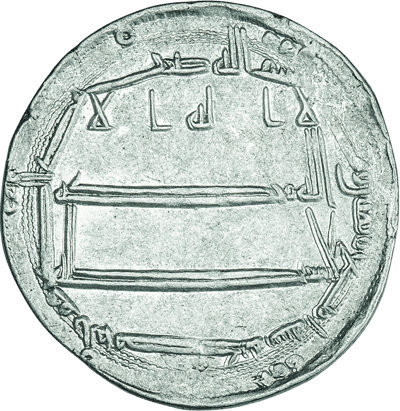


Silver Dirham Great Abbasid Empire (8th to 9th Century | Arab Golden Age)










- Genuine Original: over 1,200 years old
- Legendary Era: Age of the Caliphs
- Kufic Script: pure art of writing
- Genuine OriginalOriginal circulating coinage from the Middle Ages, not a restrike
- Legendary EraFrom the realm of Harun al-Rashid and One Thousand and One Nights
- Kufic ScriptDeclaration of faith in angular calligraphy on both sides
 Price alert set
 share
shareSilver Dirham of the Abbasids – Trade Currency from the Arab Golden Age
This piece of metal weighs barely three grams. And yet it holds an entire era within it: the Silver Dirham from the great Abbasid Empire dates back to that period of the 8th and 9th centuries when Baghdad was the richest and most learned city in the known world. Whoever holds this coin in their hand holds genuine circulating currency from the Middle Ages – not a modern memorial piece, not a restrike, but authentic history you can touch. For collectors of historical silver coins, these pieces rank among the most tangible testimonies of a vanished high civilization.
The Abbasid Caliphate: A World Power Between the Maghreb and Central Asia
The Abbasid dynasty seized power over the caliphate in 750, thereby succeeding the Umayyads. Their name derives from al-ʿAbbās ibn ʿAbd al-Muttalib, an uncle of the Prophet Muhammad. The new center of power arose on the Tigris: Baghdad, officially Madinat as-Salam – the "City of Peace." From there, caliphs such as al-Mansur, al-Mahdi, and above all Harun al-Rashid (786–809) ruled an empire whose trade routes extended from North Africa to Central Asia.
It was a golden age of science, medicine, mathematics, and poetry. To this day, Harun al-Rashid remains the ruler at whose court the tales of "One Thousand and One Nights" are set. The dirham was the backbone of this economic sphere – and it traveled remarkably far. Islamic silver coins turn up in hoards from Scandinavia to northern England, because the Vikings traded them in long-distance commerce for furs, hides, and ivory. Silver was the world currency of the early Middle Ages, and the dirham was its most important carrier.
Design: Calligraphy Instead of a Ruler's Portrait
Anyone looking for a portrait will search in vain. Islamic coins of this era deliberately dispense with imagery – instead, the dirham bears Arabic script on both sides, rendered in the angular, strictly composed Kufic calligraphy. At the center of the obverse are several lines of the profession of faith, surrounded by a marginal inscription that traditionally names the mint and the year of minting according to the Islamic calendar. The reverse repeats this principle with further lines in the field and an inscription running along the edge.
The pieces were hand-hammered. That is why each specimen is slightly irregularly rounded, and every planchet shape is unique. It is precisely this handcrafted individuality that gives the piece its appeal – no two dirhams are identical.
The Key Facts at a Glance
Precious metal: Silver
Face value: Dirham
Country of origin: Great Abbasid Empire
Gross weight: 2.9 g
Diameter: approx. 23 mm
Fineness and fine weight: variable (historical hand-struck coinage)
Year of issue, mint, caliph: various – allocated according to availability
Condition: These pieces are circulated currency and bear corresponding traces: darker patina, individual centering, nicks, wear, and occasionally weaker areas of the legend. This is precisely what makes them appealing. Since the year of issue, mint, and reverse variant may vary, the specimen delivered will differ from the image shown – you receive an original, not a mass-produced item. Please understand that the image in the shop serves as an example and that the delivered item may individually differ in appearance and condition due to historical circumstances.
Series: History
Please note: Since this is circulating currency more than 1,200 years old, the year of minting, place of minting, and size of the planchets are not uniform. Fineness and fine weight also vary. You are acquiring a historically grown original bearing signs of use – not a machine-made product.
Why This Dirham Appeals to Collectors and Investors
Historical depth: a means of payment from the heyday of the Abbasid Caliphate, minted in the era of Baghdad, Kufa, and al-Muhammadiya
Authenticity instead of replica: original circulating currency, not a modern restrike
Small format, great impact: handy at around 23 mm, ideal for a display case, collector's album, or as a gift with a story to tell
Silver as a proven tangible asset: the metal retains its physical properties over centuries – these coins prove it impressively
Finite supply: historical pieces cannot be reproduced; what is on the market is all there is
Gold and silver are the oldest currencies of mankind. They have outlasted caliphates, kingdoms, and paper money systems – without their purchasing power ever having to rely on trust in a government.
Silver as a Tangible Asset – Yesterday and Today
What made the dirham valuable in the 9th century still holds true today: silver possesses an intrinsic value that does not depend on a promise, but on its physical properties. Unlike fiat money, it cannot be multiplied at will. Add to this the modern component: industry demands silver in large quantities for electronics, solar technology, and medical technology, while the available supply remains limited.
This is why many buyers value silver as an inflation hedge and as crisis protection. Small silver units have also always been a practical medium of exchange – the dirham itself is historical proof of this. And for wealth meant to be passed down through generations, physical precious metal offers a quality that hardly any other tangible asset can match: it does not age.
For tax purposes in Germany: profits from the sale of physical silver coins are generally tax-free after a holding period of at least one year. Please clarify the details of your personal situation with your tax advisor.
Compared: Dirham, Denarius, and Modern Bullion Coins
Alongside the Roman denarius or the medieval pfennig, the Abbasid dirham occupies a special position. The denarius depicts imperial portraits, while the dirham features pure calligraphic art – a completely different aesthetic approach that appeals to many collectors precisely for this reason. Compared to modern bullion coins such as a silver ounce, the difference is obvious: the dirham contains less metal, but offers a provenance that cannot be minted. Its value stems from rarity, age, and demand among collectors, not solely from its fine weight. Those who want both combine historical pieces with common bullion products – the classic combination of passion and substance.
Shipping is carried out as insured value shipping. Since each piece is a unique item, the packaging may vary.
Product depiction may differ from the final product.
