





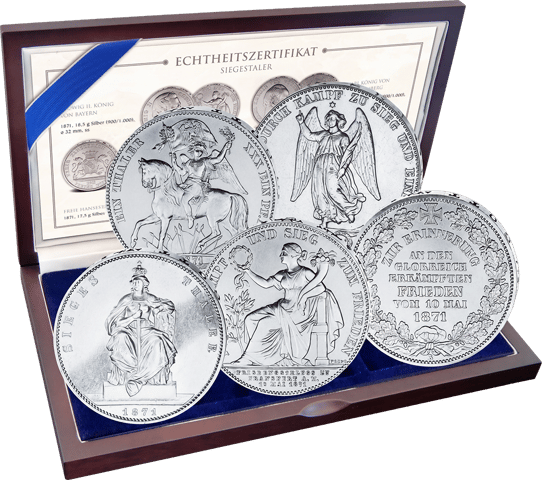


Silver Coin Set Siegestaler 1871 (Complete Set for the Founding of the Reich)












- Last Thalers: before the introduction of the Mark
- Four Kings: plus the Hanseatic city of Bremen
- Certificate of Authenticity: in an elegant case
- Last ThalersWith the Mark, centuries of thaler minting came to an end
- Four KingsFeaturing Wilhelm I, Ludwig II, Johann and Karl
- Certificate of AuthenticityWith images and descriptions of the included thalers
 Price alert
  Share
Share
Originals · five thalers
Thalers that commemorate
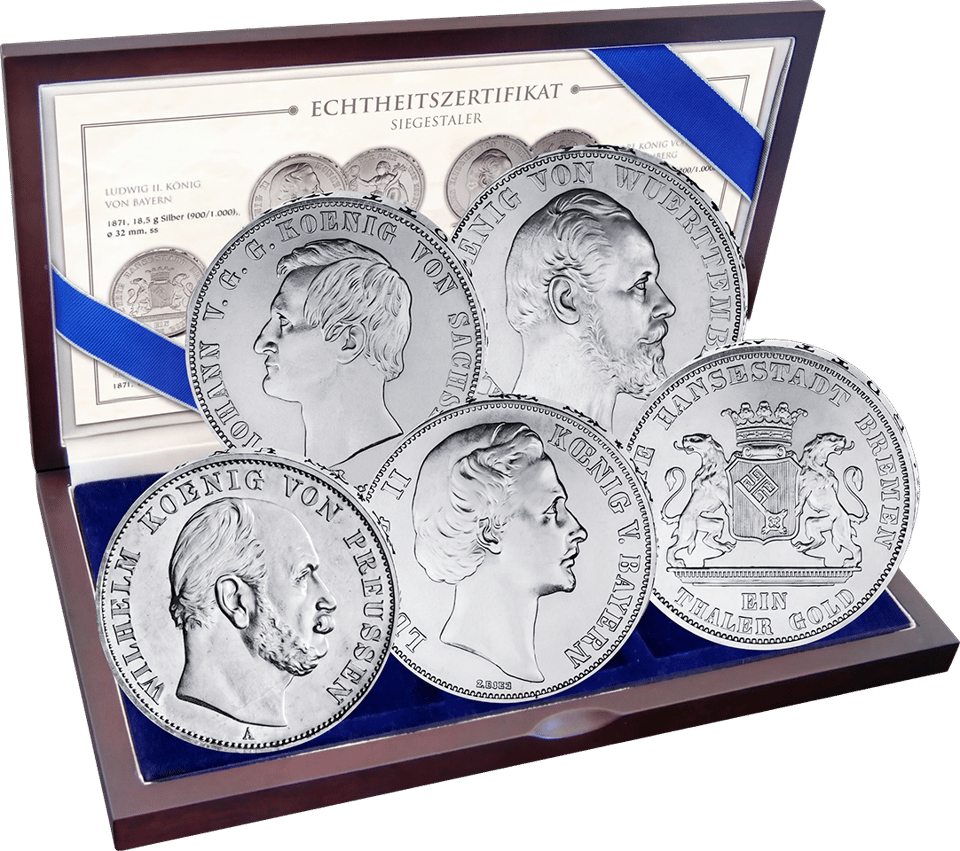
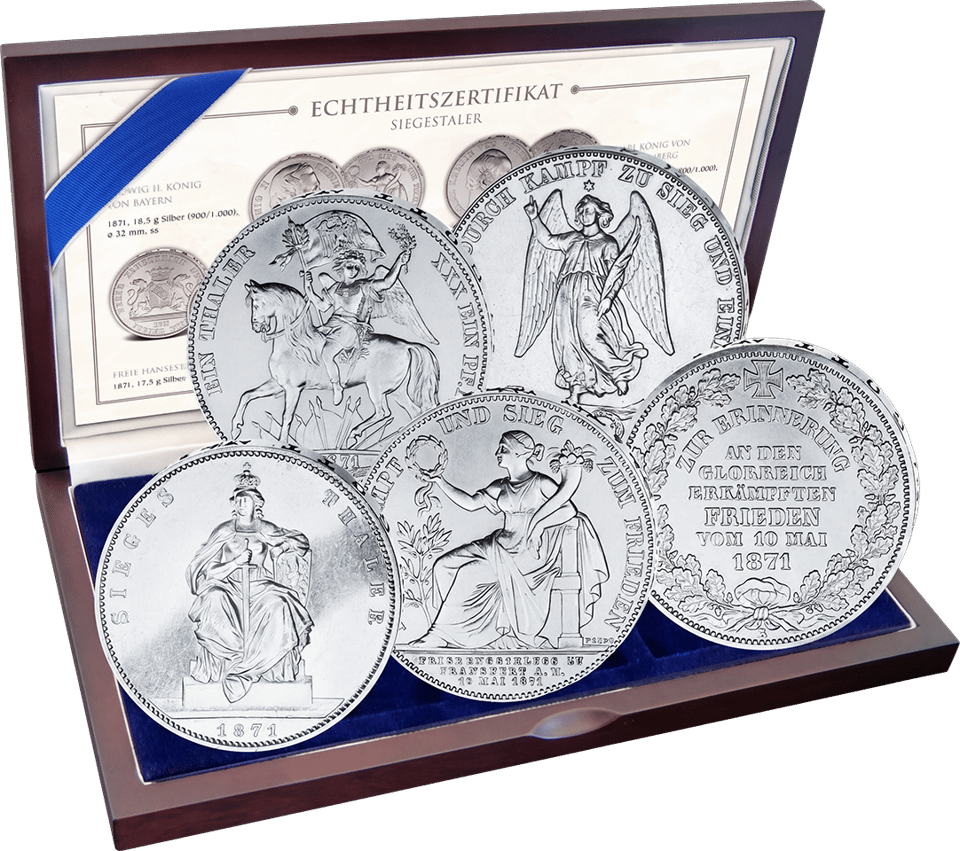
Set of five thalers, case with the obverses
Under the law of 1871, large silver coins could for the time being only be struck as commemorative coins. The case holds five thalers; their reverses show, among other things, a rider and an enthroned female figure.
On the thalers
What the thalers bear
The thalers bear no mark; they come from the time before. They still show what they stand for:
The obverses show portraits and a coat of arms with HANSESTADT BREMEN, the reverses among other things a rider, a goddess of victory and an enthroned female figure.

Before the mark
By law: a sixth of a thaler as half a mark
Before the mark, the thaler counted in the north and the gulden of 60 kreuzer in the south.
“counting the ⅓ thaler piece as one mark and the 1/6 thaler piece as half a mark”
In other words: a third of a thaler counts as one mark, a sixth of a thaler as half a mark.
So the old pieces were accepted until they were withdrawn from circulation. The single thaler remained valid until 1907.
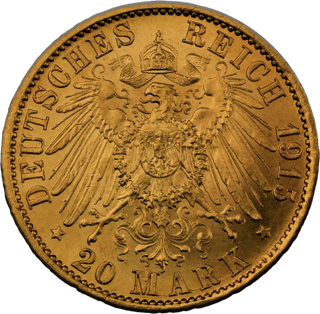
The gold of the mark
The gold of the German Empire
Twenty and ten marks in gold, 900/1,000: a twenty-mark piece weighs 7.96 grams, of which 7.17 grams is fine gold.
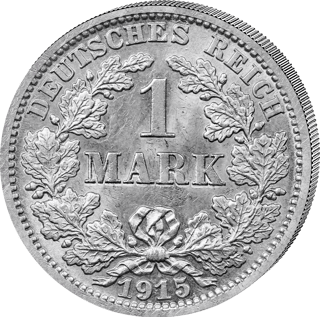
The mark in silver
The silver mark in the hand
A mark holds 5 grams of fine silver, 900/1,000, and measures 24 millimetres. No one had to accept silver coins for amounts over 20 marks.

Commemorative coins
When a coin marks an event
Under the law of 1871 the striking of large silver coins was suspended, with one exception:
“No striking … of large silver coins, with the exception of commemorative coins, shall take place until further notice.”
This power expired on 31 December 1873. The Victory Thaler of 1871 from Prussia is a commemorative coin for the victory over France in 1871: it shows the head of Wilhelm I with WILHELM KOENIG VON PREUSSEN, and on the other side a seated crowned woman with sword and shield and SIEGES THALER.
The coinage act of 1909 empowered the Federal Council to have five-, three- and two-mark pieces made as commemorative coins in a different design.
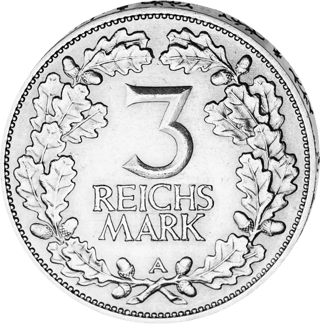
Rentenmark and Reichsmark
The Reichsmark from 1924
The coinage act of 30 August 1924 introduced the Reichsmark; in October 1924 it came into circulation alongside the Rentenmark, one to one.
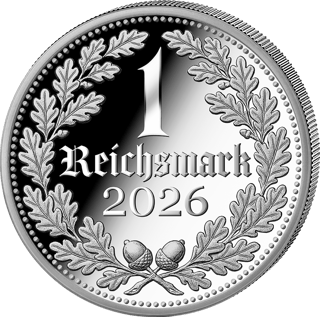
Our strikes
What our strikes take up
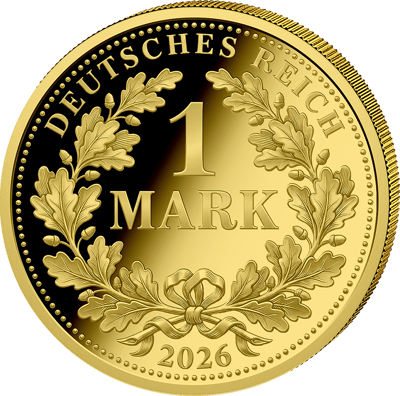
Our strikes bear the lettering 1 Reichsmark or 1 Mark in an oak wreath. They are newly struck, no Reichsmark of the past and no legal tender of the Reich.
At a glance
- Type
- Set of originals
- Era
- German Empire
- Metal
- Silver
- Number of pieces
- 5 pieces
- Contents
- five thalers in a case
- Packaging
- Case
Details from our product data, the coinage acts and the photo. The year and mint mark of your piece may differ from the photo.

Original and new strike
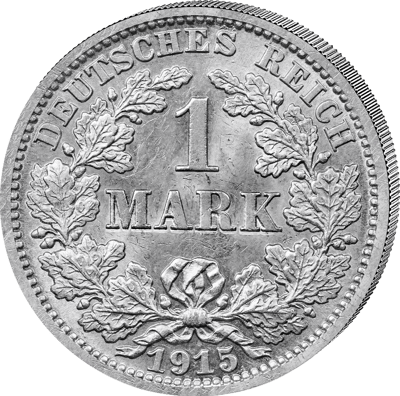
On the left a mark from the German Empire, on the right our strike of 1/200 ounce of fine gold, which takes up DEUTSCHES REICH and 1 MARK in an oak wreath.
One was money throughout the Reich, the other is newly struck: two pieces, one image.
Victory Taler 1871 – a silver set marking the birth of the German Empire
There are coins that are more than precious metal: they are minted history. The Victory Taler of 1871 undoubtedly belongs to this category. With the victory in the Franco-Prussian War of 1870/71 and the founding of the German Empire, an era came to an end – and with it the centuries-old tradition of the German Taler. This exclusive complete set brings together five original silver Talers from the fateful year 1871 in a high-quality case complete with certificate of authenticity. Anyone who loves historical silver coins holds here a piece of the founding of the Empire in their hands.
The last Talers before the Mark
The German Victory Talers – often spelled contemporarily as „Siegesthaler“ – tell of war, unity and the founding of the Empire. They were minted as Vereinstaler (Union Talers) from silver with a fineness of 900/1000. Shortly thereafter, with the introduction of the Mark in the young German Empire, Taler minting came to an end. The Victory Taler is thus literally the last German Taler. This is exactly what makes it so sought-after among collectors: it marks the closing point of a long numismatic era and, at the same time, the beginning of a new one.
The occasion for the minting was the won war against France, whose peace was sealed on 10 May 1871 in Frankfurt. Several states of the old German territories issued their own commemorative coinages – each with its own design, each a small work of die-cutting art. In numismatic reference literature, these pieces are still listed today under their Thun catalogue numbers.
Which states the set brings together
The appeal of this collection lies in the diversity of its designs. On the obverses, the rulers of the German kingdoms look out; on the reverses, allegories celebrate victory and peace:
Kingdom of Prussia – King Wilhelm I (Thun 272), reverse with an enthroned Borussia in a victorious pose, sword and shield, inscription „Siegesthaler“.
Kingdom of Bavaria – King Ludwig II, reverse with the winged goddess of victory Victoria and the inscription commemorating the peace treaty with France.
Kingdom of Saxony – King Johann, reverse with a winged rider.
Kingdom of Württemberg – King Karl, reverse with an angel and the inscription „Mit Gott durch Kampf zu Sieg und Einigung“ (With God through struggle to victory and unity).
Free Hanseatic City of Bremen – crowned city coat of arms, reverse with the inscription „Zur Erinnerung an den glorreich erkämpften Frieden vom 10. Mai 1871“ (In memory of the gloriously won peace of 10 May 1871).
Thus, the set brings together the most significant Victory Taler coinages of the German Empire – a complete numismatic panorama of the founding of the Empire, in which Prussia is represented just as much as the South German kingdoms and the old Hanseatic city.
Technical specifications and condition
Set of 5 original silver Talers, minted in 1871
Material: silver, fineness 900/1000
Approx. 18 grams per coin, with a diameter of about 32 to 33 millimetres
Country of origin: Germany
Condition: bank-standard circulated goods (historical originals)
Delivery: in a case with certificate of authenticity
These are original mintings over 150 years old, made of solid silver – substantial coins whose historical character can be felt the moment you hold them. Minor signs of wear are typical of circulated goods and underline the authenticity and age of the pieces.
A collector's item with substance
Complete Victory Taler sets are becoming increasingly rare, as many of the Talers once minted have not survived the long decades. For collectors, this ensemble combines historical significance with genuine precious metal – a double appeal of history and material value. Precious metals have long been regarded as an inflation hedge and as crisis protection: gold and silver have outlasted currencies, empires and crises for centuries. Where paper currencies have come and gone, precious metal has remained a reliable tangible asset.
Whoever owns the Victory Taler set preserves an authentic testimony to German history – minted from genuine silver, carried by a great narrative.
Whether as the centrepiece of a collection on the German Empire, as a family heirloom passed down through generations, or as a tangible piece of precious metal with history: this complete set of Victory Talers from 1871 is a piece of the founding of the Empire that one is always glad to pick up again.
Product depiction may differ from the final product.
