




Change nothing
For more than five hundred years the zecchino kept its weight, its fineness and its image. That stubbornness is exactly what made it the trading currency of the Mediterranean: whoever took one did not have to test it.

 More than 280,000
 Over 30 years
 Secure shipping
 Google: 4.9/5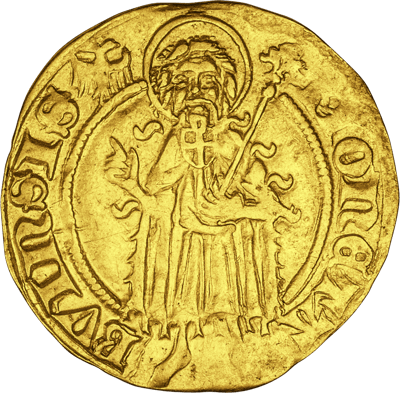


Unfortunately, this item is currently out of stock. We will be happy to send you an e-mail as soon as this product becomes available again.
 Original gold guilder with Saint Peter and Cologne coat of arms from the late Middle Ages – solid gold with genuine historyEach piece a hand-struck one-of-a-kind with patina and certificate of authenticity – ranked number 1 in the Germany categoryRarity plus gold value: proven crisis protection to pass on, insured and delivered anonymouslyA witness to history in solid gold: Original gold guilder of the Holy Roman Empire from 1371-1463, hand-struck in Cologne – over half a millennium of trading history in your handsA unique piece for collectors: Each specimen shows its own centering, patina and coat-of-arms variations – not a mass product, but a rare original with certificate of authenticityTangible asset across generations: Gold has never had a value of zero in 6,000 years – gold content and rarity make this guilder a hedge against crisis and inflation
 Price alert
  Share
ShareMedieval original

You are looking at the obverse.
Between the day this piece was made and the day you hold it there are roughly
600years
Where it belongs
The Middle Ages had no world currency. What counted a day's ride away was a separate question, and anyone trading converted constantly. These seven pieces stand for seven answers to that.
621 to 907
Imperial China
China cast its money instead of striking it: molten bronze into moulds, the result a round piece with a square hole so a thousand of them could go on one string. In 621 Emperor Gaozu had the Kaiyuan Tongbao introduced and prescribed a weight for it that later became the Chinese unit qian. For almost three hundred years this piece stayed the standard.
8th to 9th century
Abbasid caliphate
From Baghdad ruled the greatest power of the day, and its silver dirham ran from Central Asia to Scandinavia. It carries no image, only script: creed, mint, year and ruler. Viking graves in Sweden are full of them, because trade reached down the Russian rivers all the way to the Baltic.
1099 to 1268
Crusader states
After taking Antioch in 1098 the new princes struck their own money, and it looks exactly like their position: a western denier, a cross, a helmeted head, and legends wavering between Latin and Greek. The money of a state that lay between two worlds and lasted less than two hundred years.
1284 to 1797
Republic of Venice
In 1284, under Doge Giovanni Dandolo, Venice introduced the gold ducat, later called the zecchino, at 3.545 grams of the purest gold medieval metallurgy could make. The Republic changed nothing about that standard until its end in 1797. Over five hundred years, the same weight and the same image: that is why the zecchino was good from Alexandria to Antwerp.
1371 to 1463
Rhenish gold gulden
In the Empire the archbishops of Cologne, Mainz and Trier struck alongside the Palatinate on the model of the Florentine florin and agreed their coins among themselves. Cologne put the apostle Peter on the front and the city arms on the back. The Rhenish gulden became the leading money of the Empire, the one prices were quoted in even when people paid in pennies.
Your piece
1381 to 1407
Meissen groschen
The prince's groschen came from the silver of the Ore Mountains and was meant to hold against the Rhenish gulden: around twenty-three of them to one gulden. From 1396 it was struck with markedly less silver, and the blanks were boiled in tartar so the surface stayed white. From the outside the groschen looked the same as before.
14th to 15th century
Hollow penny
The smallest denominator of daily life: a leaf of silver, struck on one side into a soft bed so the image stands proud at the front and stays hollow at the back. Schweidnitz in Silesia put a boar on it, the arms of the town. Fourteen millimetres, a fifth of a gram, and with it people paid for cloth, grain and carting.
For more than five hundred years the zecchino kept its weight, its fineness and its image. That stubbornness is exactly what made it the trading currency of the Mediterranean: whoever took one did not have to test it.
In some regions hollow pennies were called in at regular intervals, in places twice a year: old money became void and had to be exchanged for new. The fee for that was often the mint lord's only tax income, and whoever came late lost part of their money. Money with an expiry date, six hundred years before the term.
Keeping it
Medieval coins are not modern blanks. A hollow penny is a fifth of a gram of sheet silver and bends between two fingers, gold is soft enough for a fingernail to leave a mark, and the dark layer on silver and bronze is patina: grown over centuries, a sign of authenticity among collectors, and not recoverable once it is polished away.
Thin flans need support across their whole surface. A capsule or a coin frame, not a loose bag in which the sheet props itself up on an edge.
Fingerprints contain acid and salt. Take the piece between thumb and forefinger at the edge, over a soft surface.
No vinegar, no silver cloth, no ultrasound. If a crust has to come off, let a conservator do it, not the kitchen sink.
Condition: These pieces are circulated coins – and they look the part. Darker patina, individual centring, small nicks, wear, and in places weaker-struck legend sections: these are not flaws, but biography. Every trace comes from hands that used them centuries ago to settle goods, freight or debts. Since the year of minting, mint and reverse variant can vary, the piece delivered may differ from the image shown. Please understand the photo in the shop explicitly as a sample image: appearance, exact weight and condition vary from piece to piece for historical reasons. You are purchasing an original.
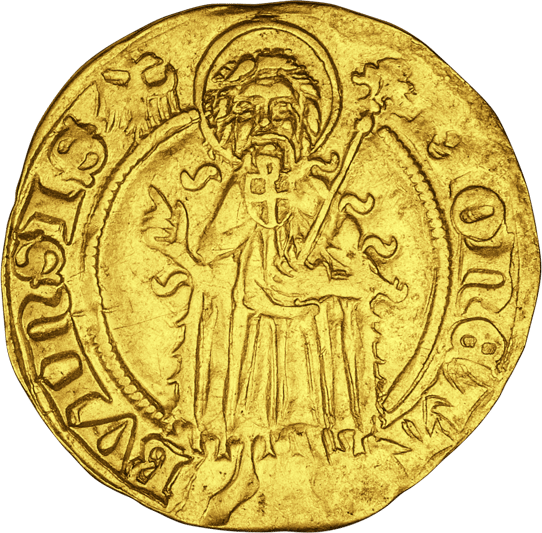
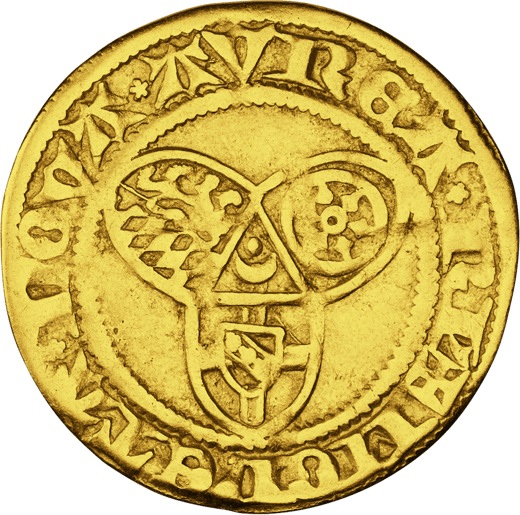
Design: The obverse shows Saint Peter, patron of the Archdiocese of Cologne, with key and crosier; the reverse bears coats of arms within a trefoil – the hallmark of the Rhenish electors and their coinage union.
Material and fineness: Solid gold; the fineness varies depending on the minting period, as the coinage treaties of the late Middle Ages ranged between roughly 23½ and 19 karat.
Mint: Various medieval mints in the Archdiocese of Cologne – among those documented are Bonn, Riel and Deutz.
Format: 23 mm diameter with a raw weight of about 3.9 g – a handy, remarkably thin gold flan.
Security: Delivered with a certificate of authenticity, shipped exclusively as insured shipping.
In the late Middle Ages, Cologne was one of Europe's great commercial hubs. Anyone buying cloth, wine or weapons here paid in gulden – and this Gold Gulden is exactly such a piece in your hand. The Archbishops of Cologne held the gold coinage privilege since 1346, and what emerged from it became the leading currency of the Rhineland.
The obverse shows the prince of the apostles, Peter, patron saint of Cologne Cathedral and the Archdiocese. Key, cross staff, halo – every detail is deliberate, every detail hand-cut into the die. The reverse belongs to politics: within the trefoil appear the coats of arms of the treaty partners, namely Mainz, Trier and the Palatinate/Bavaria, alongside the Cologne shield. This coat-of-arms reverse is the trademark of the Rhenish Coinage Union, founded by the four electors in 1386. A small bonus for collectors: because every mint, every archbishop and every treaty round produced its own variants, hardly any two pieces are alike.
Individual centring: Hand-struck with a hammer – legends may be close to the edge or in places weaker in detail.
Traces of circulation: Nicks, minor wear and darker patina bear witness that this coin genuinely financed trade.
Various years and mints: Year of issue, place of minting and reverse variant may differ.
Image as example: The piece delivered differs in appearance and condition for historical reasons – you receive an original, not a mass-produced item.
This is precisely where the appeal lies. A mirror-polished Proof strike of today is perfect, but interchangeable; this Gold Gulden is a witness to history. Many of the once abundantly minted pieces were melted down over the centuries, which makes the surviving stock correspondingly scarce.
Classic gold coins such as the Krugerrand or Vienna Philharmonic score points with precisely defined fine weight, tight margins and worldwide tradability – ideal for pure weight accumulation. The historical Gold Gulden plays in a different league: its value is drawn from gold content and rarity, from craftsmanship and provenance. It stands alongside the great trading coins of its era, such as the Florentine Fiorino or the Venetian Zecchino. Combining both – modern bars and coins as a foundation, historical rarities as the finishing touch – covers two needs at once.
For over 6,000 years, this precious metal has served as a store of value, and throughout this entire time it has never had a value of zero. Paper currencies have come and gone; gold has remained. This makes it a proven inflation hedge and a solid form of crisis protection – scarce in supply, recognised worldwide, and liquid at all times. It is no coincidence that central banks still hoard gold reserves today, even as they print fiat money themselves. A tax note on the side: in Germany, profits from the sale of physical gold are generally tax-free after a holding period of at least one year.
This coin was struck when Cologne helped shape Europe's trade – and it still shines today. Gold never loses its lustre, neither physically nor as a store of value.
For collectors of medieval coins, for enthusiasts of Rhineland history, and for anyone wishing to pass tangible assets down through generations, this rare Gold Gulden is a special piece. Secure an original from the Holy Roman Empire – including a certificate of authenticity and insured shipping.
Product depiction may differ from the final product.
Stay informed with product launches, financial news and exclusive offers. Sign up for our free newsletter today.
By entering your email address and clicking the "Submit" button, you give the following consent: "I agree to be informed by email about new products, financial news and exclusive offers, and therefore consent to the processing of my email address for the purpose of sending the newsletter. I can revoke this consent at any time without giving reasons, with effect for the future. The lawfulness of processing carried out prior to revocation remains unaffected."