






- Known worldwide: quick to turn into cash
- Anniversary year: 60 years since 1967
- Piece by piece: sell as needed
- Known worldwideThe springbok is recognized worldwide at first glance
- Anniversary yearMinted in the year the coin legend turns 60
- Piece by pieceYou never sell more gold than you actually need
This product will be in stock from 15/01/2027
We will gladly send you an email as soon as the goods have arrived.
- Known worldwide: quick to turn into cash
- Anniversary year: 60 years since 1967
- Piece by piece: sell as needed
 Price alert
 Share
Krugerrand · 2027 Issue
The leap that began in 1967.
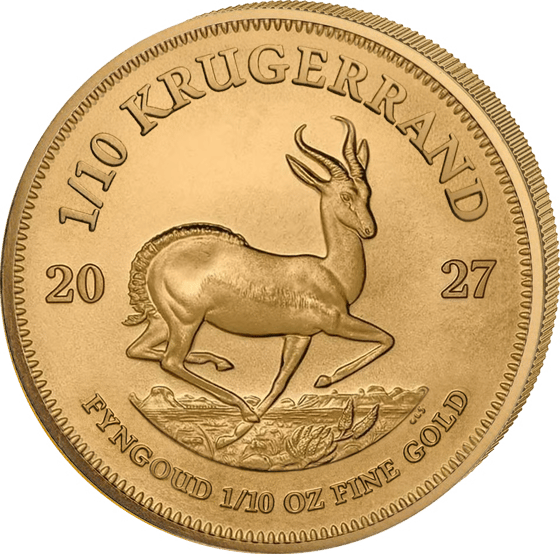
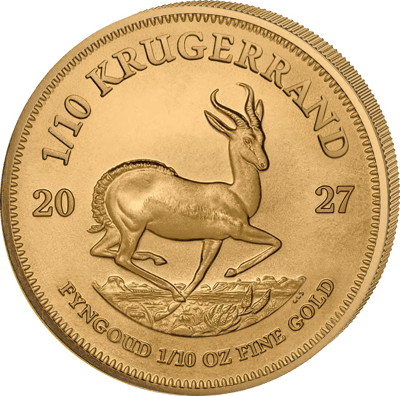
You are looking at the side with the springbok.
Gold for the hands of ordinary people.
In the late 1960s, around three quarters of the western world’s gold came from South Africa. The Chamber of Mines wanted ordinary people, too, to be able to own gold.
With the Krugerrand, a new kind of coin came into being for this purpose: exactly one ounce of fine gold, with no face value struck on it. Its value was meant to come directly from the gold it contains.
6,012,293
Krugerrand bullion coins were issued in 1978 alone, 187 tonnes of gold in all.
A leap through history
1886
Gold on the Witwatersrand
On the Witwatersrand, the ridge of white water, rich gold deposits are discovered. South Africa’s currency is also named after it: the rand.
1947
The springbok
The sculptor Coert Steynberg draws his springbok in 1946 and 1947. It first appears in 1947 on the 5-shilling coin marking the visit of the British royal family.
1967
The first Krugerrand
On 3 July, commissioned by the South African Reserve Bank and the Chamber of Mines, the South African Mint strikes the first Krugerrand.
1980
3 new sizes
The half ounce, the quarter ounce and the tenth ounce are added so that smaller sums can also be invested in gold.
2017
Fifty years
For the anniversary, the first silver Krugerrand appears, along with the 1/20 and 1/50 ounce in gold. For these coins, the designers go back to the original wax models and designs.
The motif
The springbok and the president
- The springbok
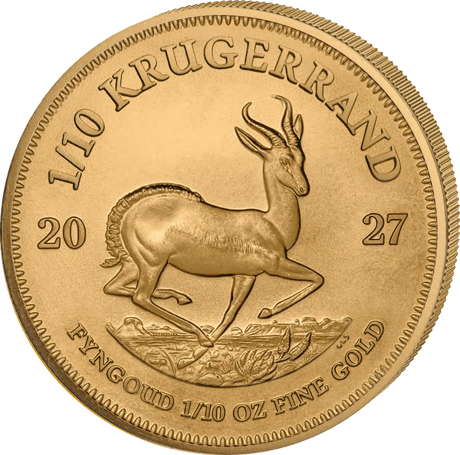
- South Africa’s national animal in mid-leap. The springbok owes its name to its characteristic leaps. It was designed by the sculptor Coert Steynberg.
- The aloe
- The motif includes an Aloe claviflora, one of South Africa’s best-known aloes. It grows in the dry interior of the country, where the springbok is also at home.
- Fyngoud
- Below the springbok is the fine gold content, framed by FYNGOUD in Afrikaans and FINE GOLD in English. Fyngoud means fine gold.
- Paul Kruger
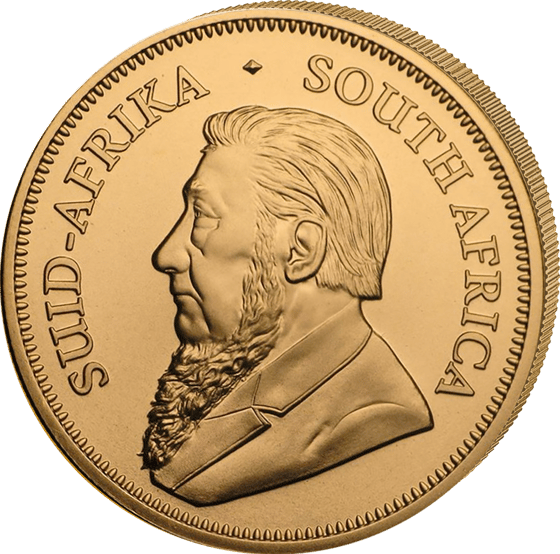
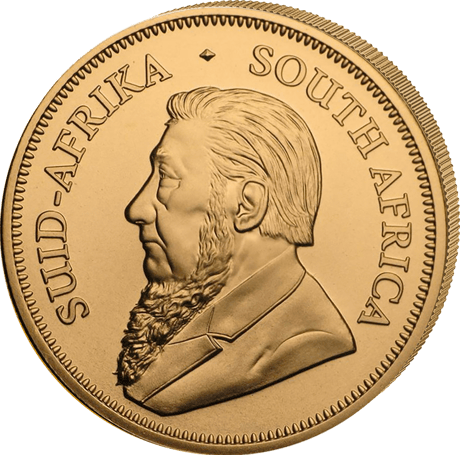
- The other side shows Paul Kruger in profile. In 1883 he became president of the South African Republic, also known as the Transvaal. The portrait was created by the die engraver Otto Schultz. According to the South African Mint, it goes back to the Kruger half-crown of 1892.
- The name
- Krugerrand combines the name Kruger with the rand, South Africa’s currency.
The alloy
Eleven parts gold, one part copper
The Krugerrand is made of 22-carat gold: eleven twelfths fine gold and one twelfth copper. The copper makes the coin harder and more resistant to scratches. It also gives the coin its warm, reddish sheen.
Every coin contains its full weight in fine gold, and the copper is added on top. That is why the one-ounce coin weighs 33.93 grams and yet contains exactly one ounce of fine gold.
The South African Mint produces the bullion coins together with the Rand Refinery. The refinery in Germiston was founded in 1920 so that South Africa’s gold no longer had to be shipped to London for refining. There, refined gold is cast into strips, rolled and punched into coin blanks.
The same leap since 1967.
Only the year is new.
By its 50th anniversary in 2017, more than 60 million Krugerrands had been sold. The 2027 issue carries this story forward, in your hand and perhaps one day in the hand of someone you pass it on to.
3.11 g fine gold · 916.67/1,000
· Brilliant uncirculated · Coin capsule
Issuing country: South Africa. The South African Mint is a wholly owned subsidiary of the South African Reserve Bank.
1/10 oz Krugerrand 2027 – the legend in a handy small format
- Special feature: the world's most popular gold bullion coin
- Investment goal: inflation hedge, value preservation and crisis protection
- Design: obverse featuring Paul Kruger, President of the South African Republic from 1883 to 1902. The reverse shows South Africa's national animal, the springbok, leaping over aloe plants and table mountains.
- Named after: Paul Kruger and the Rand, legal tender in South Africa since 1961
- Material / fineness: 22-karat alloy with 916.67/1,000 gold. The remaining 8.33% copper gives the coin its warm, reddish-gold tone and makes it especially durable.
- Manufacturer: the renowned Rand Refinery of South Africa, one of the world's most important gold refineries
- Country of origin: South Africa, home of the Krugerrand since 1967
Hardly any coin represents physical gold as much as the Krugerrand. Among all gold coins, it has made history: the first ounce was minted on 3 July 1967, and the 1/2, 1/4 and 1/10 ounce fractional coins followed in 1980. With the 1/10 oz Gold Krugerrand 2027, you hold this success story in its smallest form right in your hands. And that in the very year the world's most famous gold coin celebrates its 60th anniversary.
Springbok and president: a design that has remained for 60 years
The obverse shows Paul Kruger in left-facing profile, framed by the inscriptions SUID-AFRIKA and SOUTH AFRICA. The portrait was created by engraver Otto Schultz and dates back to 1892. The reverse belongs to the springbok. Sculptor Coert Steynberg originally designed the antelope in 1947 for the five-shilling coin, and since 1967 it has leapt across every Krugerrand. Surrounding the animal are the inscription 1/10 KRUGERRAND, the split year 20 and 27, and the bilingual weight indication FYNGOUD 1/10 OZ FINE GOLD.
It is precisely this consistency that makes the coin so appealing. The Krugerrand is recognizable at a glance, anywhere in the world.
Technical specifications of the Krugerrand gold coin
- Fine weight: 3.11 g (1/10 oz) fine gold
- Gross weight: 3.39 g
- Fineness: 916.67/1,000 (22 karat)
- Diameter: 16.50 mm
- Face value: no face value
- Year of issue: 2027
- Condition: Brilliant Uncirculated, delivered in a coin capsule
- Manufacturer: Rand Refinery, South Africa
Rand Refinery and South African Mint: gold straight from the source
The Rand Refinery in Germiston, near Johannesburg, was founded in 1920. It is considered the world's largest single-site gold refining complex and is accredited by the London Bullion Market Association (LBMA). The blanks for every Krugerrand are produced there, and the refinery is also involved in worldwide distribution. The coin itself is minted by the South African Mint. Incidentally, the name "Rand" refers not only to the national currency but also to the Witwatersrand, one of South Africa's major gold-mining regions.
Why 1/10 oz? Flexibility by design
The small denomination has clear advantages. It is well suited for getting started and for regular, self-directed saving. It also makes a popular gift for a christening, birthday, or graduation. Above all, a holding of tenth-ounce coins can later be sold piece by piece, so you never need to sell more than you currently need.
In fairness, it should also be said that the premium per gram of gold is higher for small coins than for the one-ounce issue. Anyone looking to acquire the greatest amount of gold at the lowest possible premium is better off choosing the larger sibling. Anyone who values divisibility combines both sizes.
Compared with the Maple Leaf or the Vienna Philharmonic, both of which are made of 999.9 fine gold, the Krugerrand is significantly more resistant to scratches and dents thanks to its copper alloy. The gold content, however, is exactly the same: one-tenth of a troy ounce of fine gold. Collectors who wish to honor the anniversary year 2027 in particular will also find limited special editions in Proof quality with their own anniversary mark. The Brilliant Uncirculated year of issue offered here remains the classic choice for investors.
Gold, the world's oldest currency
For over 6,000 years, gold has served as a store of value. Even in ancient Egypt it was used as a unit of measure for trade. Kings and emperors wore it as a symbol of their power, and along the Silk Road it facilitated the exchange of goods. In the 19th and 20th centuries, under the gold standard, paper money could be exchanged at any time for a fixed quantity of gold. Gold has never had a value of zero. It has intrinsic value, is scarce, and cannot be multiplied at will. Fiat money is different, since central banks can print more of it at any time.
Gold is God's money. It has shone for thousands of years and will never lose its shine.
It is remarkable that it is precisely the central banks that are the world's largest holders of gold. They keep gold as a reserve, which clearly shows just how much trust they actually place in their own paper money.
Benefits for investors in Germany
- As investment gold, the Krugerrand is exempt from VAT.
- Under current law, profits from the sale are tax-free if you have held the coin for at least one year.
- The Krugerrand is highly liquid. It is traded worldwide and can be quickly converted into cash whenever needed.
- It is durable, as gold retains its physical properties for centuries.
A piece of gold for generations
The 1/10 oz Krugerrand 2027 combines six decades of coin history with a format that fits into any wealth planning strategy. It protects your purchasing power and provides support during political and economic crises. When trust in paper currencies wavers, it serves as a reliable store of value. As a long-term retirement provision, you can also pass it on to children and grandchildren. A small springbok with a big impact.
Product image may differ from the actual product.
 ManufacturerRand RefineryRefiner · South AfricaAll products