






1 oz Gold Rothschild Hercules 1954 (n.d.) - 500 Dirhams
- Monetary History: pioneer of the gold ounce
- London Quality: R·M·R hallmark
- Rarity: most were melted down
- Monetary HistoryRegarded as the first one-ounce gold coin, 13 years before the Krugerrand
- London QualityRefined at the Royal Mint Refinery, recognized worldwide
- RarityOnly a few examples escaped melting around 1960



- Monetary History: pioneer of the gold ounce
- London Quality: R·M·R hallmark
- Rarity: most were melted down
 Price alert
 Share
Rothschild Hercules 1954: The legendary ounce from the cosmopolitan city of Tangier
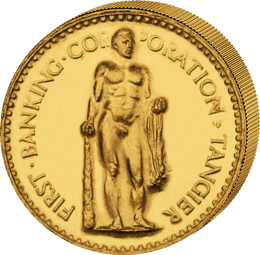
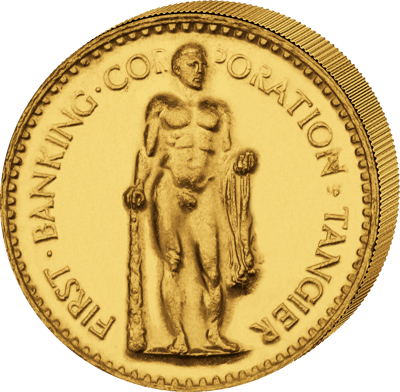
- Design: Hercules in a classic statuesque pose: he leans on his knotted club, with the pelt of the Nemean Lion draped over his arm. He is framed by the inscription "FIRST · BANKING · CORPORATION · TANGIER" and a finely detailed wreath of pearls.
- Material / Fineness: 22-carat gold with a fineness of 916.67/1,000. At a gross weight of 33.93 g, the coin contains exactly one troy ounce (31.1 g) of fine gold.
- Manufacturer: Refined by the London banking house N. M. Rothschild & Sons, issued by the First Banking Corporation in Tangier.
Some coins tell history. This one helped write it. The 1 oz Gold Rothschild Hercules was created in 1954 in a city that, at the time, stood like hardly any other for free trade, cosmopolitan openness and discreet financial dealings: Tangier, the international zone at the northern tip of Morocco. Anyone looking for historic gold coins with genuine provenance will find here a piece known to numismatists around the world, yet rarely offered for sale.
A bank and its promise in gold
In 1950, the First Banking Corporation made Tangier its headquarters. Its founder, Edouard le Roux, was convinced that only a currency backed by gold could guarantee true stability. In 1954, he therefore had pieces of one troy ounce each produced, refined by N. M. Rothschild & Sons in London. Their nickname has endured to this day: "Hercules".
The success was considerable. The Hercules ounces even outlasted the bank itself, which lost its special status when Tangier did so in 1956. As late as 1974, the "Hercules" was still being traded in Tangier and appeared on the price lists of Swiss banks. However, a large part of the mintage was melted down from 1960 onwards. This is precisely why surviving examples are so sought after today.
Hercules and the Strait of Gibraltar
Why Hercules of all figures? According to legend, the hero erected the famous Pillars of Hercules at the Strait of Gibraltar, just a few kilometres from Tangier. For a bank at the gateway between the Mediterranean and the Atlantic, there could hardly have been a more fitting design. On the obverse, he stands frontally, nude and muscular, in the classical statuary style. His head is slightly tilted, his curly hair finely detailed. With his right hand he leans on the knobbed club, while over his left arm the lion's pelt, with head and paws, falls in heavy folds. The bold relief looks almost like a small sculpture.
The reverse is restrained and elegant, entirely in the style of a bank steeped in tradition:
- Inscription "ONE FINE OUNCE TROY (GRMS 31·103) OF GOLD ASSAY 916·7"
- Two lines reading "REFINED BY" above a ring bearing the inscription "N·M·ROTHSCHILD & SONS"
- In the centre, the monogram "RM·R"
- A wreath of pearls on both sides and a cleanly reeded edge
You will search in vain for a date. The piece was minted without a date (n.d.) and is attributed to the year 1954 in catalogues. There it is listed with a face value of 500 Dirhams (KM X#12).
The secret forerunner of the Krugerrand
The Krugerrand from South Africa is generally regarded as the pioneer of the one-ounce, 22-carat gold coin. Yet the Hercules from Tangier came 13 years earlier, with the same fineness of 916.67/1,000 and likewise exactly one troy ounce of fine gold. One fascinating difference: at 25.50 mm in diameter, the Hercules is noticeably more compact than the Krugerrand, which measures around 32.8 mm, but is correspondingly thicker.
What does this mean for buyers? The Krugerrand is a classic bullion product with a very high mintage and a low premium. The Hercules, by contrast, is a genuine collector's item. It combines numismatic appeal, the Rothschild name and a rare history. This is reflected in the price, but in return you own a piece that people love to talk about and that stands out in any collection.
For collectors and investors with a sense of history
The example offered is a historic original from the secondary market. It is graded in Mint State (MS), i.e. above "extremely fine". To keep the surface and relief undamaged, the coin is delivered in a coin capsule. With its full troy ounce of fine gold, the piece also carries a material value that exists independently of any collecting trend.
Gold: Lasting value, inflation hedge and crisis protection
For over 6,000 years, the yellow metal has served as a store of value. Even in ancient Egypt it was a benchmark for trade, and kings and emperors alike wore it as a sign of their power. Gold is the oldest currency in the world and has outlived every paper currency. It is not for nothing that it is called the money of God. Its value has never fallen to zero, because it possesses an inherent, intrinsic value.
Today, this is more important than ever. Central banks can expand the supply of fiat money at will, whereas the supply of gold is limited. As an inflation hedge, it preserves purchasing power. As crisis protection, it provides stability in politically and economically turbulent times. Gold is recognised worldwide, highly liquid and tradeable at any time. It is no coincidence that central banks themselves are among the largest holders of gold in the world. What's more: in Germany, profits from the sale of physical gold are generally tax-free after a holding period of at least one year.
The Rothschild Hercules at a glance
- Face value: 500 Dirhams (according to the catalogue), country of origin Morocco
- Year of minting: 1954, without date (n.d.)
- Fineness: 916.67/1,000 (22 carat)
- Fine weight: 31.1 g (1 oz), gross weight: 33.93 g
- Diameter: 25.50 mm
- Manufacturer: N. M. Rothschild & Sons for the First Banking Corporation, Tangier
- Condition: Mint State (MS), historic original from the secondary market
- Packaging: coin capsule
Here you hold a piece of financial history in your hands: minted in the name of Rothschild, carried by the myth of antiquity's strongest hero. Collectors gain a showpiece, and anyone wishing to pass on wealth through generations gains a timeless companion. Gold has shone for millennia, and this Hercules shines especially bright.
Product image may differ from the actual product.
