





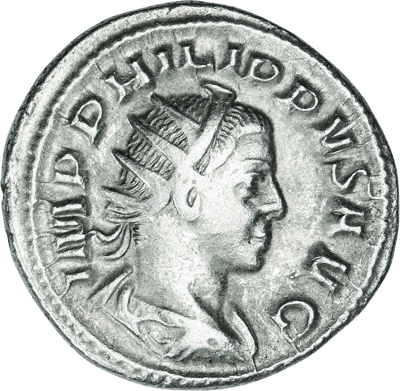


Antoninianus Emperor Philip II (260-268 AD | Ten-Year Augustus)










- Ancient Original: hand-struck
- Brief Reign: only from 247 to 249
- Radiate Crown: symbol of the double denarius
- Ancient OriginalStruck with hammer and die around 1,800 years ago
- Brief ReignA testament to the joint rule of father and son
- Radiate CrownThe emperor's crown shows the value of two denarii
 Price alert set
 share
shareAntoninianus of Emperor Philip II – Elevated to Augustus at the Age of Ten
Minting quality: deliberately not a modern Proof – each piece was struck by hand with hammer and die roughly 1,800 years ago
Precious metal: silver or silver-containing alloy (billon), fineness varies
Format: raw weight 4.2 g, diameter approx. 21 mm – handy, portable, divisible
Denomination: Antoninianus, the famous double denarius of the Roman imperial era
Issuing ruler: Philip II, son of Philip the Arab, Augustus from 247 to 249 AD
Origin: Roman Empire – an ancient original, not a series product or a replica
Condition: circulated coinage with natural patina, grades of preservation vary
Handling: fixed-price item, delivered as insured value shipping
Some coins are beautiful. This one is a witness to history. Whoever holds an Antoninianus of Philip II in their hand holds a piece of silver that passed through Roman hands – across market stalls, pay chests and legionary camps, long before any country that we now call Europe existed. It is precisely this connection between precious metal and history that makes this piece one of the most appealing entry points into ancient numismatics.
The Ten-Year-Old Co-Emperor: Who Was Philip II?
Marcus Iulius Severus Philippus, usually referred to in scholarship as Philip II, was the son of Emperor Philip the Arab and Otacilia Severa. He was seven years old when his father ascended the throne in 244, was raised to the rank of Caesar that very same year, and in 247, at the age of ten, was elevated to Augustus – nominally an equal co-ruler. The occasion was his father's return to Rome following successful campaigns against the Germanic tribes and the Carpi; in the glow of this triumph, he raised his son to Augustus. The joint reign of the two Philips fell into an exceptional year: in 248, Rome celebrated its thousandth anniversary with magnificent games.
The end came abruptly. In the decisive Battle of Verona in the autumn of 249, Philip the Arab fell; his twelve-year-old son, who had remained in Rome, was captured and killed in the camp of the Praetorian Guard. The attempt to found a new dynasty thus ended after only two years – making the coins of this young Augustus documents of a very brief era.
Obverse and Reverse – What the Pictured Example Shows
Obverse: draped, cuirassed bust facing right wearing a radiate crown, legend IMP PHILIPPVS AVG. On the Antoniniani, Philip wears the radiate crown because it denotes the denomination here.
Reverse: LIBERALITAS AVGG III – father and son sit together on curule chairs, a reference to the third monetary donation to the Roman people. The double G stands for two Augusti.
Antoninianus: The Double Denarius of the 3rd Century
In 215 AD, Emperor Caracalla introduced a new coin type that was valued at two denarii but whose weight corresponded to only 1.5 denarii. The name Antoninianus is a modern coinage, derived from the emperor's official name Antoninus. After Gordian III, this denomination gradually replaced the denarius as the leading silver coin – under the Philips, the Antoninianus was thus the everyday currency of the empire par excellence. Only after around 253 AD did the silver content drop dramatically, reaching a low point between the beginning of Gallienus's sole rule in 260 and the reign of Aurelian. The coins of Philip II therefore still date from a phase in which the denomination contained significantly more silver.
Condition: Lived History Instead of High Gloss
These pieces are circulated legal tender and bear corresponding traces: darker patina, individual centering, nicks, wear, and in some cases weaker portions of the legend. This is precisely what makes them appealing. Since the year of minting, the mint, and the reverse variant may vary, the delivered specimen will differ from the picture shown – you receive an original, not a series product. We therefore ask for your understanding that the image in the shop represents an example and may individually differ from the delivered item in terms of appearance and condition due to historical circumstances.
An ancient coin is not assessed like a modern issue in Proof. Its value lies in authenticity, historical depth, and rarity – not in mirror-like fields.
Silver as Substance: Collector's Joy Meets Precious Metal
Silver has been a monetary metal, medium of exchange, and symbol of prosperity for thousands of years. This Antoninianus demonstrates this impressively: the face value of that time has long since become history, but the metal within it remained. Anyone who acquires silver coins today is investing in a tangible asset with intrinsic value – unlike fiat money, which is based solely on trust in institutions. At the same time, silver is an industrial material in demand from electronics, solar, and medical technology, while supply remains limited.
Inflation hedge: Precious metal in physical form is traditionally regarded as an inflation hedge, because it cannot be arbitrarily multiplied.
Crisis protection: small, divisible silver coins have been valued as a means of exchange since antiquity – an idea that still holds true today when it comes to crisis protection.
Tax aspect: Profits from the sale of silver are generally tax-free, provided the holding period is at least one year.
Affordable entry point: Compared to gold, silver is significantly more accessible – especially for building up a historical collection.
Value across generations: Silver is durable, low in corrosion, and can easily be passed down.
Comparison: Antoninianus, Denarius, and Modern Silver Coins
The classic denarius is smaller, usually finer in silver, but often visually less imposing. The Antoninianus scores with a larger flan, radiate crown, and an enormous variety of designs – hardly any denomination tells so many stories. Compared to later Antoniniani of Gallienus or Aurelian, which were significantly debased, the piece of Philip II stands in a still comparatively solid phase. And compared to modern bullion coins: fine weight and fineness vary here, the appeal lies in collector's value. Anyone wanting both can combine this historical original with standard investment products.
Gold is humanity's oldest currency and has outlived all others – silver followed the same path as everyday money. This Antoninianus is tangible proof: an empire passed away, its emperors fell, but the metal endured. An ideal gift for those interested in history, a strong opening piece for a collection of Roman imperial coins, and a piece of substance that you can actually hold in your hand.
Product depiction may differ from the final product.
