




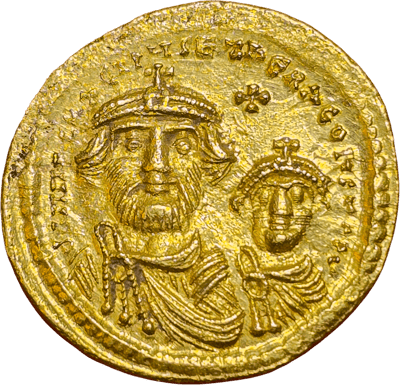


Gold Solidus Emperor Heraclius (610-664 AD | Eastern Roman Empire)









- Imperial Gold: from the 7th century
- Double Portrait: emperor with co-ruler
- With Certificate: authenticity confirmed
- Imperial GoldOriginal means of payment that has endured for 1,400 years
- Double PortraitFather and son crowned side by side, a cross between them
- With CertificateEvery piece comes with a certificate of authenticity
 Price alert set
 share
shareSolidus of Emperor Heraclius – 1,400 Years of World History in Your Hand
Design: The obverse shows the impressive double portrait: Emperor Heraclius with a long full beard, beside him the younger co-ruler Heraclius Constantinus (Constantine III), both crowned, with a cross between their heads. The reverse bears the cross potent on three steps, the victory formula VICTORIA AVGU and beneath it the famous abbreviation CONOB. Hand-struck – each specimen shows its own striking characteristics, slight off-centering and individual flan shapes.
Material and fineness: Gold of the highest quality of late antiquity.
Manufacturer: Various imperial mints of the Eastern Roman Empire. The largest striking volume came from Constantinople; workshops also operated in Alexandria, Carthage and Ravenna.
Further details: Diameter 20 mm, face value Solidus, various years of issue, country of origin Eastern Roman Empire (Byzantium).
Condition: Circulated coin, bank-standard – delivered with a certificate of authenticity.
This coin was money when Europe still consisted of ruins and new beginnings. It passed through the hands of merchants, soldiers and tax collectors, survived empires, sieges and dynasties – and now lies in your hand. This is precisely its appeal: a gold Solidus from Byzantium is not a modern collector's product, but an original means of payment from the 7th century.
The Solidus: The Hardest Currency of Late Antiquity
The Solidus was introduced in 309 by Constantine the Great, initially in Trier, as a replacement for the devalued Aureus. Its weight corresponded to 1/72 of a Roman pound, i.e. around 4.5 grams; its diameter was about 20 mm. What followed is unparalleled in monetary history: for over a thousand years, this denomination – later as Histamenon and Hyperpyron – remained in circulation. Historians are not without reason calling the Solidus the "euro of the Middle Ages".
CONOB: not merely a mint mark, but a guarantee of quality – "the proper standard of Constantinople", with OB standing for obryzon, i.e. gold purified by fire assay.
Etymology: The words "sold" (pay), "söldner" (mercenary) and "soldat" (soldier) derive from this coin. Those who served in the Byzantine army were paid in Solidi.
Purchasing power: A Roman soldier's annual pay in the 5th and 6th centuries was around four to five Solidi – a single gold piece held enormous value.
Value ratio: One Solidus equalled 24 Siliquae, the silver coins of late antiquity – the basis of our modern concept of carat.
Condition: These pieces are circulated means of payment and bear corresponding traces: darker patina, individual centering, nicks, wear and sometimes weaker areas of the legend. This is exactly what makes them appealing. Since the year of issue, mint and reverse variant vary, the delivered specimen will differ from the picture shown – you receive an original, not a mass-produced item. Please understand that the image in the shop is expressly to be regarded as an example and may differ individually from the delivered item in terms of appearance and condition due to historical circumstances.
Emperor Heraclius – The Last Ruler of Antiquity
Flavius Heraclius, Greek Herakleios, reigned from 610 to 641 AD. He took over a Byzantine Empire on the brink of collapse: Persians in the east, Avars and Slavs in the north, empty coffers in Constantinople. Heraclius reformed the administration and army, led a grueling war against the Persians to victory, and brought the relic of the True Cross back to Jerusalem. Under his rule, Greek became the official language of the empire – historians regard him both as the last emperor of late antiquity and the first ruler of the Middle Byzantine Empire. The double portrait with his son Heraclius Constantine on the obverse is political communication in its purest form: dynastic continuity, minted in gold.
Silver in the Shadow of Gold
Interesting for connoisseurs: it was precisely under Heraclius that the white metal also experienced a renaissance. Around 615, he had the silver Hexagram struck, bearing the invocation Deus adiuta Romanis – "God, help the Romans". For millennia, silver served as coinage metal, as a means of exchange in everyday small transactions, and as a symbol of wealth. It possesses intrinsic value, is in strong industrial demand in electronics, solar and medical technology, and, given its limited supply, is durable, liquid and tradable worldwide. Both metals complement each other excellently within a portfolio – especially as a hedge against currency instability. For tax purposes, physical precious metals held as private assets are generally exempt from capital gains tax after a holding period of at least one year (not tax advice).
For Collectors and Investors: Substance with History
Ancient coinage appeals to two kinds of collectors' hearts. Numismatists appreciate design variants, mint letters and stylistic differences between Constantinople and the provincial mints. Those who focus on substance receive nearly 4.41 grams of fine gold in a form that will never exist again – for the dies of this era have been lost for over a millennium. Compared to modern gold coins such as the Krugerrand or Maple Leaf, the premium is higher, because historical rarity is added; in return, the supply is definitively limited and will never grow again. Contemporary bullion coins score with narrow spreads, while the Solidus scores with aura and numismatic depth. Many buyers combine both.
Gold is humanity's oldest currency – it has outlived every paper currency that ever competed against it. The Solidus is living proof: its metal is worth today exactly what metal is worth.
As inflation hedge and as a tangible crisis protection, physical precious metal has asserted its role for centuries. A Solidus combines this preservation of value with a piece of cultural history that can be passed down – from generation to generation, entirely without counterparty risk.
Delivery and Condition
Original ancient circulated coin: signs of circulation, scratches and edge irregularities are typical and part of the authenticity.
Design, year of issue, mint and exact fineness vary – you will receive a specimen from the type series of Emperor Heraclius.
Includes certificate of authenticity, shipped as insured value shipment.
Product depiction may differ from the final product.
