






Unfortunately, this item is currently out of stock. We will be happy to send you an e-mail as soon as this product becomes available again.

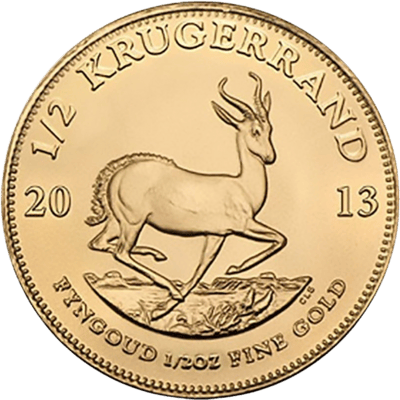
- Famous design: Kruger and springbok
- Reddish gold tone: thanks to copper content
- Rand Refinery: origin South Africa
- Famous designPaul Kruger on front, South Africa's springbok on reverse
- Reddish gold toneCopper gives it a reddish tone and more durability
- Rand RefineryThe renowned mint has produced the series since 1967
 Price alert set
 share
shareKrugerrand · 2013 Issue
The leap that began in 1967.
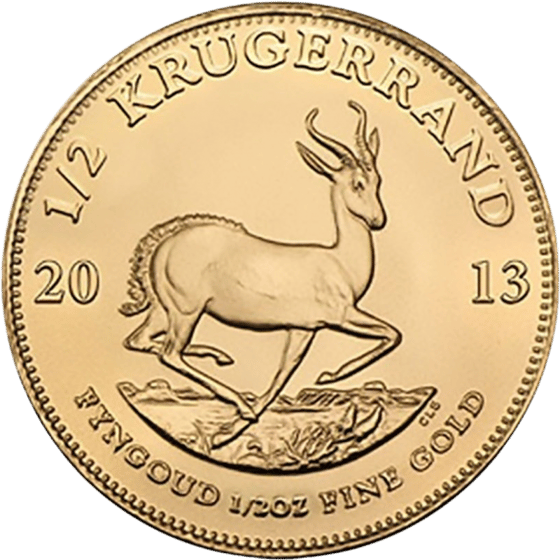
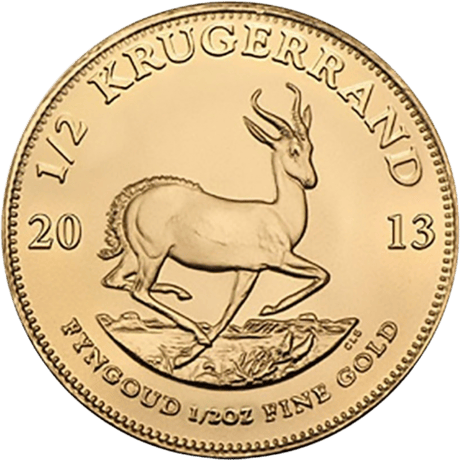
You are looking at the side with the springbok.
Gold for the hands of ordinary people.
In the late 1960s, around three quarters of the western world’s gold came from South Africa. The Chamber of Mines wanted ordinary people, too, to be able to own gold.
With the Krugerrand, a new kind of coin came into being for this purpose: exactly one ounce of fine gold, with no face value struck on it. Its value was meant to come directly from the gold it contains.
6,012,293
Krugerrand bullion coins were issued in 1978 alone, 187 tonnes of gold in all.
A leap through history
1886
Gold on the Witwatersrand
On the Witwatersrand, the ridge of white water, rich gold deposits are discovered. South Africa’s currency is also named after it: the rand.
1947
The springbok
The sculptor Coert Steynberg draws his springbok in 1946 and 1947. It first appears in 1947 on the 5-shilling coin marking the visit of the British royal family.
1967
The first Krugerrand
On 3 July, commissioned by the South African Reserve Bank and the Chamber of Mines, the South African Mint strikes the first Krugerrand.
1980
Smaller sizes
The half ounce, the quarter ounce and the tenth ounce are added so that smaller sums can also be invested in gold.
2017
Fifty years
For the anniversary, the first silver Krugerrand appears, along with the 1/20 and 1/50 ounce in gold. For these coins, the designers go back to the original wax models and designs.
The motif
The springbok and the president
- The springbok
- South Africa’s national animal in mid-leap. The springbok owes its name to its characteristic leaps. It was designed by the sculptor Coert Steynberg.
- The aloe
- The motif includes an Aloe claviflora, one of South Africa’s best-known aloes. It grows in the dry interior of the country, where the springbok is also at home.
- Fyngoud
- Below the springbok is the fine gold content, framed by FYNGOUD in Afrikaans and FINE GOLD in English. Fyngoud means fine gold.
- Paul Kruger
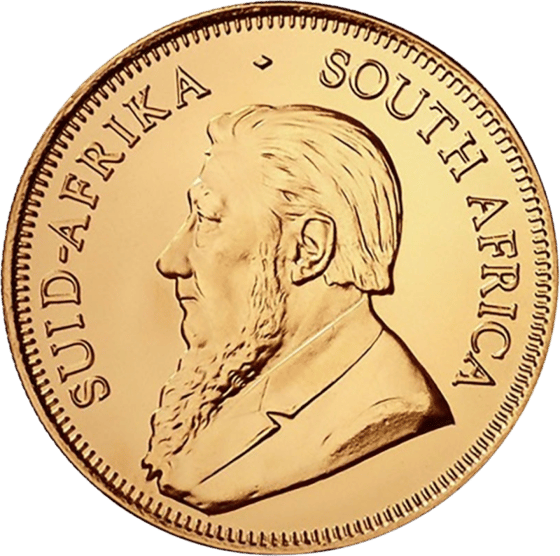
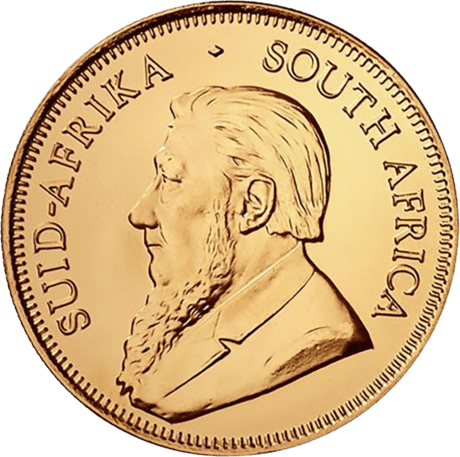
- The other side shows Paul Kruger in profile. In 1883 he became president of the South African Republic, also known as the Transvaal. The portrait was created by the die engraver Otto Schultz. According to the South African Mint, it goes back to the Kruger half-crown of 1892.
- The name
- Krugerrand combines the name Kruger with the rand, South Africa’s currency.
The alloy
Eleven parts gold, one part copper
The Krugerrand is made of 22-carat gold: eleven twelfths fine gold and one twelfth copper. The copper makes the coin harder and more resistant to scratches. It also gives the coin its warm, reddish sheen.
Every coin contains its full weight in fine gold, and the copper is added on top. That is why the one-ounce coin weighs 33.93 grams and yet contains exactly one ounce of fine gold.
The South African Mint produces the bullion coins together with the Rand Refinery. The refinery in Germiston was founded in 1920 so that South Africa’s gold no longer had to be shipped to London for refining. There, refined gold is cast into strips, rolled and punched into coin blanks.
The same leap since 1967.
This issue too.
By its 50th anniversary in 2017, more than 60 million Krugerrands had been sold. The 2013 issue is part of this story, and the story goes on, in your hand and perhaps one day in the hand of someone you pass it on to.
15.55 g fine gold · 916.67/1,000
· Brilliant uncirculated · Coin capsule
Issuing country: South Africa. The South African Mint is a wholly owned subsidiary of the South African Reserve Bank.
The 1/2 oz Gold Krugerrand 2013 is a true jewel among gold coins. Produced by the renowned Rand Refinery in South Africa, it captivates collectors and investors alike with its exquisite minting and stable intrinsic value. Presented in a coin capsule, this coin is a high-quality investment product and an excellent way to diversify your portfolio and hedge against inflation and economic crises.
The 1/2 oz Gold Krugerrand 2013: A Fascinating Piece of History
At the sight of the 1/2 oz Gold Krugerrand 2013, one is immediately transported into the history of South Africa. The portrait struck on the obverse shows Paul Kruger, the former President of the South African Republic, who gave the Krugerrand its name. The reverse is adorned with South Africa's national animal, the springbok, a proud symbol for the country and its people.
- Special feature: The world's most popular gold bullion coin
- Investment goal: inflation hedge, preservation of value, and crisis protection
- Design: The obverse depicts Paul Kruger, who was President of the South African Republic from 1883 to 1902. The reverse shows South Africa's national animal, the springbok.
- Named after: Paul Kruger and South Africa's legal tender currency since 1961, the Rand
- Material / fineness: The Krugerrand consists of gold with a fineness of 916.67/1,000. The remaining portion consists of copper, which gives the coin its characteristic reddish-golden color and makes it more durable.
- Manufacturer: The coin is produced by the renowned Rand Refinery in South Africa.
- Country of origin: South Africa since 1967
A Stable Store of Value Made of Gold
The 1/2 oz Gold Krugerrand 2013 is not only a fascinating collector's item but also a stable store of value. Gold has been a proven store of value for over 6,000 years and has never had a value of zero. It possesses intrinsic value and protects against loss of purchasing power. Gold is tradable worldwide and can be used as a medium of exchange. With a fine weight of 15.55 g and a diameter of 27.00 mm, the coin is compact and convenient to transport.
The 1/2 oz Gold Krugerrand 2013 is more than just a gold coin. It is a sign of stability, a symbol of permanence, and a valuable companion in uncertain times.
Invest in the World's Oldest Currency
Gold is the world's oldest currency and has outlasted all other currencies. It offers protection against political and economic crises and has a low correlation with other asset classes such as stocks and bonds, which contributes to portfolio diversification. Gold can serve as long-term retirement provision and pass wealth from generation to generation. It acts as a store of value when trust in fiat money fluctuates or declines.
The 1/2 oz Gold Krugerrand 2013: A Safe Investment
The 1/2 oz Gold Krugerrand 2013 is a safe investment in uncertain times. It offers the security and stability of gold, which has been regarded as a safe haven in times of crisis for thousands of years. With its excellent minting and historical significance, it is an outstanding addition to any portfolio. Invest in the 1/2 oz Gold Krugerrand 2013 and secure a piece of history that retains its value.
Product depiction may differ from the final product.