





- Imperial design: with double eagle
- Crown since 1892: year 1912
- Fine weight: 3.05 g gold
- Imperial designEmperor Franz Joseph on front, imperial eagle on back
- Crown since 1892Restrikes bear the year 1912
- Fine weightA gold coin with a fineness of 900/1,000







- Imperial design: with double eagle
- Crown since 1892: year 1912
- Fine weight: 3.05 g gold
 Price alert
 Share

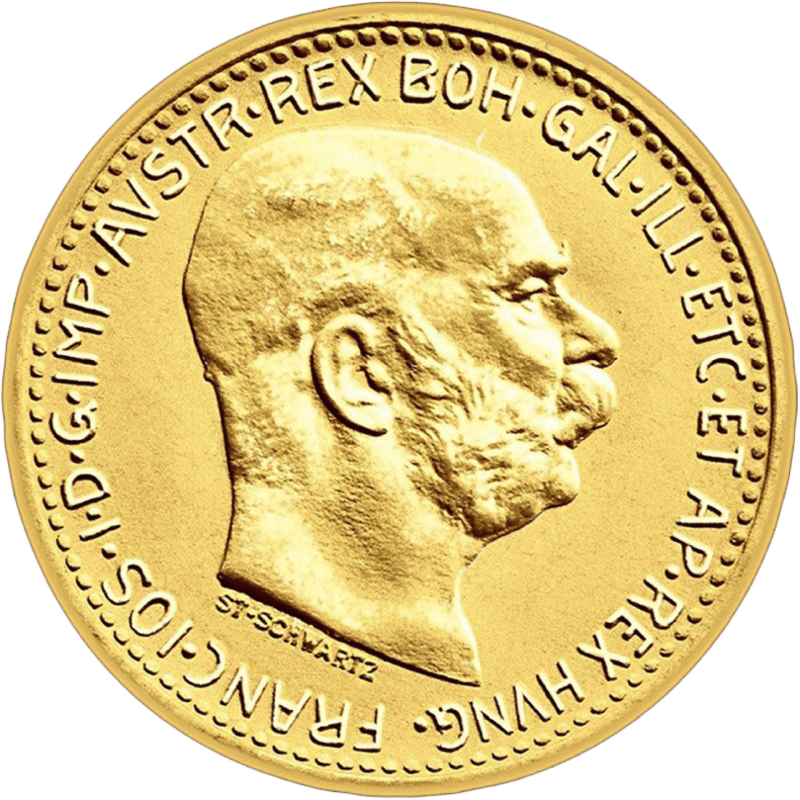
The gold of the Habsburgs · Kronen
10 Gold Kronen Austria.The emperor’s profile on the first gold currency.
With the krone, Austria gained its first gold currency in 1892. These 10 Kronen read 1912.
- Fine gold
- 3.05 g
- Fineness
- 900/1,000
- On the coin
- 1912
With the krone, Austria gained its first gold currency in 1892. These 10 Kronen read 1912.
- Fine gold
- 3.05 g
- Fineness
- 900/1,000
- On the coin
- 1912
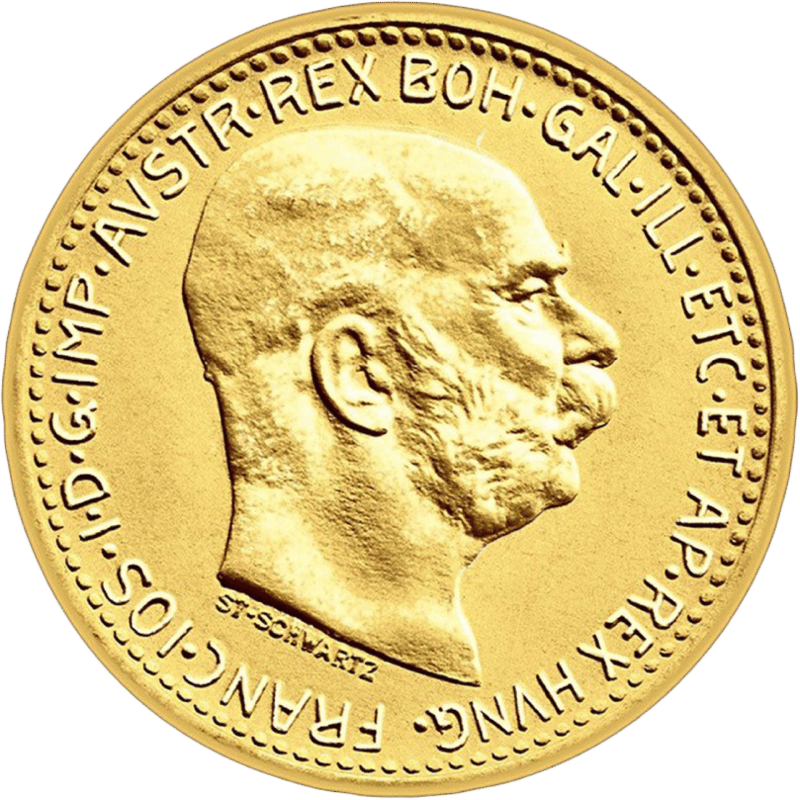
Up close
The emperor in profile, without a wreath, on 10 Kronen in gold.
Here the coin shows the emperor without a wreath. The portrait is the work of the medallist Stefan Schwartz, and his signature stands below the neck.

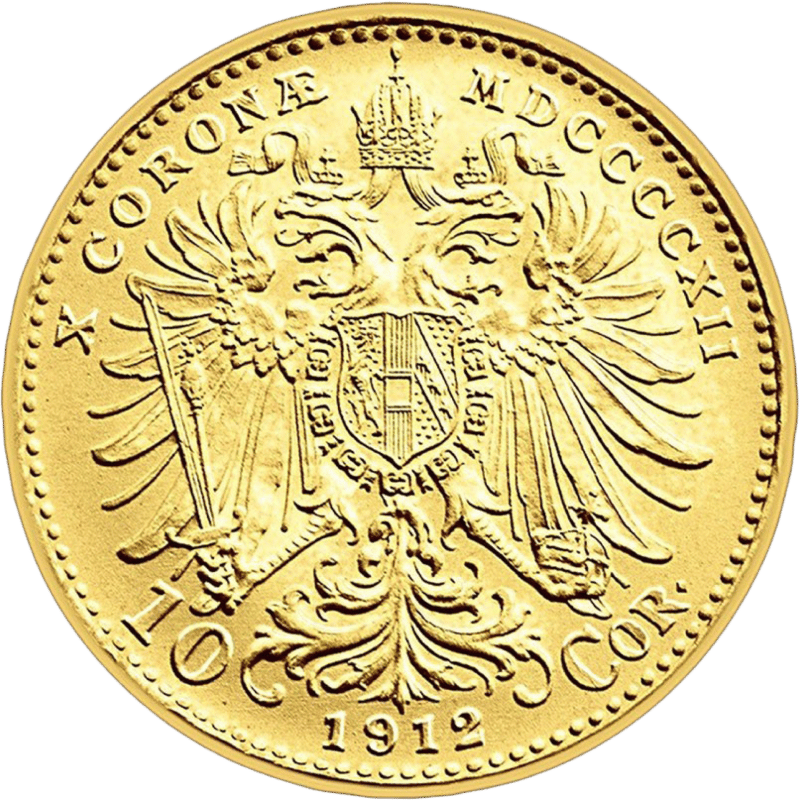
The reverse
The 10 Kronen turn: 1912 stands at the top as MDCCCCXII.
At the top stand X CORONAE and the year MDCCCCXII in Roman numerals, at the bottom 10 COR. and 1912 in figures.
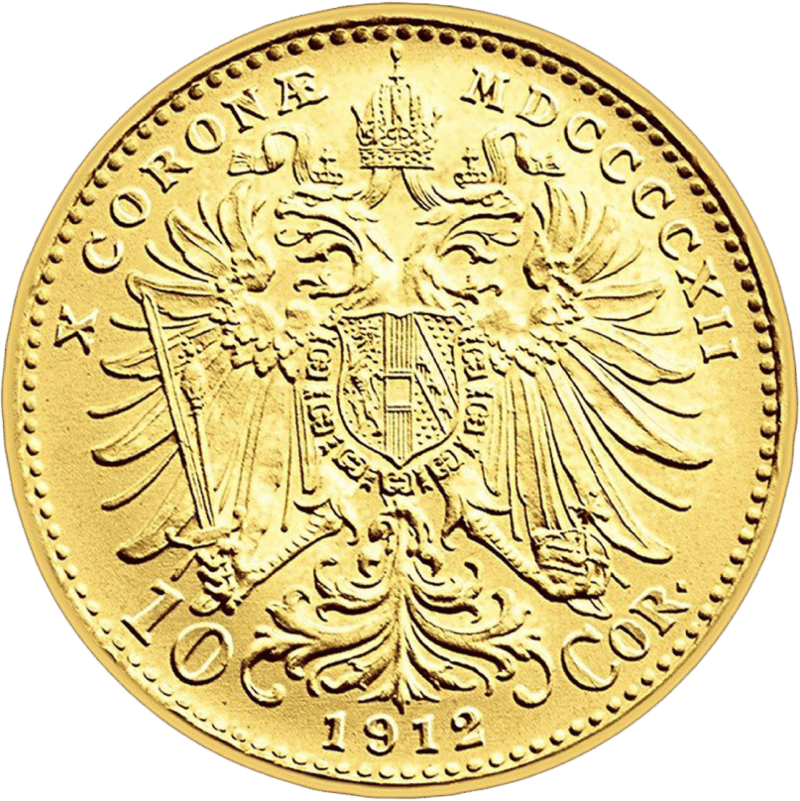
The reverse up close
Value and year both appear twice on this side: in Roman numerals at the top, in Arabic numerals at the bottom.

Kronen from 1892
10, 20 and 100 Kronen.The gold of Austria’s first gold currency.
With the currency reform of 1892 the krone became Austria’s first gold currency, and the 10 and 20 Kronen replaced the gulden. The reverse reads CORONAE, Latin for crowns.
- 1892In August the krone replaces the gulden. It is Austria’s first gold currency.
- 1900Until 1 January 1900 gulden and krone are valid side by side: 2 kronen for 1 gulden.
- 1908For the emperor’s 60th jubilee the 100 Kronen coin joins the family.
- 1912This year stands on the 10 Kronen.

The mint
10 Kronen from Vienna.Struck on the Heumarkt, in the heart of the city.
The mint building on the Heumarkt has stood since 1838. The Münze Österreich is still based here today, and here, in the heart of Vienna, its coins are made.
- 1733Since this year Vienna has had the mint’s engraving academy.
- 1838The mint building on the Heumarkt is completed.
- 1918Since then Vienna has been Austria’s only mint.
All 7 on the shelf
From 4 Florin to 100 Kronen.7 gold coins of the emperor in a row.
In true proportion, by the dimensions of the Münze Österreich, with more fine gold from left to right.
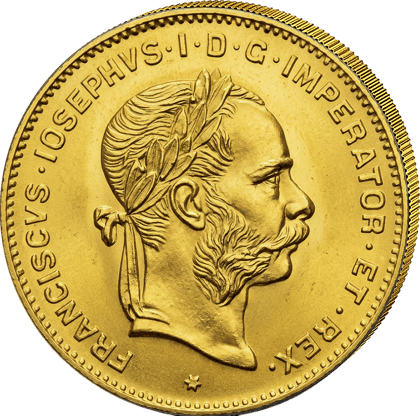 4 Florin2.90 g
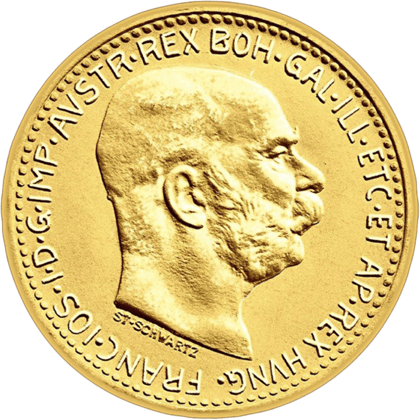 10 Kronen3.05 gThis page
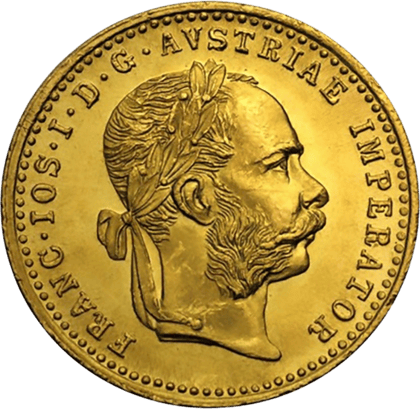 1 Ducat3.44 g
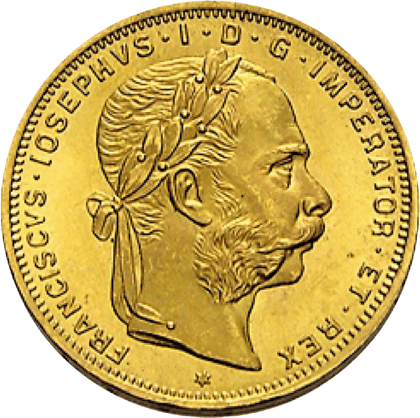 8 Florin5.81 g
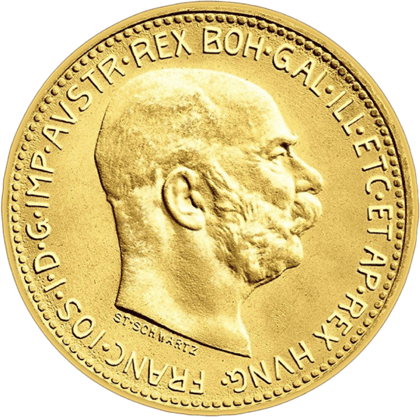 20 Kronen6.10 g
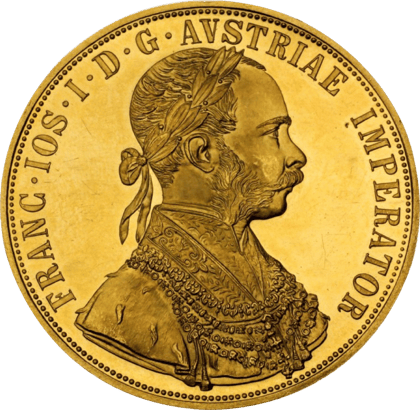 4 Ducats13.77 g
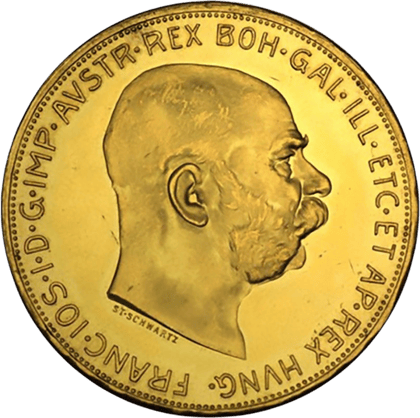 100 Kronen30.49 g
The fact sheet
10 Kronen in gold, measure by measure.
- Face value
- 10 Kronen
- Year on the coin
- 1912
- Obverse
- Emperor Franz Joseph I in profile
- Reverse
- Double eagle, value in kronen
- Portrait
- Stefan Schwartz
- Mint
- Münze Österreich, Vienna
- Country
- Austria
- Packaging
- Coin capsule
Dimensions and weights as stated by the Münze Österreich. The year is the one that stands on the coin.
The family
The gold of the Habsburgs.7 coins with Franz Joseph I, struck in Vienna.
Ducats, florin and kronen: 3 families with the emperor’s portrait, all from Vienna.
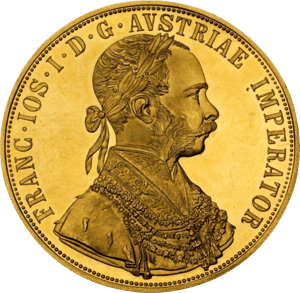
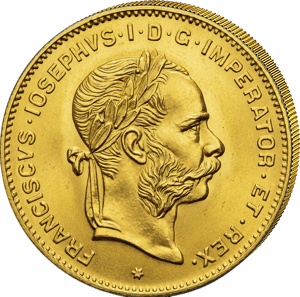
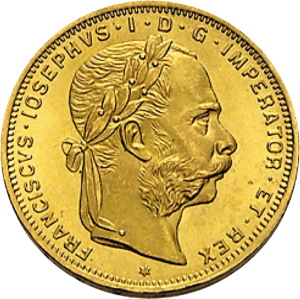
Kronen
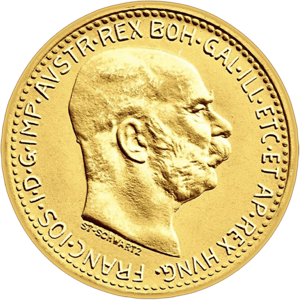 10 Kronen3.05 g fine goldThis page
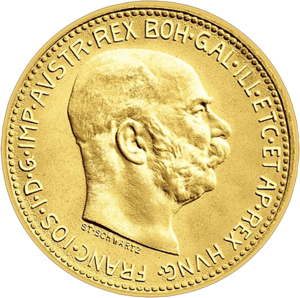 20 Kronen6.10 g fine gold
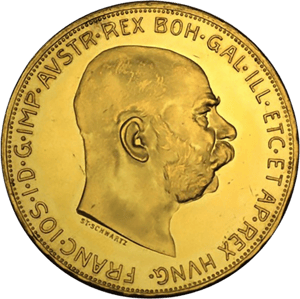 100 Kronen30.49 g fine gold

The gold of the Habsburgs
10 Gold Kronen.Viennese gold with the emperor in profile.
The emperor’s portrait by Stefan Schwartz in front, the double eagle behind, gold 900/1,000 from Vienna.
10 Gold Crowns Austria: the entry point into imperial crown gold
- Design: The coin bears the portrait of Franz Joseph I with a long series of abbreviated Latin titles.
- Material / Fineness: The alloy achieves a fineness of 900/1,000, meaning the coin contains 3.05 g of pure gold.
- Manufacturer: A product of the Austrian Mint, with its centuries-long minting tradition.
- Denomination: 10 Crowns with a diameter of 19 mm, the entry point into the Austrian gold crowns.
- Provisioning: Small value units that make excellent barter coins in times of crisis.
A solid gold reserve doesn't have to begin with a large coin. With 3.05 g of fine gold, the 10 Gold Crowns Austria are ideal for gaining first experience with physical gold or for supplementing an existing reserve. At the same time, they rank among the historic gold coins whose imperial portrait recalls the era of the Danube Monarchy.
The emperor's titles in the inscription
The emperor's portrait is accompanied by the inscription FRANC IOS I D G IMP AVSTR REX BOH GAL ILL ETC ET AP REX HVNG. Spelled out, it means: Franz Joseph I, by the Grace of God Emperor of Austria, King of Bohemia, Galicia, Illyria and so forth, as well as Apostolic King of Hungary. A fine beaded rim forms the border. The artist is also represented on the coin, as the name SCHWARTZ belongs to the engraver who designed the portrait.
Three gold coins, one currency
With the Crown, Austria-Hungary introduced a currency built on gold. Alongside the 10 Crowns, there were also gold coins of 20 and 100 Crowns, making the coin at hand the lowest denomination. Its total weight is 3.39 g, with a fine gold content of 3.05 g at a fineness of 900/1,000. It is offered as circulated merchandise in bank-standard condition, so visible signs of wear are normal.
A barter coin for turbulent times
What particularly recommends this coin for crisis provisioning is its denomination. A 10-Crown coin represents a manageable value and can therefore be exchanged easily should the usual means of payment ever fail. Since gold is recognized as a store of value around the globe, the coin also remains a usable medium of exchange abroad.
From the Austrian Mint
The 10 Gold Crowns Austria come from the Austrian Mint, one of the largest mints in Europe. The history of the house dates back to the year 1194, and alongside coins, it also offers high-quality gold bars.
From the gold standard to today
At the time of the Crowns, many currencies were directly tied to gold, and paper money could be redeemed for a fixed amount of the precious metal. Today, paper money is no longer backed by gold; central banks control its supply at their own discretion. Gold, on the other hand, has served as a proven store of value for thousands of years. With the 10 Gold Crowns Austria, you create an inflation hedge made of real metal that no central bank can multiply. Private investors in Germany also do not have to pay tax on a sales profit if they have held the coin for longer than one year.
Key data of the coin
- Face value: 10 Crowns
- Fine weight: 3.05 g
- Gross weight: 3.39 g
- Fineness: 900/1,000
- Diameter: 19 mm
- Manufacturer: Austrian Mint
- Country of origin: Austria
Even a great gold treasure is, in the end, made up of individual pieces.
Lay the foundation for your personal gold reserve with the 10 Gold Crowns Austria from Kettner Edelmetalle.
Product image may differ from the actual product.
 ManufacturerMünze ÖsterreichState mint · AustriaAll products
