





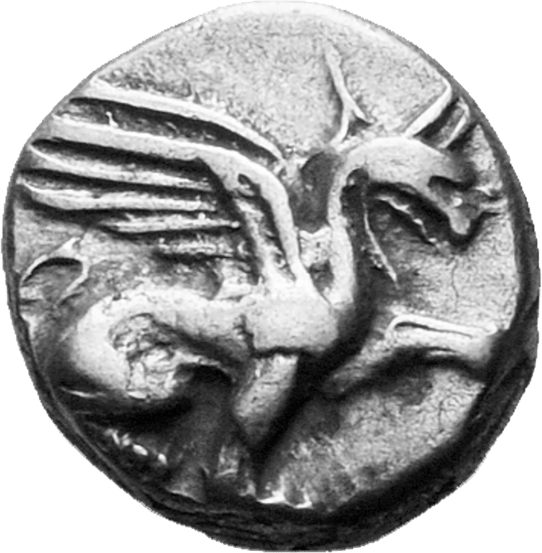


Silver Diobol Ionian Griffin of Teos (300-200 BC | Original from Greek Antiquity)
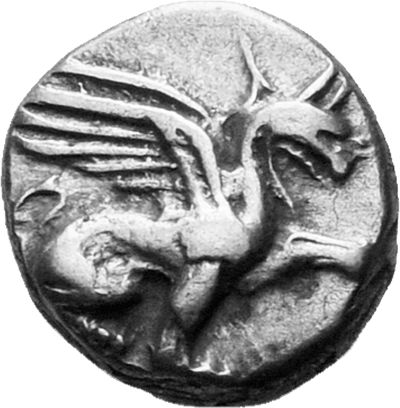












- Witness to history: over 2,200 years old
- Lyre of Apollo: on the reverse
- True one-of-a-kind: hand-struck
- Witness to historyOutlasted Persians, Macedonians, Seleucids and Romans
- Lyre of ApolloThe tortoiseshell lyre honors the music city of Teos
- True one-of-a-kindNo aftercast, no replica: each piece with its own patina
 Price alert
  Share
ShareAncient original
Classical GreeceDiobol of Teos


You are looking at the front.
Between the day someone struck this piece with a single hammer blow and the day you hold it, there are roughly
2,300years
- Struck by hand
- Original, not a restrike
- 9 mm across
- 30 days return policy
Where it belongs
Eleven epochs, a thousand years, one shelf.
Every city struck its own image and stood behind the weight with it: the owl for Athens, the turtle for Aegina, the griffin for Teos. The pieces are small, often a single gram, and were genuinely carried in the mouth, because clothing had no pockets.
7th to 5th century BC
Archaic Greece
5th to 4th century BC
Classical Greece
Your piece
6th century to 330 BC
Achaemenid Persia
5th to 2nd century BC
Carthage
336 to 30 BC
The hellenistic age
3rd to 1st century BC
Celtic tribes
27 BC to AD 235
The Roman empire
AD 235 to 284
Crisis of the third century
AD 284 to 313
The tetrarchy
AD 306 to 363
The Constantinian dynasty
AD 395 to 1453
The eastern Roman empire
Keeping it
First things first: do not clean it.
The dark layer on bronze and the matte grey on silver are called patina. It has grown over centuries and collectors treat it as a mark of authenticity. Polishing it away does not give you a nicer piece, it gives you a damaged one: auction houses regularly value a brightly cleaned coin below the same coin with its patina intact.
Hold it by the edge
Fingerprints contain acid and salt. Take the piece between thumb and forefinger by the rim, over a soft surface.
Store it dry and dark
Moisture is the only real enemy. A pouch or a capsule in a dry place is enough; PVC sleeves are not, they attack the surface.
No agents, no brush
No vinegar, no silver cloth, no ultrasound. If you want a crust removed, let a conservator do it, not the kitchen sink.
The Griffin of Teos: Over 2,200 Years of History in the Palm of Your Hand
Some coins are simply beautiful. This one is a witness to history. The silver diobol of the Ionian city of Teos was struck between 300 and 200 BC, at a time when the successors of Alexander the Great were vying for control of Asia Minor, and the largest Dionysus temple of the ancient world was rising from the ground in Teos. Whoever holds this piece in their hand is holding an original from Greek antiquity: just 9 millimetres in diameter, roughly 1 gram in weight, hand-struck from silver. No recast, no modern re-strike, no replica.
Griffin and Chelys: The Design in Detail
The obverse shows the city's heraldic animal: a griffin seated facing right, its forepaw raised, its wings finely feathered, its eagle's beak open. Lion's body, eagle's head, wings – the griffin was regarded as the sacred companion of Apollo and guardian of gold and hidden treasures. Since the 6th century BC it has appeared on every coinage of Teos, from the heavy stater through the drachm and tetrobol down to the tiny tetartemorion.
The reverse bears a chelys, the lyre made from a tortoise shell, which myth attributes to Hermes and which Apollo made his own instrument. Beside it are the letters ΤΗΙ for ΤΗΙΩΝ, the legend of the people of Teos, along with the name of the responsible mint magistrate, such as ΔΙΟΥΧΗΣ. This design is no coincidence: in Teos, the first artists' guild in history was formed, the Dionysiac Technitai, made up of actors, musicians and poets.
The Facts of This Coin at a Glance
Material: Silver, ancient hand-struck coinage without a defined fineness rating
Gross weight: 1 g
Diameter: 9 mm
Period of minting: approx. 300–200 BC
Mint location: Teos, Ionia (Asia Minor)
Denomination: Diobol, i.e. two obols
Condition: These pieces were circulated as legal tender and bear corresponding traces: darker patina, individual centring, nicks, wear, and in places weaker areas of the legend. This is precisely what gives them their charm. Since the year of minting, the mint, and the reverse variant can differ, the specimen delivered will differ from the illustration – you are receiving an original, not a mass-produced item. We therefore ask for your understanding that the image shown in the shop is an example and may individually differ from the delivered item in terms of appearance and condition due to historical circumstances.
What Was a Diobol Actually Worth?
The Greeks calculated in drachms. Six obols made up one drachm, so a diobol corresponded to two obols, or one third of a drachm. This was everyday money. Small change for the market, for the ferryman, for a jug of wine from the vineyards surrounding the city. This is precisely the appeal of this coinage: large tetradrachms were stored in temple treasuries and state coffers, whereas this diobol passed through the hands of fishermen, merchants and craftsmen.
Teos: City of Wine, Music and Maritime Trade
Teos was located on the Bay of Sığacık near Seferihisar, around 50 kilometres southwest of present-day Izmir. As a member of the Ionian League, the port city grew wealthy through trade. The poet Anacreon was born here. From 220 BC onwards, the architect Hermogenes built the monumental Temple of Dionysus, completed around 190 BC and considered the largest of its kind in Asia Minor. This coin dates precisely to this golden age. Comparable pieces can be found today in museum collections and in major numismatic reference works.
Gold and silver are humanity's oldest currencies. This diobol has outlasted the Persians, Macedonians, Seleucids and Romans, and today it still rests as a precious metal of enduring value in the hand of its owner.
Comparison: Diobol, Drachm and Tetradrachm
Anyone collecting Greek silver coins often starts with the Athenian owl or a tetradrachm from Macedonia. These large silver coins impress through their size, weight and visual impact, but they demand a considerably larger budget. The diobol of Teos takes the opposite approach: a very compact denomination, yet featuring one of the most expressive animal designs of the entire ancient world. Compared to the bronze coinage of the same city, it has the clear advantage of being precious metal. Compared to Roman denarii, it is once again centuries older. And in a collection of small ancient silver coins, the griffin is almost a must-have piece.
Who This Ancient Diobol Is Suitable For
For newcomers to ancient numismatics who are seeking a genuine piece of Greece. For collectors of mythological designs. And for anyone who wants to add a historical facet to their precious metal holdings – one with a story to tell. Each specimen is a hand-struck one-of-a-kind: die position, centring, patina and condition vary from coin to coin – this is exactly what makes ancient coinage so distinctive. Delivery is made via insured value shipping.
Product depiction may differ from the final product.
