





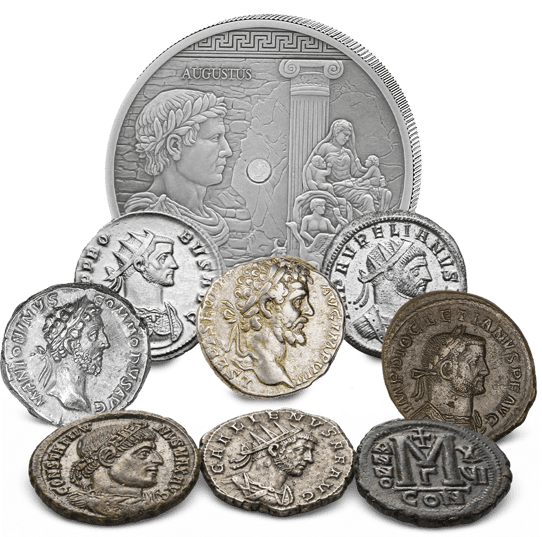




Imperium Romanum - 600 Years Collection (from Augustus to Justinian)
Unfortunately, this item is currently out of stock. We will be happy to send you an e-mail as soon as this product becomes available again.
- Genuine Originals: eight ancient coins
- Limited Ounce: only 999 pieces
- Ideal Gift: for lovers of Rome
- Genuine OriginalsOnce soldiers' pay and traders' money of Rome
- Limited OunceThe modern silver ounce exists only 999 times worldwide
- Ideal GiftNine coins tell the history of Rome, ready to hold
- 1 xSilver Denarius Emperor Septimius Severus (193-211 AD | Victor over Persia)
- 1 xAntoninianus Emperor Gallienus (260-268 AD | Age of the Imperial Crisis)
- 1 xAntoninianus Emperor Aurelian (270-275 AD | Age of the Imperial Crisis)
- 1 xSilver Denarius Emperor Commodus (180-192 AD | An Emperor as Gladiator)
- 1 xBronze Follis Emperor Constantine I the Great (306-337 AD | Rise of Christianity)
- 1 xBronze Large Follis Emperor Diocletian (284-305 AD | Age of the Tetrarchy)
- 1 x1 oz Silver Masters of Empires Augustus 2025 (Mintage: 999 | Antique Finish)
- 1 xAntoninianus Emperor Probus (276-282 AD | Age of Germanic Invasions)
- 1 xBronze Follis Emperor Justinian I (543 AD | Era of the Reconquest of Italy)
 Price alert set
 share
shareCurated collection
The Roman Empire
Ancient originals and modern strikes, laid out side by side.
A collection usually takes years to grow. This one arrives complete.
9
pieces in this collection
Why as a collection
Put together, not hunted down.
Anyone collecting a subject one piece at a time buys whatever happens to be in stock. Older years, small mintages and strikes from other countries turn up later, or never again.
- One common thread
- The pieces were chosen for a subject, not for what happened to be available.
- A subject closed
- Instead of filling gaps over time, the subject stands whole from the first day.
- No hunting needed
- Gathering what lies together here one piece at a time costs time and attention over years.
What the additions in the name mean.
These terms appear in the article names of the collections. They describe how a coin was made.
- Proof
- The most elaborate way of striking. The die is polished, the field of the coin mirrors, the motif stands matt on top of it.
- Antique finish
- The finished strike is treated afterwards until it looks dark and uneven, like a piece that lay in the ground for a long time.
- High relief
- The motif stands noticeably higher above the field than usual. For that the coin passes through the press several times.
- Partial gilding
- A thin layer of gold is applied to parts of a silver coin so that single areas stand out.
Collecting usually takes years.
Here everything is together on day one.
Different mints, different years, different formats. Gathered one by one, that would be the work of many evenings.
- Pieces
- 9
- Fine weight
- 31.1 g
- Subject
- The Roman Empire
Imperium Romanum: 600 Years of World History in One Collection
From Augustus, Rome's first emperor, to Justinian, who once again sought to reclaim the lost Western Empire: this collection spans an arc of roughly six centuries. Eight original ancient Roman coins from the Roman Imperial era and the early Byzantine period meet a modern troy ounce of fine silver dedicated to the founder of the imperial office. The result is no random pile of metal. It is a history book you can hold in your hand.
Each of the ancient coins was real money. Legionaries were paid with it, merchants in Gaul, Syria and North Africa settled accounts with it. Denarius, Antoninianus, Follis – arranged in chronological order, these pieces tell how the Roman Empire flourished, plunged into crisis, reinvented itself and ultimately became Christian.
The Collection's Contents at a Glance
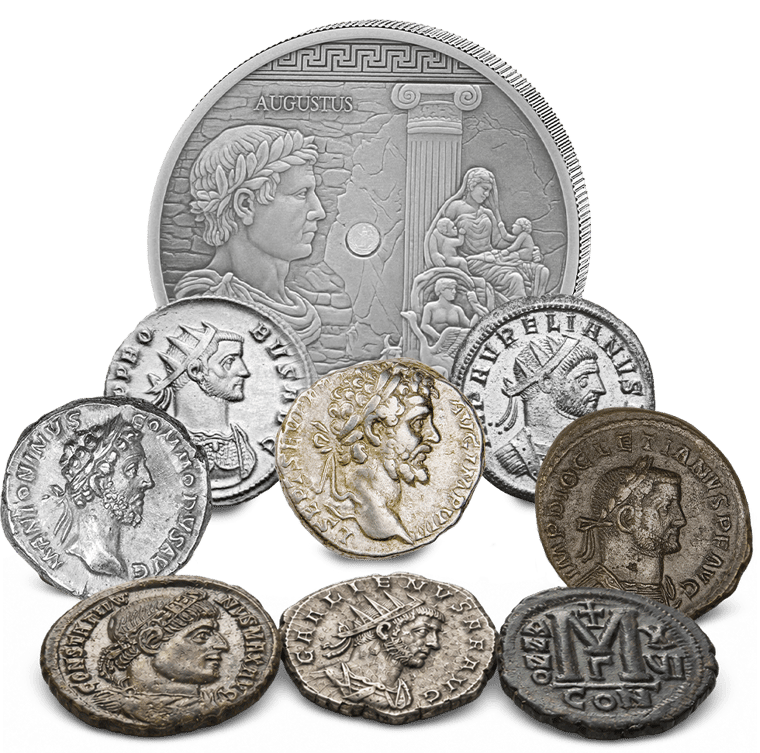
- 1 oz Silver Masters of Empires Augustus 2025 – mintage of 999 pieces, antique finish, 31.1 g silver
- Silver Denarius Emperor Commodus (180–192 AD | An emperor as gladiator) – approx. 3.0 g
- Silver Denarius Emperor Septimius Severus (193–211 AD | Victor over Persia) – approx. 3.2 g
- Silver Antoninianus Emperor Gallienus (260–268 AD | Age of the Crisis of the Empire) – approx. 3.5 g
- Silver Antoninianus Emperor Aurelian (270–275 AD | Age of the Crisis of the Empire) – approx. 3.9 g
- Silver Antoninianus Emperor Probus (276–282 AD | Age of the Germanic Invasions) – approx. 3.9 g
- Bronze Large Follis Emperor Diocletian (284–305 AD | Age of the Tetrarchy) – approx. 10 g
- Bronze Follis Emperor Constantine I the Great (306–337 AD | Rise of Christianity) – approx. 4.5 g
- Bronze Follis Emperor Justinian I (543 AD | Time of the Reconquest of Italy) – approx. 17 g
Augustus: The Modern Ounce as the Centrepiece
Visually and thematically, the Augustus coin forms the opening act. It is the first issue in the "Masters of Empires" series, hails from the issuing country of Cameroon, and is limited worldwide to just 999 pieces. The coin's design looks like an ancient marble relief: on the left, the laurel-wreathed profile of the emperor set against cracked ashlar masonry, with the inscription AUGUSTUS above. In the centre rises a fluted column with a volute capital. On the right sits a mother figure with two children on her lap, a bull and a sheep resting at her feet – imagery reminiscent of the Ara Pacis and, by extension, the Pax Romana.
A genuine detail for connoisseurs is the inset micro-coin of about 3 mm, recalling the peace coin minted under Augustus. The antique finish with its matte-grey patina, the surrounding meander frieze and the reeded edge round off the design. Anyone who collects modern silver coins will find here a coin that fits thematically perfectly alongside the originals beside it – and, with 31.1 g of fine silver, brings genuine substance along with it.
From Commodus to Justinian: Emperors, Crises and Reforms
The Denarii: Splendour and Hubris at the End of the 2nd Century
Commodus, son of the philosopher-emperor Marcus Aurelius, personally appeared in the arena and had himself celebrated as the Roman Hercules. An emperor as gladiator – Rome had never seen anything like it. After his assassination at the end of 192, the Year of the Four Emperors followed, from which Septimius Severus emerged victorious. The ruler, who hailed from Leptis Magna in North Africa, marched against the Parthians, who at the time ruled over Persia, captured their capital Ctesiphon, and from then on bore the victory title Parthicus Maximus. Both denarii show the bearded, laurel-wreathed imperial portrait in the classical manner.
The Antoniniani: Money in the Crisis of the Empire
The Antoninianus, also called antoninianus, was introduced under Caracalla and can be recognised by the ruler's radiate crown. Under Gallienus the empire experienced its darkest hour: his father Valerian was captured by the Persians in 260, while in the west the Gallic Empire broke away. Aurelian won back the breakaway provinces, had Rome fortified with the wall named after him, and reformed the coinage system – not for nothing was he celebrated as "Restorer of the World". Probus, finally, drove back the Franks, Alamanni and Burgundians and secured the threatened frontiers. Fascinatingly, the silver content of the antoniniani dropped dramatically over the course of the 3rd century. These pieces are thus a tangible record of early currency debasement.
Diocletian and Constantine: The Follis and a New Order
With Diocletian came the turning point. He divided power among four emperors in the Tetrarchy and, with his coinage reform, created a new leading denomination, the follis. The large follis in this collection weighs around 10 g and impresses with its broad flan. Constantine the Great triumphed at the Milvian Bridge in 312, promoted Christianity, and founded Constantinople – the city that remained the capital of the Eastern Roman Empire for more than a millennium.
Justinian I: The Dream of the Old Empire
The final piece is a heavy follis of Justinian from the year 543. His generals reconquered North Africa and Italy for the empire, and in Constantinople the Hagia Sophia was built. The reverse bears the large "M" as a mark of value for 40 nummi, topped by a cross – an unmistakable motif of early Byzantine coinage.
Preservation: Originals with Character
All eight historical coins are genuine originals and were used as legal tender roughly 1,480 to over 1,840 years ago. As such, they are circulated pieces bearing individual traces: natural patina, off-centre or warped flans, wear, and in some cases weaker legends. The year of issue, mint and reverse variant may vary, meaning each coin supplied is a unique piece and may differ from the image shown. A detailed explanation of the condition can be found on the respective individual product pages.
Collection or Individual Purchase? A Comparison
- Curated overview: Nine stations of Roman history form a coherent journey through time – from the Principate to Late Antiquity.
- Material diversity: Silver, billon and bronze show how Rome's currency changed over the centuries.
- Bridge between old and new: The modern Augustus ounce complements the ancient originals with pure fine silver.
- Ideal as a gift: A set with genuine substance for history enthusiasts and newcomers to numismatics alike.
Anyone looking for just one particular emperor will also find the coins available as individual items. Classic bullion coins such as Maple Leaf or Vienna Philharmonic, by contrast, offer standardised fineness but no historical depth. This collection combines both: collector's value and the substance of genuine silver.
Tangible Asset with Six Centuries of Experience
Gold is humanity's oldest currency and has outlived all others. Silver has accompanied it just as long as a coinage metal. The ancient Roman coin in your hand proves it: empires pass, precious metal endures. The gradual debasement of the antoninianus in particular shows why people have always relied on physical assets as protection against inflation and crisis.
Nine coins, six centuries, one empire – this collection makes the history of Rome tangible like hardly any other collector's item.
Product depiction may differ from the final product.