





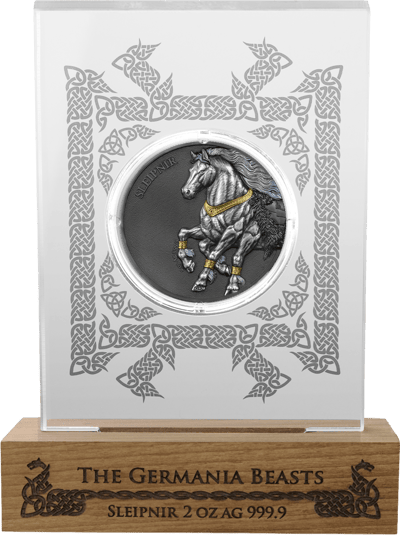





2 oz Silver Germania Beasts Sleipnir 2026 (Mintage: 999 | Antique Finish | Ruthenium | UV Effect | Partially Gilded)









- Odin's Horse: double high relief
- Series Finale: crowning conclusion
- Authenticity Verified: individually numbered
- Odin's HorseThe eight-legged horse in full motion with flowing mane
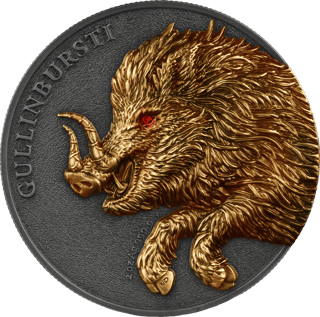
- Series FinaleCompletes the series after Fafnir, Fenrir and Gullinbursti
- Authenticity VerifiedEach piece comes numbered with certificate of authenticity
 Price alert set
 share
share
Strike · 2 ounces fine silver
A few pages that survived.
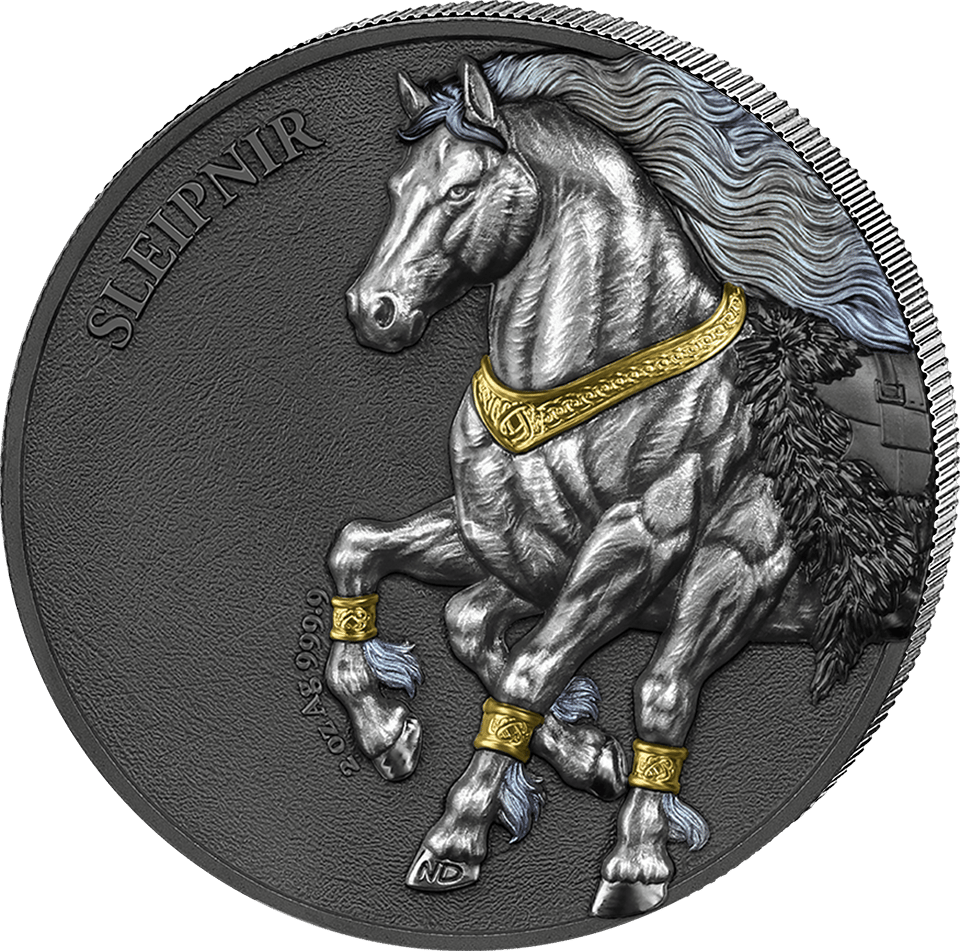
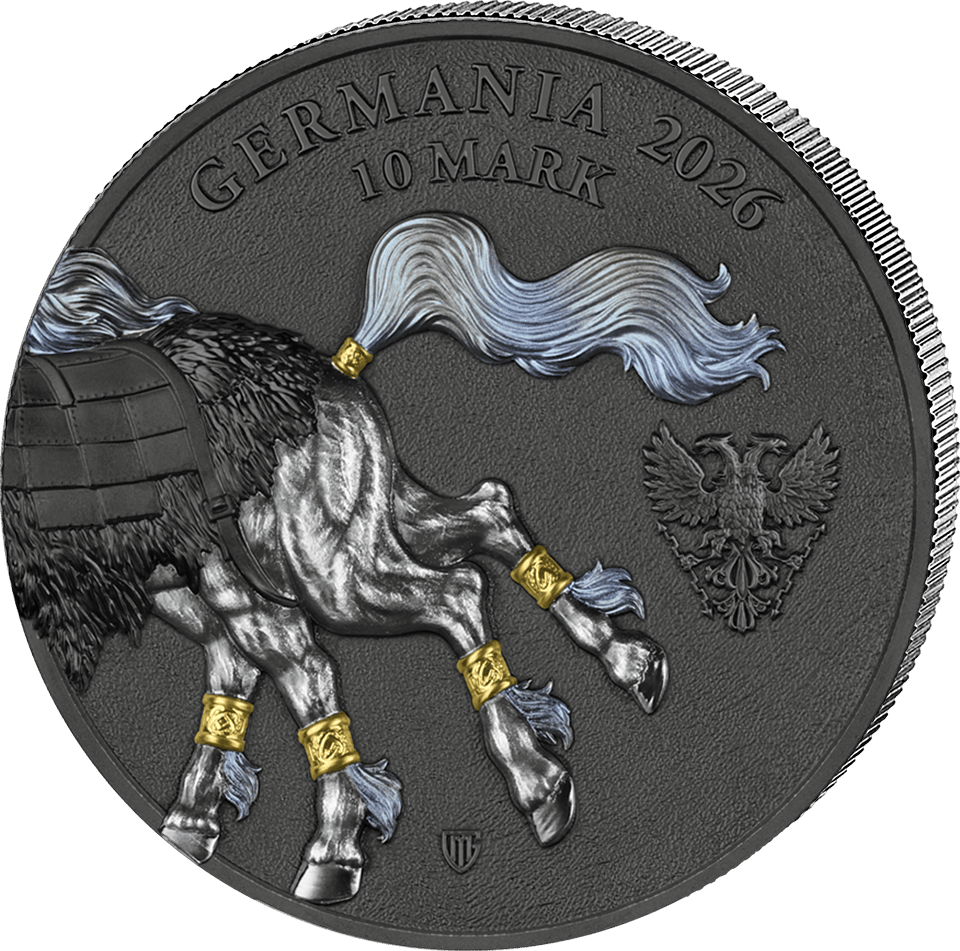
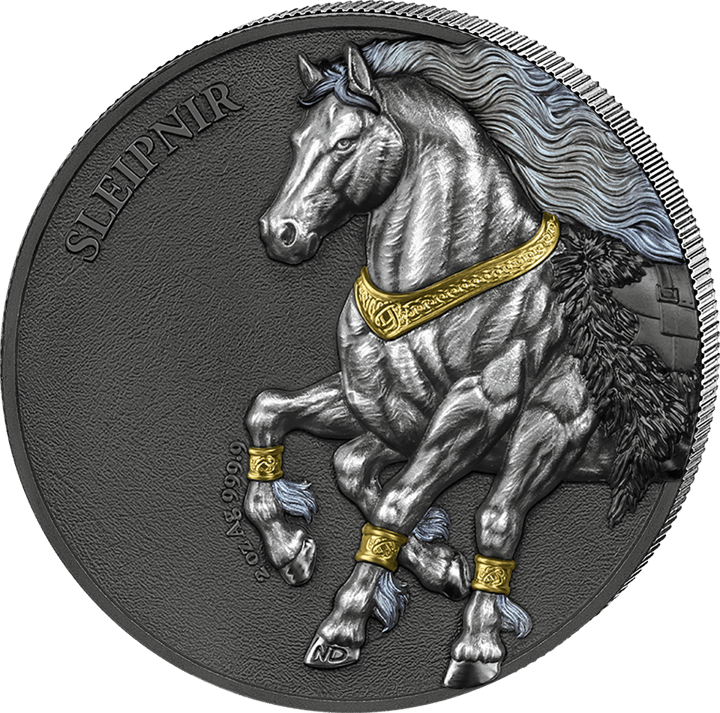
Sleipnir 2026, 2 ounces of fine silver, design side
The horse runs across both sides of the strike, head and chest on the front, saddle and tail on the back. It has eight legs, just as tradition describes Sleipnir.
The names in our week
Three names we say every week.
Thursday, Friday and Wednesday still carry names from this world of gods. In German, Donnerstag and Freitag do too, formed on the model of the Roman week, but Mittwoch has lost its old name.
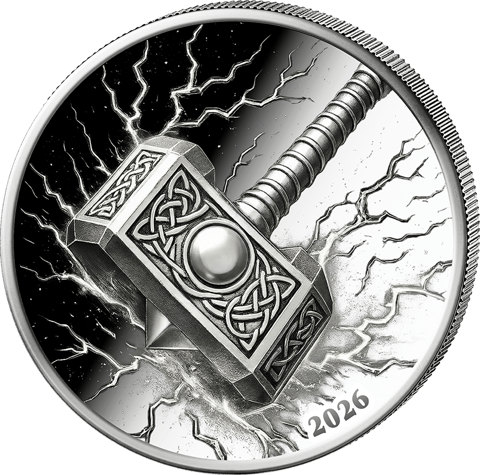
- ThursdayThorThe day of Thor, whose name is the Germanic word for thunder. In German it is Donnerstag, the day of Donar, translated from the Latin day of Jupiter.
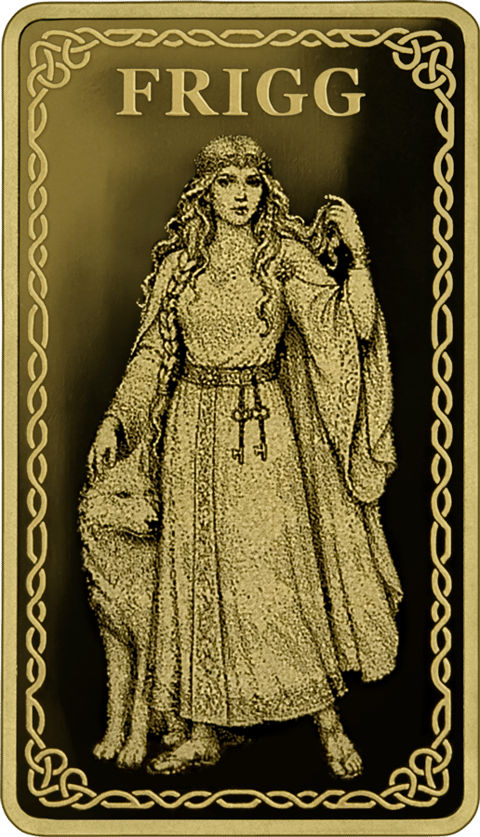
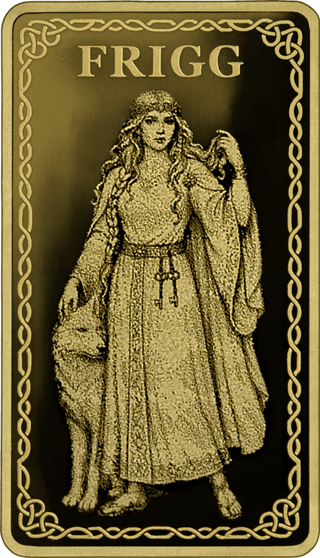
- FridayFriggThe day of the goddess Frija, called Frigg in the North, modelled on the Latin day of Venus. Her name is in Friday and in the German Freitag.
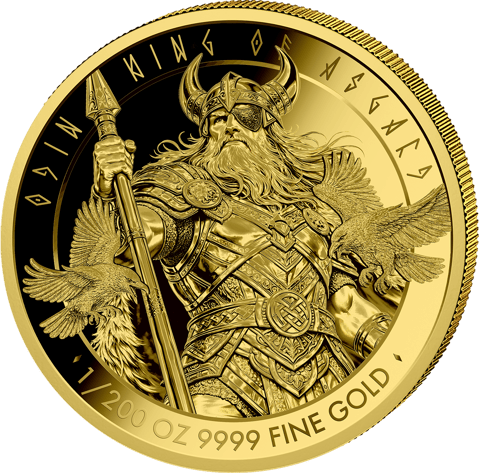
- WednesdayOdinWednesday kept the older name, the day of Wodan, called Odin in the North, as did the Dutch woensdag and the Swedish onsdag. In German it gave way to Mittwoch, the middle of the week, a name created by the Church.
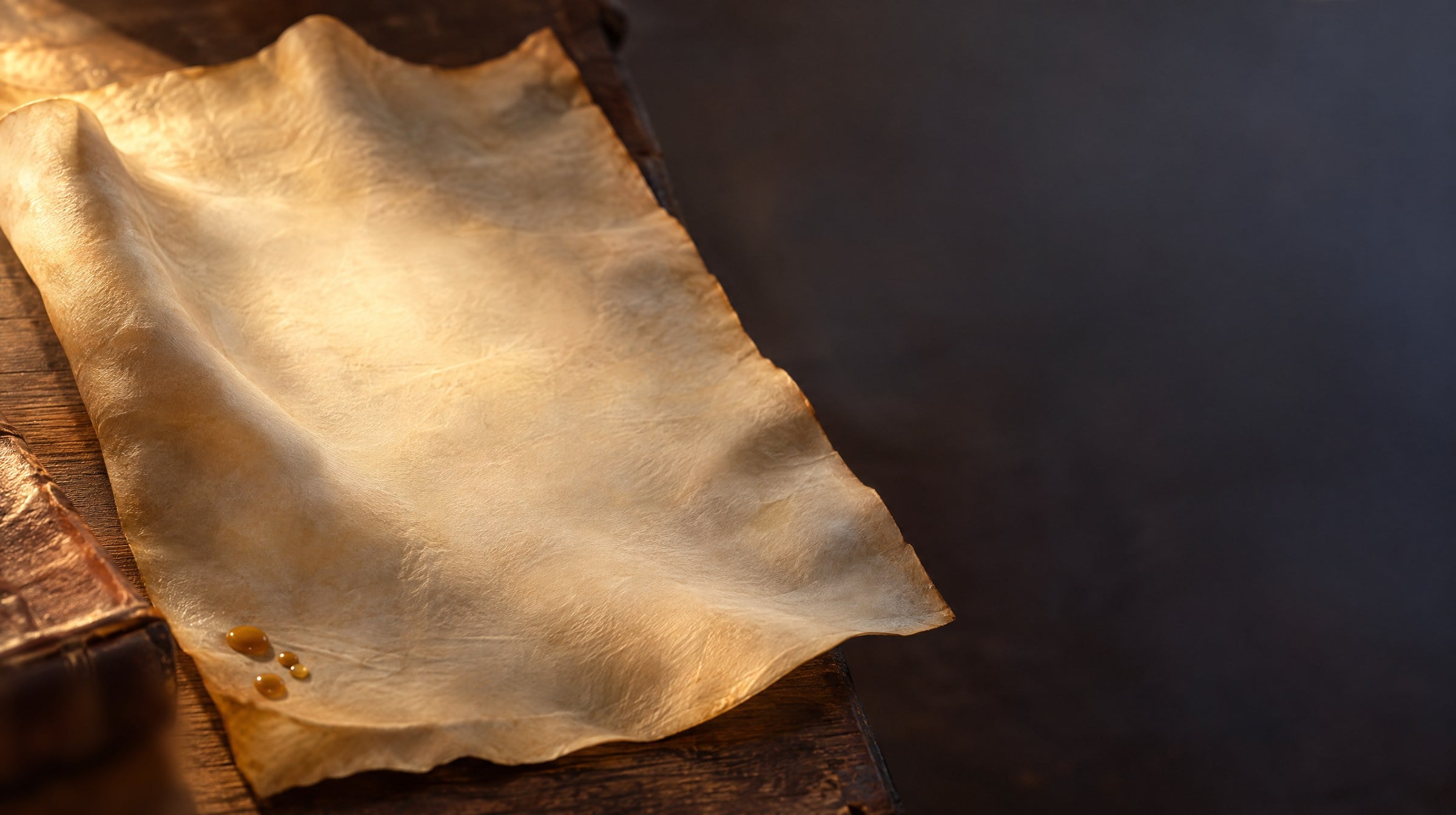
Merseburg · 10th century
Two charms, not found until 1841.
In the 10th century, two charms were written in an Old High German dialect on the front of a leaf. The manuscript is held in the cathedral chapter library in Merseburg.
In 1841 the historian Georg Waitz found the lines in the library of the cathedral chapter, and the following year Jacob Grimm called the manuscript a “treasure”.
According to the cathedral chapter, they are the only pagan incantations preserved in Germany and the only known Old High German record that shows figures of this world of gods in action: Wodan, Balder, Friia, Volla, Sunna, Phol and Sinhtgunt.
“Phol ende Uuodan uuorun zi holza.” Phol and Wodan made their way into the wood.

Iceland · around 1220
A textbook for young poets.
Around 1220 the Icelander Snorri Sturluson, 1179 to 1241, wrote his Edda. According to Britannica, it was meant to teach young poets the difficult metres and to make the old material understandable to a Christian age.
Two of its parts are called Gylfaginning, “The Beguiling of Gylfi”, and Skáldskaparmál, “The Language of Poetry”. For his account of the gods, Snorri cites poems that also appear in the Codex Regius.

Codex Regius · 45 leaves
A book on which the poems depend.
A parchment book from the late 13th century, its scribe unknown. According to the Árni Magnússon Institute, it is the oldest and most important surviving collection of Eddic poems, and most of the poems exist nowhere else but here and in copies of it.
At the front stand the poems about the gods, headed by the Völuspá. Nothing is known of the book’s path until 1643, when Bishop Brynjólfur Sveinsson wrote his initials and the year into it; eight leaves were already missing.
In 1662 the bishop sent the book to King Frederick III in Copenhagen. It stayed there for more than three centuries.
The third place
Where each figure has come down to us.
- SleipnirTradition knows him as Odin’s horse with eight legs.
- ThorThe National Museum of Denmark in Copenhagen holds a soapstone casting mould from Trendgården in North Jutland, from the second half of the 10th century, with cross and hammer in a single mould.
- OdinOdin, Wodan, Woden and Wotan are names of one god. In Merseburg he is called Uuodan, and the Codex Regius puts the Hávamál in his mouth.
- FriggOn the page in Merseburg her name appears as Friia.
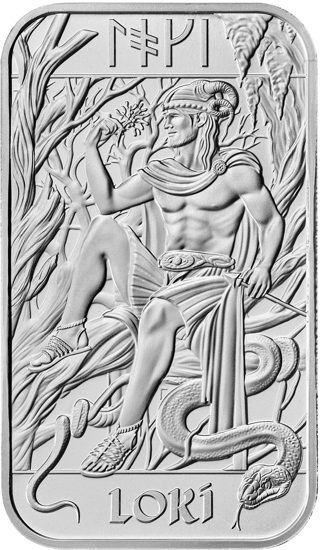
- LokiAccording to Britannica, the medieval sources attest no cult of Loki, and his name appears in no place name. Most of what is known about him comes from the texts.
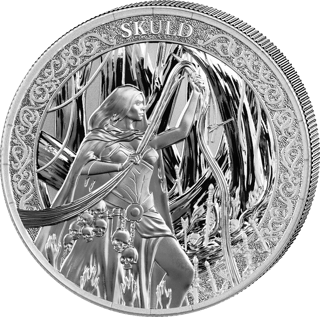
- The three NornsThey are the three Norns of the Völuspá, the poem that opens the Codex Regius.
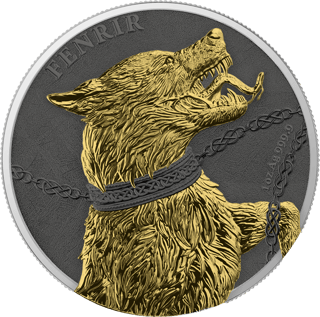
- FenrirA figure in the poetry of Norway and Iceland in the 10th and 11th centuries.
- GullinburstiThe boar is a figure from Snorri’s Edda.
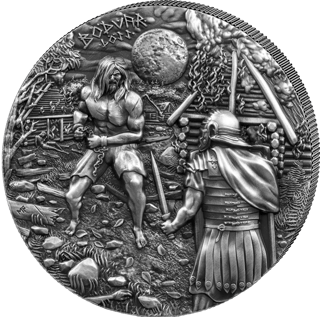
- Bödvar BjarkiHe is known from Danish tradition and from an Icelandic saga.
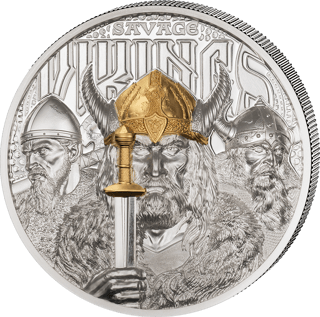
- The Viking AgeMost of the poems about the gods were probably composed in the last centuries before Christianity. After that they lived on by word of mouth until they were written down.
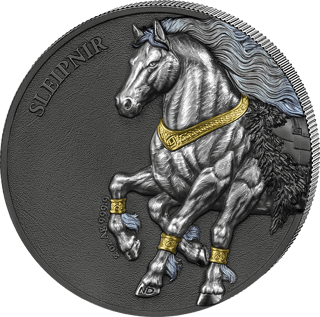
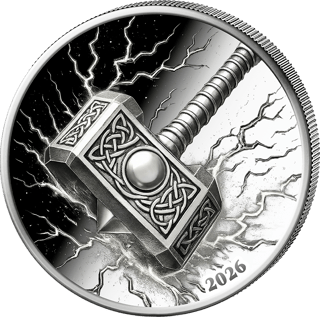
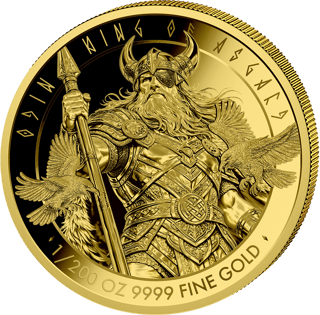
Under the loupe
Eight legs across two sides.
On the front the horse wears a harness across its chest, and on the back follow the hindquarters, saddle and tail. Four legs on the front, four on the back, all with fetlock bands.
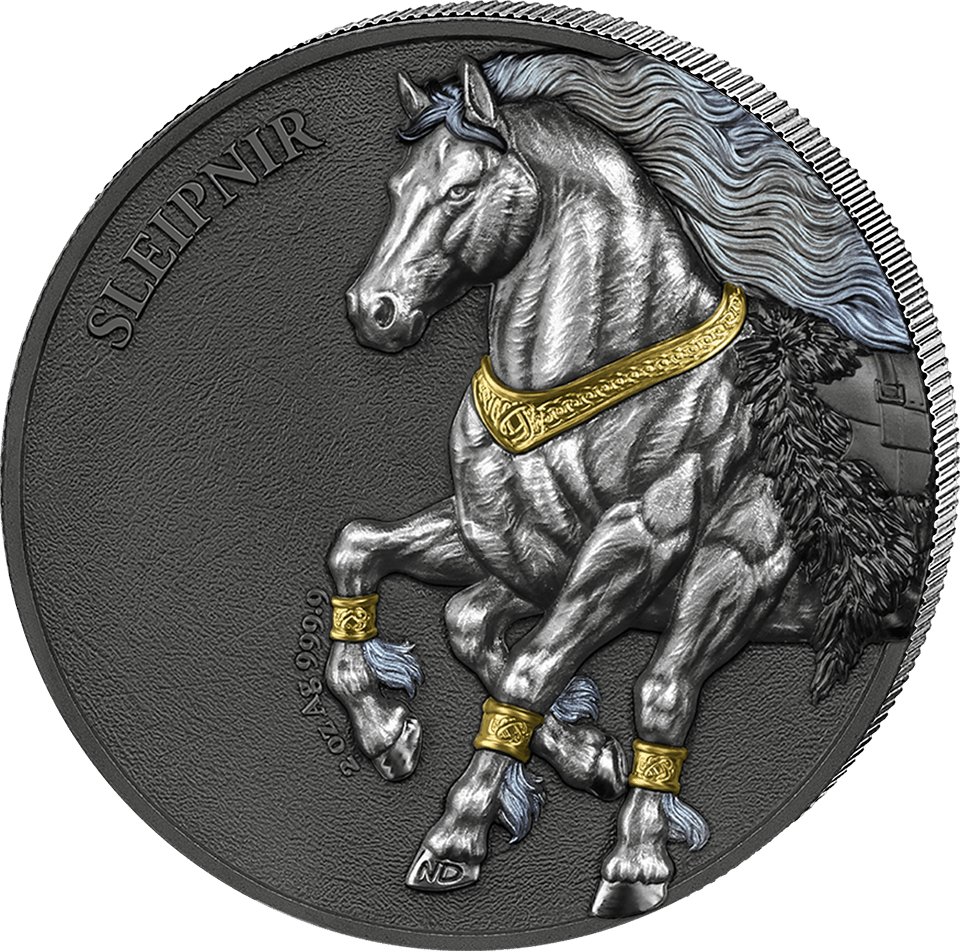
HeadHead and mane
GildingThe gilded harness
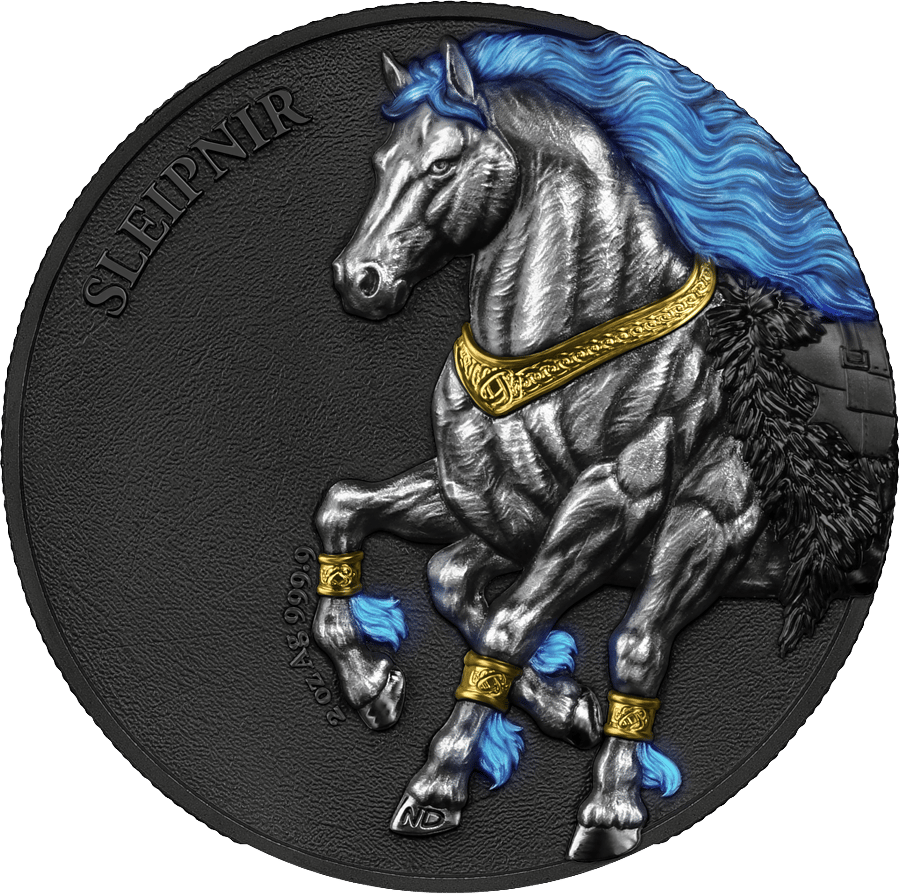
UV lightThe mane under UV light
Enlarged from the pictures in our gallery.
The craft
How this strike is made.
Struck by the Germania Mint. The value side names no state, only GERMANIA and the stated value 10 Mark.
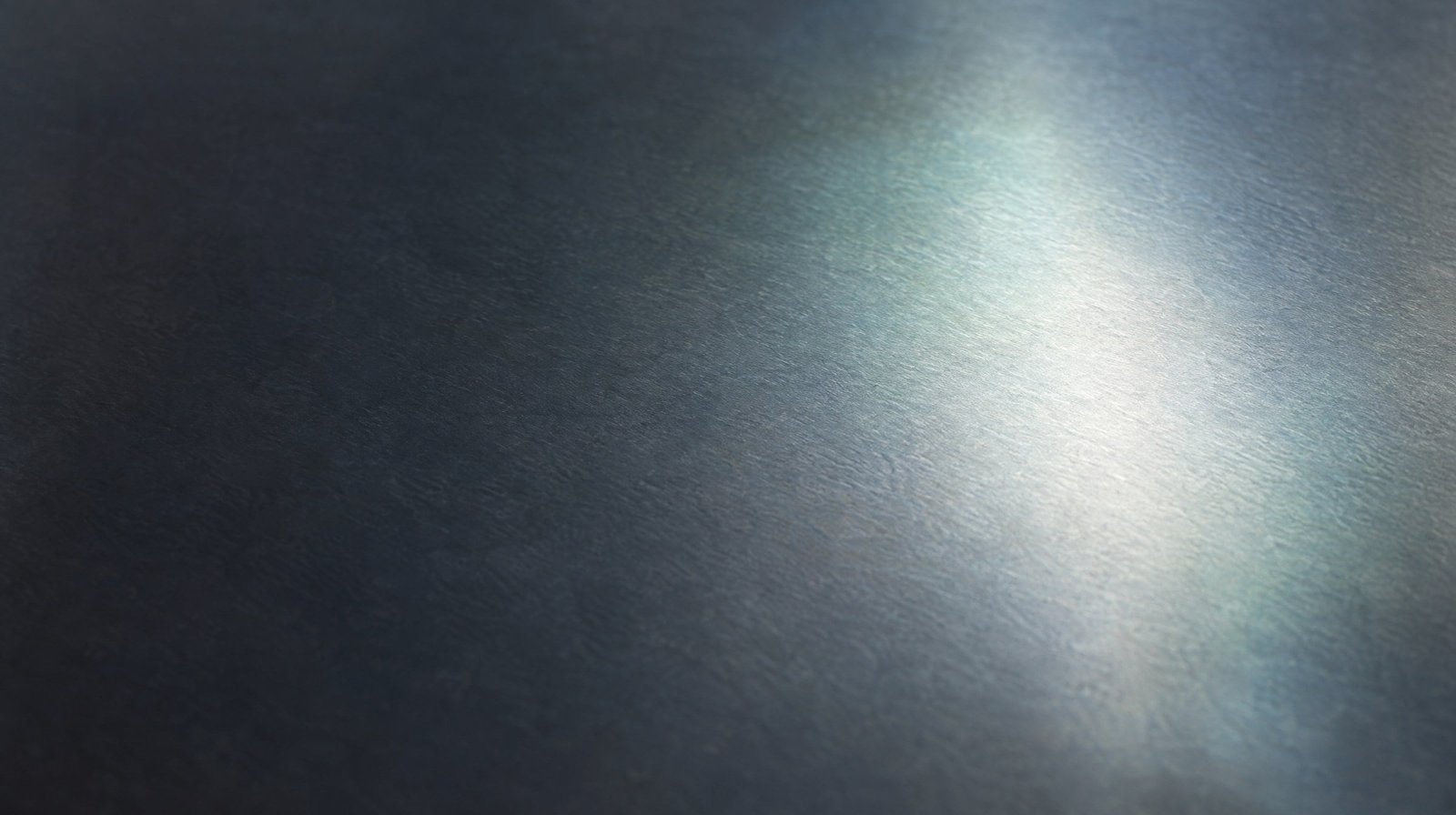
- Antique finish
- The surface is deliberately patinated. In the recesses the silver stays dark, on the high points it shines bright, so that every edge stands out.
- Partial gilding
- The harness and leg rings are gilded and glow against the dark field.
- UV effect
- Under UV light the mane glows blue.

To scale
Small and large, in true proportion.
From the gold bar of 1/100 ounce to two ounces of silver, side by side to scale. The piece on this page is marked.
Click an available piece to open its page.
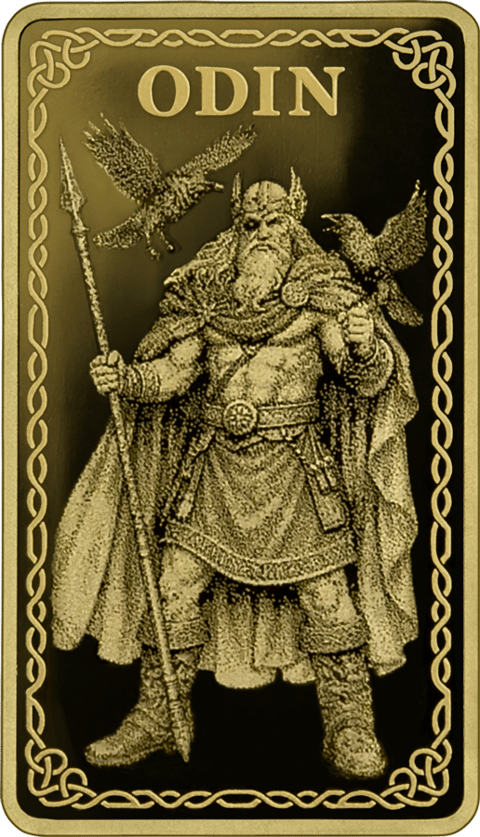 1/100 ounceGold, 15.14 × 8.63 mmGold15.14 × 8.63 mm
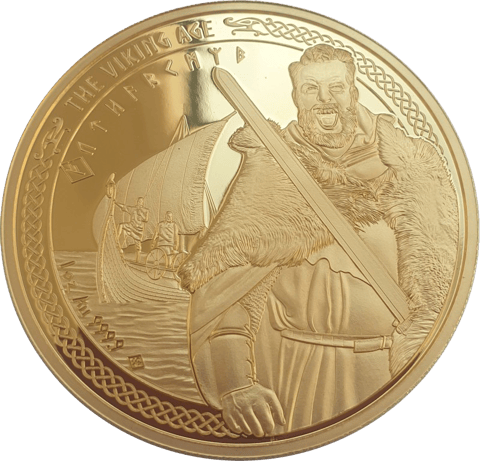 1 ounceGold, 38.6 mmGold38.6 mm
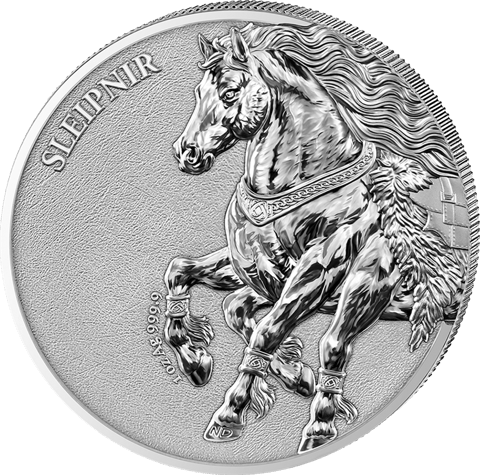 1 ounceSilver, 38.61 mmSilver38.61 mm
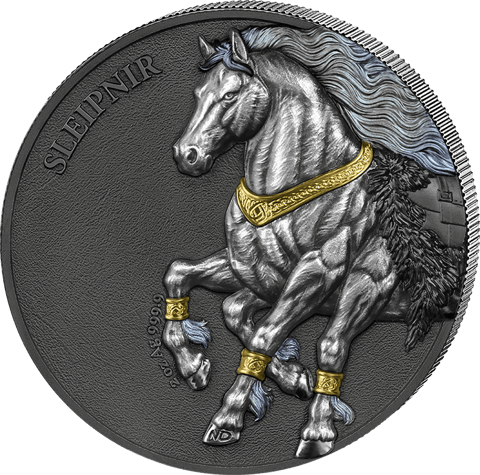 2 ouncesSilver, 45 mmSilver45 mm
At a glance
- Type
- Silver strike
- Metal
- Silver
- Motif
- Sleipnir across two sides
- Weight
- 2 ounces fine silver
- Fineness
- 999.9/1,000
- Stated value
- 10 Mark
- Diameter
- 45 mm
- Year
- 2026
- Quality
- Antique finish
- Embellishment
- partially gilded, Ruthenium, UV effect
- Mintage
- 999 pieces
- Design
- Natalia Danysz
- Mint
- Germania Mint
- Packaging
- Acrylic display stand with certificate

Reykjavík · 21 April 1971
On 21 April 1971 the Danish naval ship “Vædderen” docked in Reykjavík. The harbour was crowded as naval officers carried ashore three parcels in brown paper, with the Codex Regius and the Flateyjarbók inside.
The books are back in Iceland and are kept in Reykjavík today. We say the names every week.
“Has the whole population ever gathered with enthusiasm to receive two books?”
2 oz Silver Germania Beasts Sleipnir 2026 – the rare finale of a cult series
With Sleipnir, the circle closes: this 2 oz Silver Germania edition is the grand finale of the popular "Germania Beasts" series and, at the same time, a genuine rarity. Only a few collectors worldwide will ever hold this piece in their hands.
- Strictly limited: a very low mintage of only 999 pieces worldwide.
- Growth opportunities: high value appreciation potential due to the strict limitation and high demand.
- Rarity: extremely rare collector's coin from the "Mythical Creatures" series.
- Investment goal: a distinguished collector's piece with higher value appreciation potential.
- Design: Sleipnir, Odin's eight-legged steed, in impressive Ultra High Relief.
- Material / fineness: 2 oz silver with a fineness of 999.9/1,000 – partially gilded and finished.
- Manufacturer: produced by the renowned Germania Mint.
- Country of origin: Poland.
Sleipnir – Odin's eight-legged steed
Hardly any figure from Norse and Germanic mythology is as fascinating as Sleipnir. The eight-legged horse was considered the mount of Odin, the father of the gods, and was known for its unmatched speed – a creature that traveled effortlessly between the nine worlds. It is precisely this motion that the coin captures. On one side, the muscular front body rises with a flowing mane, while on the other, the rear body completes the famous eight-legged silhouette. The double-headed eagle, the emblem of the Germania Mint, rounds out the image. Sleipnir is the fourth and final creature of the saga – following Fafnir, Fenrir, and Gullinbursti, it forms the crowning conclusion.
Minting artistry you can hardly put down
This edition is a feast for the senses. The ruthenium coating immerses the background and saddle in a deep, dark black, while the antique finish lends the horse's body a venerable depth. Fine, partially gilded details set golden accents on the bridle and legs. Under UV light, the mane comes alive in a glowing blue – a spectacular effect that reveals a second, almost ghostly view of the design. All of this is captured in an elaborate, double-height relief minting (Ultra High Relief) that brings every contour to life in three dimensions.
Ruthenium, antique finish, UV effect, and partially gilded elements on 2 troy ounces of fine silver – a combination that turns this collector's coin into a small work of art.
Technical data & features
- Precious metal: silver, fineness 999.9/1,000
- Fine weight: 62.21 g (2 oz)
- Diameter: 45.00 mm
- Face value: 10 Mark (Germania 2026)
- Year of issue: 2026
- Mintage: strictly limited to 999 pieces
- Finishing: ruthenium, antique finish, UV effect, partially gilded
- Scope of delivery: acrylic glass stand with certificate of authenticity
Each specimen is delivered numbered and presented in an elegant acrylic glass stand – including a certificate of authenticity documenting the value of the piece. Anyone who appreciates classic silver coins and extraordinary themed mintings will find a highlight for their collection here.
Why silver and this collector's coin?
Silver has accompanied mankind for millennia as a coinage metal and a store of value and is treasured by collectors around the globe. It is durable, retains its physical properties, and possesses an intrinsic value thanks to its widespread industrial use – from electronics to solar and medical technology. Unlike a purely bullion-focused minting, this piece combines material value with the appeal of a strictly limited mintage. A charming side note: in Germany, profits from the sale of physical silver are generally tax-free, provided the holding period of at least one year is observed.
For anyone searching for a special collector's piece, the Sleipnir 2 oz is a clear recommendation. The combination of mythological design, technical sophistication, and the limitation to just 999 pieces makes this edition one of the most sought-after mintings of the 2026 vintage – and thus a candidate with pronounced value appreciation potential.
Product depiction may differ from the final product.
