






Currency of the German East Africa Protectorate (Original Witnesses of History | 1890 to 1916)
- New arrival: Product is new in the shop
- Secure shipping: 100% insured & anonymous delivery
- New arrivalProduct is new in the shop
- Secure shipping100% insured & anonymous delivery




- New arrival: Product is new in the shop
- Secure shipping: 100% insured & anonymous delivery
 1 ×1 Rupie Banknote 1915-1916 (Emergency Money in the 1st World War | German East Africa Colony)
 1 ×1 Pesa German East Africa Company (1890-1892 | German East Africa Protectorate)
 1 ×Pesa & Heller Set German East Africa (1890-1916)
This package saves you £8.02

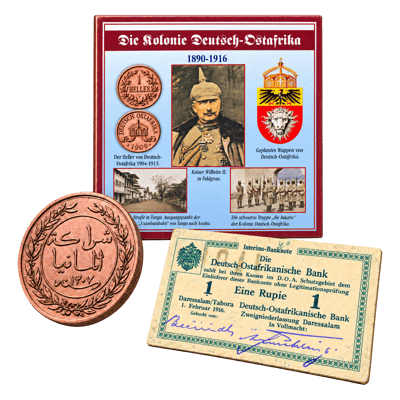
Currency of the German East Africa Protectorate: three originals from a quarter century of colonial history
What did people pay with around 1900 at the market in Dar es Salaam? And what did they use when, during the First World War, no ship brought money from Berlin anymore? This set answers both questions with genuine witnesses of history. It brings together the 1 Pesa of the German East Africa Company, the Pesa & Heller set of German East Africa, and a 1 Rupee interim banknote from the war years. Inside are coins and paper money from 1890 to 1916, from the colony's first copper coin to the emergency money of the final war years.
German East Africa, known internationally as German East Africa, was the largest colony of the German Empire. It covered what is now Tanzania, Rwanda and Burundi. Hardly any other collecting area shows so vividly how money mediated between Africa, Arabia, India and Europe.
What's included in this set
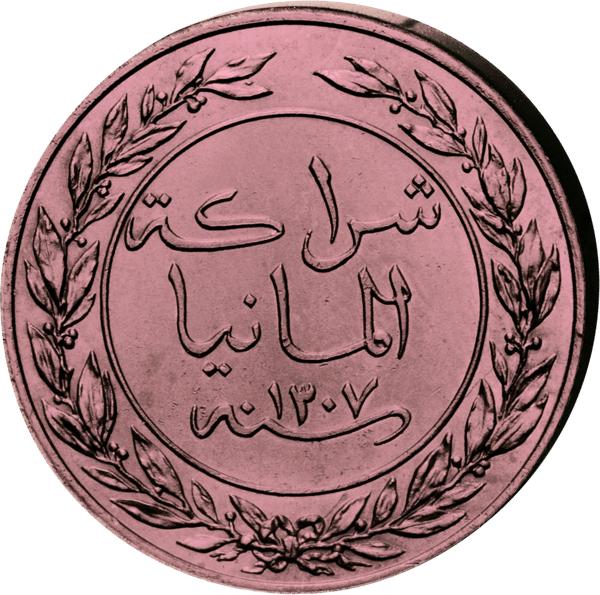
- 1 x 1 Pesa German East Africa Company (1890 to 1892): coin made of copper, gross weight 6.5 g, struck in Berlin.
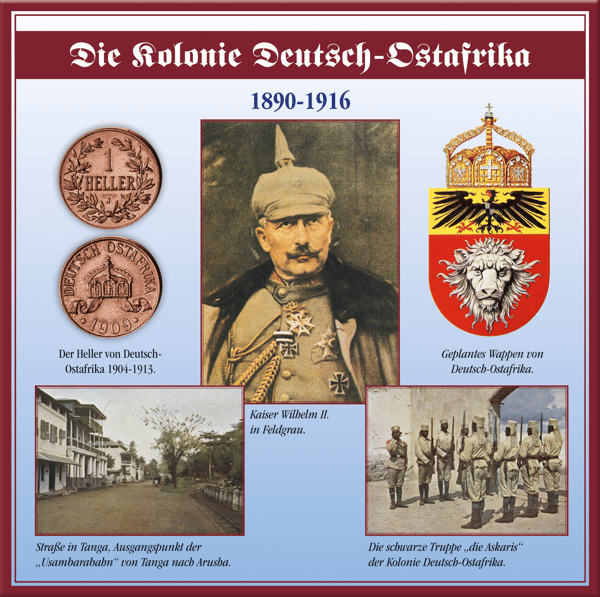
- 1 x Pesa & Heller set German East Africa (1890 to 1916): four original coins on an illustrated blister card, total weight around 74 g.
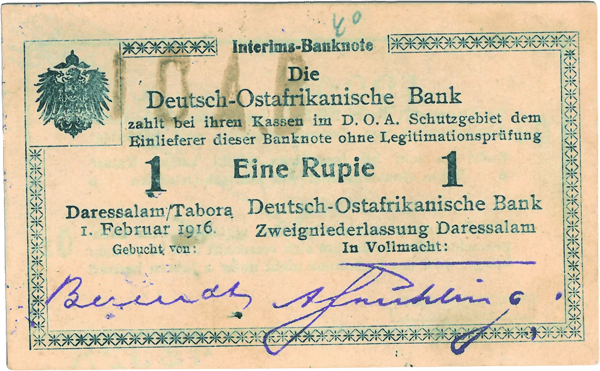
- 1 x 1 Rupee banknote 1915 to 1916: interim banknote of the German East Africa Bank, emergency money from the First World War.
Rupee, Pesa, Heller: how people reckoned in East Africa
The Indian rupee had circulated along the East African coast since time immemorial. The Germans adopted this system rather than replacing it. From 1890, the German East Africa Company had its own coins struck: 64 Pesa made up one Rupee. The Rupee itself was made of silver, issued as silver coins in whole, half and quarter pieces. In 1903, the right to mint coins passed to the Empire. From 1904, the Rupee was divided decimally into 100 Heller, and the Pesa gradually disappeared from circulation.
The Pesa: imperial eagle meets Arabic script
One side shows the crowned imperial eagle, the inscription DEUTSCH-OSTAFRIKANISCHE GESELLSCHAFT and the year. On the other side, an Arabic inscription appears within a laurel wreath. Roughly translated, it means "Company of Germany", followed below by the year according to the Islamic calendar. In the shop image, this is 1307, that is, 1890. Why Arabic? On the coast, long under the influence of the Sultan of Zanzibar, Arabic was the language of trade. Anyone who wanted to pay had to be understood.
The set: from the Pesa to the Heller emergency coin from Tabora
The set contains one Pesa from 1890, one 1 Heller and two 20 Heller coins from 1916, one in brass and one in copper. The 1 Heller in the shop image dates from 1909 and bears the mint mark J for Hamburg. The 20 Heller pieces are genuine emergency coins. The naval blockade had cut off supplies, so at the end of 1915 the governor had a provisional mint set up in Tabora. Its coins bear the mint mark T. What was melted down consisted mainly of empty cartridge cases from the colonial protective force, along with every available piece of brass and copper, right down to parts of the scuttled cruiser "Königsberg".
The blister card shows Kaiser Wilhelm II in field grey, the colony's planned coat of arms, a street in Tanga and the Askari troops.
The interim banknote: paper money from the newspaper printing house
Banknotes, too, no longer came from Germany during the war. For this reason, the German East Africa Bank, Dar es Salaam branch, had interim banknotes printed locally, among others at the Deutsch-Ostafrikanische Zeitung G.m.b.H. The note shown is dated 1 February 1916 and names Dar es Salaam/Tabora as the place of issue. It bears a small imperial eagle, violet signatures and a stamped control number. On the reverse is a declaration of backing in German and Swahili, stating that the note's equivalent value was "fully deposited" with the Imperial Governorate.
Printing was done on whatever paper happened to be available. This is why collectors find a great variety of paper types, series and signatures among these notes. Many build an entire collection around them.
Paper money lives on the promise that its equivalent value is deposited somewhere. Gold needs no such promise: it is humanity's oldest currency and has outlived all others.
A note on the condition of the historical pieces
All pieces are originals, not restrikes. The coins and the banknote were genuine means of payment and have passed through many hands. This shows: copper patina, wear, stains or creases are part of such witnesses of history. For this reason, the condition varies from piece to piece. We describe the exact condition in detail for each individual item. The year of issue, mint mark, series and control number of your pieces may differ from the shop image.
Our tip: do not clean historical copper. Collectors value the patina that has developed over decades; it is part of each coin's character.
Who this set is suitable for
- Collectors of German colonies: the Pesa, the Heller and the Rupee note show the money of the protectorate from the Company era through to the war.
- History enthusiasts: each piece tells its own chapter, from the Arabic inscription to the cartridge case.
- Newcomers: coins and banknote come together in one set. This lets you get to know condition, patina and variants directly on the original.
- Gift givers: the blister card sparks curiosity right from the moment of unpacking.
In comparison: colonial money or modern copper coinage?
Modern copper rounds come flawless straight from the minting press and can be re-struck at any time. This set is the exact opposite. These pieces were genuine money, they are over a hundred years old, and no two specimens are alike. The flip side: perfectly preserved original pieces are the exception. For those seeking authenticity, this is precisely the appeal. Those who want to dig deeper can later add the silver Rupees of the same colony to their collection.
A collector's item with character: with the currency of the German East Africa Protectorate, you hold tangible monetary and colonial history in your hands, one that has endured for over a century.
Product image may differ from the actual product.
